
Playwright Ins Choi was born in South Korea and emigrated to Canada with his family as an infant. Taking to theater at an early age, he participated in his high school’s plays and later graduated from York University with a degree in theater, then worked with Toronto’s fu-GEN, self-described as an “Asian Canadian Theatre Company.” Turning to writing, he authored Kim’s Convenience, a play about a family of Korean immigrants in Toronto headed by a stubborn patriarch, with an understanding mother (Umma) and two adult children — the artistic, still-single Janet, and estranged son Jung — rounding out the family. The play explores a clash of cultural expectations, as Appa — “Dad” or “Daddy” in Korean, the only name he’s given in the play — attempts to assert his authority not only in the store (where he’s quick to discern which customers are likely to shoplift, his profiling inevitably veering into problematic territory) but also in the lives of his offspring. Stubborn, but ultimately loving, Appa is the pillar around which the family centers, despite the estrangement between himself and Jung.
Choi has played both characters. He portrayed Jung when the play first ran in 2011; since then, Kim’s Convenience has been adapted as a TV series that ran for 65 episodes over five seasons (2016 – 2021) and was originally broadcast on Canada’s CBC Television. (The sitcom can now be seen on Netflix.)
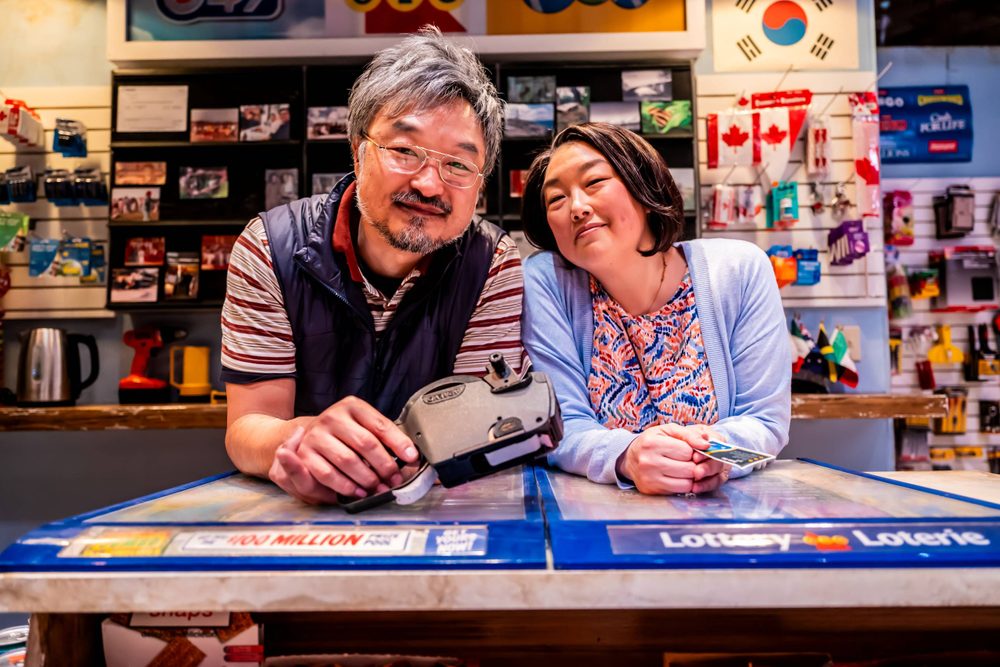
The play has had productions Off-Broadway (in 2017, in which Choi reprised the role of Jung) and in London (in 2024, in which Choi took on the role of Appa). Kim’s Convenience now heads to Boston, where it’s being produced by The Huntington Theatre as part of the company’s Huntington Selects series. The play will run November 6 – 30 at the Calderwood Pavilion at the Boston Center for the Arts. Director Weyni Mengesha helms the production, in which Choi stars once more as Appa. Esther Chung plays Umma, Kelly J. Seo plays Janet, Ryan Jinn plays Jung, and Brandon McKnight plays a quartet of roles, including an old friend of Jung’s who is now a police officer (and a potential romantic interest for Janet, to the delight of her perennially concerned parents).
Ins Choi opened up in a Zoom chat about the play, his roles in its various productions, the links between the stage and TV versions, and what Kim’s Convenience means to audiences in 2025.

Kilian Melloy: The play has had quite a journey. It was originally produced in Canada in 2011, then it was turned into a TV show that ran for five seasons. Now it’s back on stage.
Ins Choi: It’s kind of a wild ride, especially if you add to the equation that I played Jung in the initial stage production and then took a step away from acting to do more writing. And now and then, post-pandemic, post-writers’ strike, I kind of moved back into acting, and now I’m playing the role of Appa. It feels right. It feels like someone planned it. But, you know, there’s no plans here; I’m just kind of tumbling through life, walking through the doors that are opening before me. It’s great. I love it.
Kilian Melloy: Does it feel like a natural evolution for you as an actor to be playing Appa now, whereas back in the day, you were playing Jung?
Ins Choi: I feel like it’s natural to play older characters as you get older.
[Laughter]
Ins Choi: I didn’t actually plan it this way, but I feel any young actors, if they’re capable of writing a play, they should write roles for themselves at every stage of their career — like, the young lover, and then middle age, and then elderly. All the characters are parts of me. Janet is me as a young artist. Jung is me as I watched all my peers be successful in their careers, moving out of downtown, buying a mortgage, getting married, having kids, and I felt like I was the one left behind in terms of life, so I wrote Jung from that time in my life.
In an early draft, I had envisioned myself playing both Appa and Jung. It would have been a two-hander, me and a female actress who would play Umma and Janet, and we’d have done a more unconventional play. So, the idea that I would play Appa one day was always kind of in the back of my head. I have two kids, teenagers. They call their mom Mommy, and they call me Appa. I feel like they’ve been preparing me for this role for their whole lives.
Kilian Melloy: Does the role of Appa fit you better than the role of Jung did, or vice-versa?
Ins Choi: They’re both me in many ways. There’s more stage time for Appa. I remember playing Jung. It’s just two scenes, so I could show up late.
[Laughter]
Ins Choi: I wouldn’t show up late, but I could come to the theater very casually and not even get into costume until the show started, which was a nice, easy way in, right off the top, right ’til the end. Appa requires more energy, maybe a bigger heart, if I would compare the two roles. Jung is a little selfish. One way to put it is, Jung is just thinking about himself a little bit, whereas Appa is thinking — well, he’s thinking about himself, too, but he’s also thinking about bigger things. What does life come to? What do we leave? How can we matter more at the end of our time? So, looking out, whereas Jung is maybe more inward-looking.
Kilian Melloy: With your insight playing both of those characters, does it seem to you that Jung is a chip off the old block in 40 years or 30 years? Is he going to become Appa in some sense?
Ins Choi: I think so. We all begin our lives in the shadow of our parents or our caregivers, but we all want to make a mark. We all want to achieve something. But then, as we do achieve things, or even if we don’t, we kind of realize that there’s more to life than that gold medal or, you know, that trophy. It’s like, “This is great, but who do I share this with?” Or, “Who am I?”
Kilian Melloy: There’s another dual role, so to speak, that you serve in having been both the author of this play and an actor in the play. Is this something you find divides your energies, or is the experience of doing both those things additive?
Ins Choi: I think it’s helpful to have the playwright in the room.
[Laughter]
Ins Choi: This play first went up in 2011, and there were some lines where the definition of certain words changed over the past 15 years. Like, there was a line of, “I want to hook up.” Like, “hooking up” back then meant just hanging out or reconnecting. But since then, it’s come to mean a different thing, so we had to change that line. It was helpful for the playwright, for me, to be there, like, “Okay, yeah, so we change ‘hook up’ to ‘connect with, or catch up with,’ or something like that.”
Kilian Melloy: As we said earlier, Kim’s Convenience isn’t just a stage production. It was a TV sitcom for five years, which gave you so much more room to explore the characters and the storylines. Were you tempted to revise the play in any way as a result?
Ins Choi: No, not really. I wanted fans of the TV show to bear witness to the source material from which the TV show sprang. But the play has Janet at age 30, and Jung at 32, and Umma and Appa as near 60. For the TV show, we rolled time back to have Janet around 20 years old, at least in season one. The TV sitcom is exploring the time before the play.
Kilian Melloy: Kim’s Convenience didn’t stay in Canada, obviously. It’s been produced in different countries; you can see the show on Netflix, and now you’re coming to Boston, to the Huntington. What about this play allows it to cross cultures and remain so fresh and relevant today?
Ins Choi: I don’t really know. It’s funny. People like to laugh. I think it’s still a rare sight to see an Asian family on stage. There’s a lot of Asian American playwrights — Lauren Yee, Julia Cho, Lloyd Suh, Chris Grace, who I just saw [at the Huntington in his solo show Sardines]. Sometimes it’s about one character, an Asian protagonist, but having a whole family on stage is still a rare sight. Maybe that’s a draw. I remember playing in the prairies in Canada and just wondering, “I don’t know if these folks are going to get it. It did well in Toronto and other urban centers, but here in the prairies?” And people loved it. It has to do with a family business. I remember talking to this one woman who shared about her family’s restaurant, and how it was exactly the same kind of conversation about who was going to take over the restaurant, where the kids are, “I want to get out of this restaurant, but it’s like the mafia — they pull me back in!”

[Laughter]
Ins Choi: We just finished a run in San Francisco, and I feel like the political climate cast a different light on this play that I had never [seen], with ICE raids and, specifically, 300 Korean workers being rounded up in Atlanta, and then the Korean government had to get involved. Like, what the…? You read the news, and then there’s this play about this working-class Korean family trying to make ends meet. It cast a different, relevant light on the play, unfortunately.
At the core, it’s about a broken family that’s trying to heal, that’s trying to express their love to each other, but they can’t find the words. I feel like that maybe relates over time and across cultures.
Kilian Melloy: The play does feel like a breath of normalcy in a world that feels anything but normal. I can imagine that you’re going to continue to see appreciative audiences, and I’m sure Boston will embrace the play.
Ins Choi: Yeah, I can’t wait! I’ve never been to Boston. It’s my first time. I’m here right now to do some press. I’ve noticed a lot of red brick, which is beautiful. It reminds me of different parts of Toronto. I’m eager, and our whole team is eager, to come to share this play, but also take in the sights and the culture and the taste of Boston.
This interview has been edited for length and clarity. Kim’s Convenience runs November 6 – 30 at the Calderwood Pavilion at the Boston Center for the Arts. For tickets and more information, go to the Huntington Theatre’s website