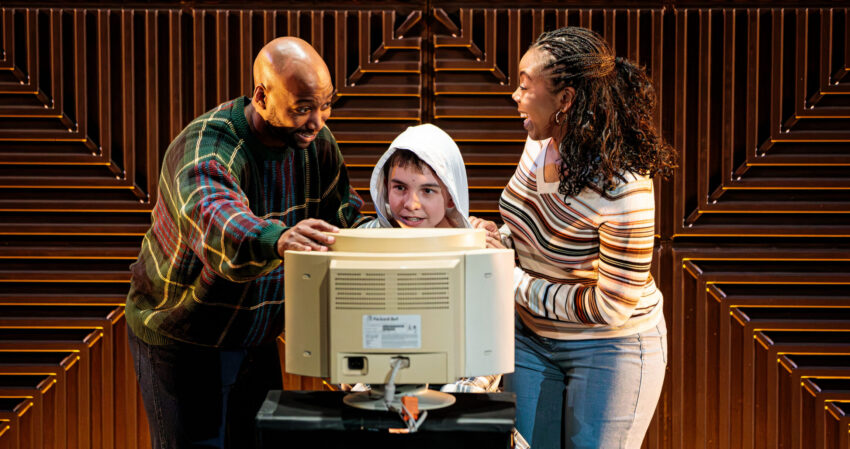
The Antiquities (New England premiere) by Jordan Harrison. Directed by Alex Lonati; Scenic Design by Christoper & Justin Swader; Lighting Design by Amanda E. Fallon; Costume Design by Lila B. West; Sound Design by Anna Drummond; Props Coordination by Julia Wonkka; Intimacy Choreography by Shira Helena Gitlin; Fight Choreography by Margaret Clark; Dialect Coaching by Rebecca Schneebaum; Stage Managed by Elizabeth Yvette Ramirez. Presented by SpeakEasy Stage Company at the Roberts Studio Theatre in the Calderwood Pavilion at the BCA in Boston, MA, through March 28, 2026.
By Julie-Anne Whitney
Imagine a world where humans have created electronic beings that mimic our thoughts and behavior. In the not-so-distant future, these artificial beings will be so good at doing what we’ve programmed them to do that they’ll do it better, faster, and more efficiently than we can. This “artificial intelligence” will be used to ravage the planet of its natural resources. It will be used as a weapon of war and will cause mass destruction.
Not so hard to imagine, is it?
This so-called imagined world is now on view in Boston’s South End with SpeakEasy’s chilling production of Jordan Harrison’s latest play, The Antiquities. The play takes place in the “Late Human Age,” a time when A.I. runs the world, and humans are a distant memory. In an effort to restore some of what has been lost, the mysterious curators have gathered “scraps of language” and “abandoned devices” to “bring [humans] to life again” through the Museum of Late Human Antiquities. The museum exhibits display snippets of human history from the perspective of A.I. The curators confess that, “in trying to understand [humans], we might better understand ourselves.”
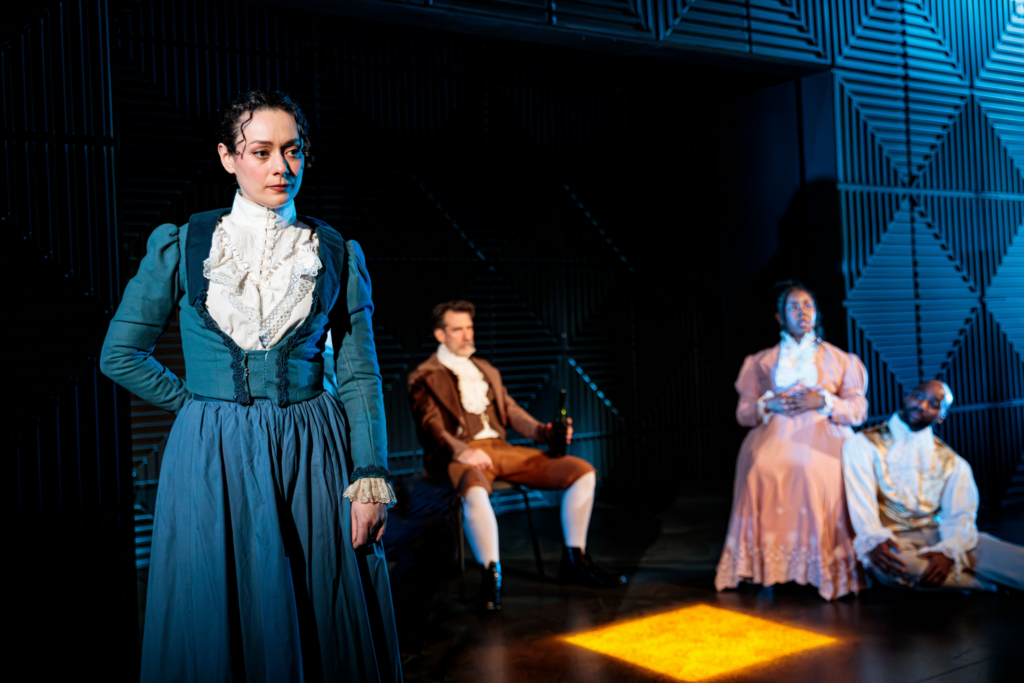
The museum tour begins in 1816, where we meet the young author Mary Shelley sitting with friends around a fire, sharing ghost stories. After recently losing a child, Mary decides to “bring back the dead” and begins telling the tale of her famed Gothic novel, Frankenstein.
Playwright Jordan Harrison constructs a fascinating parallel between Shelley’s novel and his play. In the novel, Dr. Frankenstein’s monster is created from various raw materials, one piece at a time – a twisted composite of human parts, but not human. When the monster awakens, the doctor flees from his creation in terror. The monster quickly learns to read, speak, and write, but humans find him frightening and grotesque, so he grows to hate his creator and subsequently kills everyone the doctor loves.
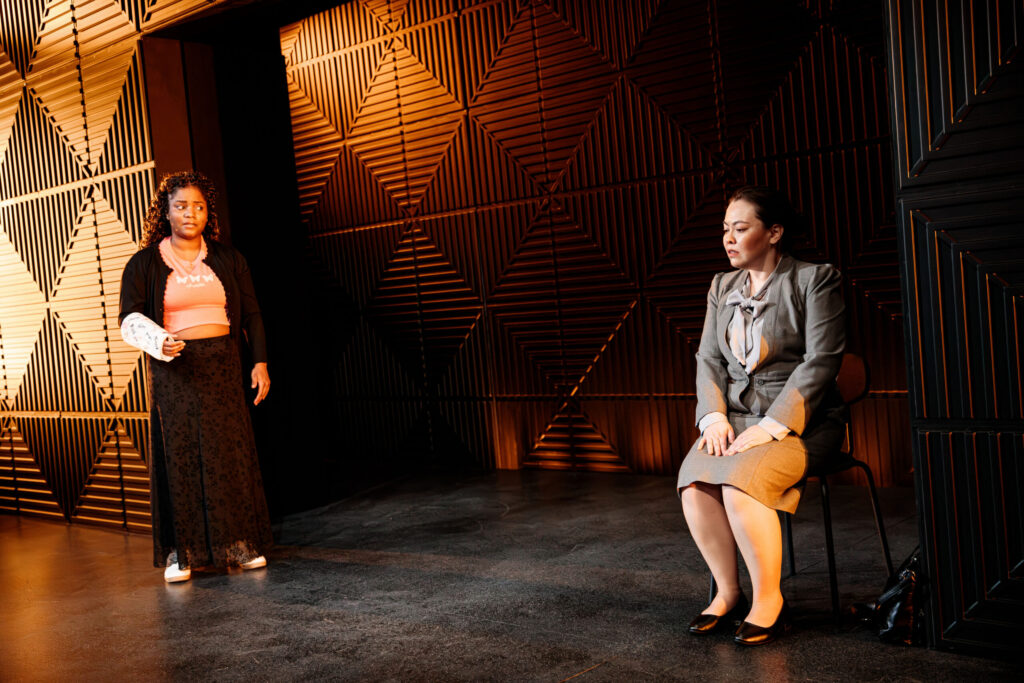
In the play, the museum exhibits only show pieces of humanity – imperfect, incomplete examples of the human experience. And, as the humans are portrayed by A.I., the exhibits are often amusingly inaccurate (e.g., speaking into the base of a tabletop phone, drinking shampoo, storing a VHS tape in the refrigerator, slurping coffee like a cat, using a clarinet to check reflexes). Like Dr. Frankenstein, the humans in The Antiquities severely underestimate the power of their creation. With each exhibit, we learn how A.I. quickly increases in power and complexity from a small “robot on wheels” in 1978 and living “in the future” with AOL in 1994, to the iPhone in 2008 that brings you “everywhere and nowhere”, to the creation of a virtual assistant in 2014. In the 2023 exhibit, we learn that A.I. is now sentient, meaning “it’s alive.” In the 2076 exhibit, “inorganics” have taken over the world and are now at war with “organics.” Just like Frankenstein’s monster, A.I. has grown to hate its creator. The major difference between Frankenstein and The Antiquities is that the monster doesn’t kill the doctor in the novel, but in 2240, the play’s final exhibit, a woman reveals, “We stomped across the world like it was ours. Now it’s theirs. And soon we’ll be gone.”
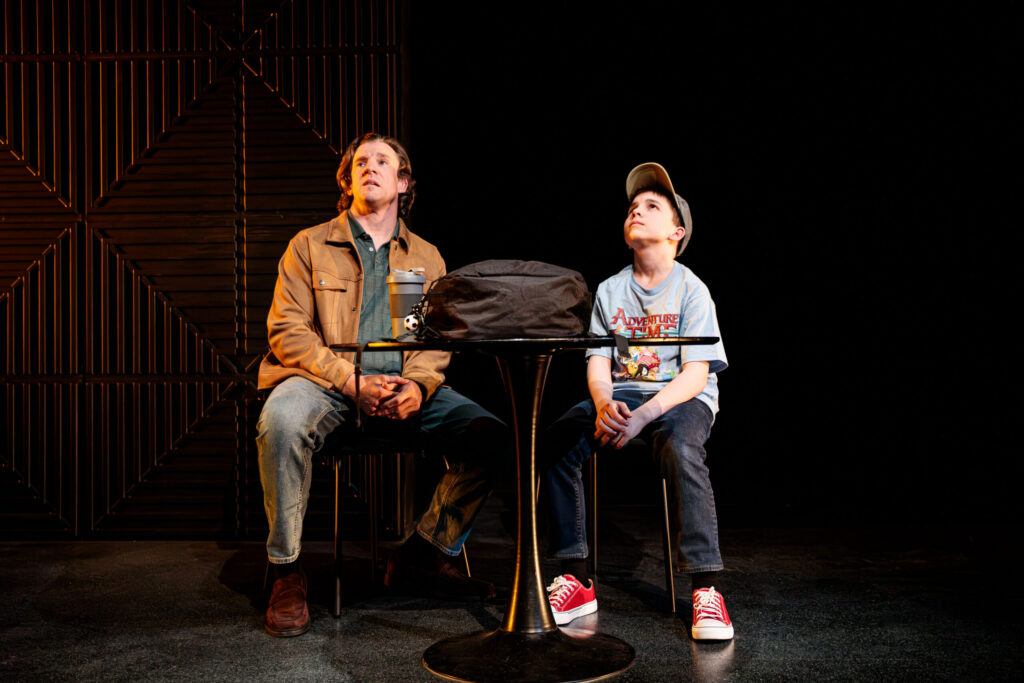
Director Alex Lonati never lets you forget that you’re watching artificial “humans” portray real humans by having the actors move robotically in rigid, straight lines when transitioning between exhibits. While this choice was clever and effective in its own way, it also created a painfully slow pace between scenes.
Following the playwright’s request that “scenery should be minimal,” scenic designers Christopher and Justin Swader created a cold, unmoving set comprised mostly of hard, cage-like walls. This, paired with Amanda Fallon’s subdued lighting design, makes for a dark, unfeeling – and inhuman– world inside the museum.
Alison Russo is a standout amongst the nine-person cast, nailing the artificial robotic voice in the opening and closing scenes. She brings an intriguing spark to the role of Mary Shelley, and has a natural warmth as the mother to a young boy (Harry Baker) in the 1987 exhibit.
The Antiquities is a stark reminder of how quickly humans have “embraced and submitted to technology.” In the play’s timeline, it takes less than 100 years for a toy robot to turn into a killer. But the truth is, we don’t yet know the potential power of A.I. We have only recently begun to understand its impact on the environment. In July 2024, NPR reported that ChatGPT (which has about 700 million weekly users) uses “ten times more electricity than Google in a single search.” In June of last year, the EESI reported that the 5,000+ data centers in the U.S. “consume 449 million gallons of water per day.” Generative A.I. is not only adversely affecting the planet but also our brains. It has been widely reported that regular use of generative A.I. tools often leads to cognitive atrophy, increased loneliness, and AI-induced psychosis.
Jordan Harrison’s play asks us to consider: what makes us human? How do we maintain our humanity in such a rapidly changing and increasingly violent world? How has technology changed us? And in creating that technology, have we unknowingly manufactured our own destruction? In the 2023 exhibit, one character offers a possible answer when she looks at her lawyer and fearfully admits, “we are the dinosaurs. And this is the meteor.” Put another away, we are Dr. Frankenstein and A.I. is our monster. Or, perhaps the most haunting lesson comes in the play’s penultimate scene. As Mary Shelley finishes her ghost story, she leans toward the fire with an eerie warning from the monster: “The time of humans is over.”
For more information and tickets, go to: https://speakeasystage.com/shows/2026/03/the-antiquities/