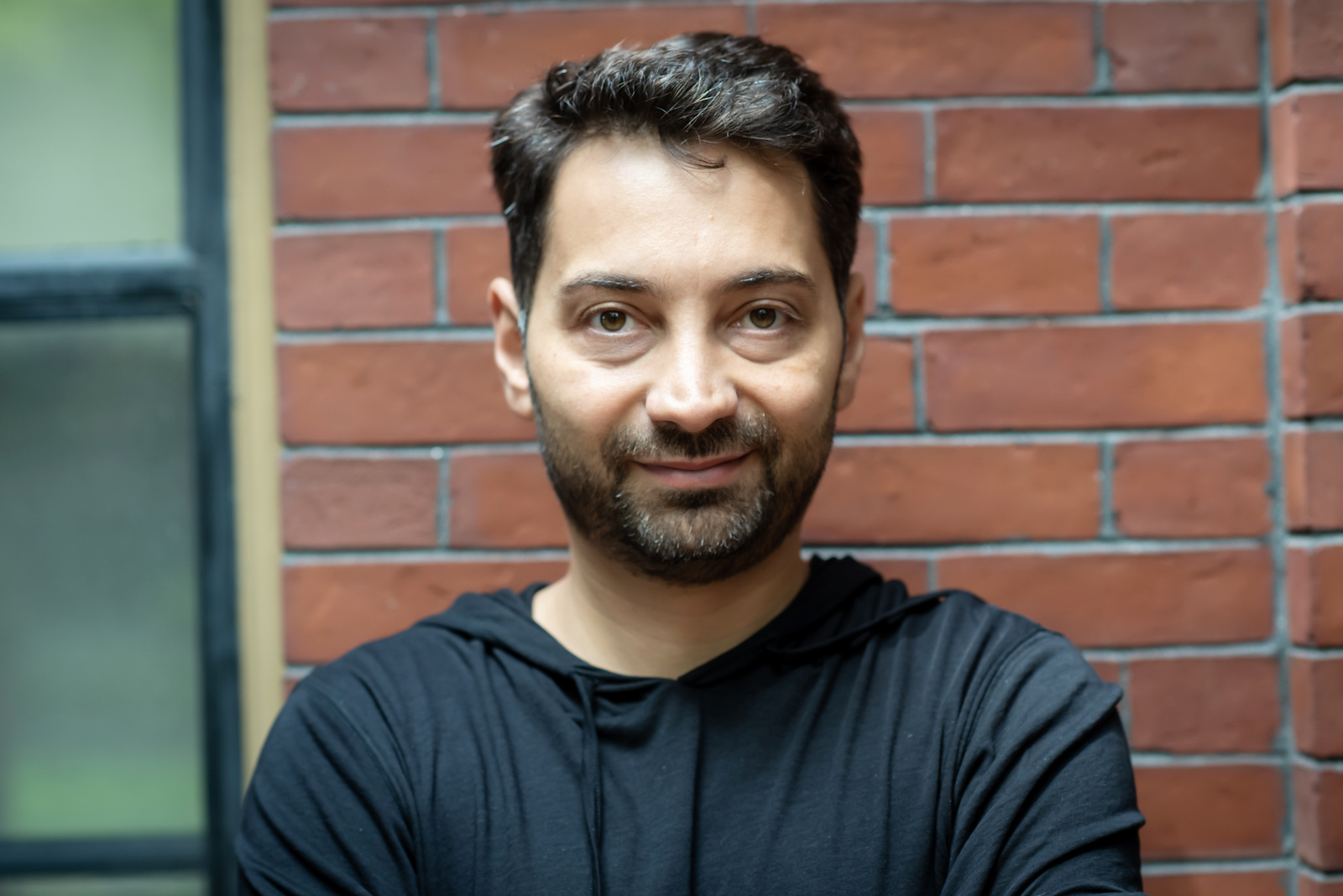
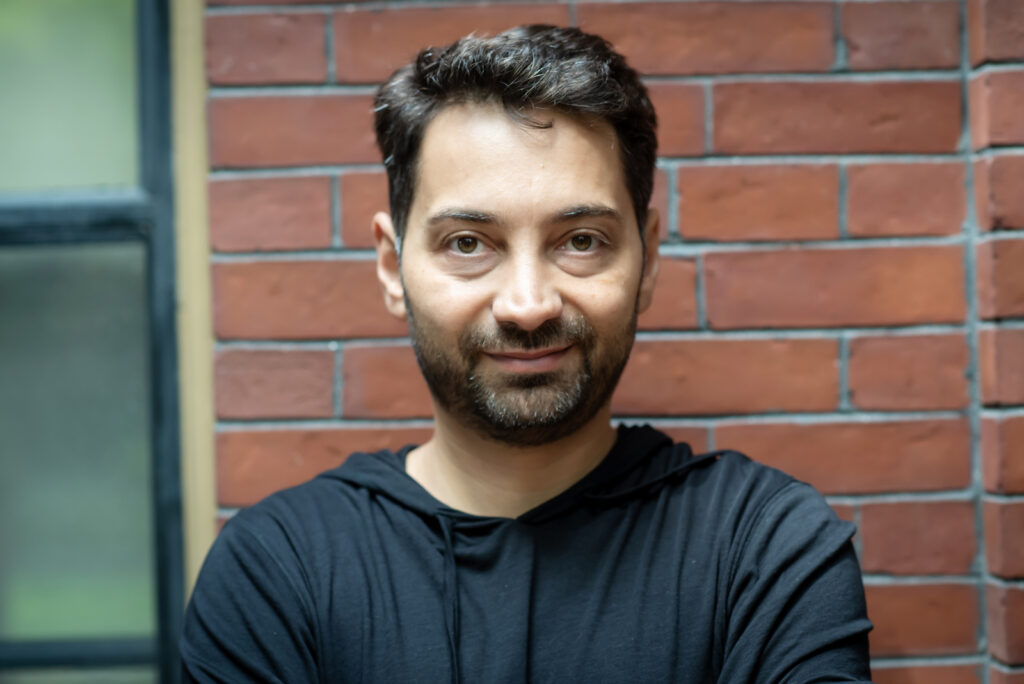
Igor Golyak, the leader of Arlekin Players, is set to oversee the return of his adaptation of Roy Chen’s modern version of the classic S. Ansky play The Dybbuk to Boston. The play was a sensation last year, thrilling audiences and earning accolades, including an Elliot Norton Award for Outstanding Production. Now it returns to Beacon Hill’s Vilna Shul, the site of its earlier run — a venue that, Golyak explains in our interview, has significant resonance.
A story of love… and grievance, too… that crosses from life to death (and, in a way, back again), The Dybbuk is populated by the souls of the dead, most prominently Khonen, a young man who was promised as the groom to a woman named Leia before either of them were ever born. But the world of the living is a treacherous place, and even men of virtue like Sender — Leia’s father — may find themselves breaking solemn promises. Such is the case when Sender determines to marry Leia to a wealthy suitor, leaving love-stricken Khonen, an impoverished Yeshiva student, in the cold. So passionate is Khonen about the betrothal, though, that he drops dead when Sender breaks off the arrangement… but his spirit does not depart. Rather, Khonen becomes a dybbuk, a restless soul caught between worlds. His fixation on Leia threatens her life, which is a matter of communal concern to a traumatized village that has endured numerous antisemitic attacks by Cossacks.
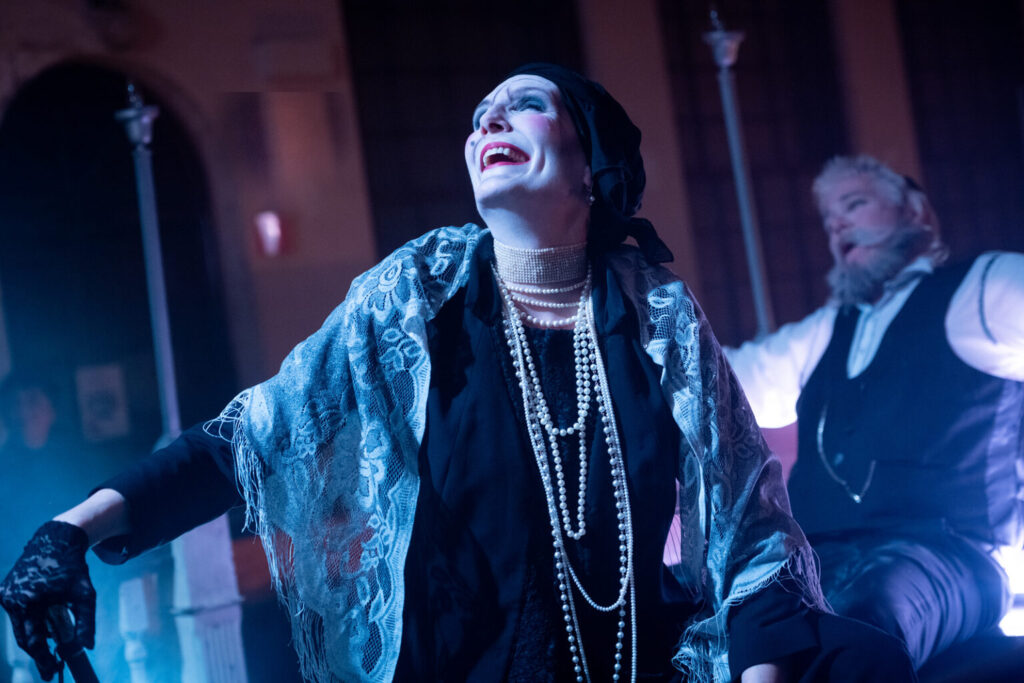
First produced in Poland in 1920, The Dybbuk has, suitably, clung to this mortal world with tenacity that matches Khonen’s. A 1937 movie version was only the first in a long line of big and small screen adaptations. There have been countless theatrical updates, at least one ballet, and several operas. It was to Roy Chen’s 2014 version that Golyak gravitated for his new adaptation, and the Arlekin Players delivered a stunning production. Andrey Burkovskiy and Yana Gladkikh return to the roles of Khonen and Leia, as do Robert Walsh and Deborah Martin, who co-star as Sender and Frade, Leia’s father and grandmother, respectively.
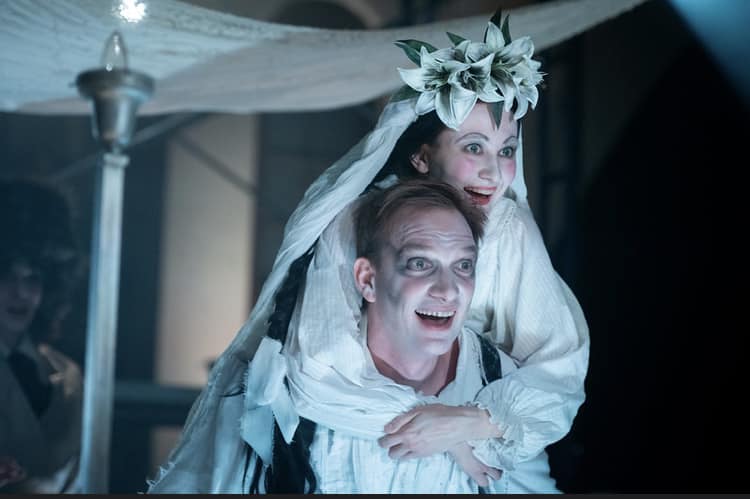
Photos: Irina Danilova
Igor Golyak sat down for a Zoom chat to discuss the play’s meanings — personal as well as universal — and bringing the Arlekin Players production back once more.
Kilian Melloy: My impression of The Dybbuk is that it’s not a play so much about love as it is justice — or is it really more about self-determination?
Igor Golyak: Say more. What do you mean, “justice?”
Kilian Melloy: The reason that Khonen is stuck on Earth, we’re told, is that his father had made a deal in which Khonen was going to be married to Leah. But Leah’s father Sender did not honor that agreement. Sender points out that Khonen is a ghost and says he has no real feelings. If that is true, then the issue is one of karma or of justice — but again, is it also an issue of self-determination? Khonen wants to do something, and Leah, too, wants to do something other than what’s expected of them.
Igor Golyak: Well, he’s not really stuck on Earth. He’s stuck between going into the next world and Earth. So, he’s not on Earth per se.
For me, it is actually about love. I can see your point about justice, and that he was promised Leia, but for me in today’s world, that’s less of a point that catches me. In the adaptation, Sender has a monologue in the trial scene where he explains why he does what he does. In the course of the play, we learn that there were raids by Cossacks [on] the Jewish settlements. There’s a dead couple that was killed on their wedding day. Everyone knows about it. Everyone talks about it. It’s right in the center of staging, according to the stage directions of the original, so there is something super-important about that, and I think there’s something super-important about that in conjunction with today’s world, where Jews feel unprotected. When Sender delivers his monologue, he talks about the fact that Khonen has nothing, and he cannot protect her. Money was used to pay off the Cossacks and the priests so that the daughters wouldn’t get raped. It’s not interesting to do a play about money-hungry people, but if we believe that Sender is changing the agreement because he needs protection for his daughter, then how does that work with the whole world structure that is built by God? Those are the things that make this play relatable to me today.
I don’t know whose side I am on. Yes, there’s love. There is a lot of love — love that supersedes borders of life and death. But there’s also this question of continuing the tree of existence, and branches of Jewish existence. Continuing that and surviving has been a huge part of the original play. [When] the main rabbi, Azriel, talks in his monologue, he talks about how if [Khonen] kills Leah, he kills the branch of the Jewish family tree that will no longer give birth to more Jews. This idea, for me, is super-prevalent in the play. It’s not that the dybbuk kills, it’s that the world that we live in keeps killing the branches of the Jewish tree.
Kilian Melloy: That’s a beautiful interpretation.
Igor Golyak: Yeah, because it connects to today’s world, it connects to me, connects to us. And people hear that when they attend the play. I think it’s a questioning of love, it’s a questioning of faith. It’s a questioning of God because there is a Jewish tradition that there are soul mates that come together because of a higher calling — their match is made in Heaven. It’s made by something that we cannot control. If we believe that that’s the case, if it’s sealed in Heaven, then how can we break that seal on Earth? And if we do break that seal, does that mean that God has no control over what happens on Earth? Or is there some higher meaning that we cannot understand?
Kilian Melloy: The Dybbuk was written by S. Ansky and first produced in 1920 in Poland, and there have been many adaptations since then. This one is by Roy Chen, which you adapted for the current production. Was it because you felt that this material could use an update to now, or because it resonates so strongly still with our world that you felt a need to create a new adaptation?
Igor Golyak: Let me tell you a story about Anski. So, Anski is a pseudonym for [Shloyme Zaynvl] Rapoport. He was from Russia, influenced very much by the Russian ways of directing and acting with Stanislavski. Actually, Stanislavski was going to produce it at the Moscow Art Theater, and then the revolution started, so he couldn’t get it produced. A troupe from Vilna — which was Vilnius in Lithuania — announced that they were going to produce it at the funeral of Anski, and so they decided they were going to produce it. It became a huge hit. They started touring this play. They actually divided the theater company into two to be able to tour this play in more places, until World War II, and then they were all gassed. What’s super interesting is that the company was called A Troupe from Vilna, and where are we doing this? At the Vilna Shul! I’m completely not answering your question, but the approach is that this Vilna troupe, which died in the Holocaust, is why we’re doing it at the Vilna Shul. I don’t know if you’ve ever been there, but it’s a beautiful space with uncovered walls, and behind the sheet rock, there are [murals]. It’s one of the most amazing and beautiful places. You could see if this Vilna troupe was to go somewhere in this world, if they were dybbuks, they would live at the Vilna Shul. And so, that’s the Vilna troupe that is performing this play. That’s the story of this play coming together at that space.
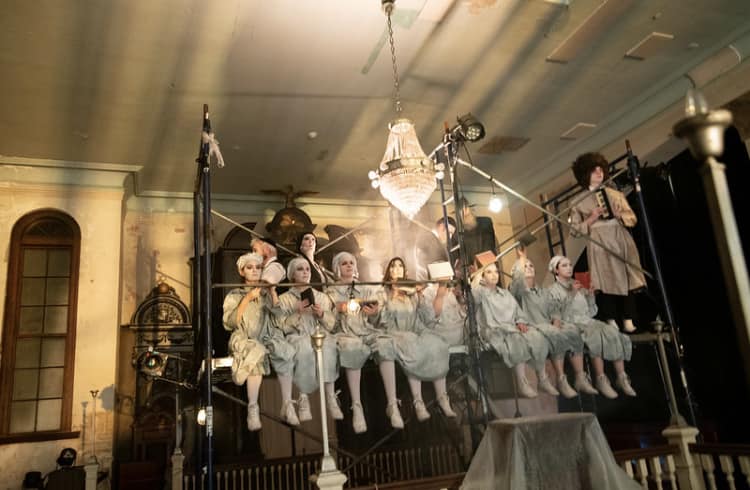
But your question was about [Roy Chen’s version]. He did this adaptation for the Gesher theater in Israel, maybe 10 years ago, and it became a hit. It toured the world. It was a very, very successful play. I was thinking about the Vilna Shul and what I should do there, and then this came to mind. I contacted Roy, and there were some small things that I changed and adapted from that version [to bring the play] into the world after October 7. That’s how it came to be.
What clinched it for us [was] how different from the original [Chen’s version] is. I think the story is incredible, and Anski’s research on shtetls and the life of a shtetl is incredible work. I think the original does sound outdated. It has a million characters. The story is super, super long. Our show runs one hour and 45 minutes without an intermission. If we were to do [the original] version, it would be more like four hours. It’s huge. It’s just not possible to do in today’s world. So, this is a condensed and, I would say, updated version for our time.
Kilian Melloy: You were born in Ukraine, and initially, as I understand it, the idea for Arlekin Players was to build a bridge between U.S. culture and Russian culture. Now, with Russia’s aggression against Ukraine, does this production also resonate with you personally in terms of contemporary events?
Igor Golyak: The war in Ukraine is a part of my thinking in terms of my identity. That’s where I was born, that’s where I’m from. I feel attacked when Ukraine is attacked. Russia is attacking Ukraine, but I feel like all of me was created in Russia, in terms of me as an artist. On top of all of that, the Ukrainian Cossacks that raided these villages are very explicitly [referenced] in The Dybbuk, and I’m from Ukraine. And then, also, my Jewish identity, with October 7 and rising antisemitism in this world — it makes you want to retreat from people. But then there’s this love story that breaks borders, that is between worlds but connects worlds. So, I don’t have any answers. I just have these questions that I’m pondering in the work.
Kilian Melloy: The Dybbuk was such a huge success and was so well acclaimed during its first run. From your perspective, what made it connect so strongly with audiences?
Igor Golyak: The theme of antisemitism that is present in the play; I think that’s something that people connect to. But at the same time, there’s this beautiful love story. There’s hope in people, if such love can exist. It’s acknowledging where we are, and I think it’s also giving hope to people.
It’s also just a beautiful production. The lightning design is incredible. The space is so special. We have two incredible artists that left Russia after the war. They were some of the best artists in Russia at one time; very popular, A-list actors. It was just so well received, and it just made people closer. That’s why we’re bringing it back.
Kilian Melloy: What are you planning for your next works?
Igor Golyak: I just opened a show in London a week and a half ago, which was called The Wanderers, by Anna Ziegler, and then I came back at the end of last week and am going straight into tech for The Dybbuk. So, that’s what’s been happening this season.
In terms of the future for this season, there’s an Ionesco play that I’m exploring called Frenzy for Two — or, as we call it, Delirium. We workshopped it at the New York Theatre Workshop at the end of last season, and we’re looking to have a premiere of it in Boston in late spring and then, hopefully, move it over to New York for its New York premiere. Before that, we’re planning to bring Our Class to San Francisco in March. Our Class had a run at BAM [Brooklyn Academy of Music] and then Classic Stage Company in New York. It won four Lucille Lortel awards, and then we brought it to Boston last season. It was hugely successful.
This interview has been edited for length and clarity. The Dybbuk returns to The Vilna Shul on Beacon Hill Oct. 30 – November 16. For tickets and more information, visit the Arlekin Players website.