by Kilian Melloy
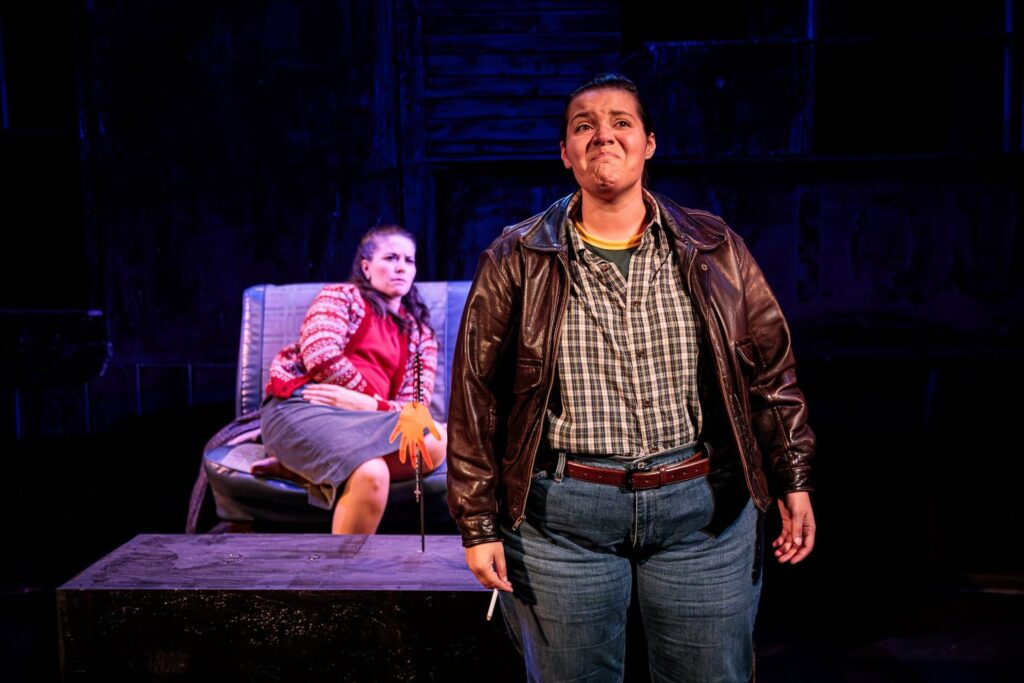
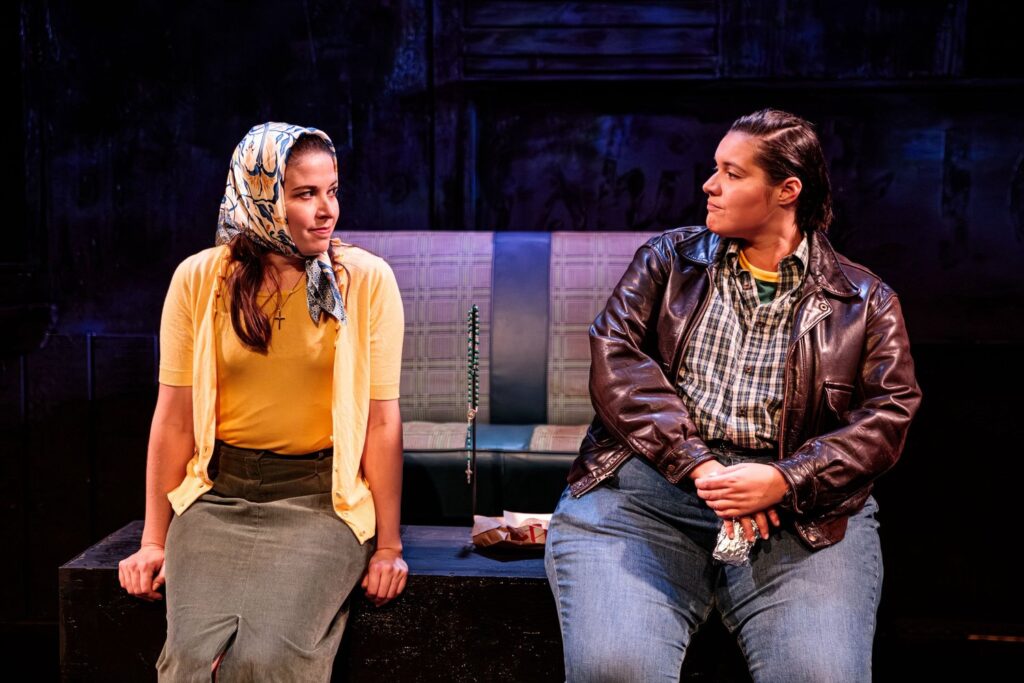
Boston Playwrights’ Theatre’s season continues with KJ Moran Velz’s new play Mother Mary, a story set in 1968 that finds two women — cab driver Jo Cruz and Catholic schoolteacher Mary O’Sullivan — navigating not just the streets of Southie, but also the perils of the time and the eternal mysteries of love. What starts as a ride home turns into a shared daily ritual of commuting and discussing books like The Price of Salt. Jo’s uncertainties and Mary’s innocence are roadblocks on the road to romance, but so too are the insults hurled by community members who can see plainly that Jo likes women… something that Mary, catching onto, finds herself intrigued by. There’s a complication in that Mary is pregnant thanks to her boyfriend (also Catholic, but deployed to Vietnam), but that might just be something Jo happens to be able to help with…
From abortion to lesbian sexuality, the play pulls no punches — but neither does it stint on laughter.
Theater Mirror caught up with KJ Moran Velz to find out more.
Kilian Melloy: Tell me about the play.
KJ Moran Velz: The way I typically describe the play is as a reverse nativity story. It follows Mary and Jo, and much like Mary and Joseph on their way to Bethlehem to have a baby, Mary and Joe are on a similar journey to not have a baby. What arises from that complicated question, especially for Mary, who is a faithful Catholic and has grown up in a home where Catholicism is at the heart of every action. What does it mean for her to go on this journey to not only seek an abortion, but end up falling in love with the taxi driver who’s bringing her there?
The character of Mary is an amalgamation of many faithful Irish Catholic women in my family, and their mothers feature quite prominently in the play. The actor playing Mary will also embody Mrs. O’Sullivan, her mother, and Jo embodies Nurse Cruz, her mother. It’s a play about mothering and about becoming a mother, or not becoming a mother, and the complicated questions and feelings that arise from that.
Kilian Melloy: Boston is a very Catholic town, but so are places like, say, Chicago. So, how is this play particular to Boston?
KJ Moran Velz: In some ways, this play could take place in Chicago or Philadelphia or Baltimore, but in thinking about that question, I feel like this play could only happen in Boston, because so much of Mary is Boston, and so much of that is because my family is Irish Catholic Boston.
What separates Boston from these cities at the time [of the play’s setting] is that Southie, at the time, had one of the highest rates of unemployment in the country, and that high rate of unemployment, which was compounded by violence [and] poverty, really made Southie an interesting place for the story, especially considering the segregation throughout Boston during this time in particular and the strength of the different ethnic enclaves. Busing and desegregation rumbling underneath a lot of the conflicts in this play come from Mary, who has lived in Southie her whole life. She has a limited worldview. And Jo is a taxicab driver and drove on the island [Puerto Rico] and also in New York, so she has a very different worldview. It’s [about] how these two women who are so different, who come from such different neighborhoods, different lives, find that they have so much in common, and find that their stories and the stories of their families are actually more similar than they could have thought.
Kilian Melloy: As you’ve referenced, the play takes place in 1968. But could the story take place today, or are there some direct resonances and parallels between then and now?
KJ Moran Velz: I think that, unfortunately, there is a lot of resonance right now [with 1968], considering abortion being illegal, or close to illegal, in over 15 states now. We have this system where women are seeking health care, much as Mary did in 1968, when it’s very dangerous to do so, and the threat of the law is hanging over her. I do think that that will resonate with people.
Kilian Melloy: What other inspirations did you draw on for this play?
KJ Moran Velz: I have been writing it, starting it in 2021, and I think the overturning of Roe v. Wade elevated its relevance and its resonance. In terms of inspiration. I grew up in Boston, Irish, and going to Catholic school, and I always felt like there was a deep connection between the islands of Ireland and Puerto Rico in terms of their shared struggles for independence and for self-determination. When I was an undergrad, I was a Spanish major, and I was assigned this whole unit on Puerto Rican poetry, and that unlocked something in me and something in this story that features pretty heavily in the story of Jo and Mary.
Another [source] of inspiration is the varied histories of abortion and queer women anywhere, but particularly in the United States. So much of our history has been lost to time because of the logistics of being able to provide abortions or to be a lesbian. Both of those things required a lot of secrecy, a lot of discretion.
I think the biggest inspiration for this piece is the idea of, ‘What it would have been like to be a woman in 1968?’ Would I have fallen in love with my wife if it were 1968? Would the society I was raised in be too much of a barrier for me to understand my own sexuality? Something I think a lot about as a queer person is all the queer people who have come before me, and the deep sadness I feel that I will never know them, whether in writing or otherwise; feeling this connection to my queer ancestors and wishing that I knew more about them. I’m someone who spent a lot of time reading every single thing I could about queer people in Boston during this time and before, and I think some of this play is in honor of them and is my attempt at exploring what their lives were like.
I think the resonance for today is that queer people have always existed. They’re always going to exist. Everybody has that aunt who had a roommate, and they were roommates forever. Abortions have existed as long as pregnancy has existed, and it’s going to keep happening. Instead of pushing things aside, it’s bringing it into the light and witnessing it in its fullness.
Kilian Melloy: So there’s certainly a lot of rom in this rom-com, but what’s your comedy like? Are you someone who goes for one-liners? Absurdity? Irony?
KJ Moran Velz: It’s a lot of one-liners. Mary and Jo are deeply funny women. Jo spends some of the play in direct address to the audience, and a lot of that is her opportunity to explore what she’s thinking as she gets to know Mary and is trying to prevent herself from falling in love with Mary. There are so many spaces for comedy when you have someone who’s doing something that they don’t want to do, but also really want to do.
This play is unapologetically queer, especially for the character of Jo, who is a butch woman. There’s no hiding the fact that she’s a dyke, and that comes with a lot of danger and threats of violence in the play. But the way that she deals with it, and the way that Mary deals with a lot of her own trauma, is through making a joke of it and being flexible with the moments where it’s dangerous and choosing to still continue their lives. There’s a form of resistance in their resisting the forces that don’t want them to be together, that don’t want them to exist. Their payback is joy and laughter. And they just, they just make each other laugh. These are fast, shocking women who tease each other a bunch. They’re very playful.
I think the play is how they deal with the strife. I’m in the process of becoming a drama therapist, and one of the big things in my training is the idea that play can help us in those moments where life is too much, where life is so heavy. If we approach that moment with play, it doesn’t mean that that thing doesn’t stop being heavy or stop being serious, but if we add some play to it, we’re able to find the joy and the light amongst the darkness. I think that’s what Mary and Jo do.
Kilian Melloy: What are you looking for audiences to take away from the play?
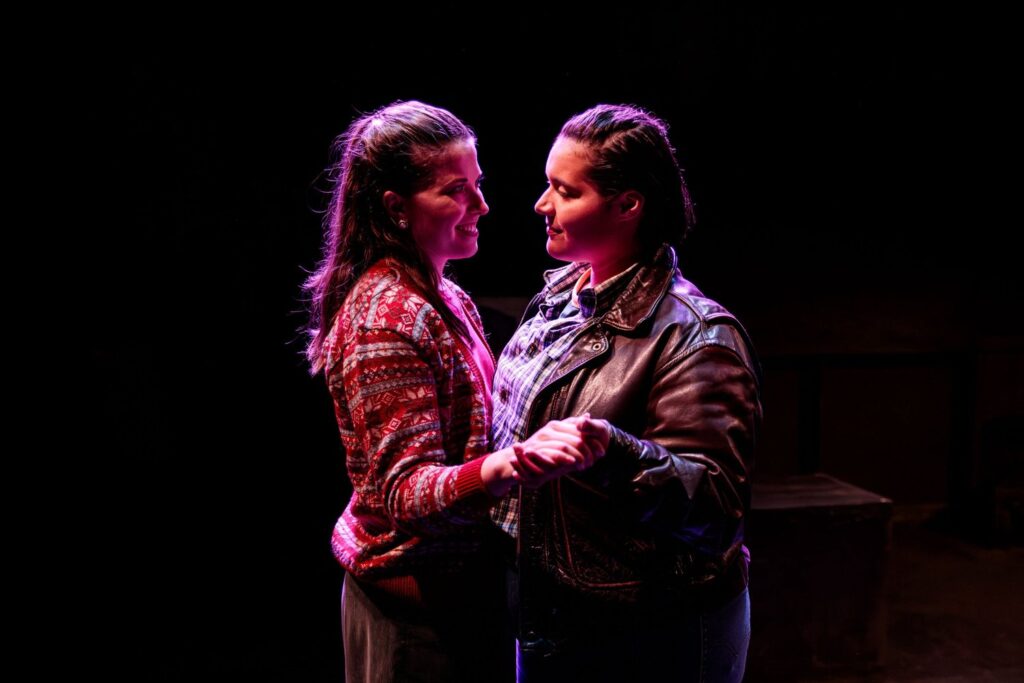
KJ Moran Velz: I hope the audiences come out of this with kind of a new appreciation for the difficult choices women have to make. I hope people feel love and also feel like the stories of queer women don’t always have to end in marriages or death.
Kilian Melloy: Maybe Boston marriages.
KJ Moran Velz: Maybe Boston marriages, absolutely. Boston marriages didn’t make it into this play, but I’m sure they’ll make it into a future one.
Kilian Melloy: Speaking of, what are you working on next?
KJ Moran Velz: My next play takes place in Quincy. It’s a story about another woman named Mary, and this time it takes place right now. Mary moves into the home where her grandparents first lived when they immigrated from Ireland. Her grandfather is haunting the house as a ghost, and finds out that Mary is married to a cop. It’s a play about what it means to be an Irish American and also engage with the history of policing in both the United States and Ireland. How do those things intersect? And then, of course, she has an ex-girlfriend who happens to live right next door.
There are always gonna be queer women in my plays, and there are always going to be Irish Catholics, and then there’s always gonna be the question of what it means to be Irish American.
This interview has been edited for length and clarity. Mother Mary will play at the Boston Playwrights’ Theatre Oct. 9 – 26. For tickets and more information, visit https://www.bostonplaywrights.org/our-25-26-season