by Kilian Melloy
It’s hellishly hard to get Stephen King’s work to translate well from page to screen; you’d better be a Stanley Kubrick, a Bran DePalma, or a Mike Flanagan if you hope to create the same sense of dread and terror King imbues his novels and short stories, or a Frank Darabont or a Rob Reiner to capture some of the same emotional charge and general atmospherics.
One Rob Reiner adaptation in particular still sends chills down the spine: His 1990 Kathy Bates and James Caan-starring big screen version of King’s novel Misery, in which Caan plays Paul Sheldon, a popular writer who’s been involved in a car crash in a snowbound Colorado locale. Paul is rescued by Annie, a nurse who also happens to be — as she puts it herself — his number one fan. Though badly injured, Paul is in capable hands; Annie has the skills and the equipment to set him up in her home for care that rivals anything he’d get in a hospital… except for one thing: Annie’s sunny, compassionate side is counterbalanced by an equally violent and volatile aspect, one that can suddenly emerge and wreak all sorts of physical and psychological torment on her captive patient. What really sets Annie off is Paul’s determination to end his long, successful line of novels starring a character called Misery and start writing more serious fiction. Paul’s latest Misery novel is meant to be the last, since it kills off the title character. As devoted as Annie is to Paul Sheldon, the author of the Misery books, she’s definitely no fan of Paul Sheldon the post-Misery writer. Presenting Paul with a typewriter, a ream of paper, and a demand to make things right, Annie makes it clear that if Paul doesn’t find some way to un-kill Misery, he’s going to join the fictional character in meeting a gruesome demise — and if you don’t think Annie is up to the execution, just wait until you see how she reacts to Paul’s futile escape attempts. (That’s one of the things about Reiner’s movie version that still raises hackles thirty-five years later.)
The Rob Reiner film was adapted for the screen by William Goldman, famed in cinema circles for the screenplays to films like Butch Cassidy and the Sundance Kid and Marathon Man, not to mention having written both the novel and the Rob Reiner film version of The Princess Bride. But Goldman wasn’t done with Misery when the movie became a success; he revisited the novel in 2015 to write a 90-minute stage version that highlights the battle of wits between Paul and Annie, but also delves deeply, and painfully, into the emotional entanglements found in any relationship where care and cruelty co-exist.
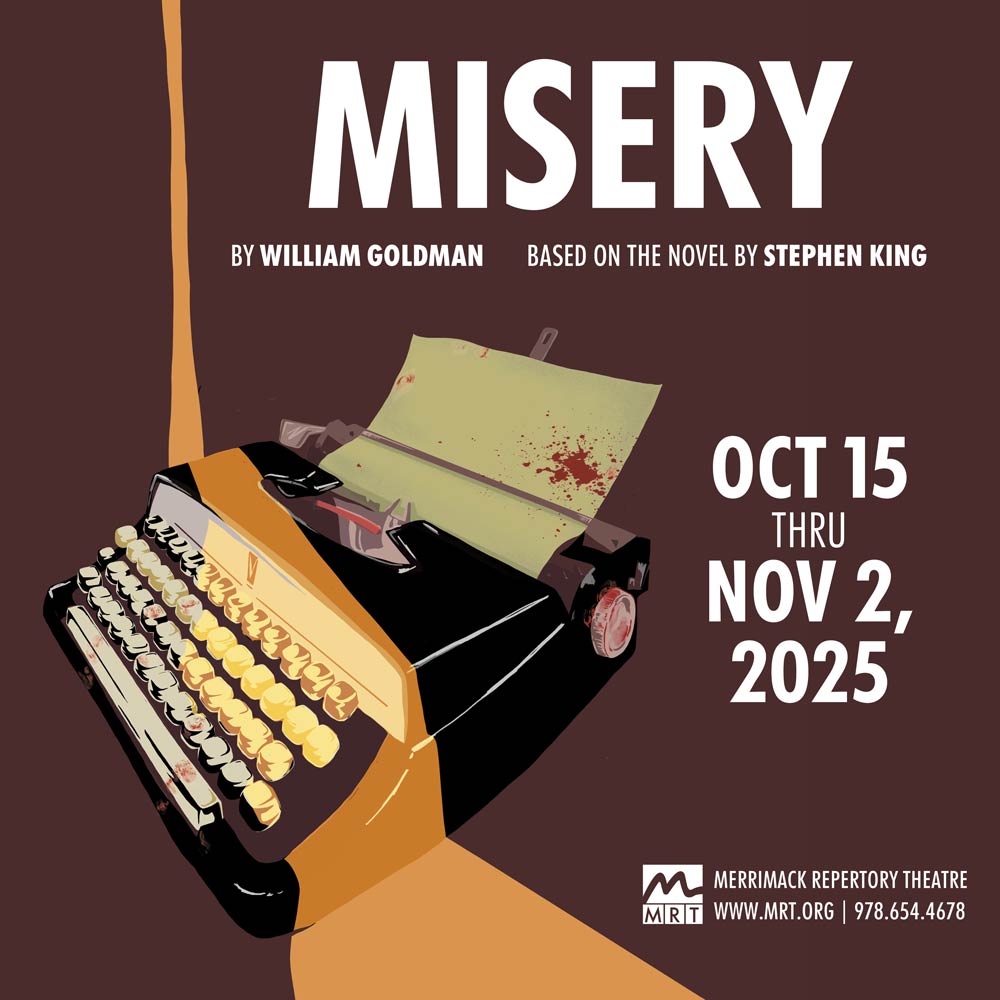
Merrimack Repertory Theatre brings Misery to its stage as part of its current season. Running October 15 – November 2, the show offers a thrilling pairing of Karen MacDonald as Annie and Tom Coiner as Paul. A veteran of MRT, having starred in several previous productions by the company, as well as dozens of other Equity productions, Coiner has also been featured in TV series ranging from Boardwalk Empire to The Good Fight (with an episode of Law & Order soon to air). Coiner is a Massachusetts native, so it was no surprise that he showed up to our interview wearing his Red Sox hat — a sartorial choice of which Sox fan Stephen King himself would no doubt approve.

Kilian Melloy: Your character, Paul, is such a playground for an actor. He’s tormented, yet he’s so smart; he’s so witty, so dry.
Tom Coiner: He’s a wonderfully acerbic character, even when he’s drugged out, when he’s in a lot of pain, or even when he’s very emotional. Annie has an inferiority complex about her own intelligence. He unintentionally angers her when she thinks he’s correcting her, when he’s actually just chiming in on a story she’s telling. There are a lot of times when his intelligence helps him, and then there are also times in the play where it’s a liability. I love that.
Kilian Melloy: What is it like to be playing moments of stark terror opposite Karen McDonald?
Tom Coiner: Karen can really run the gamut. She can be very scary. She can be very creepy. There’s all kinds of adjectives for the things that she sends me. It’s been really fun to get the scripts out of our hands and [make eye contact in rehearsal]. She can really send you there — my heart is thumping by the time I’m done with those scenes. It’s interesting how the body doesn’t know the difference. You really get to learn that lesson in a play like this. At the end of rehearsal, I’d chill out because my body has been through some simulations of things that are intense.
Kilian Melloy: William Goldman not only wrote the screenplay for the movie version, he wrote the stage version as well. I was amazed at how tight and complete the script is.
Tom Coiner: I call him one of the 20th century’s best writers, because for people of my generation, The Princess Bride is almost like a sacred text, [both] the book and the movie. This production is equally alluring for the chance to work on Stephen King material and for the chance to work on a William Goldman script. I have not seen the movie, but I understand the differences in the script, and I think that the differences between the play and the book are elegant evolutions of the story. I think [Goldman is] helping Stephen King find a better ending. I think the hobbling in the movie and in the play is superior to the de-footing that happens in the book, because it resets Paul’s injuries. It’s not a new injury and a more horrific one; it actually brings him back [to square one], and back for the audience, who have watched his healing, to see it. That sledgehammer moment — there’s something really elegant about the parallels there.
And there’s also a little line in there where Paul says to Annie, “It’s not the idea for a story, it’s what you do with it.” It’s interesting to play a writer character. You’re always like, “Oh, it’s based on the guy who wrote it.” But there’s actually two writers here, and to find the places where the text is like, “Oh, is that William, or is that Stephen?” — like, who’s talking? It’s very fun, as a lover of scripts, to go through this.
Kilian Melloy: When you first opened that script, were you intimidated?
Tom Coiner: I was really excited. Stage combat is something that we learn as actors [and] I like fighting, but I’ve always been better at getting beat up. It’s always between both the attacker and the attack to sell a stage combat moment, and I was always better at selling it when I was receiving [the attack]. There’s a lot of technical challenges in the play. All of these moments of violence are challenges for stage combat. It has been a long time since I’ve done something more complicated than a slap or a simple punch — something that involves carrying an injury through multiple scenes, and then the healing journey. Paul, as an actor, has a lot of conditions that he is working under: How much pain he’s in, how drugged he is from the drug that she gives him, how scared he is, how tired he is. There’s dozens of conditions throughout the play. This play is not The 39 Steps, where you’re running around like your pants are on fire. I’m lying in a bed for most of it, but then there are these very physical challenges of being consistent with the injuries and not breaking the suspension of disbelief.
Kilian Melloy: Horror might work best when it’s got a certain universality. We’ve all probably dealt with somebody like Annie, who’s volatile, and you don’t know what’s going to set them off, and they might have power over you.
Tom Coiner: And they might be vindictive in a way that doesn’t make sense to you. Stephen King’s way of working is to see things in real life and then draw them to a horrifying extremity — like, what if clowns really were as scary as kids think they are? He takes these simple things and then studies them in such detail that he’s able to stretch them out to these grotesque and horrifying proportions. There’s a six-scene sequence at the beginning of the play that if Annie let me go during any of those scenes, there’d be no harm, no foul. You know, “I’ll come visit you every couple years, just to say hi. We’ll have lunch.” But then there’s a point of no return where it’s like, “I’ve got to get out of here,” and then there’s another point of no return where it’s her or me. That’s what’s great about it, is that attenuation of that person you might meet at the post office, but what if you had to go back home with them? What if you then had to spend the rest of your life with them? What if they were going to kill you in a couple of weeks? All these “what-ifs” stack on each other and make it more engrossing, because it starts with that entry point that we all recognize.
Kilian Melloy: Are you drawing on things from your own life — thinking back to some psycho you knew in college or something — to inform how Paul deals with Annie?
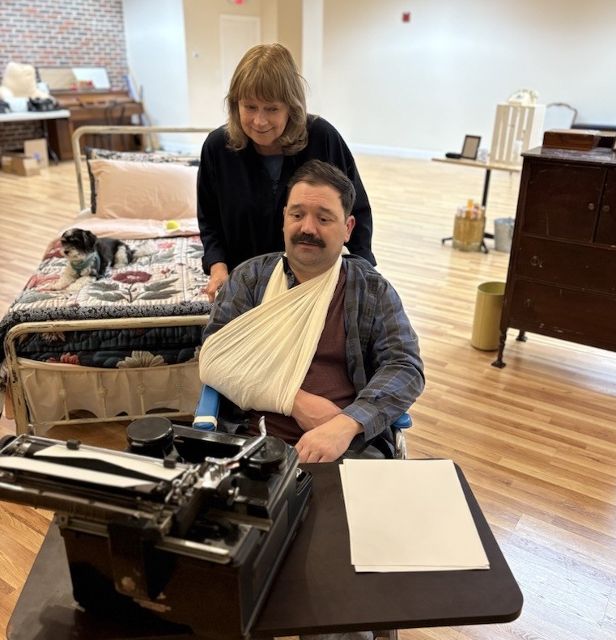
Tom Coiner: We both are, for sure — Karen, especially, because she has to lock into the behavior. The behavior has to make sense to her in some way so that she can do it every night. And for me, I will suddenly remember somebody who felt like I had to watch them like the weather and take my cues from how they were feeling. There’s also a parent-child thing that this reminds you of, where it’s like, “Remember being locked in your room sometimes?” like a time out or whatever. Paul is on permanent time out. They slip into that relationship, too. All those different relationships that they live in end up reminding Karen and I of things that we’ve done, and we’ll tell a personal anecdote that fattens the scene up a little bit, or we’ll fatten up a line of dialogue to be richer. We start a conversation about people like [Annie]. A lot of rehearsing is expanding the thought bubble around scenes and individual collections of lines, like, “That reminds you of that; that reminds me of this.” It’s a wonderful way to work.
Kilian Melloy: You said something about William Goldman coming up with maybe a better ending, at least for the stage. He does come up with a surprise that’s somewhat shocking, yet appropriate.
Tom Coiner: I think one of the signs of a great writer is their ability to thread the needle on an ending. Sometimes the initial writer is too close to a story. I think William Goldman, since he’s an adapter and a screenwriter, saw something that Paul could find: That there is a metaphor for how art is made, and the pain an artist endures, and the pain an addicted artist, which Paul is during the course of the play, [endures]. It’s not lost on me that Stephen King has struggled with addiction. The idea of a piece of art saving your life, and the trials and things that all of us live through if we’re making art — the idea that it enriches our art is one of the only positive takes we can have from bad things. Sometimes, there’s a bad thing that happened, and no one is coming to apologize to you about it. We all have those. It’s just, “I will never get to forgive this.” I can forgive them privately, but we’ll never have that moment, and you have to craft your own reconciliation. I think that’s one of the great salutary potentials of art, is that it allows people who have experienced trauma to see that you get to choose what you make of it going forward in your life.
Kilian Melloy: What is next on your horizon?
Tom Coiner: Well, in a couple of weeks, I have an episode of Law and Order that’s coming out. It’s called “Bend the Knee.” They were supposed to air it this week, but then I think they pushed some scheduling thing, and I think it’s happening October 26, as best I can tell. I’m excited about that. And I just had a commercial with Eli Manning about the 10th anniversary of his campaign to Tackle Kids Cancer. We made a nice little spot for that, with footballs flying at people from all angles. It was a lot of fun to film. After that, you know — auditions. I’m a working stiff. I also teach at UMass Lowell; I teach Introduction to Acting and Audition for the Camera. I read a lot of scripts, and I talk about what’s happening in scenes. That’s all I do every day. That’s all I hope to do.
This interview has been edited for length and clarity. ‘Misery’ runs at Merrimack Repertory Theatre Oct. 15 – Nov. 2. For tickets and more information, visit the MRT website: mrt.org/