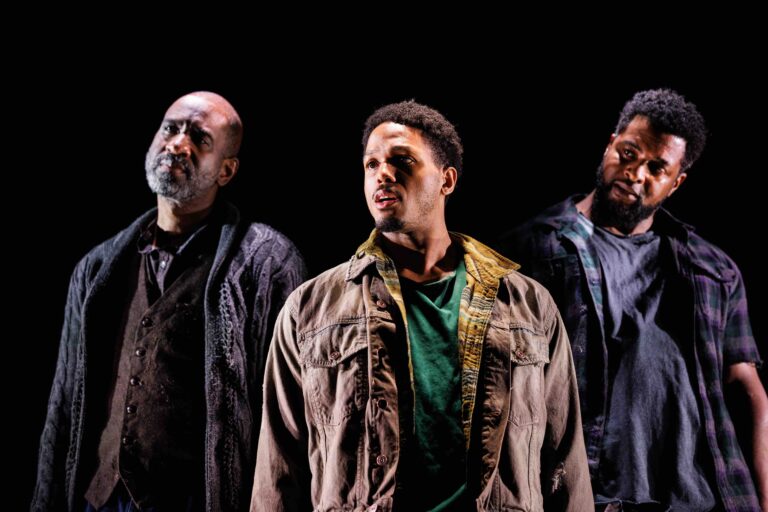
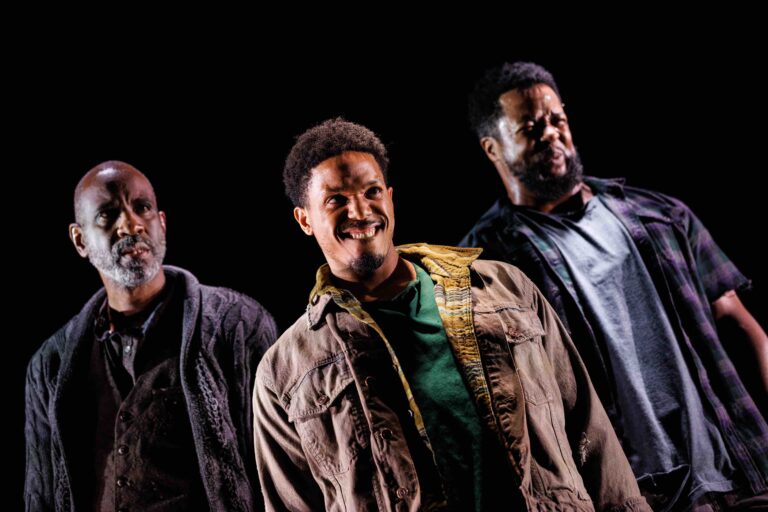
Hang Time, written and directed by Zora Howard; scenic design by Neal Wilkinson; movement direction by Charlie Oates; stunt direction by Rick Sordelet; lighting design by Reza Behjat; sound design by Megan Culley; costume design by Dominique Fawn Hill; produced by The Flea; presented by ArtsEmerson at the Jackie Liebergott Black Box Theatre/Paramount Center in Boston, MA through October 12, 2025.
by Julie-Anne Whitney
From the moment you walk into ArtsEmerson’s Black Box Theatre, you are confronted with an awful scene: three Black men hanging in mid-air. The image is provocative and shocking. You are no longer just an audience member; you have become a witness.
Pulitzer Prize-finalist Zora Howard’s Hang Time is a searingly powerful play that highlights the complex inner worlds of three Black men and the horrifying brutality that takes their lives. It is an unflinching look at the Black Man’s experience and the painful, enduring impacts of systemic racism in America.
Throughout the hour-long performance, the three actors remain close together on a single, tiered platform, meant to suggest the thick trunk of an old tree. As you watch the men being hanged by invisible ropes again and again and again, you also see them repeatedly waking from their deaths to discuss their lives. They have real, intimate conversations about love, sex, jail, money, music, travel, and family. Each time they wake up, you hear sounds of life; crickets, birds, the wind, a train, and the gruesome tug of a rope tightening and stretching under the weight of their bodies.
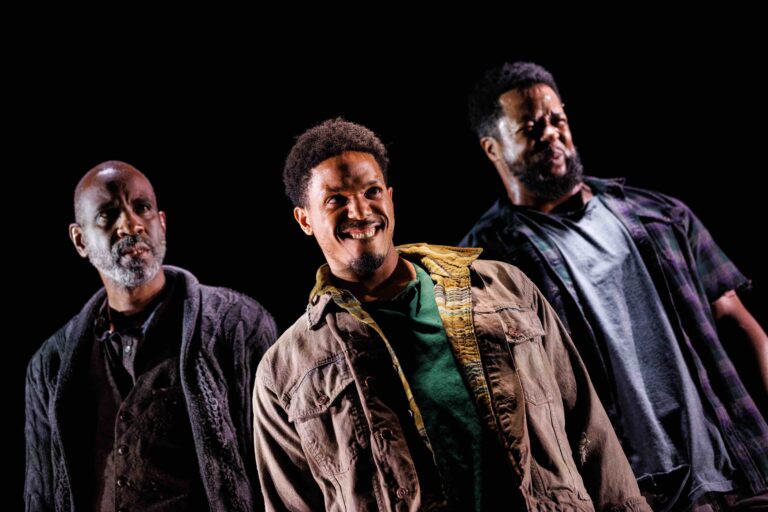
The conversations between the three men highlight their different personalities, experiences, and desires. Blood (Bryce Foley) is an earnest, hopeful young man who yearns for adventure away from the pressure of familial responsibilities. Slim (Kamal Bolden) is a bitter, resentful man who boasts about his sexual exploits and sings “ugly” blues songs to avoid feelings of shame and grief. Bird (Julian Rozzell), the oldest and wisest of the three, is a quiet, lonely man weighed down by loss and pain.
Bryce Foley gives a deeply moving performance in the role of Blood. As Blood repeatedly acknowledges the “pretty day” outside, it points to all the pretty days he won’t get to see. In one particularly shattering moment, Blood fights back against the idea that his dreams are unattainable and that he won’t get to travel the world. As the platform slowly lowers beneath his feet, Blood struggles against the metaphorical rope around his throat, crying out, “I got things to do! I got things to do! I gotta get there. I gotta get there.”
All of the design elements of this production work seamlessly together, from Charlie Oates’ eerily precise movement direction and Rick Sordelet’s seemingly magical stunt direction to Megan Culley’s understated yet impactful sound design and Reza Behjat’s strikingly minimalist lighting design. There isn’t one element that stands out or detracts from the others; the space is intentionally sparse to keep your eyes on the three men.
The longer the play went on, I began to wonder, are the men dead and we’re seeing remnants of the lives they lived, or are these glimpses of the lives they won’t get to live? Did the lynchings happen in their past or are they in their future? Then I realized there’s a reason the time and place are not specified in this story. That ambiguity is a chilling reminder that this story– these murders– could take place anywhere at any time. It could even be today. These horrible times are not over; they never stopped.
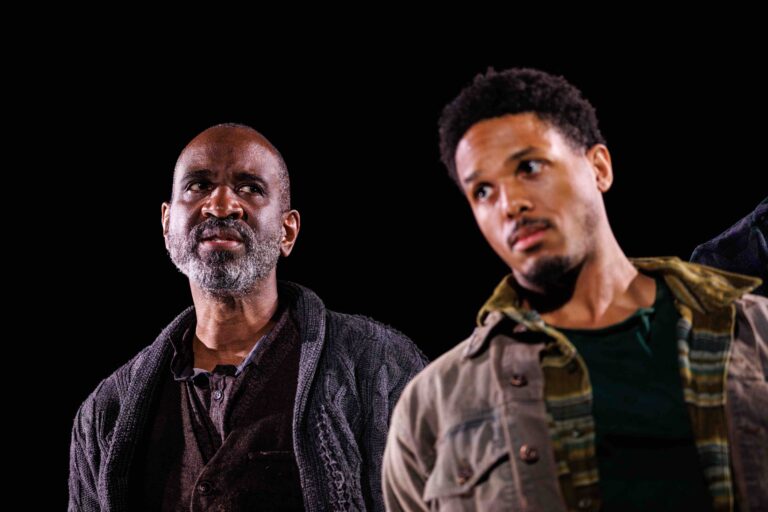
Hang Time forces you to bear witness, to lean in, to confront. It is a reckoning and a powerful call to action. It demands that you think about the lives these Black men deserved but didn’t get to have. It demands your response– emotionally, socially, and politically. It demands change.
For more information and tickets, go to: https://artsemerson.org/events/hang-time/