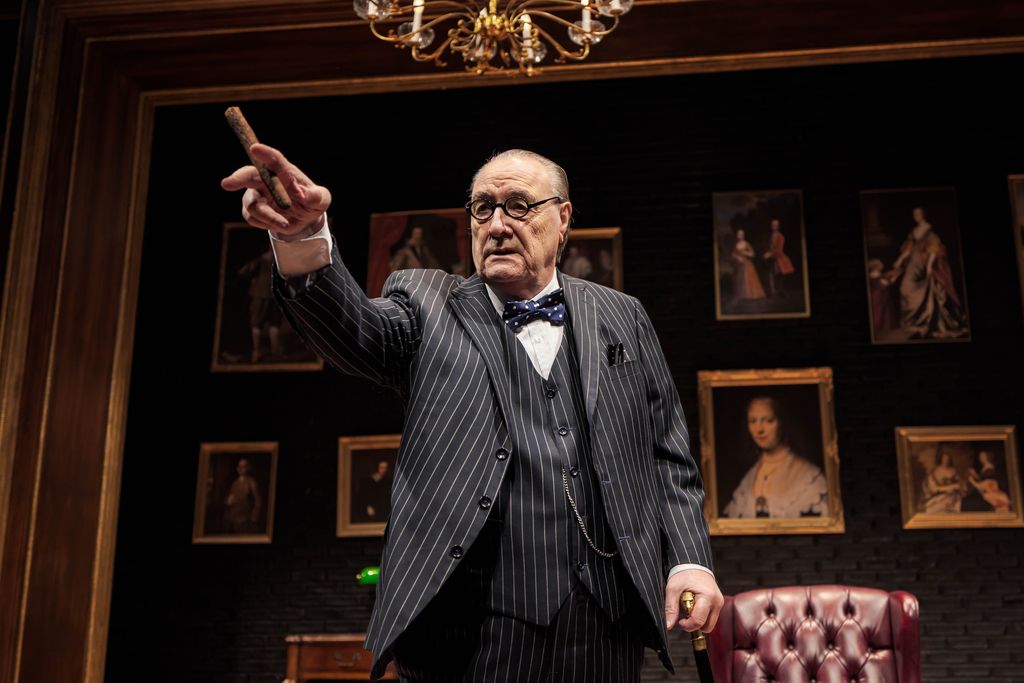
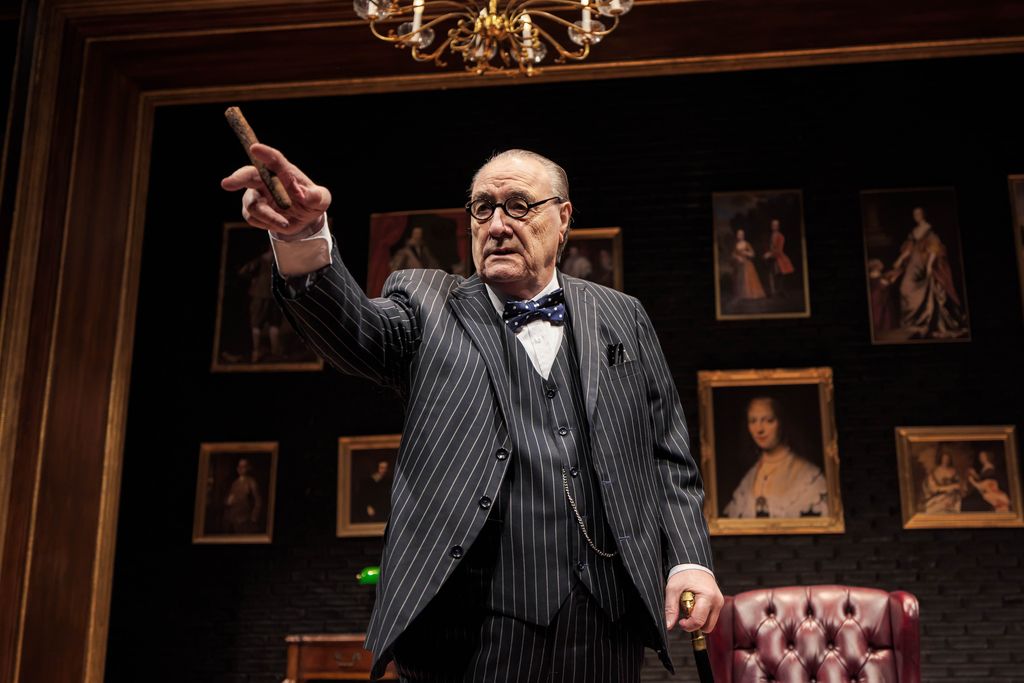
“Churchill” − Created and directed by David Payne. Presented by Emery Entertainment, Standford Calderwood Pavilion, 539 Tremont Street, through October 12.
by Michele Markarian
One-person shows are tricky in terms of verisimilitude – who is the person talking to? Why are they standing before us? Years ago, my grandmother, knowing I was fond of Emily Dickinson, took me to see “The Belle of Amherst” with Julie Harris. My twelve-year-old self didn’t buy the fact that Emily was willing to address a roomful of 650 strangers at Boston’s Colonial Theater for no apparent reason other than the fact that we were there. She even offered us cake when clearly there wasn’t enough to go around. It didn’t make for a credible suspension of disbelief.
David Payne’s one-man Churchill suffers no such flaw. It is 1963, and Churchill, awarded an honorary US citizenship by President John F. Kennedy, has been asked to give a speech regarding his career and the American contributions to it at the Oxford American Society at Blenheim Palace (Churchill is the first person ever to receive this honor). We, the audience, are the attendees. From the beginning, this draws us in by making us part of the piece. It also makes it easier to imagine that the actor before us really is Winston Churchill, and to his credit, Payne inhabits the role marvelously.
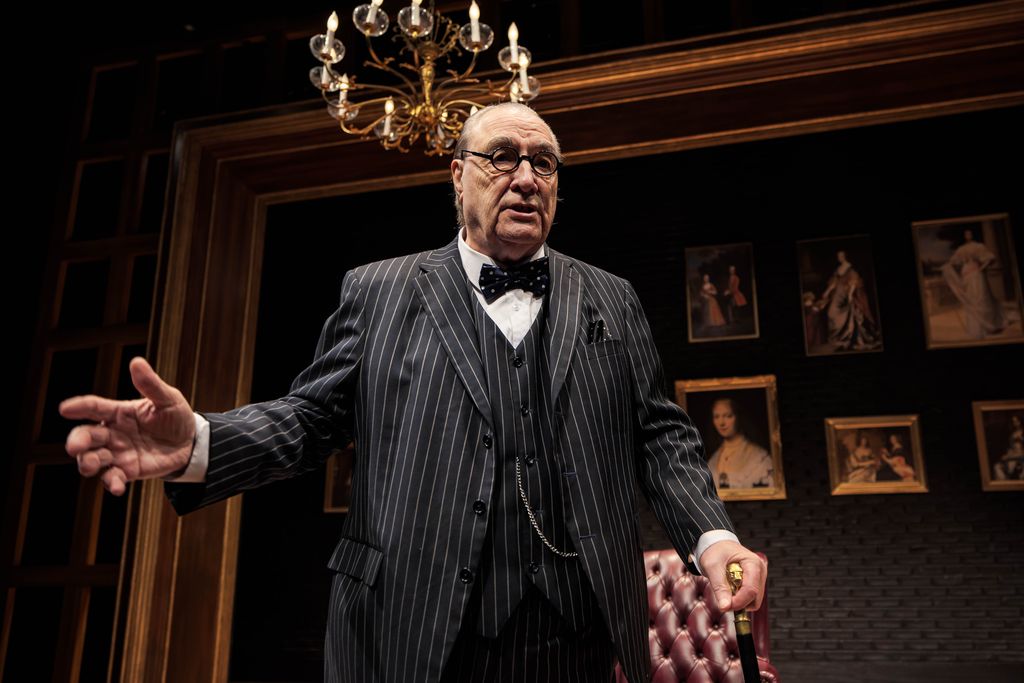
Churchill was born at Blenheim Palace, not because he grew up there, but because his pregnant, American mother was having such a good time at a party there that he decided to make his appearance early. Churchill doted on his parents and hated being in boarding school, away from home. It was this early separation from the parents he loved that Churchill blames for his lifelong struggle with depression, or the “black dog”, as he refers to it. We are treated to the interesting history of Churchill, who points out that while everyone remembers his courage in World War II, World War II literally took up only five years of his present 88. His illustrious past includes being a war correspondent for the Boer War – he sympathized with the Boers – and his disastrous appointment as First Lord of the Admiralty, where he led a failed attack on Gallipoli during World War I, after which he fell out of favor. The lessons he learned from it helped him, as Prime Minister at the age of 65, to challenge and defeat Adolf Hitler. In between, he took up painting, telling us, “I sometimes think that if it wasn’t for painting, I would struggle to live”.
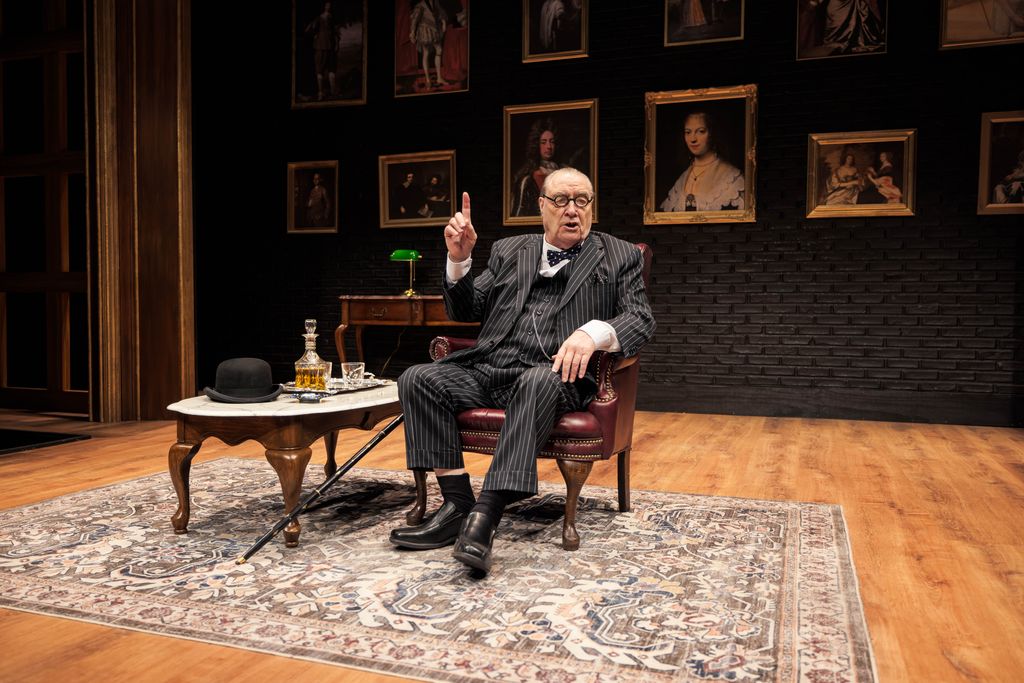
Payne has created a program chock full of spicy, funny, and historical anecdotes about powerful figures in history – Lady Astor, Teddy Roosevelt, Lord Chamberlain, FDR, and Queen Elizabeth II. The best praise Churchill saves for his wife, Clementine, crediting her with being the reason for his every success. Performed against a simple set – leather chair, table, whisky glass, with a cane and cigar as props – Payne takes us back to a time when powerful men held a moral responsibility to be great, to rise to the duty of their position. He cleverly weaves American politics into the speech. When he tells us that “no better Constitution was ever written in English,” a hush came over the audience before we all burst into applause. Payne’s Churchill is a reminder that great men, while seemingly in short supply these days, once existed and will exist again.
For more information and tickets, go to: https://www.bostontheatrescene.com/shows-and-events/churchill/#performance-picker