
By Kilian Melloy
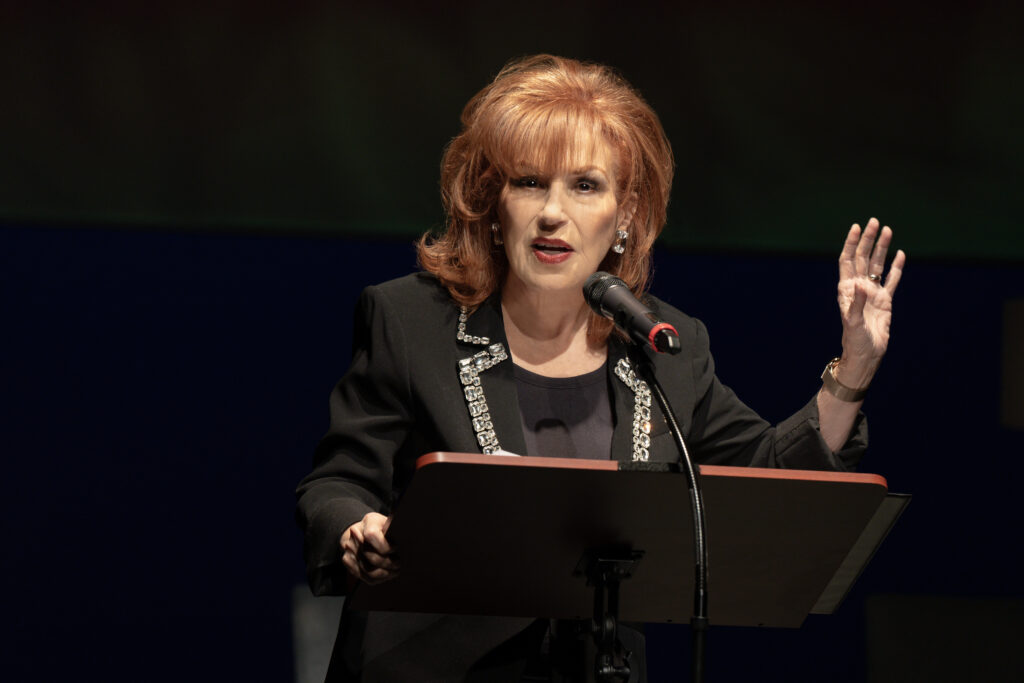
An arranged marriage in an Orthodox Jewish community. A husband whose love of dressing in his woman’s clothing isn’t a dealbreaker — until he starts using her makeup, too. Men with wandering eyes and, err, vital organs. A husband of half a century who is still as randy as ever… to his wife’s despair. These are just a few of the hilarious real-life marriages described in the round-robin collection of monologues titled My First Ex-Husband by standup comedian, talk show host, author, and playwright Joy Behar. The play is coming to The Huntington Calderwood at the Boston Center for the Arts for a run from Sept. 12 – 28.
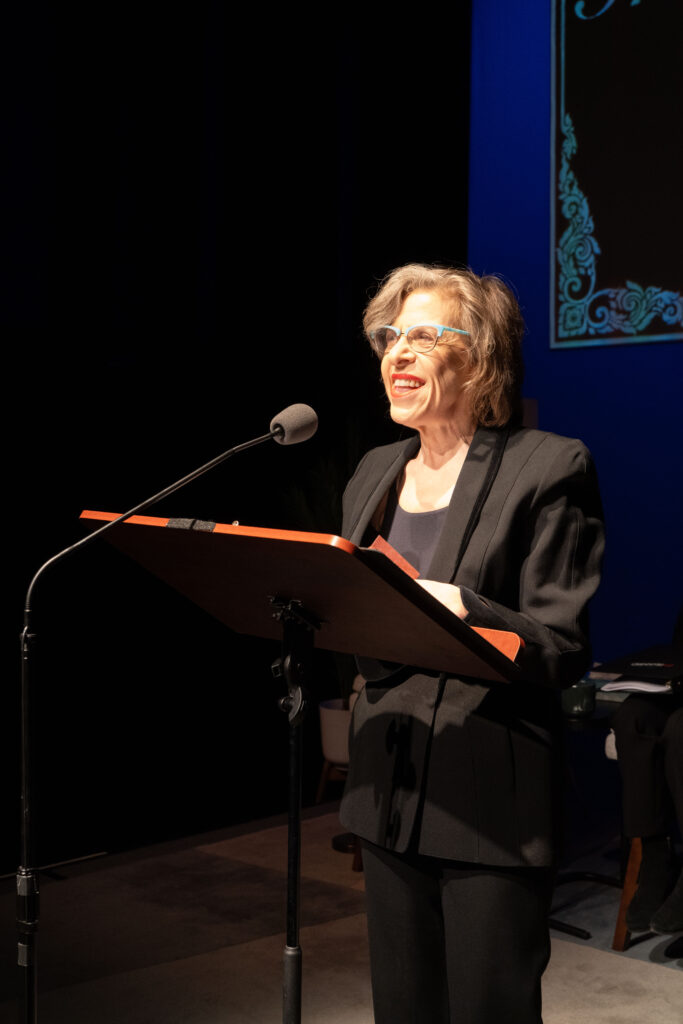
The comedian and talk show host shares monologuing duties with four other performers: Stand-up comics Judy Gold and Jackie Hoffman, and actors Veanne Cox and Tonya Pinkins. (Behar and Hoffman will appear in select performances.) One after the other,the actors will perform eight monologues relating an ex-wife’s point of view, detailing not just unions that went (or always were) wrong, but pithy, universal observations about the nature of the institution itself.
Behar, perhaps best known for hosting The View, notes to Theater Mirror that the play’s structure was influenced by that of The Vagina Monologues, in which she performed off-Broadway in 1999. Behar notes, too, that she’s written a number of other plays, including her autobiographical solo show Me, My Mouth, and I, and her latest, an anthology of five short works titled Bonkers in the Boroughs that, Behar says, “was produced at the New York Comedy Festival last year, and it will probably be produced again this summer out in Sag Harbor.”
Behar pauses after pointing this out. “Am I being too wordy here?” she asks. “I think I’m so wordy.”
Not at all. To paraphrase, if wordy be the food of comedy, speak on.

Theater Mirror: This play is based on interviews with women who are talking about their ex-husbands. How did this come about?
Joy Behar: This particular play started with me talking to one of my girlfriends. Both of us were divorced around the time, like ’79, ’80-ish, when everyone was getting divorced. It seemed like an epidemic. So, that’s how it started: [My] girlfriend and I talking about our divorces and what happened, and I said, “Let’s put this on tape.” Then I transcribed it, and I kept it in the drawer for a while. And then I said, “You know what, I’m gonna ask somebody else.” And then a couple of people told me about somebody else’s story, and then I put them all together. They’re all true stories — of course, there’s some embellishment, and there’s more humor [that’s been added], but basically they’re true stories.
Theater Mirror: How many such stories did you collect, and how did you pick and choose to winnow down to these eight monologues?
Joy Behar: Each one of the eight monologues is different from the one before it. How is the woman who’s married to a kind of mob guy different? If you’re going to do that one, we’re not going to hear another one about a mob guy. That’s how I chose them. I still have a few in my stockpile, which I haven’t worked on yet. I recently put in a new one about a woman who has alopecia, so if something comes to me that’s completely different, I’ll put it in.
Theater Mirror: Does that mean you’d have to take something out?
Joy Behar: Yeah — I think eight is the sweet spot. I think even six would work if people are in a hurry to go to the bathroom, but eight is the number that I like. It was four actresses, but I think one of the places we’re doing will just be three of us. And then I do a little bit of a warm-up at the beginning, where I talk about my own marriage and talk to the audience a little bit. You don’t want it to be too long. An hour and a half is plenty for this show.
Theater Mirror: There are so many ironies and contradictions in marriage. I especially like the line, “Should I have another affair? I mean, to save my marriage?” I think that encapsulates the surprising ways that a union can be complex and unfold in ways you wouldn’t expect.
Joy Behar: I know, and yeah, that’s fun to do. That line is kind of a crazy way to deal with stuff, I guess, but it worked for her for a while. In the beginning of that she talks about how the guy won’t stop having sex with her, and so she had an affair so that she could think about her lover while she’s having sex with her husband. She thinks that that will work again. Of course, it would not.
Theater Mirror: The play is geared toward the women in the audience, and they seem to have loved every production. But what do men think?
Joy Behar: Well, that’s a good question that I’ve asked often. I had that in my head when I put this thing together, because — and I say in the opening of the evening — I tried to ask men, and they would give me one-word answers. They were just not as articulate as the women about what happened. I worried about men thinking that this was a male-bashing session, but not one of them has said it is male-bashing. Mostly I get, “I loved it,” “I related to it,” or some say, “That’s not me. I am not like that.” The other thing I noticed is, the bigger laughs come from the men. Maybe it’s just because men have stronger voices.
Theater Mirror: You’re joined by several other performers.How do you decide who gets what monologues?
Joy Behar: You know, I’ve worked with Woody Allen, and he is the casting king. He casts so much to type that he barely has to direct you. I learned from that; I think that that’s very important. And I also believe that if you want to get some laughs out of people in a comedy — because that’s all I write are comedies; I’m not a big tragedian — you have to get actresses who know how to do comedy. We have one about a woman who escaped the Hasidic community, and I think that Jewish girls do it better than the girls who were not Jewish, because they understand it better. So, I make sure that we cast somebody who understands [the material], who understands the culture, and also can do it in a way that’s funny.
Theater Mirror: The play has had various casts. What do different performers bring that’s distinctive to them?
Joy Behar: I think that that’s one of the good things about this play, if you want to call this a play. It’s not exactly a play, like The Vagina Monologues was not exactly a play. But what I think happens is that people who have seen it more than once enjoy the idea that the actresses bring something new to the table that they hadn’t seen in the previous [production]. It’s a malleable kind of script.
Theater Mirror: Since you mention The Vagina Monologues, I was curious about whether that work might have been an influence for My First Ex-Husband.

Joy Behar: I did The Vagina Monologues. I also did another show called Love, Loss, and What I Wore, which was also in this format. I got the idea for this form from that format. I didn’t make this up. I thought it was a viable format for actors to come in and out of the show. You don’t have to make a commitment; if some big star wants to do it for one night, good. Whoopi Goldberg did one night, and we sold a lot of tickets. She was great. And then she doesn’t have to do it again if she doesn’t want to — she’s not going to make a commitment. It’s a good format for that purpose.
Also, you don’t have to memorize. You just have to know the material, because you’re reading other people’s stories, but it’s not necessary to memorize the script, which is a positive also — certainly for me, because I can’t stand memorizing scripts.
Theater Mirror: Is the show similar to stand-up in that way?
Joy Behar: Yeah, in a way. The stand-up comedians who have done it, like Susie Essman, me, Judy Gold, and Sherri Shepherd, have been able to go off script easily and come back to it in a kind of stand-up. The actresses are a little bit less apt to do that. They’re used to staying exactly on the script. So, there is a little bit of a difference in the approach.
Theater Mirror: That must be fun, because you have a chance to interact more organically with the audience than if you were going by a script just as written.
Joy Behar: Well, I’m big on improvising. I go in and out of mine; I talk to the audience. I ask them questions as I’m moving along with the script. But I don’t expect everybody to do it that way. Everybody has their own way to do it.
Theater Mirror: Can you imagine doing a solo show of My First Ex-Husband where you would perform all the monologues yourself?
Joy Behar: Oh, my God, it’s too much work. I think somebody could. I’m sure Jackie Hoffman could do it. I saw her in a show last night. She has a show called A Miserable Evening with Jackie Hoffman. It’s a solo show. She jumps all over the place, does a million characters. And Leanne could probably do it, too, because they’re both such seasoned actors. I’m a talk show host and a comedian and a writer, that’s it for me. The acting is a secondary interest of mine.

Theater Mirror: What are you working on next?
Joy Behar: I’m trying to get my other play, Bonkers in the Boroughs [produced]. It’s a series of five plays. Each one of them takes place in a different borough, and it’s New York stories. One of them is about Lenny Bruce showing up at somebody’s house and seducing the wife. Another one is about a woman who wants to talk to a dead friend because she wants to settle a score. We have one about a woman who thinks she’s Jewish, but 23andMe comes out, and a woman comes and tells her she’s not Jewish. They’re a little wacky — bonkers! — but actually accurate. In fact, two of the stories I got out of the news. I found out that Lenny Bruce was invited to people’s houses after the show, and he would go for dinner.
Theater Mirror: Going to dinner at someone’s house after the show might give a stand-up comic an opportunity for some new material.
Joy Behar: When I read that, I said, “Bingo! What would happen if Lenny Bruce went to a house with an attractive wife? Knowing his reputation, he would probably seduce her!” — and that’s what he does in the play. Another one is about one of the Manson Family girls going out with a guy. I read somewhere that Squeaky Fromme moved to Utica, New York, when she was let out of prison, so I said, “I’m putting that right in the play.” These are crazy plays, and I’m getting them produced next summer, I think.
“My First Ex-Husband” runs Sept. 12 – 28 at The Huntington Calderwood at the Boston Center for the Arts. For tickets and more information, go to the Huntington Theatre website: https://www.huntingtontheatre.org/whats-on/my-first-ex-husband/