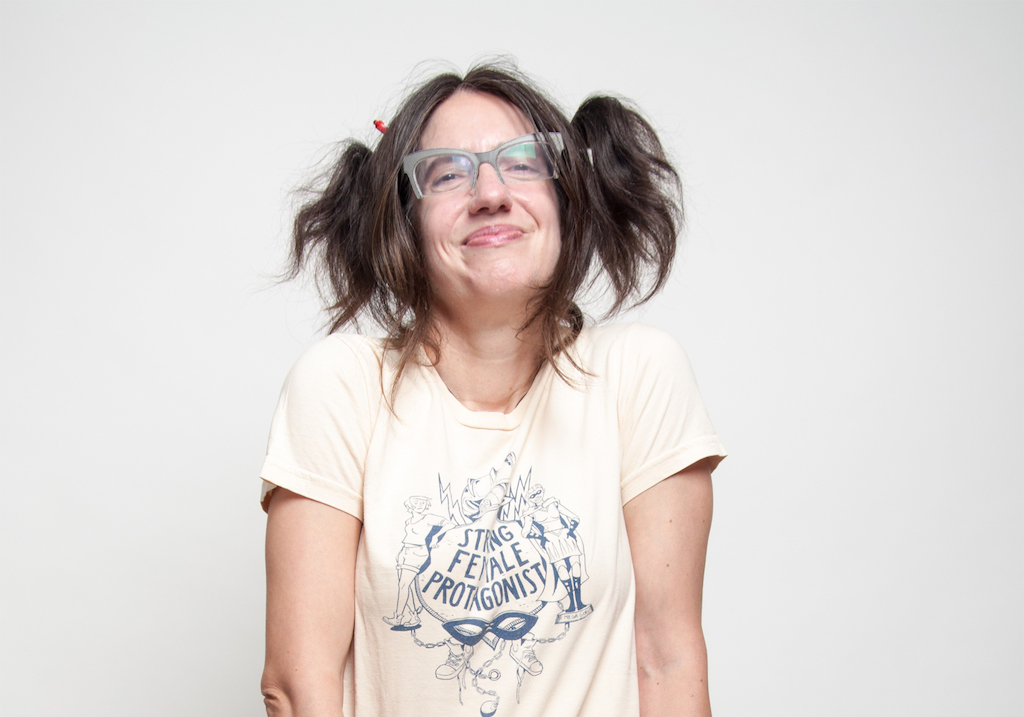
“I’m running between Tech and a few things, so I just want to make sure a little crazy right now,” playwright Crystal Skillman tells Theater Mirror. “But hey, I love crazy.”
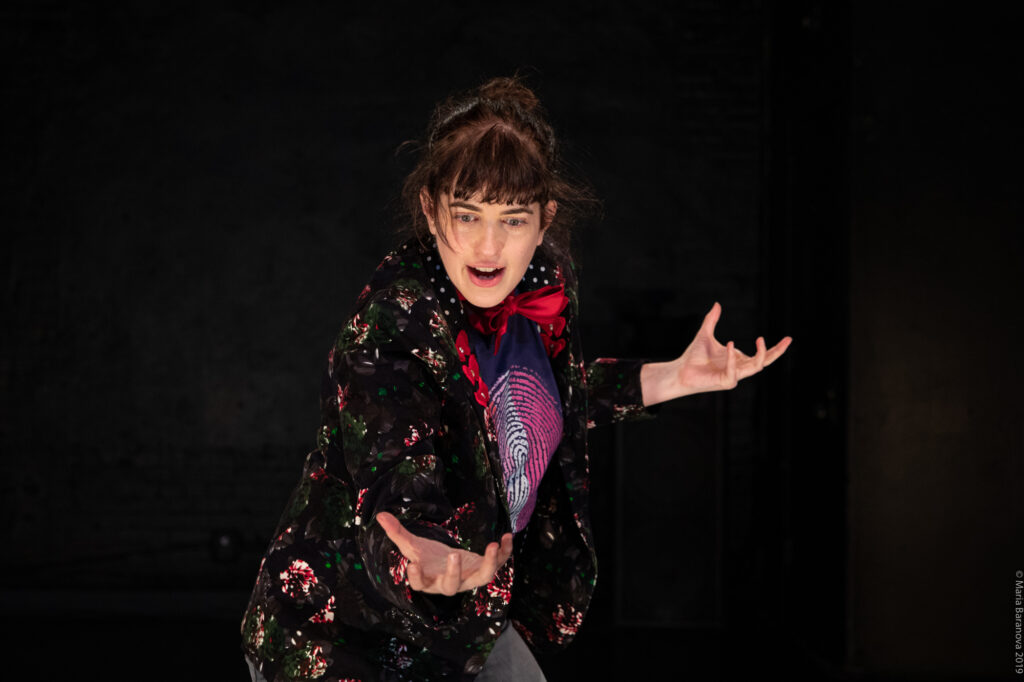
That comes through in Skillman’s powerful, moving play “Open,” a solo show that ran Off-Broadway July 12-27 at WP Theater in New York City.
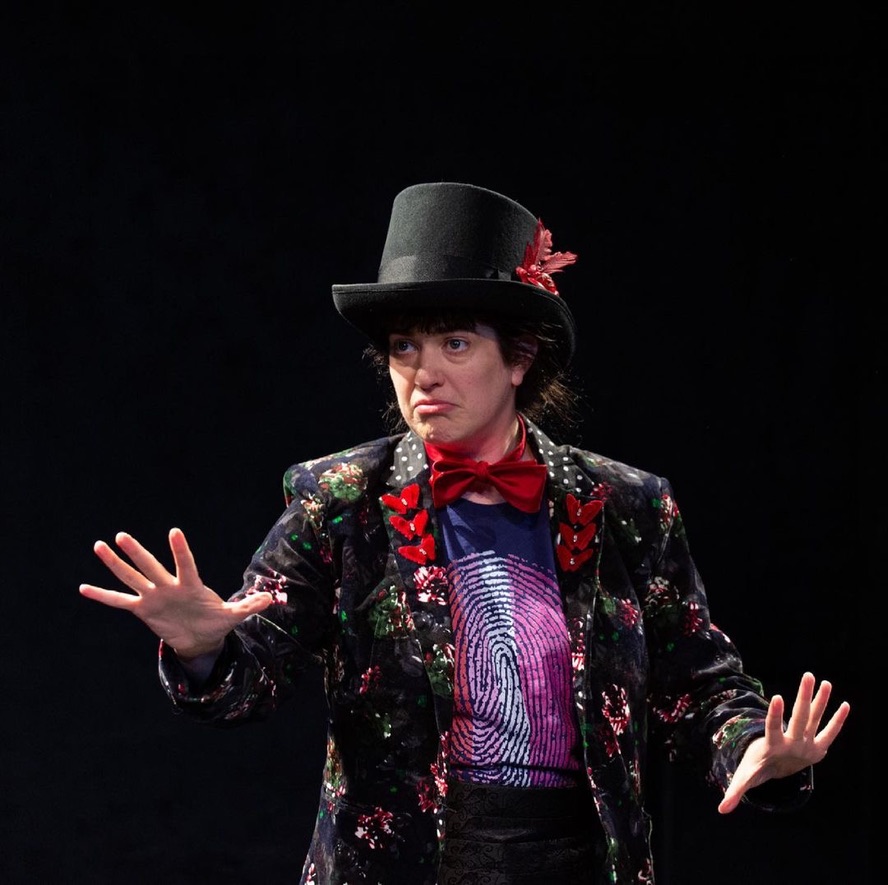
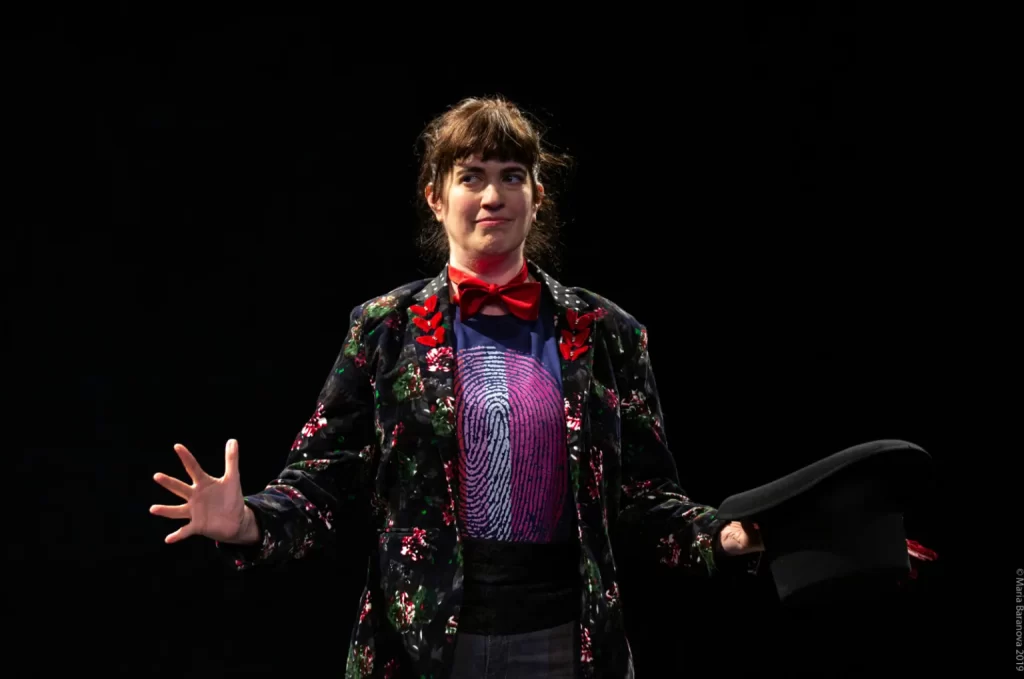
The play is intended to be produced with no set, no props… nothing, in fact, but some evocative lighting, some precise sound effects work, and a performer that can live up the sleights-of-hand that Skillman has invested in her script about a magician and the story she tells: A story of love, tragedy, and transformation.
The Magician — in the play her name is revealed to be Kristen, and Skillman refers to her that way throughout the interview — is a writer whose books “The Magic of Magic – A History of Magic!” is about to be published when she meets Jenny. A romance blossoms, becoming more tender and less tentative beat by beat. Jenny’s parents are only haltingly accepting, but they make an effort. We get to know The Magician’s family only indirectly, through anecdotes and generational legends, but there are profound emotional undercurrents sketched out there all the same. The setting is New York — a magical city in its own right, though one with a dark side — and the 2016 election provides a secondary backdrop to a world where the light of kindness and compassion seems to be fading and harder, more sinister and shadowy forces rising. When those dark forces strike, it threatens to shatter the lives of The Magician, Jenny, and Jenny’s family. In a desperate, intense monologue, The Magician interrogates the possibility that miracles truly can happen, and what it takes to manifest them. “Sometimes,” she tells us, “the only magic that we have is hope.” It’s a message that resounds today as never before.
Theater Mirror caught up with Crystal Skillman to learn more about the play’s many layers, the spell it casts on audiences here and abroad, and the transformational power of hope, love, and faith… or, if you like, magic.
Theater Mirror: I like the way that your play uses magic as a metaphor for the profoundly transformative power of love and commitment.
Crystal Skillman: I think it’s so much about safety and love. New York City is almost another character in the play. Kristen, who’s created this alter ego [of The Magician], is a writer. She’s moved from Indianapolis, she has come to New York and lives in the city and is starting to open up in a whole new way, especially as the relationship with Jenny grows. Part of that is her belief in the the beauty of the city; she takes solace at The Strand bookstore. It’s a real New York story, so when the city betrays her, in a sense, that becomes another factor.
The [recently surging] aggressiveness against the LGBTQIA community is enormous and becomes another factor in the play. When the play has been staged in other places, this also comes up; I’ve seen this make a lot of sense to people in Rome, where they immediately said it connected for them [in terms of] mafioso culture where, when you’re young, and male, you’re drawn into those communities where a lot of violence is against women and against the queer community and trans community. They actually made that connection. They were dealing with the rise of fascism when I was over there in 2022, and we seem to be surpassing, them [as far as that goes], in my opinion,
Theater Mirror: If we extend that metaphor of magic to the malice and viciousness directed at the queer community these days, what does that metaphor become? Is that black magic?
Crystal Skillman: [The black magic] is really the fact that faith in your fellow human is broken. The possibility that the magician may not have the agency to help her partner is part of the tension of the play.
I was commissioned to develop [“Open”] as an audio series, but I’m thinking of expanding to television. I’ve written the first season, and in that it is revealed that the book that she wrote, “The Magician’s Magician,” is dedicated to Jenny. Magicians have gotten ahold of it, and they believe that Kristen is a scribe for a new kind of magician. She’s being pressured to become a part of a group that’s, like, “Do no harm,” and another group who would consider using black magic for justice. What you just said is actually kind of the arc of the television series.
Theater Mirror: It must have been great to be able to revisit the material on a broader canvas, imagining it as a TV series.
Crystal Skillman: The idea the universe of “Open” is so strong. I think my universes are strong because I also write comics. Hopefully, I can keep building it out. I could also make “Open” into a graphic novel series; that’s something to think about.
Theater Mirror: Despite there being no props or set, there’s such a strong visual sense at work in “Open” through the language, as well as The Magician’s theatrical gestures that you describe in the script. Did your comics background contribute to that visual sense?
Crystal Skillman: That definitely goes with my history. I was doing theater since I was young. I liked theater, and it spoke to me, but I knew I wasn’t an actor. At the same time, I realized I was a very strong visual artist. So, I started at the Hartford art school in Connecticut, studying photography and multimedia and foundations art. And then I transferred to Parsons School of Design, where I did an additional four years. And then I began to expand into writing and poetry, but I am a visual artist first.
Working on comic books really helped with my [storytelling] structure. Also, I didn’t have four years at a college where I was putting up performance art and then being produced right away. I was living in front of people. People were seeing me revise, people were seeing me work, and I’m happy and proud of that, because I am a strong teacher, as well. I think the most helpful thing in teaching is to show you the magic but then explain how the magic happens.
Theater Mirror: Another thing is how you make use of light, as when there’s a ball of light in the magician’s hand, or there’s a box of light that she retreats to. Is light a magical power in itself for you, or is it a metaphor for something else, like safety or memory?
Crystal Skillman: It’s probably based on positive and negative space, which I see very well, partly from my work and training, and the artists I love. I’ve always felt that in a story, kind of like yin and yang, what we don’t see defines what we do see, and what we do see defines what we don’t see.
I think of my own personal life; I know that there’s a light inside me, and I know that when you do good things that light grows, and you can feel it. There’s an aliveness in us that I think is beautiful. Often, when characters in my plays are in a dark place, the light goes out because that’s what I think I see when someone’s really suffering — that the light is gone. It’s, like, a soul thing.
Theater Mirror: If the play were remounted or reimagined with Jenny, or Kristen, or both, as trans, do you think the play would need any rewriting?
Crystal Skillman: Probably not. One could be called for adjustments; we may want to lean into some of those nuances that are very specific, in terms of the threats that trans folks get. But I think it wouldn’t be very much.
I think that also speaks to the larger uniting [element in the play]: The first thing that those who are evil try to do is divide us. We see each other’s differences, [and] that’s important. That’s our identities, and that’s what makes us who we are. The divide is what’s being pushed. The more people are othered, the more those that are evil can use and exploit that. So, I really wanted the play to be a community-oriented thing. Whenever anyone does the play, I’ve seen different kinds of talkbacks and community events around it.
The tone [of the play] is something I thought a lot about, because I know that if it’s a red state, if you’re wearing a MAGA hat, I can’t reach you. But there are people that are moderate, and there are people that think, “I love my niece or nephew. I don’t quite get it, but I love them.” This play can speak to people; this play can really change your mind, in the sense of, “Am I an ally? Did I help? Did I hurt?” Like, “What happens when I don’t speak up, what happens to my niece or nephew?”
“Open” ran July 12 – 27 at WP Theater, 2162 Broadway (at 76th Street) in New York City. For more information, go to www.opentheplay.com/