By Killian Melloy
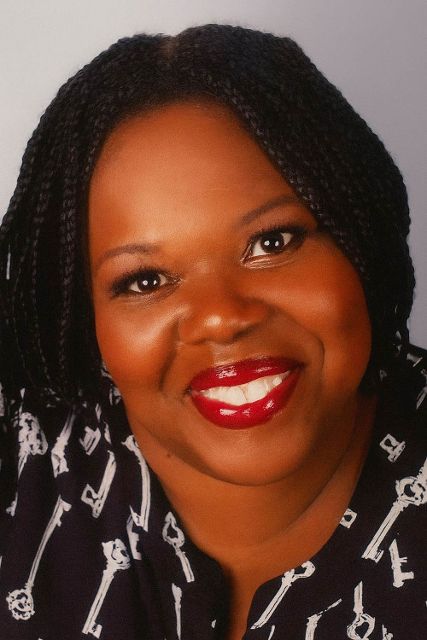
For 55 years, the National Center of Afro-American Artists’ (NCAAA) production of Langston Hughes’ “Black Nativity” has been a holiday tradition, a community gathering, and what some have called “Boston’s Black community’s holiday card to the world.” At the helm of this enduring celebration is Voncille Ross, Executive Producer and Director of NCAAA Black Nativity, whose connection to the production has endured nearly as long as the show itself.
Ross first stepped onto the stage at age 12 as a chorus member, having trained at the Elma Lewis School of Fine Arts since she was seven. Over the decades, she progressed from singer to stage manager to lighting designer, and finally — following the death of founder Elma Lewis — into her current role, which Lewis herself had asked her to fill. “She told me she didn’t expect the production to run past 50 years,” Ross recalls to Theater Mirror, “because everything must come to an end. Every curtain has a rise, and every curtain has a fall.”
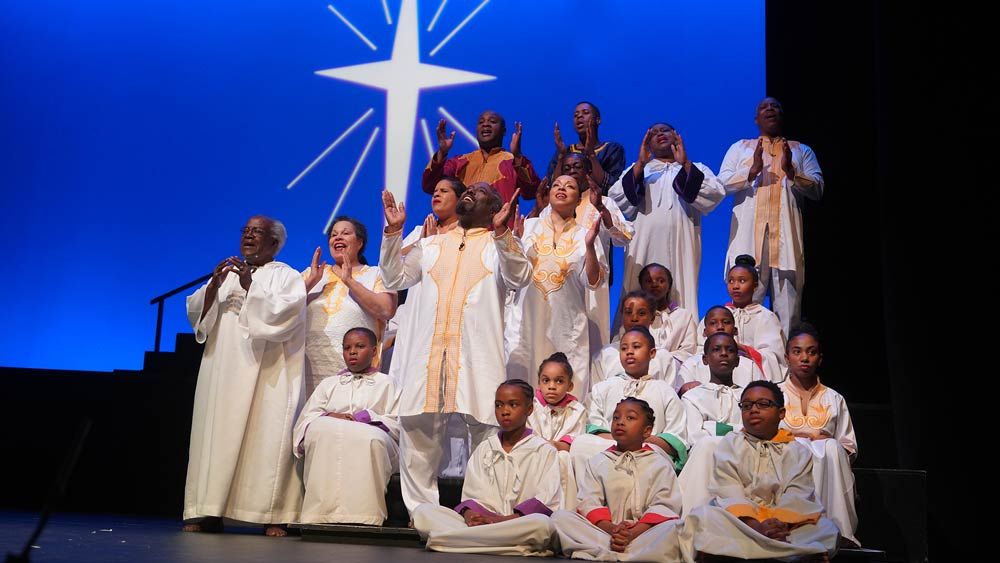
But here they are well past the half-century mark. The show remains vibrant, with a cast of 55 and a chorus more than 75 members strong on the stage at the Emerson Paramount Theater through Dec. 21. The production remains largely faithful to the vision Lewis and Hughes crafted together: A Gospel-infused musical celebration that crosses divides of time and society, bringing cast, chorus, and audiences together for 90 minutes of pure joy.
The show has evolved over the decades; the size of the cast has fluctuated as the production has moved from venue to venue over the years, and modern touches have crept in. “We now have AI,” Ross notes, “so we can do a lot of things with the background. If they’re wandering around at night on the street, you see a street or a desert. After the Christ child is born, the star appears. It just adds a lot of color, and it gives you a better vibe, a better feeling of the motion of the song, instead of just having a straight blue, or red, or white background.” What hasn’t changed is the production’s heart: A community coming together, people from all walks of life dedicating themselves to this annual labor of love.
Voncille Ross took time to chat with Theater Mirror about the show’s origins, its long and important place in Boston’s cultural landscape, and her own lifelong association with Black Nativity.
Kilian Melloy: Black Nativity has a book that was written by Langston Hughes. The play recounts the biblical story of the birth of Jesus but depicts Joseph and Mary searching for a room in a 20th-century American city. Why did Langston Hughes choose to set the story in a modern context?
Voncille Ross: Well, he wanted to bring the story back to life. This is an old story. I think he set this in an urban setting because that’s where he was, in New York.
Kilian Melloy: How does NCAAA interpret this update of the story?
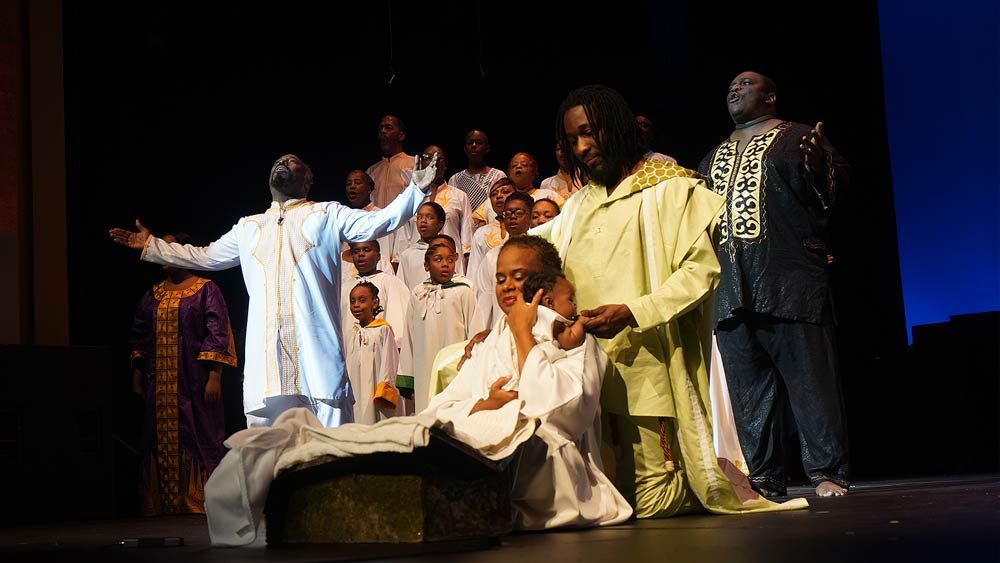
Voncille Ross: Actually, the playwright was a very good friend of the original music director. He asked him to set the music to this play. He saw the version on Broadway, and he asked him to bring a different spin, and our different spin to the original version of the play, Black Nativity, on Broadway was to add the children. Children stand on stage the entire time. And we have the birth of the baby, and it’s interpreted as if she is actually having the baby on the stage.
Much of the dialogue was actually Langston Hughes’ before he sat down and presented his play to Elma Lewis, who was the director and founder of the National Center of African American Artists, and together, this is what they came up with. They wanted the chorus to actually be the Pilgrim of the village, the Pilgrim being the town crier telling the news that the Christ child is born. It’s the African tradition of the village.
Kilian Melloy: Black Nativity will be produced for its 55th year in Boston, and it features a cast of 55. Has it always been such a large-scale production, or has it grown over the years?
Voncille Ross: Oh, this is actually slimmed down. The cast used to be huge. We used to have over 100 people just in the cast alone. It has scaled down a little bit.
Kilian Melloy: Was that huge cast made up of people who came from the community and wanted to be part of the occasion?
Voncille Ross: Yes. The dancer we have, he’s a professional dancer. Everybody else, they have other jobs. This is their passion. It’s unity that comes together, and that’s what we like to present to the children — that community, people of all types, jobs, they come together to put this on. We are the role model for the children to see that, when we work together, we see what we can do.
Kilian Melloy: Some might wonder about a take on the nativity story that features an all-Black cast, but isn’t it more honest to question a narrative that envisions a Nordic-looking Jesus when the historical figure was a person of color?
Voncille Ross: Black Nativity isn’t historically Black, it’s people of color. We’ve had people of all nationalities in the play. Mary and Joseph are of African American descent, so their child is also of African-American descent — or, he could be Latino. It depends on who lets us borrow their baby for a little while.
Kilian Melloy: There was a film version in 2013, adapted and directed by Casey Lemmons. Have you seen it?
Voncille Ross: Yes, I did.
Kilian Melloy: Did it do the play justice, do you think?
Voncille Ross: No, it does not.
Kilian Melloy: So, to get the real experience, we need to not be streaming a movie. We need to go to the Emerson Paramount.
Voncille Ross: Yes!
Kilian Melloy: This is obviously a long-running annual tradition, and it’s been called “Boston’s Black community’s holiday card to the world.” How does the show’s message end up being shared with the rest of the world?
Voncille Ross: We have people that come from Maine, New Hampshire, and beyond to see this production, and our gift is to get to do it. For those 90 minutes, we want to make you forget about all the troubles that you have in your life.
Kilian Melloy: I understand there have also been productions in Seattle over the last 10 years. Do they have their own take as well? Or do you coordinate in some way or collaborate on productions?
Voncille Ross: No, we don’t. I think there are several Black Nativities across the country, and I think they all have their little spin. They all have a basic story, but we all have different spins on how we tell it. It would be my joy to actually go see one of them live. I see something online, and people talk about what they do, and I would love to go see them, but it’s always the same time [that the work is being produced in various places].
Kilian Melloy: You’ve exceeded that 50-year mark that was predicted, and there’s no reason that the annual production of Black Nativity should come to an end anytime soon. What does the future hold?
Voncille Ross: We’re grooming the younger people. We’re getting old, so we’re grooming the younger people to step up and take over the leadership. There is a generation behind us that wants to do this.
“Black Nativity” continues through Dec. 21 at the Emerson Paramount Center. For more information, visit the Black Nativity website