Ebenezer Scrooge is the ultimate Christmas villain. Indeed, his name has become synonymous with unthinking greed paired with the sort of flinty hard-heartedness that denies joy to oneself as well as to others. His trademark exclamation of “Bah! Humbug!” has become a universal shorthand for dismissal of all things joyful and celebratory.
But redemption is possible even for Scrooge, and that’s the message of Charles Dickens’ 1843 novella A Christmas Carol. It’s unlikely that anyone reading this is unfamiliar with the story, but here’s a synopsis: It’s Christmas Eve, and the miserly Scrooge reluctantly gives his clerk, Bob Cratchit, the following day off work to celebrate a modest feast with his family. Poor Cratchit labors in a freezing office; his brood of children, which he and his wife sustain on his paltry wages, includes the sickly Tiny Tim. Scrooge has no interest in Cratchit beyond his quota of work, and certainly has no compassion for how Cratchit’s family suffers; indeed, Scrooge has little interest in familial matters of his own, spurning a Christmas dinner invitation from his nephew. But then the ghost of Scrooge’s seven-year-dead business partner, Marley, shows up to issue a warning to Scrooge to mend his ways. To drive the point home, three specters arrive in quick succession: The Ghost of Christmas Past reminds Scrooge of his hard youth, but also of happy days working for a kindly employer — a time in his life when Scrooge enjoyed the love of his fiancée. The Ghost of Christmas Present conducts Scrooge to two celebrations where, as an unseen guest, the miser witnesses the good cheer that takes place at his nephew’s home, but also sees the poverty that attends the Cratchit family’s joyful observance of the holiday. A terrifying third phantom, The Ghost of Christmas Future — accompanied by two wraiths straight out of a horror movie, ragged children called Ignorance and Want — wordlessly transports Scrooge to a terrifying Dec. 25 that’s yet to come: A day of reckoning when Scrooge will no longer be able to deny the way he has squandered his life.
It’s a resonant message. Famously, the novella’s original publication was on December 19, 1843, and its first printing had sold out by the time Christmas Eve, the setting of the story, rolled around a few days later. A dozen reprints followed before the holiday arrived again in 1844.
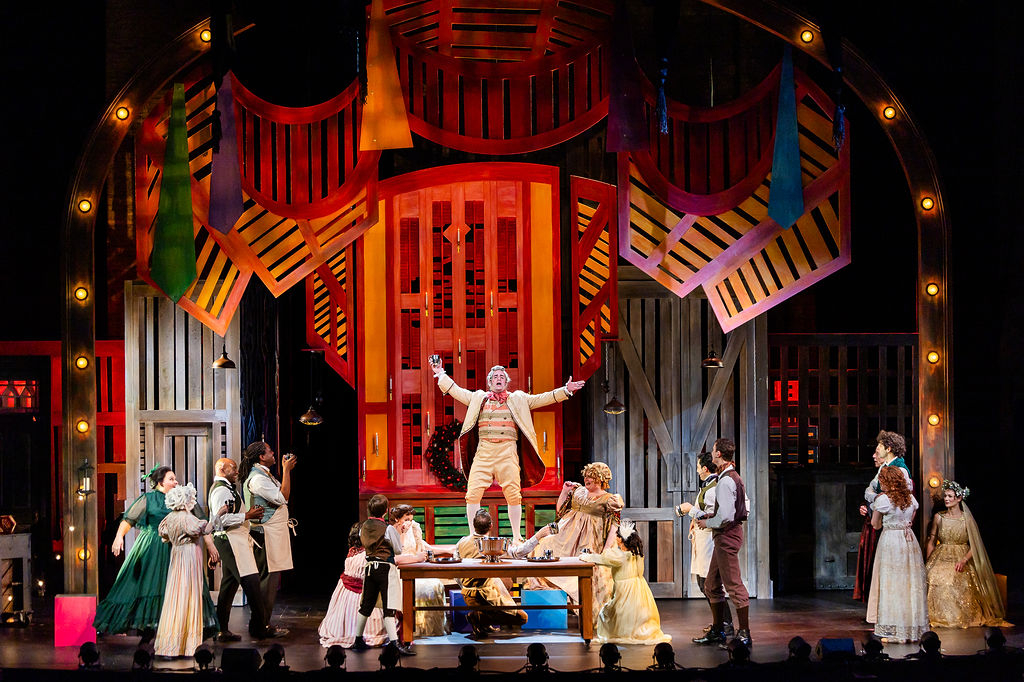
That momentum has never slowed. There are dozens of TV and stage adaptations, the first arriving only a couple of months after the story was first published. Among those adaptations are around a dozen musical versions, with playwright Steve Wargo’s adaptation standing out from the pack with its fidelity to the original novella’s style of language and its inclusion of period-appropriate Christmas songs, with arrangements by Dianne Adams McDowell.
The Commonwealth Shakespeare Company brings Wargo’s faithful adaptation to the stage for the second year running, with Boston theatrical luminary Will Lyman in the role of Scrooge and Founding Artistic Director Steve Maler at the reins. The play is running now through Dec. 22 at the Cutler Majestic Theater.
Lyman took some time for a Zoom interview, sporting Scrooge’s trademark muttonchop whiskers. Amicable, approachable, and ready with a joke, Lyman is the polar opposite of the character he’s playing — at least, prior to that character’s profound Yuletide transformation.
Kilian Melloy: It looks like you’ve got your Scrooge beard happening.
Will Lyman: We’re working on it. I don’t know if it’s gonna [be ready for the] show. I’ve got another week.
Kilian Melloy: It looks good over Zoom. There have been countless adaptations of A Christmas Carol, and about a dozen of those have been musical versions, but this one by Steve Wargo uses Christmas carols that would have been sung in Dickens’ time. Were there revelations for you among those Victorian songs?
Will Lyman: I don’t believe I had heard “Now Thrice Welcome Christmas.” I never heard the song at the end, “I Heard the Bells on Christmas Day.” I think the arrangements are phenomenal. [Dianne Adams McDowell] has woven together a number of pieces and interwoven the choruses and the verses of different pieces at the same time. It’s quite remarkable. Even the arrangements of the accompaniment are pretty phenomenal.
Kilian Melloy: You do a lot of voice work, including narrating for PBS’ Frontline, but how do you feel about being up on stage and singing? Are you disappointed Scrooge only gets one number?
Will Lyman: I can do it, but I’ve never put the work into it as a musician to consider myself a singer. I am not disappointed that Scrooge doesn’t sing more. It’s probably not particularly in character for him to sing until he does in this play, but it’s never been one of his interests, I’m sure.
Kilian Melloy: Thematically, time is very important to the story, which makes sense because a main theme is mortality. Is that reflected in the design work and direction of this production?
Will Lyman: I think it’s a very good point. [Time] is referred to [by] the church bells, which are performed by the piano. It’s very evident in the scene with Bob Cratchit when Scrooge finally says, “You can go home now, it’s five o’clock.” I think the workday ran a good deal longer in 1834, but we’re used to five o’clock, so we have here five bells. And it’s referred to at the at the end, with the fact that Scrooge discovers that everything has been done in a single night. Those are the two main references in our production, in terms of the theme being making good use of your time. I hope it comes through on some level, because certainly it is there.
Kilian Melloy: This is a favorite Christmas-time story, but between the ghosts and Scrooge being essentially scared straight, is it also fair to say it’s a horror story?
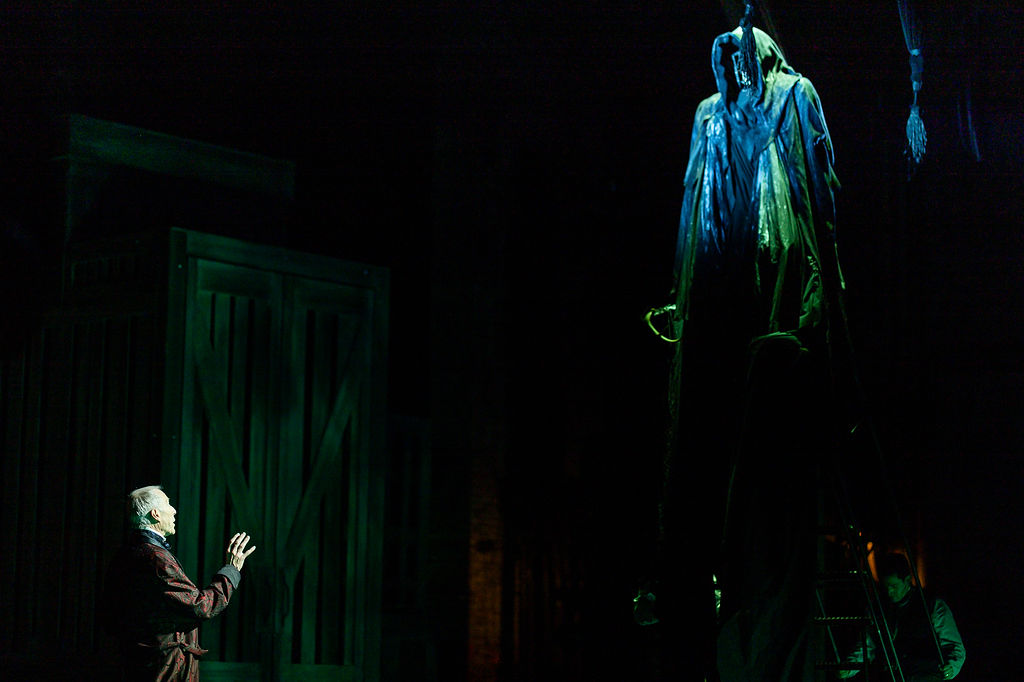
Will Lyman: The four-year-olds in our audience seem to think so from time to time.
[Laughter]
Will Lyman: I don’t think it’s a horror story, no. The ghost of Christmas Future, and Marley, depending on how Marley is played, are certainly scarier than Christmas Past and Christmas Present, who are quite benign and full of life and joy. There’s a range of choices available to the actor playing Marley as to just how scary he is.
Kilian Melloy: This story was published more than 180 years ago, and it remains so popular now. What’s your sense of why that is?
Will Lyman: I think it illustrates a seemingly ever-present struggle between [social responsibility and] self-centeredness. There’s a lot of discussion these days about the word “empathy.” We have a number of people talking about empathy being destructive, [which] leads to the lack of empathy [being] destructive. It leads to the disintegration of cultural society.
We are dependent on each other. We are dependent on the cohesion of our of our community, and those who believe that it is not essential lead us down a path of workhouses, feeling that unless you are ultimately a successful and rich person that you have in some way failed, that you have not lived up to your full potential — probably because you are lazy and would rather live off the beneficence of other people. We end up with governments that favor the successful. We don’t want to give money to poor people because they obviously aren’t doing their job, they aren’t pulling their weight, but we’re plenty willing to give money to rich people because they drive society.
I think that’s backwards. I think it’s relevant because some of us have our priorities completely backwards.
Kilian Melloy: This is the second year starring as Scrooge in Wargo’s musical version. Are you still discovering new things about him?
Will Lyman: Yes, very much. I think there was a lot left on the table. Last year, we had a rough start. We started late. Casting started late, the design started late. In fact, we didn’t have a full-run dress rehearsal before our first preview.
Kilian Melloy: How’s it going this year?
Will Lyman: We’re way ahead of last year. We’ve already had a couple of full runs in the rehearsal hall. The cast goes into the theater this evening for the first time. The crew, on the other hand, has been there for a couple of days now, so they’re way ahead of where they were last year. This year, we’ve had the opportunity to explore everything in more depth and more detail. It’s been a lot of fun.
Kilian Melloy: Do you have mental notes about how Scrooge got sucked into a mindset that greed is good?
Will Lyman: I think there are a number of factors involved. I think he had a very difficult childhood. In my book, his father was abusive and sent him away to a school that was in the process of falling apart during the years that he was there. When he was there as a small boy, and even into his teenage years, he was never taken home for Christmas. He spent Christmas time alone in the school [while] everybody [else] had gone home. He’d sit there and read books. When his sister comes to get him and says, “You’re coming home,” he goes, “How is that going to be a good idea?”
In my thinking, he went home and his father wasn’t any better. His father told his sister, “Oh, yeah, bring him home. He’ll start to be a man and [become] part of the business,” and he was miserable there. [The lesson that] the only way to survive in the world is to take care of himself is what he learned from his father. He didn’t expect anything from anybody else. Everybody else was the enemy. He just had to win.
Kilian Melloy: I don’t want to make this play sound like it’s a downer; actually, it’s quite celebratory.
Will Lyman: I think that’s the charm of it. That’s what keeps people almost addicted to it. Even last year, I ran into people who said, “You know, this is my favorite story of all time. I see this play every chance I get. I’d see it in July if I could!” It’s remarkable. When Stephen first discussed the possibility of doing this show, probably in March or April of 2024, I said, “But everybody does it, Steve. I mean, is there enough money to go around for all of these productions, and enough audience to go around?” He says, “Everybody makes money on it.” I said, “Is it possible that A Christmas Carol is the only play in the history of the world that consistently makes money?” We’re counting on a growing audience. We hope that our audience gets a little bigger each year.
Kilian Melloy: Let’s turn to the Ghost of Theater Future for a moment. What else have you got coming up that you’re looking forward to doing?
Will Lyman: I’ve kind of run into an age problem, or [maybe it’s] my lack of self-promotion, but I haven’t done anything since the last Christmas Carol. There have been a couple of films, but no theater. I take it as it comes.
As far as the Commonwealth Shakespeare Company is concerned, we’re doing A Midsummer Night’s Dream on the Common next year, the show that we began with in 1996. I think we did another production in 2008. And the CSC-2 company is doing Romeo & Juliet at the Strand Theater next May. So that’s what we’ve got.
“Charles Dickens’ A Christmas Carol” continues through Dec. 22 at the Cutler Majestic Theater. For tickets and more information, visit the Commonwealth Shakespeare Company website