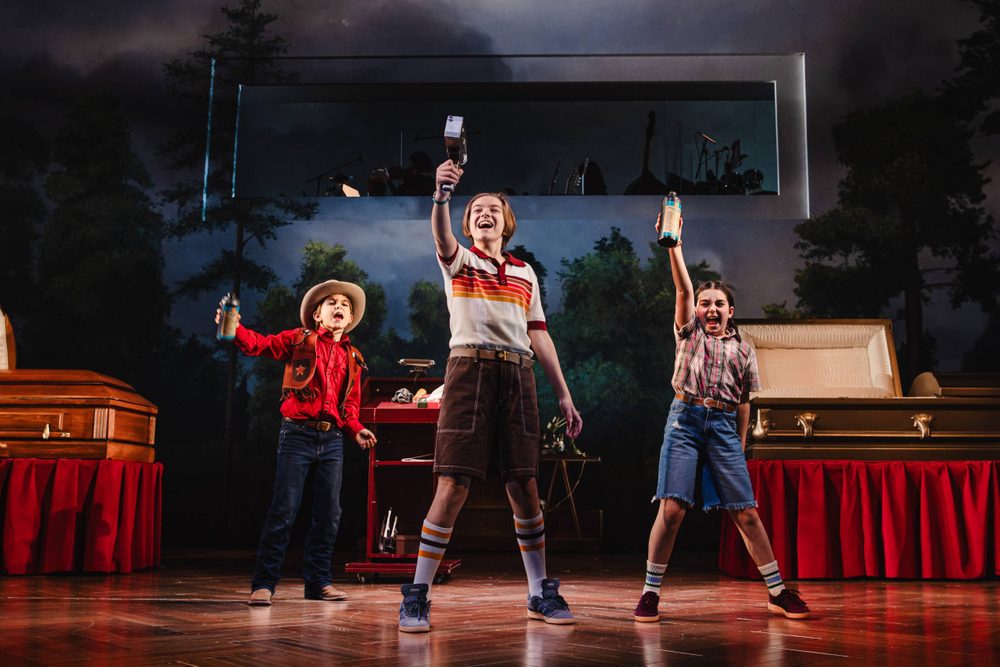
‘Fun Home’ — Music by Jeanine Tesori. Book and Lyrics by Lisa Kron. Based on the graphic novel by Alison Bechdel. Directed by Logan Ellis. At the Huntington Theatre, Huntington Ave., Boston through Dec. 14.
By Shelley A. Sackett
In less capable hands, the multiple Tony Award-winning Fun Home, at the Huntington through Dec. 14, could have been a disaster. Adapted from Alison Bechdel’s graphic novel memoir, the storyline follows a family’s journey through sexual orientation, gender roles, suicide, emotional abuse, grief, loss, and lesbian Bechdel’s complicated relationship with her tightly closeted father. To boot, the title refers to the family funeral parlor, where her father worked and she and her siblings played.
Doesn’t sound like the raw material for one of the year’s outstanding Boston area productions? Think again.
Jeanine Tesori, a two-time Tony Award recipient and two-time Pulitzer Prize finalist for drama, has created gorgeous, melodic music for Fun Home. Award-winning playwright and lyricist Lisa Kron hits all the right tones with a masterpiece of storytelling musical numbers overlayed with a balanced, nuanced script that manages to be funny, poignant, clever, wise, and heartbreaking. These two talented women breathe life into Bechdel’s memories, turning what might have been maudlin into a dense and complex story of one family’s journey as narrated by one of its travelers.
Add to the mix a stellar cast, meticulous direction (Logan Ellis), a sumptuous set (Tanya Orellana), effective lighting (Philip Rosenberg), and a superb orchestra (music direction by Jessie Rosso), and you have all the ingredients for one very special evening of theater.
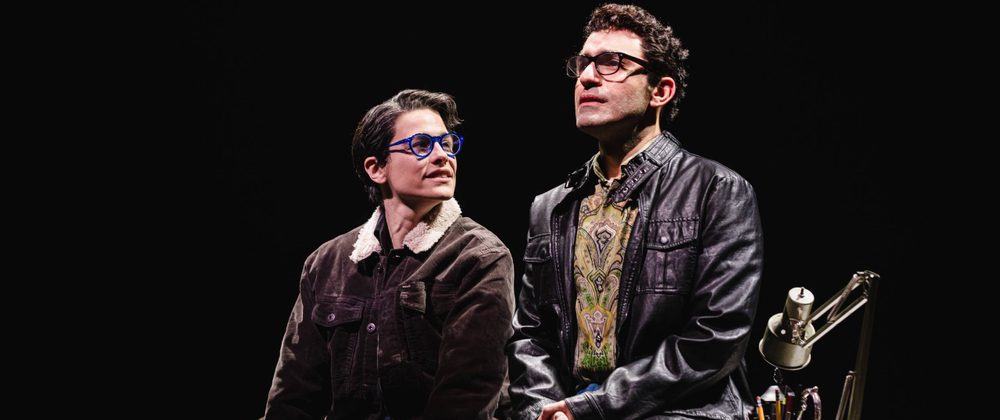
The play opens with Alison (Sarah Bockel), a 42-year-old successful cartoonist, center stage, huddled over her drafting table. She crumples one sheet of paper after another, throwing them onto the floor. She recalls two other periods in her life: one when she was 10 (Small Alison, played by the showstopping Lyla Randall) and another when she was a freshman at Oberlin College (Medium Alison, played by Maya Jacobson).
Suddenly, Small Alison’s head pops up out of the drafting table. Kron’s narrative lyrics both highlight Bockel and clue us in about her character. Alison is trying to make sense of her childhood and the larger-than-life role her father, Bruce (a knockout Nick Duckart), played in it. At the center is Alison’s joy at discovering she is a lesbian, her first year in college, and Bruce’s tortured and shamed existence as a closeted gay man living as an outwardly “normal,” heterosexual, family man. His suicide (he stepped in front of a truck) only elevated his importance in Alison’s pursuit of answers to the question, “What happened to us?” If she could only unlock the mysteries surrounding his life, perhaps she could understand those surrounding her own.
The problem is, she doesn’t trust her memory. She needs “real things,” both to draw and to rely on. She needs eyewitnesses. She needs Small and Medium Alisons. Told in a series of nonlinear vignettes connected by narration from the adult Alison character, the Bechdel family saga unfolds.
Her childhood in rural Pennsylvania was anchored by the ornate Victorian house her father obsessively and compulsively restores (two traits he also brings to his homosexuality and cruising). She and her siblings played games, including performing an imaginary advertisement for the family funeral home (Randall, as Small Alison, brings down the house in the hysterical and arresting Jackson Five-style “Come to the Fun Home”). Juxtaposed with Partridge Family scenes are their opposites. Bruce, for example, invites Roy, a young man whom he has hired to do yard work, into the house and begins to seduce him in the library while his wife, Helen (the gifted Jennifer Ellis), plays the piano upstairs, trying her best to ignore it (“Helen’s Etude”).

Medium Alison (Jacobson is terrific) enacts Alison’s memories of her first lesbian affair with Joan (Sushma Saha) and gushes with delirious post-sexual froth that she is “changing my major to Joan.” She shares that news with her parents and is forever haunted by suspicions that her coming out led to her father’s death. “I leapt out of the closet — and four months later my father killed himself by stepping in front of a truck,” the overhead caption reads.
Many of the musical numbers are more than plot devices; they are emotional powder kegs and stand-alone gems. “Telephone Wire” documents the moment where Alison and her dad try to get into a gay bar but end up defeated, even when she is carded. The tragedy of the missed opportunity for connection, and of the unspoken yearning and loss both feel but can’t acknowledge, is heartbreaking. In “Ring of Keys,” Small Alison (Randall) again brings down the house as a tiny girl transfixed by a butch delivery woman whose uniform and ring of keys open up doors she didn’t even know were locked.
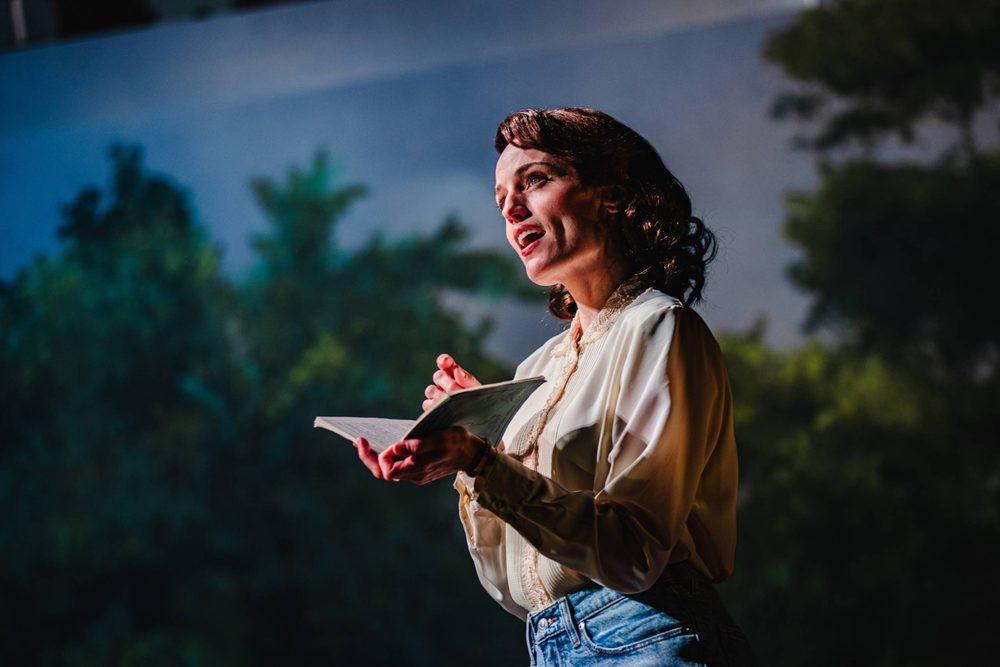
“Days and Days,” Helen’s cri de Coeur, stands out as a vehicle for Ellis’ prodigious vocal power and a showcase for Kron’s Tony-nominated lyrics. As Bruce’s long-suffering wife, humiliated and abused by the homosexual husband she just as fiercely protects and stands by, Helen admits to Alison that she has sacrificed her life to keep the family together. She wants better for her daughter and warns her not to follow in her mother’s footsteps. “I didn’t raise you to give away your days like me,” she says introspectively.
Fun Home is as complicated as it is simple. It is about a family, its underlying anguish, and the balance between fitting in and being true to oneself. Honest, moving and hilarious, the play never becomes mawkish or angry (though it has every reason to). Each character stands upright, for better and worse, owning their authentic selves.
In the finale, Alison finally realizes the moment when she felt a perfect balance in her life: when her 10-year-old self and her father played “Airplane.” In “Flying Away,” Small Alison duets with her two older selves, a melding at last of past and present that paves a clearer way to the future. The caption above them reads, “Every so often, there was a rare moment of perfect balance when I soared above him.” There wasn’t a dry eye in the house.
Highly recommended.
For more information, visit https://www.huntingtontheatre.org.