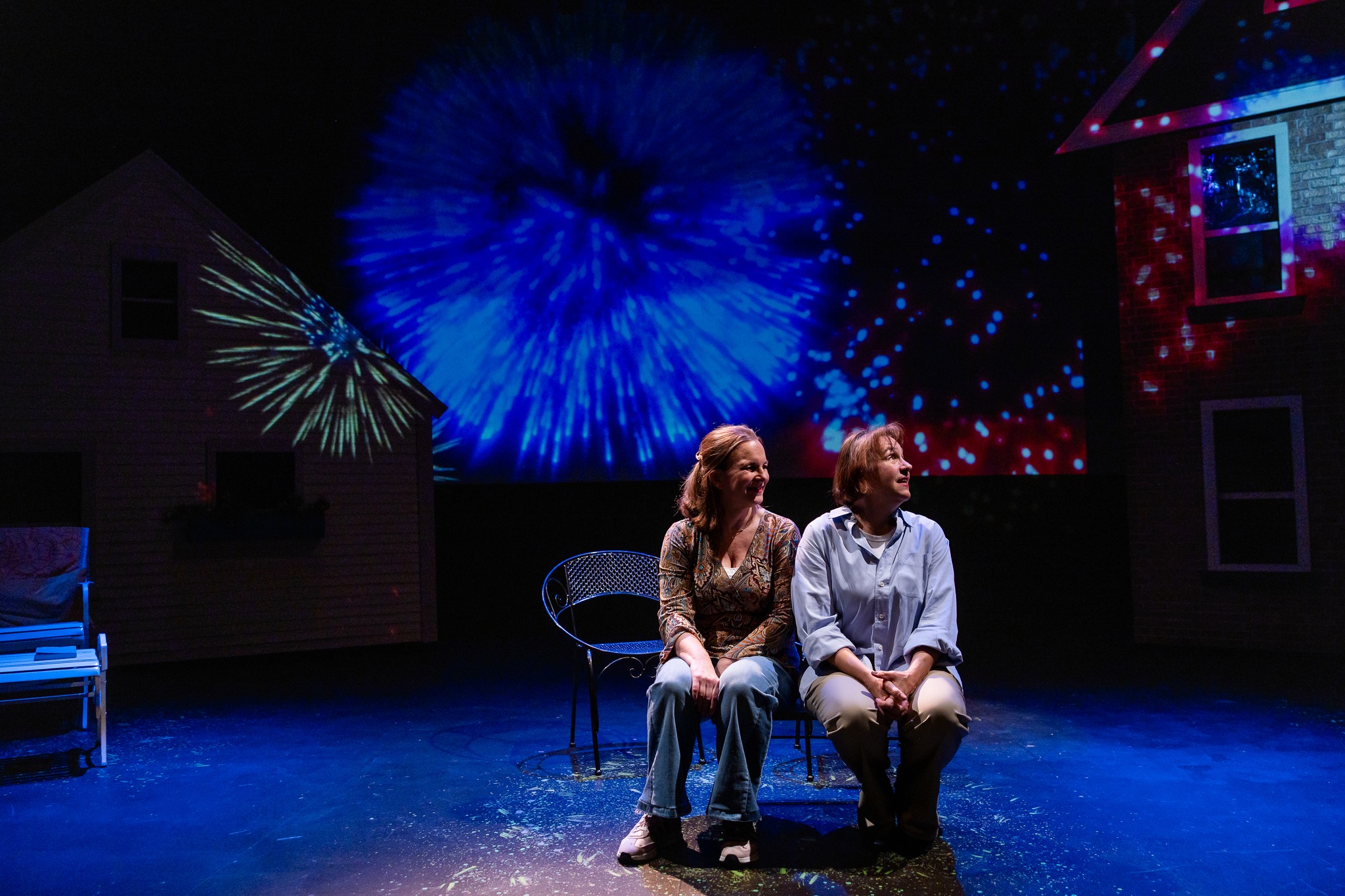
‘Summer, 1976’ − Written by David Auburn; Directed by Paula Plum; Assistant directed by Ulrika Brand; Scenic Design by Kristin Leoffler; Lighting Design by Deb Sullivan; Costume Design by Sydney Hovasse; Prop Design by Lauren Corcuera; Sound Design by Aubrey Dube; Projection Design by Justin LaHue; Stage Managed by Charles Waite Clay. Presented by Central Square Theater (CST) at 450 Massachusetts Avenue in Cambridge, MA, through November 30, 2025.
Julie-Anne Whitney
We’ve all had friendships that have petered out, some naturally and others painfully. Most of us have had moments of looking back, of longing for what was, of mourning what might have been.
In David Auburn’s Summer, 1976, two women, Diana (Lee Mikeska Gardner) and Alice (Laura Latreille), narrate their own – and each other’s – stories in a thoughtful retrospective about an unlikely friendship that fades over time. Auburn’s memory play traverses nearly 30 years of the women’s lives, from their time in Columbus when they were “forced” into friendship through their young daughters, to an unexpected meeting in Manhattan 27 years later. The play follows Diana and Alice as they recall the challenges, surprises, gifts, and pains of a friendship they both needed but failed to maintain.
Kristin Leoffler’s simple but smart scenic design shows you who the women are before you even meet them. On stage left, you see Diana’s house: a dark, unwelcoming, two-story structure built with hard, reliable brick. On stage right is Alice’s house: a plain, yellow building with chipped paint and a friendly window box full of flowers. At center stage is a small outdoor table with two matching chairs, quietly waiting to bring the characters together.

It seems, at first, that the two women couldn’t be more different. Diana is a single mother, a professor, and a painter with “family money,” while Alice is an unhappily married stay-at-home mom who reads “depressingly middlebrow” novels and is struggling financially. Though their initial perspectives of each other are full of narrow-sighted judgments, the two women eventually find common ground and learn to see the good in one another.
Like many friendships, theirs had a rocky start. Alice even declares that she “sort of immediately hated” Diana. But when she wisely tells the audience, “people aren’t just one thing,” you realize that neither woman is who they first appear to be. Diana initially comes across as controlling and uptight, but you later learn that she’s also deeply lonely and plagued by perfectionism. Alice seems like an easy-going free spirit, but she eventually reveals her social insecurities and intellectual depth.
Laura Latreille brings an easy playfulness and warmth to Alice’s laissez-faire nature, and Lee Mikeska Gardner brings a straightforward, clear-eyed maturity to the role of Diana. The two actors have an ease together that suggests they might be real friends, which helps solidify their characters’ relationship on stage. In her CST directorial debut, Paula Plum’s tactfully restrained direction allows the play to stand in its sincerity and relatability.

The simplicity of Summer, 1976 makes it easy to minimize its value. Like most women we know, Diana and Alice are deeply flawed, laden with loneliness, and longing for more. And, like most women, they are more interesting and capable than they give themselves credit for. This is not a new story, but it is, sadly, one we need to be reminded of. In producing this play, Central Square Theater, a company created and managed by women, is reminding us that women’s stories are worthy of our time. In amplifying a play about female friendship, they are inviting us to reflect on our own friendships and, perhaps more importantly, on the women in our lives – on all the things they deserve as individuals and the many, many things they give up for others.
For more information and tickets, go to: https://www.centralsquaretheater.org/