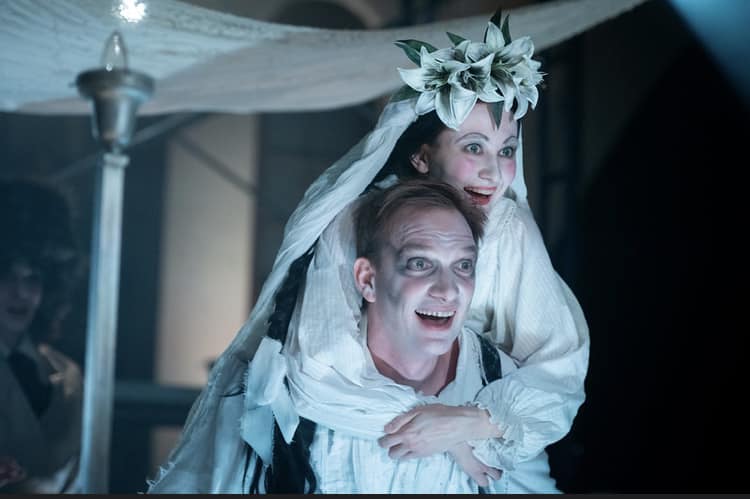
‘The Dybbuk’ – Based on the play by S. Ansky. Written by Roy Chen. Additional Material by Joachim Neugroschel. Adapted by Igor Golyak and Dr. Rachel Marrill Moss. Directed and Scenic Design by Igor Golyak. Stage Management from Madison Perez. Lighting Design by Jeff Adlberg. Costume and Prop Design by Sasha Ageeva. Composition and Sound Design by Fedor Zhuravlev. Arlekin’s ‘The Dybbuk’ runs from October 30th – September 16th at The Vilna Shul.
By Charlotte Snow
What are we willing to risk for love? Perhaps it’s a job, a home, a previous relationship, or a lifestyle. Or, for the most ardent of lovers, perhaps we’re more than willing to risk our lives? In Arlekin’s The Dybbuk, a love story that spans the realm of the living and the dead, it uplifts and challenges the notion of ‘til death do us part.’
Arlekin, based in the suburbs of Needham, is a theatre company founded by immigrants from the former Soviet Union, who are driven to create and reimagine Russian theatre, with performances presented in English, Russian, or a combination of both. This production of ‘The Dybbuk’ is a remounting of the 2024 production, which garnered a pair of Elliot Norton awards.
An aspect that differentiates this play from Arlekin’s previous offerings is that the performance venue is the second floor of the Vilna Shul synagogue. The site-specific performance evokes a sense of reverence and solemnity.
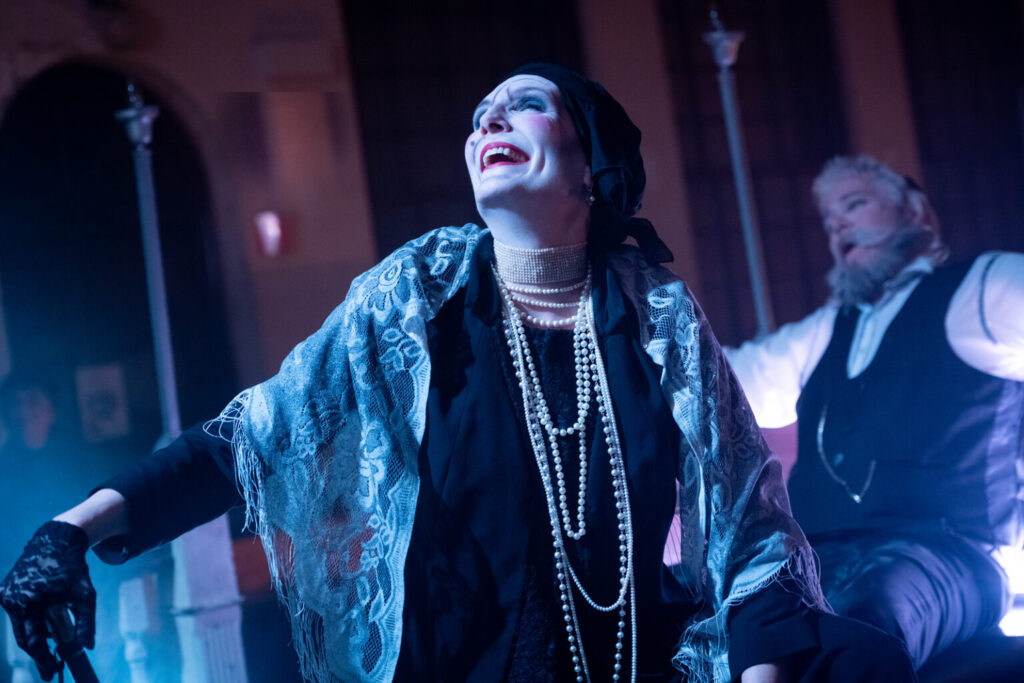
The story, originally based on a turn-of-the-century play by S. Ansky, is a surprisingly tender love story between a ghost and the young woman he possesses. A stuttering young man named Khonen (Andrey Burkovskiy) is in love with his childhood best friend, Leah (Yana Gladkikh). Unfortunately for Khonen, after asking Leah’s father for permission to marry her and getting rejected, he accidentally falls off the top of a large building. In death, he reconnects with Leah shortly before she marries a different man, and she willingly allows him to possess her.
Burkovsky and Gladkikh deliver tour de force performances as the star-crossed lovers. They are equally skilled at committing to the gentler and quieter moments as well as the louder comedic and more theatrical ones. Their chemistry drives the entire story, ensuring that the audience roots for them and their love. Rounding out the talented cast is Robert Walsh as Sender, the well-intentioned but controlling father of Leah, Deb Martin as Leah’s affectionate if not disarming grandmother, Frade, and Anna Furman as Kahne, Leah’s mother, who resides in the land of the dead with a grounded, wistful yearning. The entire cast, under Golyak’s imaginative and unwavering direction, functions as a cohesive ensemble, recounting this story with unabashed vigor.
One of the greatest strengths of the production is the design, which feels indistinguishable from the story. Jeff Adlberg’s lighting, Igor Golyak’s set, Sasha Ageeva’s props and costumes, and Fedor Zhuravlev’s composition are inextricable from the onstage action. The final effect is as delicious as it was playfully foreboding. The set design by Golyak himself is especially breathtaking and creates a playground for the actors that consists of two climbable structures (a three-story tall scaffold stands closest to the doors, and another one, two stories tall, located beside the bimah).
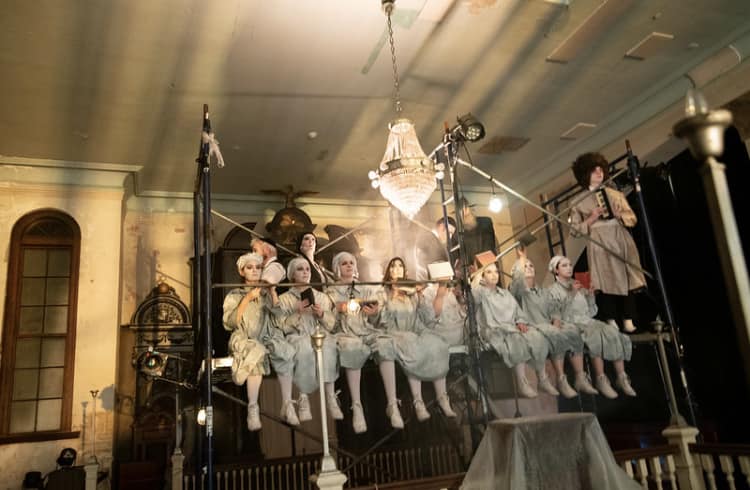
The only thing that took me out of the play was when the actors climbed up the side of the three-story structure, which caused the set to shake and wobble. It never appeared unstable or unsafe, and a little bit of movement is understandable, but it was jostling, nonetheless (physically for the actors and emotionally for the audience). Perhaps the scaffolding could be better secured to reduce anxiety levels for both parties.
The Dybbuk is an extraordinary sensation. I cannot urge people enough to catch this play before it fades into memory. For more information and tickets, go to: https://www.arlekinplayers.com