By Shelley A. Sackett
Ask a Jewish audience what their first reaction is when they think about Shakespeare’s “The Merchant of Venice,” and chances are they will mention the negative portrayal of Jews by the Venetian moneylender and play’s principal villain, Shylock. Long considered a slur against Jews, the very term was condemned by the Anti-Defamation League as antisemitic as recently as last July, when Trump described bankers as “shylocks and bad people” during a rally in Iowa.
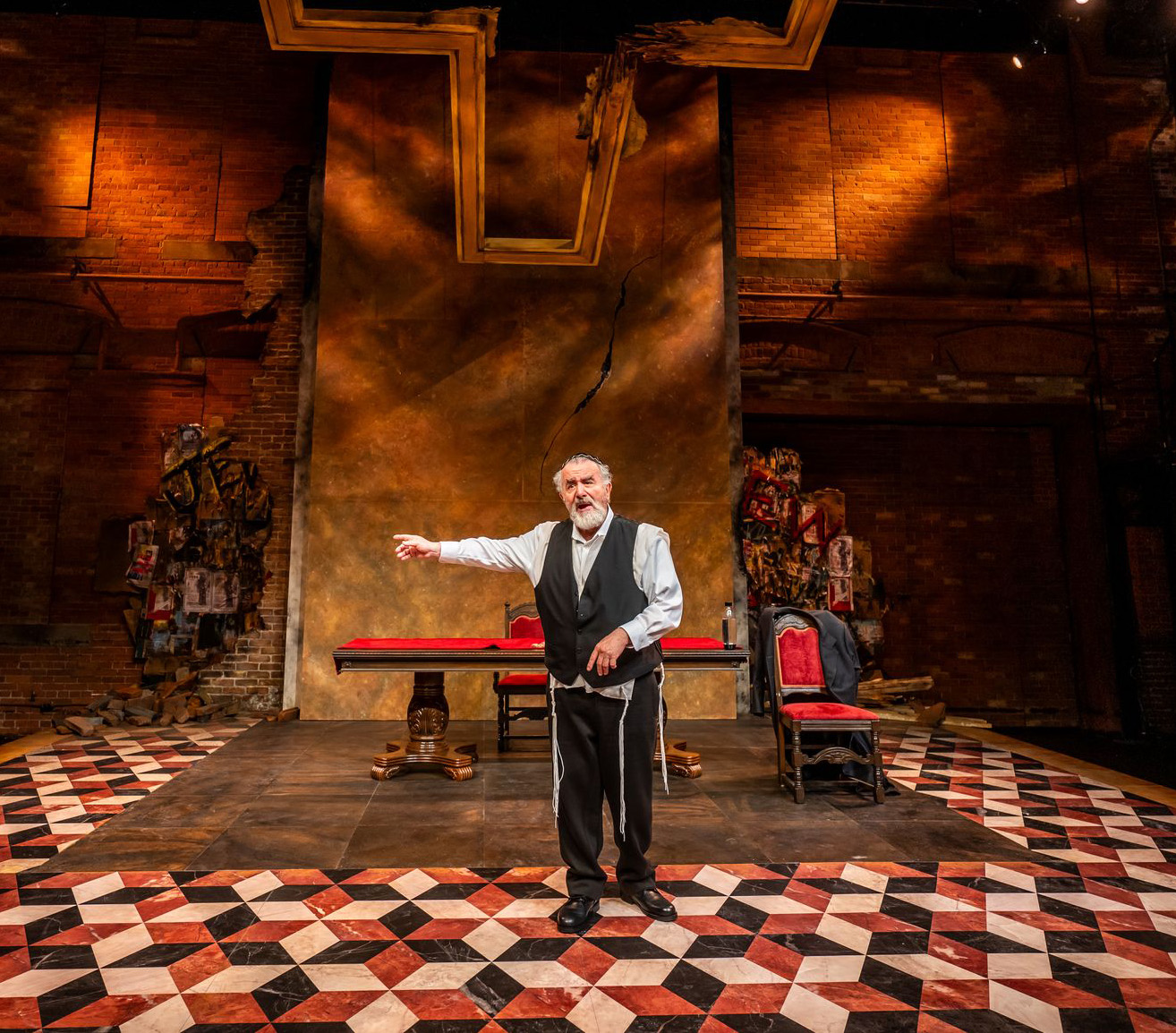
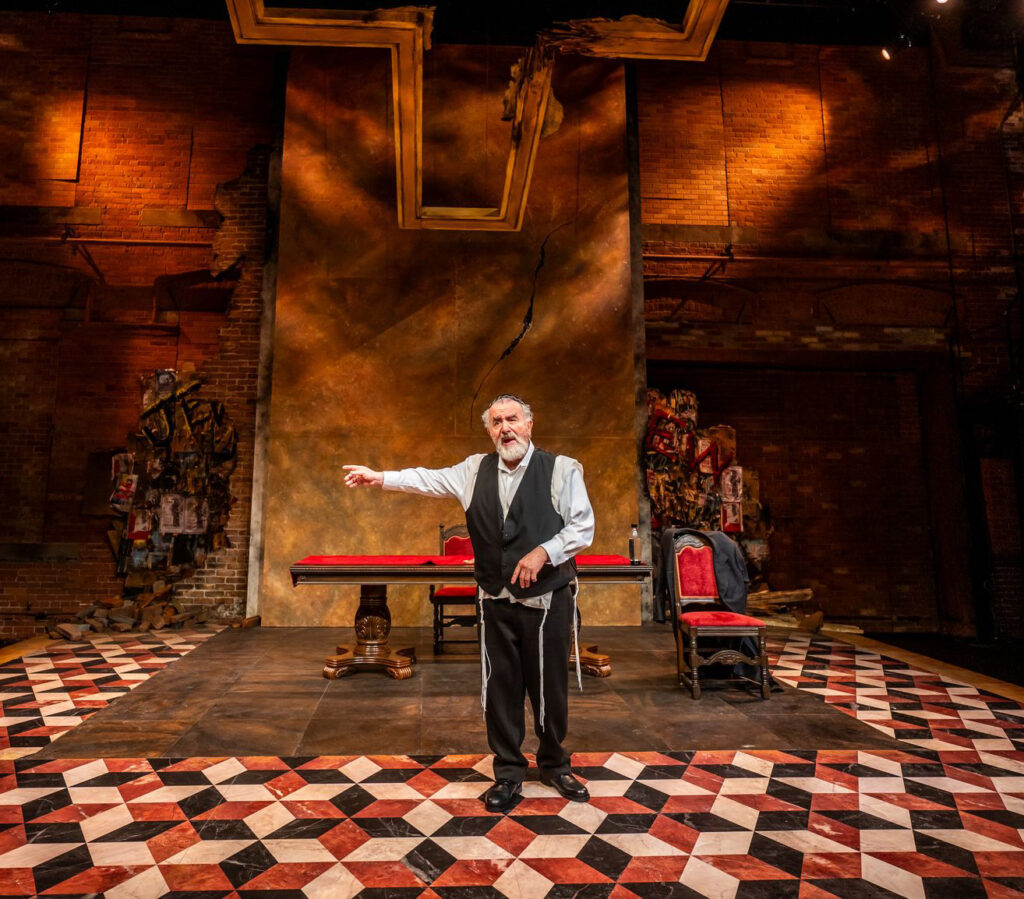
Saul Rubinek flips that ingrained stereotype on its head in “Playing Shylock,” the provocative and powerful solo play he stars in and helped develop with playwright Mark Leiren-Young and director Martin Kinch. The play premieres in New York at Polonsky Shakespeare Center and runs through Dec. 7.
Rubinek plays a fictionalized version of himself. The actor is forced to stop “The Merchant of Venice” because his portrayal of Shylock – as Rubinek, a Jewish man – has angered members of the Jewish community, who have successfully petitioned for the production to be shuttered because it “endangers the well-being of some in our community.”
During the play, Rubinek uses the show’s cancellation as a launching pad from which to engage the audience on thorny issues like antisemitism, institutional self-censorship and cultural appropriation, and stereotyping. He challenges the audience to wrestle with whether the theater might be right to consider the current climate of antisemitism or whether it’s more dangerous to censor a play than to stage it.
“Isn’t Shylock part of the history of antisemitism? The most famous Jewish character in theater? And isn’t it important to own it, talk about it and show it?” Rubinek rhetorically asked the Journal over Zoom from his California home. Contrary to popular perception, he posits that “Shylock is not a caricature. He is the first three-dimensional Jew in the history of English literature.”
He details how in 1595, when Shakespeare’s play was first produced, there had been no Jews in England in the 300 years since King Edward I issued the Edict of Expulsion in 1290 (ironically on Tisha B’Av). Jews were portrayed as clowns, puppets with horns, or a devil in religious pageants. Audiences threw figs and oyster shells at them. “They were used to thinking of Jews as not being people because they had never actually met one,” Rubinek said.
Christopher Marlowe’s “The Jew of Malta,” first produced in 1592 (three years before Shakespeare), “sold tickets like Taylor Swift” and was the first antisemitic play where a Jew was played by a living actor. Its Jewish character was a one-dimensional Machiavellian villain. Shakespeare, on the other hand, was the first playwright to humanize his Jewish character.
Although Shylock only appears in five scenes, the character and his lines are synonymous with the play, even though he is not the star (the Italian Antonio is the eponymous merchant) and is deemed vile for demanding the pound of flesh he is owed on a defaulted loan.
Rubinek points to Shylock’s most famous speech: “Hath not a Jew eyes? Hath not a Jew hands, organs, dimensions, senses, affections, passions? Fed with the same food, hurt with the same weapons, subject to the same diseases, healed by the same means, warmed and cooled by the same winter and summer, as a Christian is? … And if you wrong us, shall we not revenge? If we are like you in the rest, we will resemble you in that … The villainy you teach me, I will execute, … but I will better the instruction.”
“The point of that speech,” he said, “is not a plea for humanity;” rather, it is a declaration of a right. “We are human, just like a Christian. And if we are like you in other ways, are we not like you in villainy? Whatever you do to me, I will do back to you tenfold. That is what the character is about. That is what the speech is about. And that is why it’s ageless and relevant.”
In other words, according to Rubinek, Shylock is telling his Christian audience, “If you don’t like what you see in me, look in the mirror to see where it comes from.”
The 77-year old actor, best known for television (“Frasier,” “Billions,” “Mrs. Maisel,” “Schitt’s Creek,” “Hunters”) and films (“Unforgiven,” “True Romance,” “The Battle of Buster Scruggs” and over 60 other features), co-founded and was actor/writer/director at the Toronto Free Theatre (now Canadian Stage). He has continued his work in theater in Canada, the U.S. and Europe.
Rubinek’s love for the theater and storytelling is deeply rooted in his heritage. His parents survived the Holocaust by hiding in a Polish farmhouse for 2 1/2 years. (In 1986, he took his parents back to Poland for a reunion with these farmers and created a book, play and documentary film about the experience). He was born in a refugee camp in Germany after World War II. His father, who was a Yiddish theater actor before the war in Lodz, ran a Yiddish repertory company in Germany before the family immigrated to Canada when Rubinek was 9 months old. He spoke Yiddish and French before learning English, and at age 8 started acting in English on the stage.
Though he attended Talmud Torah and Jewish summer camp and grew up in a world of Talmudic discussion, his Jewish upbringing was secular. “I have never been fond of any organized religion, but I love the Jewish traditions. They matter to me on a deep level even though I don’t go to synagogue,” he shared. He, his wife and his children, who are half Scottish/English, celebrate the Jewish holidays and participate in, for example, tashlich. “I grew up without any grandparents, but with these rituals. They are very meaningful to me,” he added.
Rubinek recalled that his father always wanted to portray Shylock on the stage, but “Hitler stopped him. I always wanted to play my father playing Shylock in his heavy Jewish accent,” he said. One of the play’s most moving scenes is when the Rubinek character, clad in traditional Hassidic garb and channeling his father, recites Shylock’s famous “Does a Jew not bleed?” speech in Yiddish.
In the play (and during this interview), Rubinek tells the story of his 16-year-old father confronted by his father (Rubinek’s Zayde) after he had cut off his payos (sidelocks) so he could continue in the Lodz Yiddish theater he so loved. “My Zayde asked, ‘How could you go so far away from God? How can you betray your family, your people, like this?”’ Rubinek said.
His father explained that he was doing a Yiddish play by a great writer about a Jewish family and their hopes for their children. Rubinek continued, “My father said to his father, ‘Theater – if it’s good – the audience sees themselves on the stage. They laugh. They cry. And for a few minutes each night, they don’t feel so alone.’ And my Zayde said, ‘Maybe it’s not so far from God after all.’
“That’s why I wrote the play,” Rubinek said, with an emotional catch in his voice and the glimmer of a tear in his eye.
(This article first appeared in the Jewish Journal)