
By Julie-Anne Whitney
The Great Pistachio (Boston premiere), by Nicholas Cummings; Direction, Scenic, Costume, and Prop Design by Rachel Hall; Lighting Design by Michael Jay; Fight Choreography by Sydney T. Grant; Puppet Design by Em Sheeran; Stage Managed by Ben Cantor-Adams. Produced by Yorick Ensemble at the BCA Plaza Black Box Theatre in Boston, MA. Runs through February 1, 2026.
If you’re looking for a good laugh – and a reason to keep going despite all the madness out there – head over to the BCA Plaza Black Box Theatre and catch The Great Pistachio, a new absurdist comedy about the pain of isolation, finding meaning in connection, and appreciating the importance of laughter and play in a dark and desperate world.
Today’s average theater-goer isn’t usually familiar with Theatre of the Absurd. But, in these violent, turbulent times, absurdist plays might be exactly what we need. Absurdist theater is often misunderstood as meaningless, nonsensical, and unrealistic. In truth, most absurdist plays are deeply insightful, rich with metaphor, and often inspired by the very real horrors of human experience. The most enduring absurdist plays (i.e. No Exit, Waiting for Godot, Rhinoceros, etc.) were written as acts of defiance, often in resistance to fascism, oppression, and war. At their best, absurdist plays aim to provoke audiences out of their complacency, to shake people free of their despair, to emphasize individual and collective responsibility, and to encourage people to live their lives with dignity and authenticity.
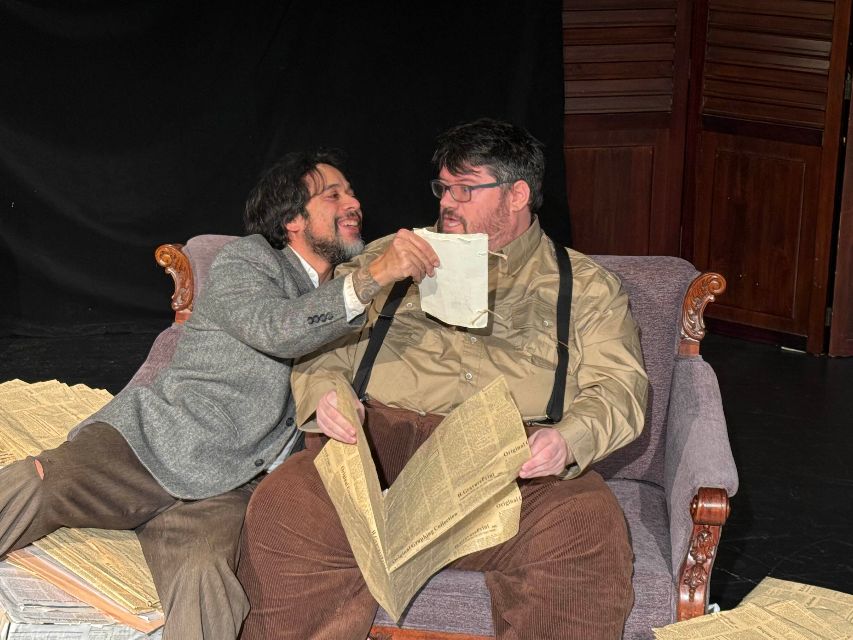
Like most absurdist plays, Nicholas Cummings’ The Great Pistachio uses comedy to portray tragic themes. The play takes place at the end of the world, but amusingly, the two central characters don’t seem to be aware that this is happening. The younger brother, Bertrand (John Brownlie), has spent the last decade in a hole in the floor, obsessively writing a play about “everything…life, death, justice, injustice, hubris, lust, discovery…” The elder brother, Boris (Tim Lawton), spends his days in a chair reading newspapers, searching for stories of “good in the world.” Through his backlog of old papers, Boris learns that “people are angry about everything,” a war has ravaged the earth, and there’s an uncontrollable storm brewing outside.
When Bertrand resurfaces with the first draft of his play, To Greater Pastures, he declares his determination to immediately cast a production of it. After calling around to all the local theaters, he is surprised to hear only static on the other end of the line. A sudden, alarming knock on the door announces the arrival of Beatrice (Ellen Keith), the only other human on earth. While Bertrand attempts to bring his “masterpiece” to life, Beatrice proceeds to erratically improvise all the characters, including “the great pistachio” (she misreads Bertrand’s handwritten title), and chaos ensues. Despite several frantic rewrites, it turns out that Bertrand’s play is not a masterpiece, but, in the end, what matters is the act of play. The characters eventually realize that working together to create something – even if it’s completely absurd– is where true mastery and joy can be found.
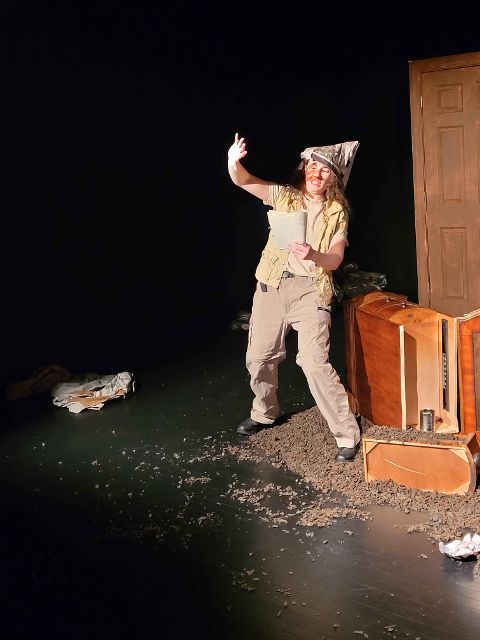
Like her character Beatrice, actor Ellen Keith brings life and light to every scene. Her wild, free-wheeling, clown-like physicality brings an infectious energy to the show. Having played Beatrice twice before in 2025 at the NY Theater Festival and the Edinburgh Fringe, her comfort and confidence in the role are undeniable. The character of Beatrice may be, as Boris describes her, “completely unhinged,” but she brings fun and silliness into a dark space by way of her strangely wonderful hats, costumes, flowers, garlands, paintings, and puppets – all made from recycled newspaper. The paper puppets, designed and built by Em Sheeran, were particularly delightful and imaginative. The one element of director and costume/scenic designer Rachel Hall’s set that stands out is a towering, dusty grandfather clock that has been broken for years. Permanently stuck at 5:30, the clock is a symbol. Just like the brothers, time stands still here.
Nicholas Cummings has written a play for our time. The Great Pistachio asks audiences to confront their impulse to retreat from – and give up on – an increasingly violent world. As the brothers reckon with the emptiness and futility of their lives, they come to accept that they know nothing of the world because neither of them has really lived in it. They will almost certainly die of starvation, whether they stay inside hiding from the world or if they open the door and confront the storm.
The story Boris is most drawn to in his newspapers is an old one about a woman who created a nearby community garden, a beautiful place for everyone to enjoy – a place he wants to see “even if it’s not there anymore.” Despite the danger outside, Boris chooses to be hopeful. He chooses to live. But when confronted with his fear of leaving the comfort and safety of his chair, he worries about how they will live out in the world. He asks, “Can anybody do it right?” to which Beatrice wisely replies, “There’s only one way to mess up living.”
For more information and tickets, go to: https://www.yorickensemble.com/upcoming-events