Photos by Benjamin Rose Photography
‘Job’ — Written by Max Wolf Friedlich. Directed by Marianna Bassham. Scenic Design by Peyton Tavares; Lighting Design by Amanda E. Fallon; Sound Design by Lee Schuna; Costume Design by E. Rosser. Presented by SpeakEasy Stage Co., Calderwood Pavilion, Boston, through Feb. 7.
By Shelley A. Sackett
Playwright Max Wolf Friedlich wastes no time establishing the life-or-death stakes in his two-person thriller, Job. The lights come up in media res. A woman holds a gun pointed directly at a man’s head. Jane (Josephine Moshiri Elwood) is shaking, enraged and desperate. Lloyd (Dennis Trainor, Jr.), clearly shaken, holds a clipboard and a pen. “Let’s just talk this through,” Lloyd entreats, right before the first of many, many abrupt blackouts, flashes and eerie sounds.
Seconds later, in the next tableau, Jane still holds the gun to Lloyd’s head, but he wears a cocky smirk. “You did it,” he spits at her. “You were right about everything.” Another blackout.
These staccato scenes repeat until the set and scene settle and hints at who/what/where and why are revealed. “… and whatever is happening in your life, I promise, we can talk about it, I will listen,” Lloyd coos. Jane, at last, relaxes and lowers her gun, seeming to come to her senses. In a flash, chameleon-like, she is terrified. “This is not who I am, I would never like -FUCK! Are you going to call the police?!” she shouts, followed soon by a compliant, “Can we keep going?”
All of this occurs within the first five minutes.
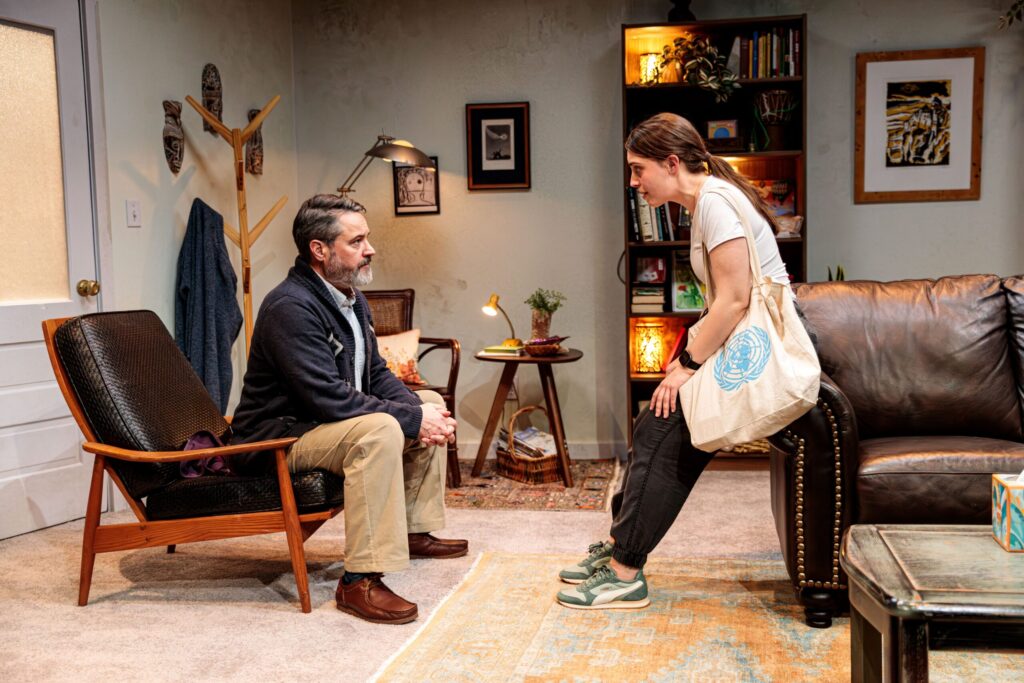
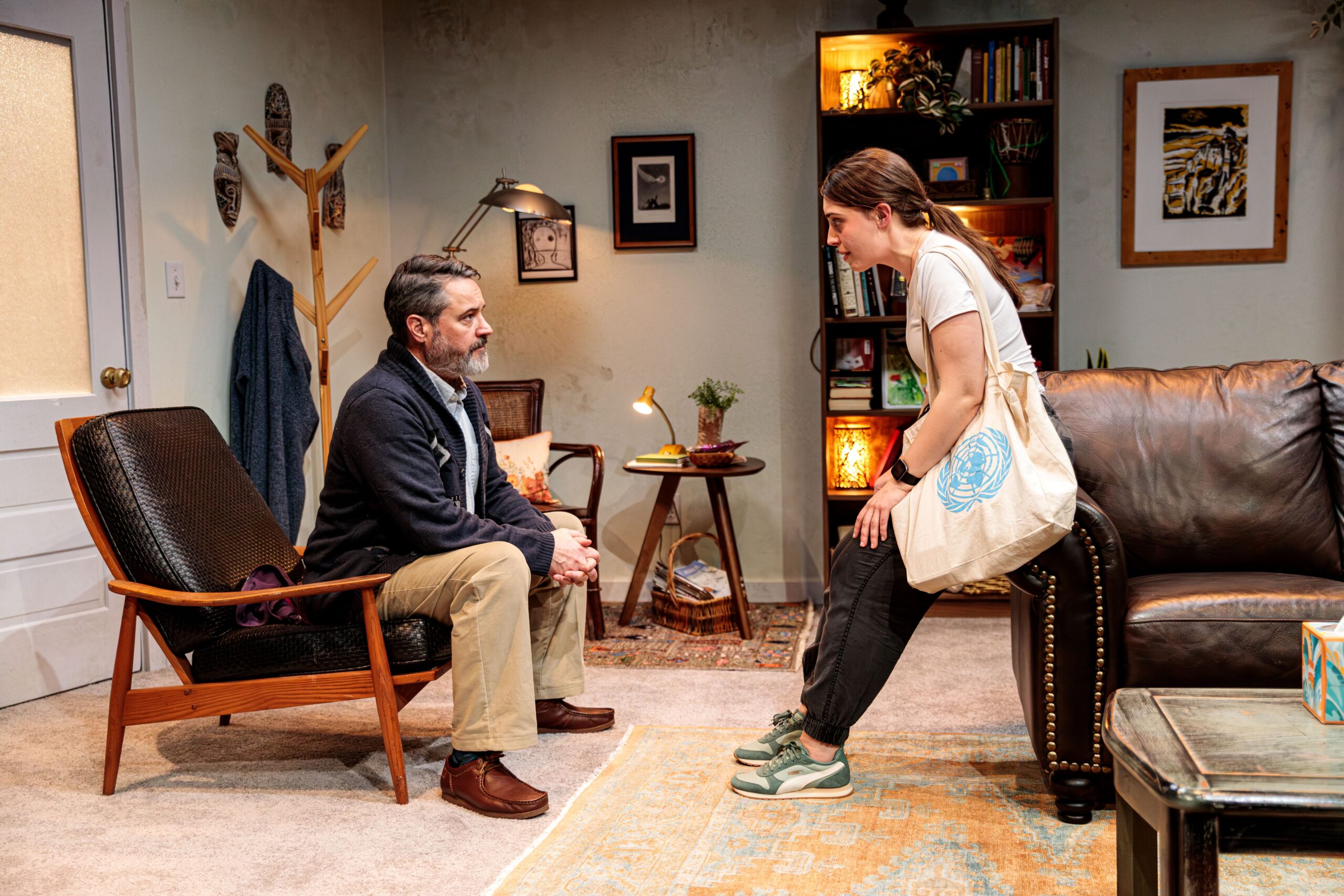
Lloyd, it turns out, is a therapist who specializes in work crises. He has been assigned to evaluate Jane’s mental fitness to return to work at a Bay Area tech company where she is a content moderator (which she calls “user care”). She spends all day watching and searching for violent, sexually perverse videos so she can report and block them. When she describes in graphic detail the ugliness she encounters, she drives home the toxic fungus of humanity that can thrive undetected in the dark underbelly of the Internet.
Like Jeanne d’Arc, she is a crusader, keeping the world safe for the billions who spend as much time in the virtual world as they do in the physical. “The internet isn’t some fringe ‘young people’ thing anymore – it’s where we live. It’s our home and I am the front line of defense − there’s nobody else,” she tells Lloyd.
What brought her to this mandated session was an in-office mental breakdown that included a screaming fit atop furniture, which a heartless co-worker recorded and posted to, ironically, the Internet. Unsurprisingly, the video went viral, reaching meme status. She is a one-woman Millennial vigilante, intelligent, combative, edgy, obsessed with the responsibility and power of her job, willing to “extract the darkness” of the online hellish landscape by sponging it. “It’s a privilege to suffer as much as I do,” she states. Her mission is ordained — to expose and root out Evil, “the kind God warns about.”

She’s also more than a little scary, even more so when holding a gun pointed at Lloyd’s head.
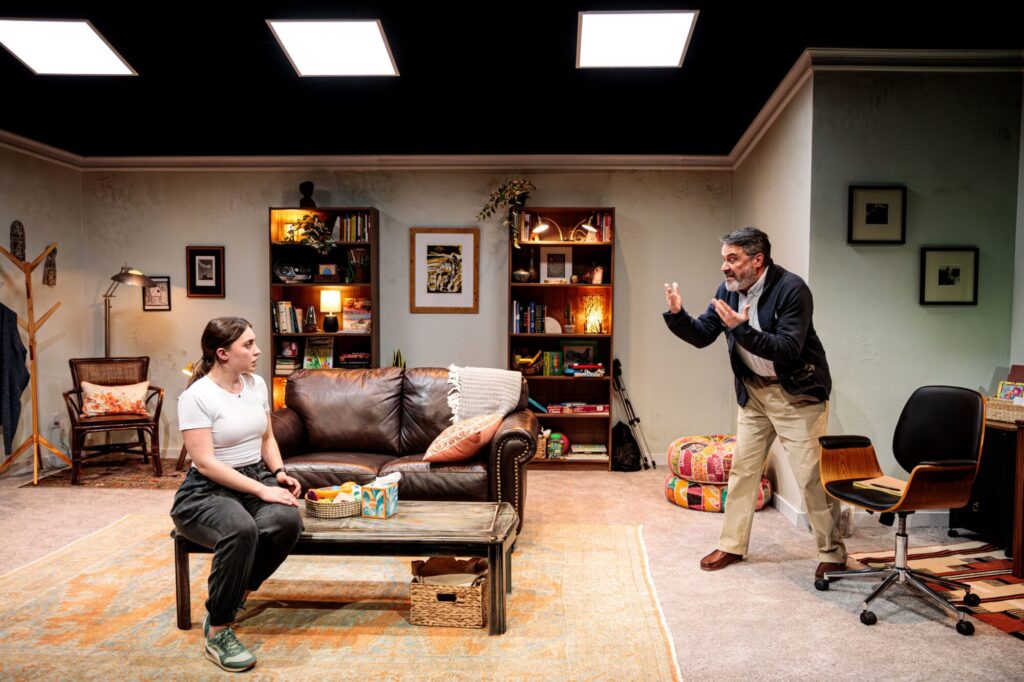
Lloyd, by contrast, is a sixty-something Boomer, an ex-hippie who hates big corporations and the type of technology Jane’s generation has foisted onto his previously crunchier environment. His office is a realistic hodge-podge of plants, posters and shabby chic. He is as calm as she is manic, as resentful of the Gen Z generation and how they have changed the global landscape as Jane is of his generation’s hypocrisy and the NIMBYism that created a housing shortage blamed on tech workers.
He is also earnest and patronizing (“My only job is to help you”), manipulative and judgmental. And, like Jane, he believes no one can do his job as well as he can. “I was destined to be your doctor,” he says matter-of-factly.
They are well-matched intellectually, their conversations sometimes morphing into a strange recasting of My Dinner with André. You can almost imagine them, under other circumstances, calmly and deftly debating the merits and demerits attributable to Boomer and Millennial/Gen Z generations.
To describe Elwood’s portrayal of Jane as flawless is an understatement. She doesn’t just play the part; she embodies it. Likewise, Trainor, Jr. is splendid as the slippery Lloyd, shifting gears with finesse and competence. Bassham’s direction is crisp and well-paced. The scripted abrupt blackouts and flashes, while effective at revealing Jane’s overstimulated mind, unfortunately become increasingly ineffective as their use increases.

Friedlich has peppered his taut, edge-of-your-seat adventure with punchy dialogue and hard-hitting questions. When does a job take on the attributes of a divine summons? How much evil can one person absorb before succumbing to its toxicity? At what point does self-sacrifice become self-preservation, and is it worth it?
Describing the details of the plot any further would risk tripping the spoiler alert buzzer, but suffice it say that Job is hardly an 80-minute therapy session. Rather, the play has more in common with a hostage situation and generational duel (and the ending is indeed a quintessential — and literal — showstopper). Highly recommended for those looking for a timely production with stellar performances and a smart, edgy script.
For more information, visit https://speakeasystage.com/