Photos by Nile Scott Studios
‘Silent Sky’ – Lauren Gunderson. Directed by Sarah Shin. Stage Management from Fanni Horváth. Lighting Design by Eduardo M. Rameriz. Costume Design by Leslie Held. Sound Design by Kai Bohlman. Props Design by Julia Wonkka. Central Square Theatre’s ‘Silent Sky’ ran from September 11th – October 5th.
By Charlotte Snow
(Editor’s Note: Charlotte Snow designed the costumes for their 2025 production of SPACE at Central Square Theater)
Lauren Gunderson, who has penned such hits as I and You, The Book of Will, and Émilie: La Marquise Du Châtelet Defends Her Life Tonight, has been the nation’s most produced playwright for several years now. To me, her writing is the antithesis of David Mamet’s (which is her second greatest accomplishment). I have long harbored a love-hate relationship with her writing style. While love that she often focuses on intelligent, independent, and resourceful female heroines who strive to break into the sciences and/or other male-dominated fields, I frequently groan and cringe at her over-reliance on humor and sickeningly sweet faux sincerity. Central Square Theatre’s production of Silent Sky only furthers this love-hate relationship, even though the production is quite well done.
Silent Sky serves as a biographical overview of the life of Henrietta Leavitt, the groundbreaking nineteenth-century astronomer. The story begins when, largely due to her sister’s begging, Henrietta gets accepted into the Harvard Observatory to work as a “computer.” Her new job, along with two other women, is to capture and record small points of light onto glass plates held together by a wooden spanker. Henrietta’s true goal is to pinpoint Earth’s location in the galaxy and determine its distance from the stars. Just as her work begins to catch the eye of the scientific community, she also catches the eye of her boss, Peter Shaw. When a personal tragedy occurs, Henrietta is forced to ask herself what she holds dearest: her family, her prospects at love, or the stars?

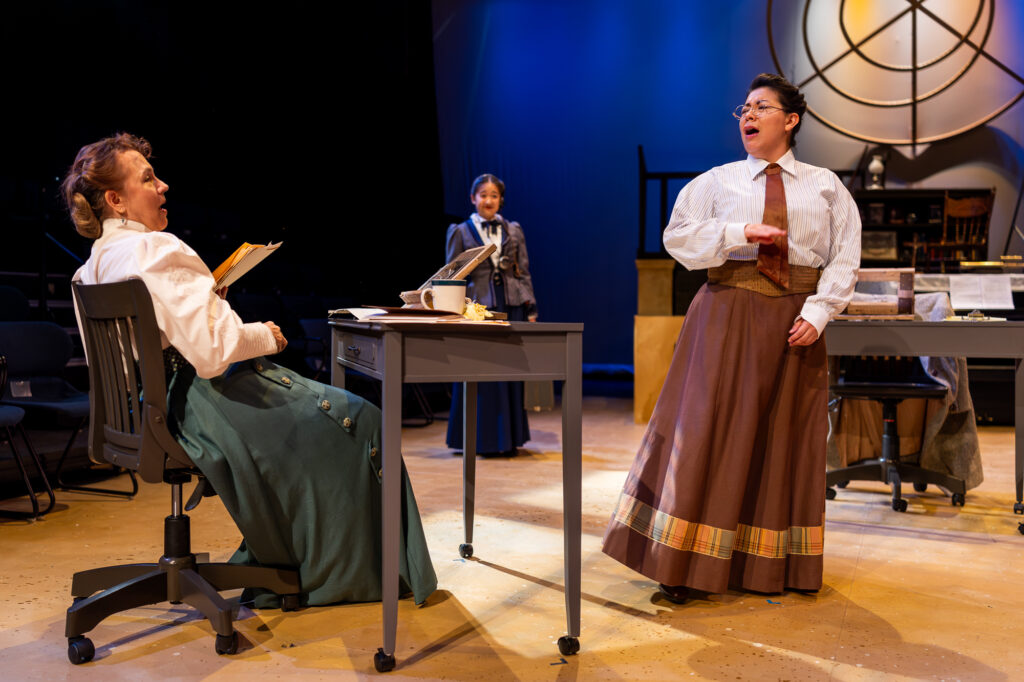
All five actors (Jenny S Lee as Henrietta Leavitt, Kandyce Whittingham as Margaret Leavitt, Lee Mikeska Gardener as Williamina Fleming, Erica Cruz Hernández as Annie Cannon, and Max Jackson as Peter Shaw) do a wonderful job at bringing vivacity to these historical figures and functioning as an ensemble. This play swims or sinks based on the actors’ alacrity, repartee, and listening, and this production swims. While both Gardener and Hernández ground the play and skillfully provide exposition, and Whittingham delivers a heartfelt and playful performance, the play is on the back of Jenny S. Lee. The trap of the role is that her character could become a steamroller, treating those around her as less important than her scientific breakthroughs. But Lee skillfully avoids this pitfall by layering Leavitt with a deep well of empathy and admiration for those around her. Max Jackson’s Peter Shaw, deftly balances the space between true sincerity and being the play’s main source of comedy, delivering Niles Crane-like levels of pining. Oftentimes, due to the script and direction, the balance leans more towards comedy than I cared for, but judging by the audience reaction, I was in the minority.
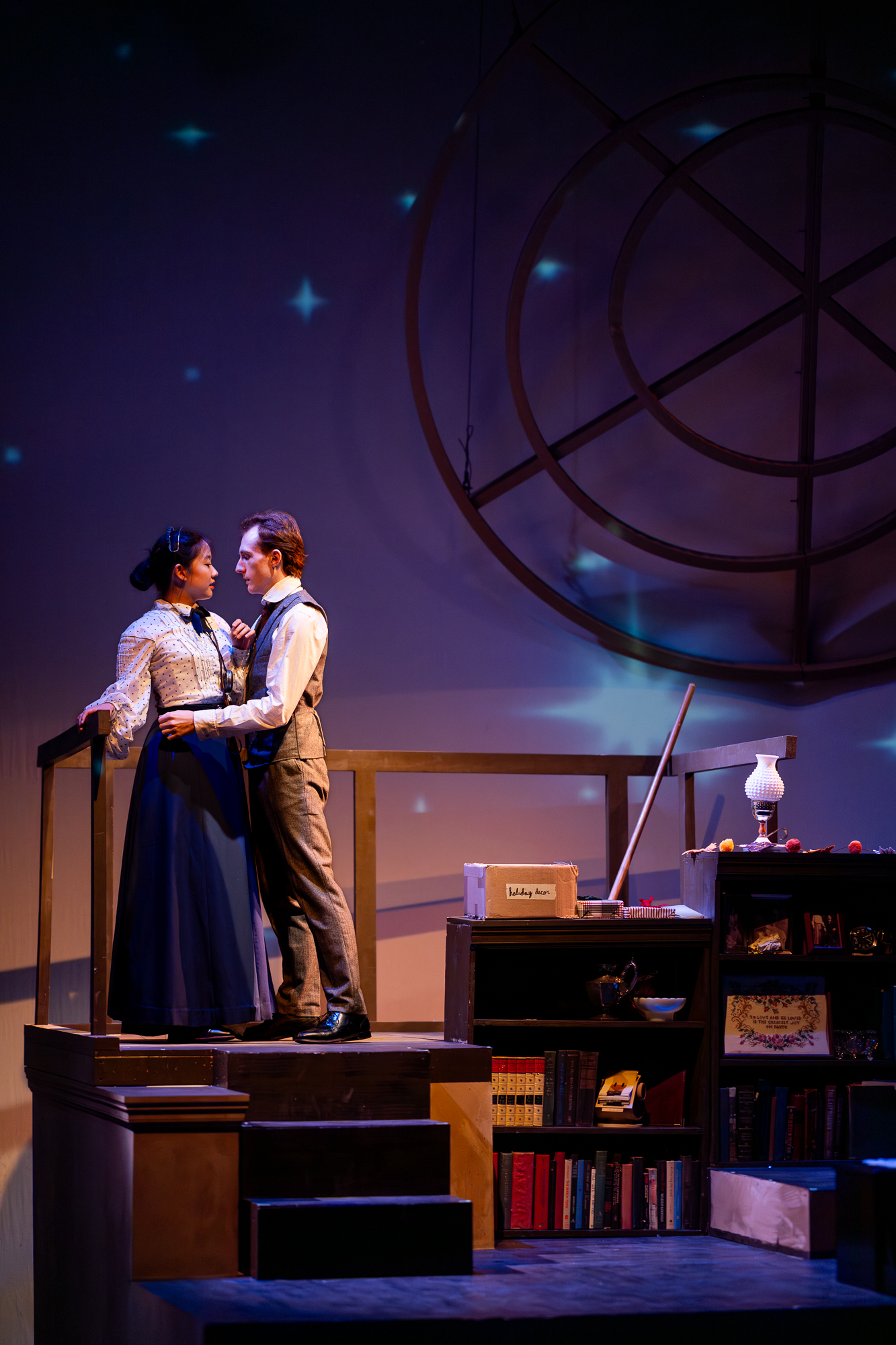
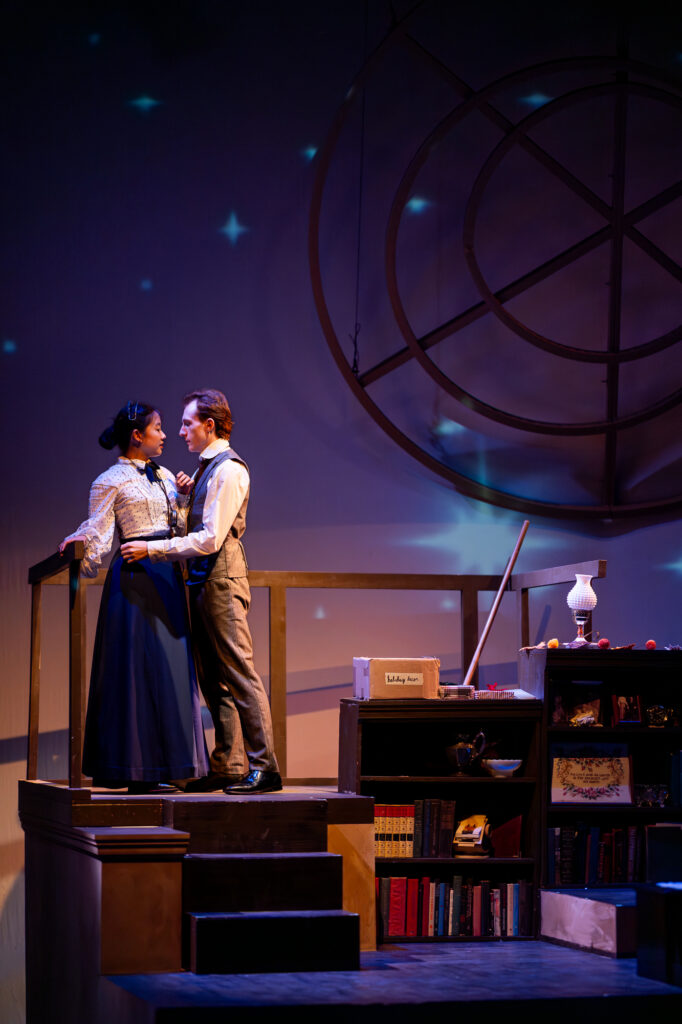
Leslie Held’s costumes were pitch-perfect, evoking both the era and reflecting the character’s personality (which is no easy trick). Julia Wonkka had the tough task of having her props be the focal point of Leavitt’s discoveries, one that was effortlessly executed. Kai Bohlman’s choice to have the play’s music be composed of Violet Wang’s piano instrumentals was simple and inspired, providing the needed momentum. Eduardo M Ramirez’s lighting depicting the eponymous silent sky full of stars shone brightly (puns intended). The lighting and sound worked in tandem beautifully, especially when Shaw and Leavitt first danced together, surrounded by a starry sky. It was an expertly choreographed scene rivaling the planetarium dance in La La Land.
My only quibble is with the set. Qingan Zhang’s set was detailed and practical, but it was also busy and neglected. The audience seating was set in a thrust, with most of the action happening in the center of the stage, effectively creating “theater in the round” for most of the play. The set representing Henrietta’s hometown and Margie’s home was a small three-platform structure that sat upstage. On the ground level was a piano, the second level was strewn with bookcases and a bureau, and the third level was left bare for playing space. This entire structure felt cramped, isolated from the bulk of the onstage action, and underutilized – with each piece of set dressing being used only once or twice. This was particularly head-scratching because the desks that the three (women) computers sat at gracefully weave in and out of the story with ease and never feel superfluous. Ultimately, the structure became distracting. The action that didn’t take place in the computer’s office could have been represented with only a few pieces of furniture that glided in and out of center stage. That being said, the telescope that Henrietta yearned to use was ever-present, floating above the women’s heads.
In an age where both science and women are being disregarded and attacked, it’s more important than ever to support the type of programming that uplifts both pillars of a democratic society. Silent Sky may have moments when its luminosity flickers, but Central Square Theater and its celebration of both women and science shine brightly.