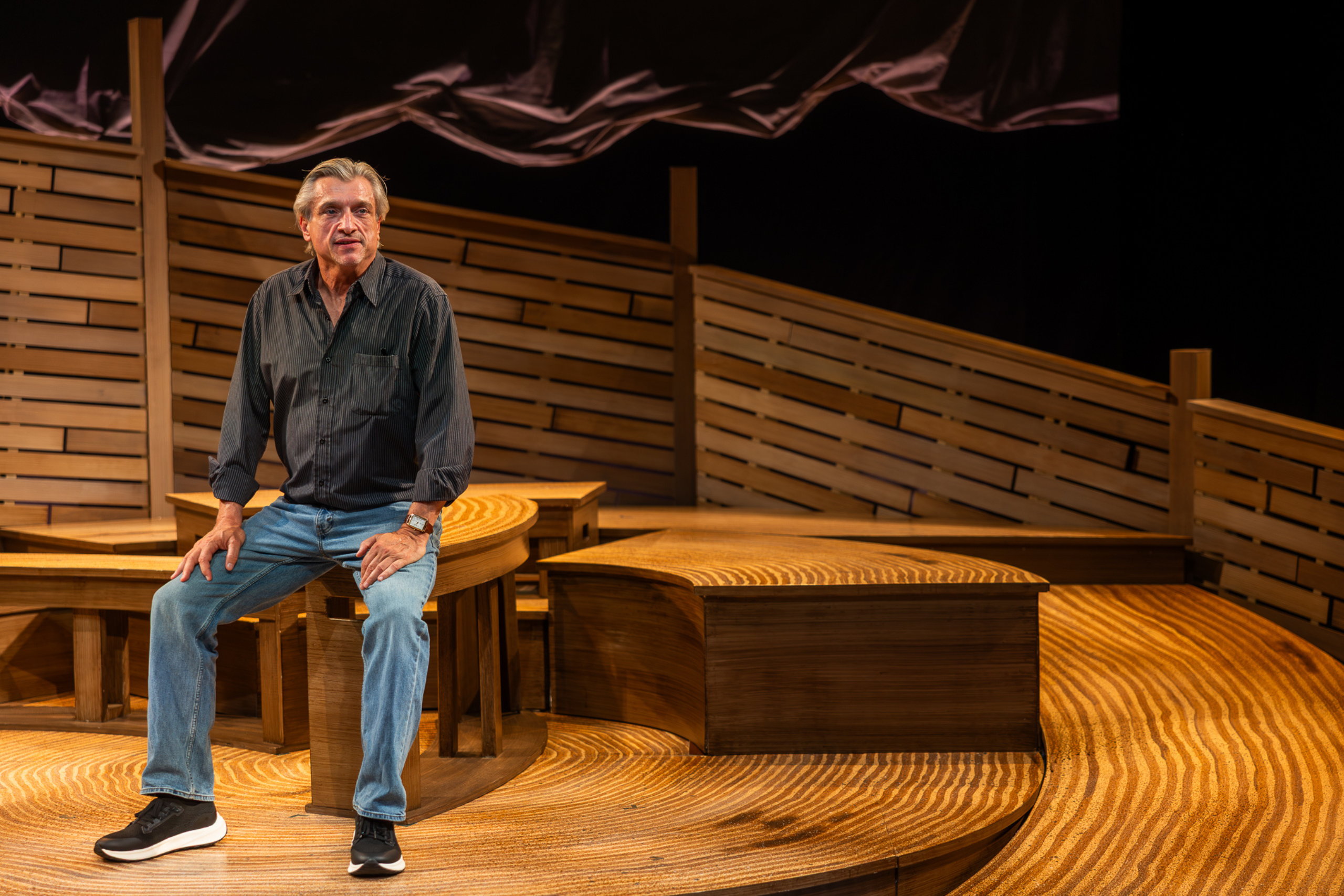
Photos by Nile Hawver
‘Our Town’ – Written by Thornton Wilder. Directed by Courtney O’Connor; Scenic Design by Shelley Barish; Costume Design by Rachel Padula-Shufelt; Lighting Design by Deb Sullivan; Sound Design by Andrew Duncan Will. Presented by The Lyric Stage Company of Boston, 140 Clarendon Street, Boston, through October 19.
By Shelley A. Sackett
Our Town, Thornton Wilder’s 1938 Pulitzer Prize-winning play, is set in the fictional New Hampshire town of Grover’s Corners. Narrated by a Stage Manager (Will McGarrahan, excellent in the sober yet not dispassionate part), this classic uses a minimal set to explore universal themes of life, love, and death. Described by Edward Albee as “the greatest American play ever written,” it presents the fictional American town of Grover’s Corners, New Hampshire, between 1901 and 1913. Through its citizens, and especially the Webb and Gibbs families, Wilder celebrates our shared humanity and the importance of appreciating the present moment, especially the glimmers of community and connection that keep us grounded and give our lives meaning.
And who couldn’t use a glimmer of light during dark times, whether it’s 1938 or 87 years later?
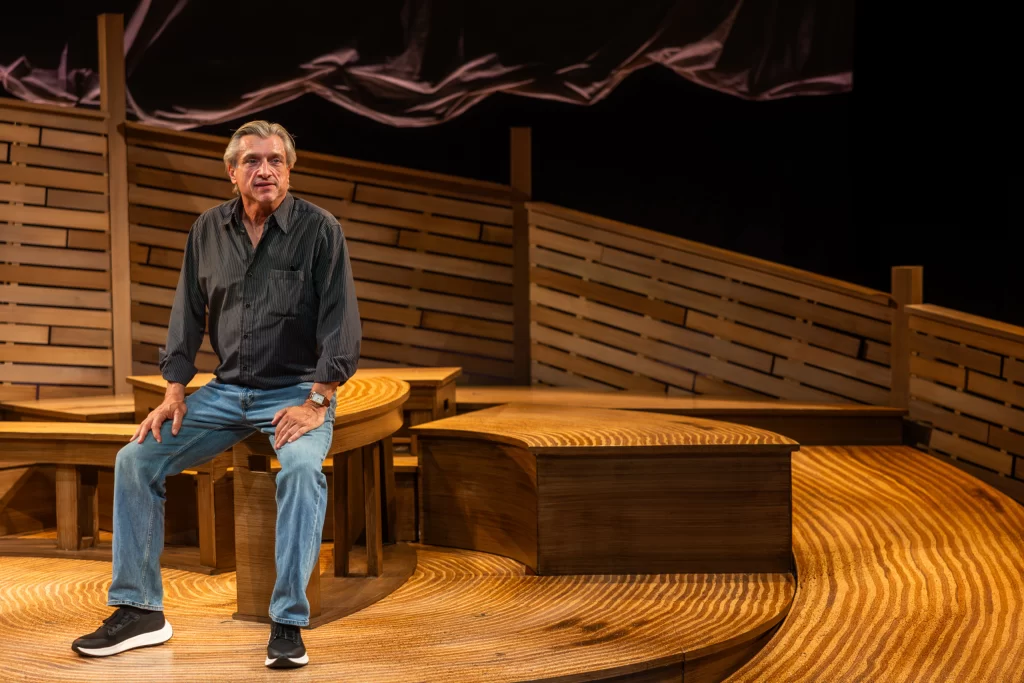
Act I (“Daily Life”) of the two-hour (one intermission) production opens on a set (Shelley Barish) of movable curved benches, Jenga-like in their flexibility and simplicity. They start as an arc and turn into whatever a scene calls for. Courtney O’Connor directs with a steady hand (especially the pantomiming in the prop-less production). Lighting and costumes subtly supplement.
The Stage Manager then presents each character, each building, and each historical fact, context meant to orient and bond the audience with time, place, and, most importantly, people.
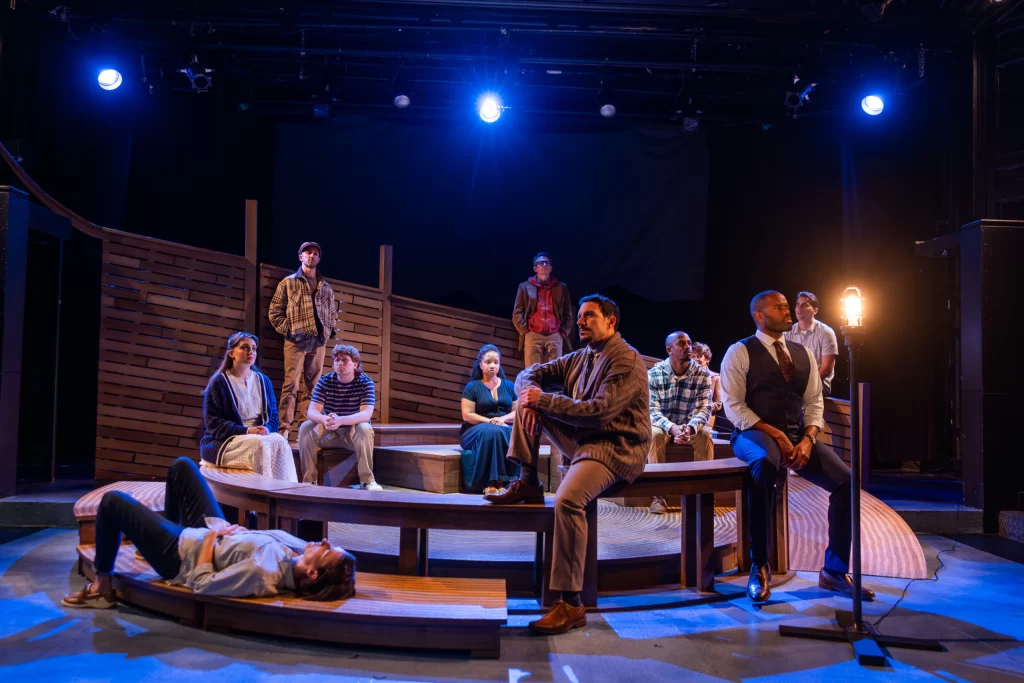
“The play is Our Town. In our town, we like to know the facts about everyone,” he states matter-of-factly.
It is dawn on May 7, 1901. The Stage Manager guides us on a tour of the town, with its six churches, town hall/post office/jail, grocery store, drug store, and the homes of the Gibbs and Webb families. We are introduced to Joe Crowell (Jacob Thomas Less) as he delivers the morning paper, “The Grovers Corner Sentinel,” to Doc Gibbs (Robert Najarian). As Howie Newsome (Jesse Garlick) delivers their milk, we meet the rest of the townspeople, including Editor Webb (the always welcome De’Lon Grant) and the rest of the Webb and Gibbs families.
Mrs. Webb (Amanda Collins) and Mrs. Gibbs (a refreshingly nuanced Thomika Marie Bridwell) ready their children and husbands for their days. Emily and Wally Webb (Josephine Moshiri Elwood, Darren Paul) and George and Rebecca Gibbs (Dan Garcia and the irresistibly magnetic Kathy St. George) attend school together. The romance between Emily and George will become the lens through which the town’s story unfolds.
Professor Willard (John Kuntz, notable as always) and Editor Webb fill in some of the gaps, giving us the skinny on the history of the town and its socioeconomic status and political and religious demographics.
The Stage Manager then gets into the weeds about each character’s relationships and challenges, along the way presenting the town’s more colorful and minor characters. Simon Stimson (Kunz), the church organist and choir director, is also the town drunk. Doc Gibbs chews his son out for not helping his mother with her chores, and George and Emily’s eventual romance begins to bud under a full moon.
The Stage Manager dismisses us with a no-nonsense, “That’s the end of Act I, folks. You can go and smoke, now. Those that smoke.”
Act II (“Love and Marriage”) opens three years later. The Stage Manager summarizes the themes of Acts I and II — daily life, love and marriage — adding, “There’s another act coming after this. I reckon you can guess what that’s about.”
Emily and George’s courtship takes center stage, and the delightful ice cream parlor scene in Act II is one of the play’s best.
As Emily and George prepare to marry, the interactions with their families are warm, intimate and funny. Bride and groom are terrified, caught between wanting to remain kids and needing to follow the rules of the natural order of things, at least as they are in Grover’s Corners.
Doubling as wedding officiant, the Stage Manager says plainly, “People were made to live two by two… I’ve married over two hundred couples in my day. Do I believe in it? I don’t know.” The important thing, reminds Mrs. Soames (St. George), is to be happy. “I’m sure they’ll be happy. I always say, ‘Happiness, that’s the great thing!’”
Act III (“Death and Eternity”) takes place nine years later. The Stage Manager paints broad brushstrokes of changes — even the farmers drive cars, people now lock their doors — but quickly circles back to the play’s main themes of the unavoidable passage of time, the importance of paying attention to life’s little moments, and the miracles that are the substance of everyday life and the fabric of eternity.
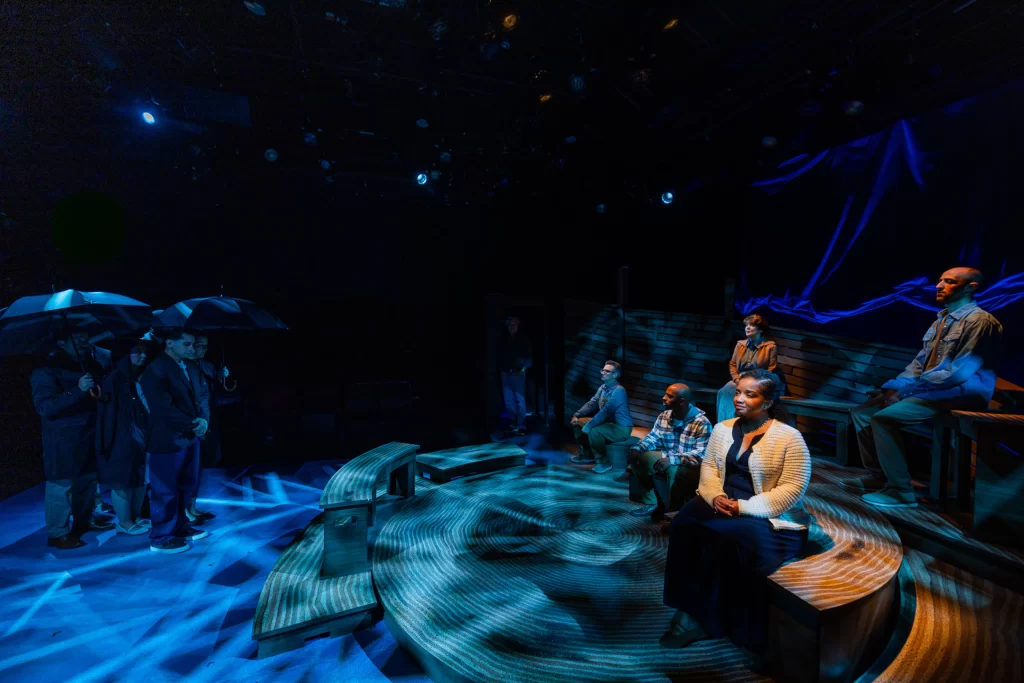
Focused on those who have passed away in the last nine years, the act takes place in the town cemetery. The Stage Manager describes how each person died before letting us know whose funeral is about to take place. The most thought-provoking of the three acts, playwright Wilder urges that we seize each day and celebrate the “magnificence and magnitude of life.” Asked if anyone truly understands the value of life while they live it, the Stage Manager responds, “No. The saints and poets, maybe —they do some.”
The rest of us? Not so much.
Some might complain that Our Town is dated and question why Lyric Stage has chosen to open its 2025/2026 season with this oft-produced classic. I say kudos to Producing Artistic Director Courtney O’Connor for recognizing an existential need in the current external turmoil to remind us that even in these dark times — especially in these dark times — we must not forget to slow down, breathe deeply and acknowledge that life is — no matter what — the most precious gift we are given.
Recommended.
For more information, visit: https://lyricstage.com/