

By Kilian Melloy
The good people of Grover’s Corner seem like American archetypes. They’re our neighbors, our local merchants and civil servants, our family members; they are us. Thornton Wilder’s 1938 play Our Town celebrates small-town America even as it mythologizes an ideal of family and community. Set in the early years of the 20th Century — the play begins in 1901 — it’s a story not just of a town, or a nation, but of most comprehensive of universalities: Human life itself. Over the course of three acts, the people of Grover’s Corner grow up, grow older, and face life transitions: Maturity, marriage, parenthood, and, eventually, the end of life.
Among the town’s inhabitants are two neighboring families, the Webbs and the Gibbses. Each family plays a key role in the community; Mr. Webb is the editor of the local newspaper, and the Gibbs patriarch is the town doctor. Each household also boasts a son and a daughter, among them schoolmates Emily Webb and George Gibb. The mothers of the two households play their parts in the fabric of the town’s life, as well, looking after their husbands and children and participating in the life of the community; when a local gossip begins talking about the drinking habits of the church’s organist, Simon Stimson, Mrs. Gibbs takes a compassionate stance toward him. (She also takes on some of her son George’s chores, seeing as how he’s too busy playing baseball and being a teenager to chop wood for the cook stove… until, that is, his father has a gentle word with him about it.)
In other words, the iconic nuclear family is well represented: The women mother their broods and look after their men, the fathers know best, and the kids flourish. Everyone does his or her job conscientiously, delivering milk, or sermons, or babies. But while the play has a sparkling nostalgic gloss about it, Wilder roots his tale of an American town in darker, richer soil. There’s folly, rot, corruption, pain, and failure close to the bedrock of the community, and the foundations of every home are dug into that loam. This Pulitzer Prize-winning masterpiece is a classic not because it regurgitates our myths to us, but because it reminds us that myth is not reality — and reality, with all its hardships and shortcomings, is what makes things matter. This is not a dream of the past, but a sympathetic and tender warning to the present, telling us to do our best to be in the present. Or, as Lyric Stage Company of Boston has it with their tag line for this production, “An American Classic for Our Time.”
Helming the production is the Lyric Stage’s Producing Artistic Director, Courtney O’Connor, who took on the position in 2020 after Spiro Veloudos’ retirement. (Veloudos died in 2023.) Since then, O’Connor “has directed several pieces for the Lyric Stage, including Be Here Now, The Book of Will, Preludes, Rooted, Assassins, Thirst, Urinetown: The Musical, and ART,” her bio at the Lyric’s website notes. ( https://www.lyricstage.com/role-member/courtney-oconnor/ )
Why this play? Why now? Courtney O’Connor delved into those questions, and more, in an interview with Theater Mirror.
Theater Mirror: “Our Town” is classic Americana. It’s like a Norman Rockwell painting brought to life on the stage, depicting a small-town life at the turn of the 20th century. But is part of its appeal also the way that it’s been traditionally staged with no props or set, so that important visual elements are allowed to play out in our imagination?
Courtney O’Connor: Oh, I absolutely think it is. And I think that the very purposeful choice of saying you’re not going to have a lot of props, you’re not going to have a lot of scenery, we’re going to force people to call upon their imaginations and their remembrances, gives it a richness, a beauty, and a depth that could not be conjured any other way. Deb Sullivan, my lighting designer, and I were saying, “If we put a sunset on the [back wall], it could look beautiful, but it will never look as beautiful as the sunset that you’re imagining in your mind.” I think it’s the same thing with the characters. In a large way, the characters are a pastiche of people that we know. They’re fleshed in just enough that they feel real and we feel connected to them, but they’re all still vague enough that we get to sit there and say, “Well, I know who Simon Stimson is in my life. I know who Emily and George are in my life. I know who Mrs. Soames is in my life.” And we sort of get to fill that in. And I think that that magical balance of giving you just enough to make it real in your own life is part of the secret sauce of the play.
It’s funny when you say it’s Norman Rockwell-esque, because — and I mean no disrespect to Norman Rockwell — he did this, too. [Rockwell’s work] really looks at the darkness underneath things, but it’s so cleverly packaged.
Theater Mirror: Does that make it harder, from a production standpoint, to not have props or a set?
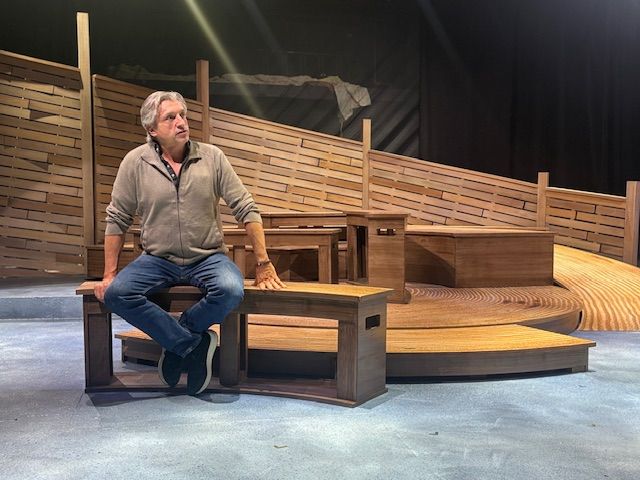
Courtney O’Connor: I think certain directors would struggle with it. I have always been a girl who says, “Give me an empty stage, and I’m happy.” Not that I don’t want scenic designers to work their magic. I love when they do! But I love being able to just get in there and create. And I think that that’s what this sort of style does, it forces you to just go in and say, “What do we need to tell this story? What is absolutely essential?” I think in a lot of ways, that’s what Wilder’s trying to say. “What is essential to life? Let’s forget about everything else.”
Theater Mirror: Will other design elements — lighting and the costuming, music and sound design — have to do some heavier lifting?
Courtney O’Connor: Yes and no. Andrew Duncan Will, the sound designer, and I are talking about hopefully evoking those memories to give you the hint of the idea, so that your mind can fill in the rest. I do believe that our minds are more powerful than an actual sound effect. When there’s a train whistle in the background, sure, we want to hear a light whistle, but we don’t want people sitting there and going, “Well, is that a 1942 locomotive…?” We just want to evoke the memory of a train. Different productions can do it in different ways. I think certain ones can strive to set that realism, to bring you into that place by doing stronger sounding and lighting and costuming. We’re going for more of “We just want to nod towards it.” I think of it like the watercolor painting books that you would get as a child. We just want to provide the outline and let you color it in as your mind colors it in, however it chooses to do so.
Theater Mirror: Using that metaphor, does the absence of sets and props broaden the palette of colors the actors can use, or broaden the lines they have to color in, or maybe get rid of the lines altogether?
Courtney O’Connor: When working with actors, you always want to try and have that. At least, I do. I want that to be my goal of saying, “Okay, here’s the framework. Now, within it, you play, you decide.” We hire smart and talented actors, and then the greatest thing we can do is trust them and make sure that everybody is telling the same story in the same way. I trust them to fill things in because their lives are rich, and their lives are deep and painful and wonderful.
Theater Mirror: Tell me a bit about the cast.
Courtney O’Connor: We just announced the cast yesterday. Kathy St. George is playing Mrs. Soames, and she’s also playing Rebecca, George Gibbs’ younger sister, which is very important to me. The older I get, the more I am conscious of the fact that past versions of ourselves are still in us. To me, it’s all circular. We are on a circular journey. So, Kathy playing both roles is very deliberate.
Will McGarrahan is our Stage Manager [character], which I’m so thrilled about. I mean, I am so thrilled with this cast. Doc Gibbs and Mrs. Gibbs are Robert Najarian and Thomika Marie Bridwell. And then the children are, Kathy is Rebecca, and then Dan Garcia is playing George. And then our Webbs are De’Lon Grant and Amanda Collins. Emily Webb is Josephine Moshiri Elwood, and Darren Paul is playing Wally, and he’s also playing Constable Warren. John Kuntz is playing Simon Stimson, and then we have Jacob Thomas Less and Jesse Garlick playing multiple roles of the townspeople. It’s a fairly small cast of 12. There are a lot of doublings of people.
Theater Mirror: That darkness you mentioned is so lightly touched on, but it’s enlarged in the imagination. Simon Stimson is a perfect example. We don’t have to see or hear much of him to know who we think he is.
Courtney O’Connor: The Wilder estate is very involved in professional productions, which is kind of awesome. There’s this woman there, Rosie, who knows this play backwards and forwards, and she was such a valuable help. I was looking at possible doublings, and I was talking through them with her, and she said, “Simon Stimson has almost the fewest lines in the play, and he is one of the most memorable. Everybody remembers him.” And she’s right, because we all know that person. Some of us probably are that person. We don’t have to see much to know what that struggle is, to know what that pain is. It’s a powerful tribute to the strength of an indelible mark that gets made by treading very lightly. I think in some ways what makes him so memorable is what we know in the play — he’s an alcoholic — but we can all sit there and go, “I know someone who struggles with depression, I know someone who struggles with [whatever else], that has that same sort of reserve and anger.”
Theater Mirror: George and Emily are the two characters we follow with the most sympathy, in a way. We follow their journey most fully because we see them as children; we see them grow up, court, and marry; and, finally, we see them as adults faced with tragedy.
Coutney O’Connor: This play is very often over-sentimentalized. I keep saying I see it as a primal scream. You’re right, it is George and Emily that we follow, but we follow Emily all the way through her journey. It was important to me that Emily not just be a sweet confection, but that she have a steeliness to her, because I think people forget that in Act Three she’s now a mother. She’s not 17 anymore; she’s in her late 20s, and she has dealt with the loss of her brother, she’s dealt with the loss of her mother-in-law. She is running a farm. There’s a strength that we sometimes don’t see portrayed in Emily that’s really important to me. Jo Elwood is going to just be phenomenal in this, because she is an outstanding actor. It’s not a sweet cry that Emily has in Act Three. It’s a primal howl.
Theater Mirror: I would have been more likely to think of David Lynch and “Blue Velvet,” but Allen Ginsberg works for me, too. “Our Howl!”
Coutney O’Connor: It’s true!
Theater Mirror: I don’t want to contribute to a sense of crystallizing this play in nostalgic amber, but it does seem like one of the appealing things is that it harkens to an America that we are farther and farther from. Maybe at this point it’s unimaginable.
Coutney O’Connor: For me, that’s why it felt like this was a good moment to do it. They talk about America, they talk about the country, they talk about our history, and they talk about it with pride. I think this play celebrates that smaller community, that — I don’t think this is the right phrase, but it makes sense for me in this context — that pride of place. I might have conflicted feelings about being an American at this moment, but I am proud to be a Bostonian, I am proud to be a Massachusetts person, and I am proud to be a member of our theater community. I think that this play zeros in on that by saying, “We’re not trying to look at the whole country. We’re not trying to look at the whole of anything. We’re just looking at this one small community. Now extrapolate from it what applies to yours, as well.” This is a reminder that maybe, if we look a little smaller, we can still feel and celebrate that sense of belonging and community.
Theater Mirror: What else are you directing this season? And — I know the answer to this is going to be “Everything,” but what should audiences be sure to mark on their calendars when they are thinking about what to see at the Lyric?
Courtney O’Connor: Oh my gosh, I’m directing Penelope, which is a one-woman show. Alex Bechtel wrote it. He’s a composer and a lovely, lovely human and musician. It’s about the wife of Odysseus realizing that maybe her husband isn’t coming home, and what does that mean for her and her future? Aimee Doherty will be playing Penelope, which I think is going to be quite spectacular. It’s a phenomenal piece. It’s so moving. I think all of us, at some point in our life, have gone, “What do I do next? I loved my past. I want that back, but it’s not coming back. So, what do I do now?” I think that’s a universal sort of emotion that people have experienced. This is a simultaneously funny, heartbreaking, warm, and engaging telling of Penelope’s story, and exploring the question of what’s next. How do I move forward in my life when I don’t want to leave the past behind? When I want the past to be my present, how do I move forward? That’s my next project, and that’s in January.
But you’re right: The answer [to the second part of the question] is, I want people to come and see everything. But you know what? That’s how it should be.
Our Town runs Sept. 19 – Oct. 19 at the Lyric Stage. For tickets and more information, visit the website ( https://www.lyricstage.com/show-item/our-town/ ).