
Photos by: Shawn Henry
‘The Glass Menagerie.’ Written by Tennessee Williams. Directed by Doug Lockwood. Scenic Design by Jenna McFarland Lord; Costume Design by Nia Safarr Banks; Lighting Design by Amanda Fallon; Sound Design by Aubrey Dube. Presented by Gloucester Stage at 267 East Main Street, Gloucester, through June 28.
By Shelley A. Sackett
Tennessee Williams’ classic autobiographical story of a struggling family, The Glass Menagerie, is no stranger to Broadway and community theater stages. It premiered in Chicago in 1944, where it was championed by several Midwest critics, and moved to Broadway in 1945. Subsequent Broadway productions were mounted in 1965, 1975, 1983, 1994, and 2005, with the likes of Jessica Tandy, Julie Harris, and Jessica Lange playing matriarch Amanda Wingfield. The 2013 revival transferred to Broadway from the American Repertory Theatre in Cambridge, MA. Known as a staple in college and community theaters’ repertoire since its 1944 début, the play and its straightforward staging is a reliable crowd pleaser and audience draw.
It’s hard to imagine any theater company could add anything new. Yet, Gloucester Stage (2025 Elliot Norton Award Winner for Outstanding Play, Midsize for its production of Hombres) has effectively (and thankfully) taken the road less traveled in its presentation of the 80-year-old classic with an interesting and thought-provoking production that allows the audience to experience Williams’ script anew through an exciting, hyper-focused and refractive lens.
Williams advises in his preface, Author’s Production Notes, “Expressionism and all other unconventional techniques in drama have only one valid aim, and that is a closer approach to truth. When a play employs unconventional techniques, it is not, or certainly shouldn’t be, trying to escape its responsibility of dealing with reality, or interpreting experience, but is actually or should be attempting to find a closer approach, a more penetrating and vivid expression of things as they are.”
Kudos to Director Doug Lockwood and Scenic Designer Jenna McFarland Lord for taking those words to heart.
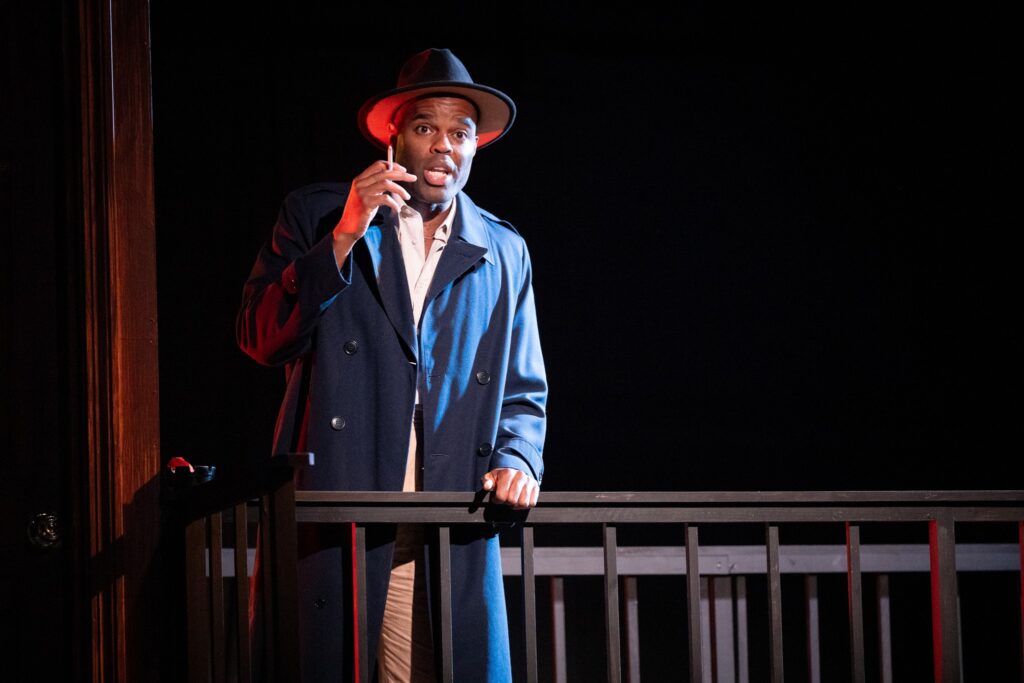
The Glass Menagerie is a seven-scene memory play with a storyline that follows Tom Wingfield (De’Lon Grant) as he looks back on his family life in St. Louis during the 1930s. In the opening scene, Tom appears slightly offstage to deliver his soliloquy. “The play is memory. Being a memory play, it is dimly lighted, it is sentimental, it is not realistic,” he says, warning that what he is about to share may not be THE truth, but it is certainly what he remembers (or thinks he does). “Yes, I have tricks in my pocket, I have things up my sleeve. But I am the opposite of a stage magician. He gives you an illusion that has the appearance of truth. I give you truth in the pleasant disguise of illusion.”
He describes exactly who we will see — his mother, Amanda, his sister, Laura, himself, a mystery man — and who we will NOT see: his father, who was a telephone man who “fell in love with long distances.”
The set reflects the otherworldly dreaminess Tom describes. Gauzy, torn gold floor-length drapes enclose the stage like curtains around a freestanding shower/tub. As Amanda’s voice becomes audible, Tom pulls back the curtains and enters the Wingfield residence.
On stage are Amanda (Adrianne Krstansky), Laura (Liza Giangrande) and four chairs. Amanda and Laura sit at an imaginary table, pantomiming eating. Their gestures are in perfect spatial sync, creating the impression that they (and, therefore, we) are suspended in this dreamlike world of memory and mirage, where props are invisible and reality is a hermetically sealed snow globe. Even the only wall art, a baroque gold frame that is supposed to hold a portrait of Tom’s father, is empty.
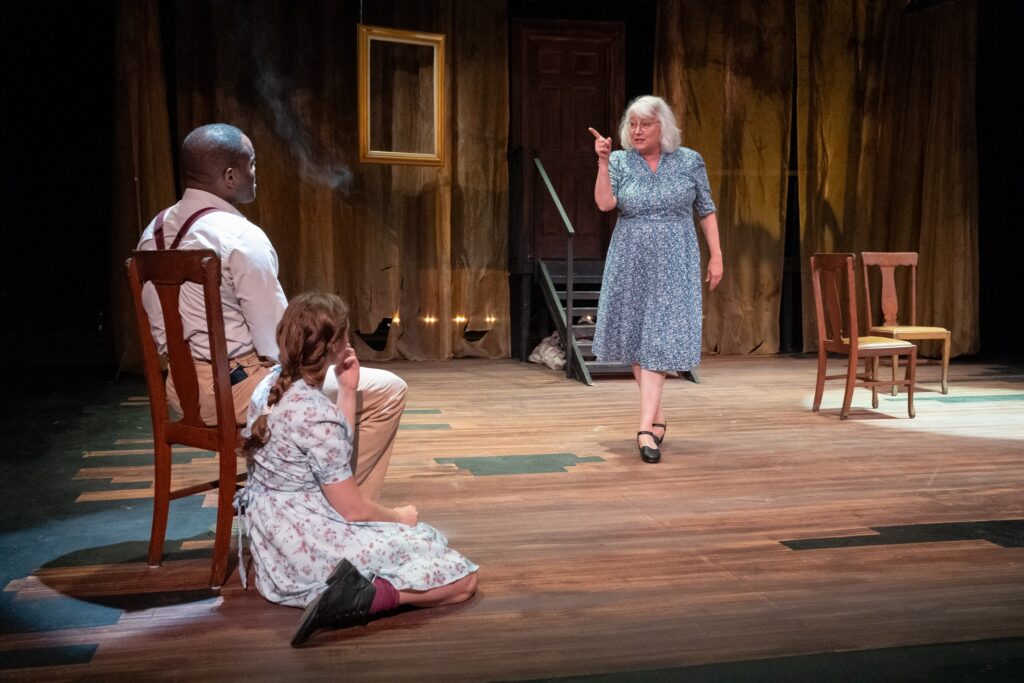
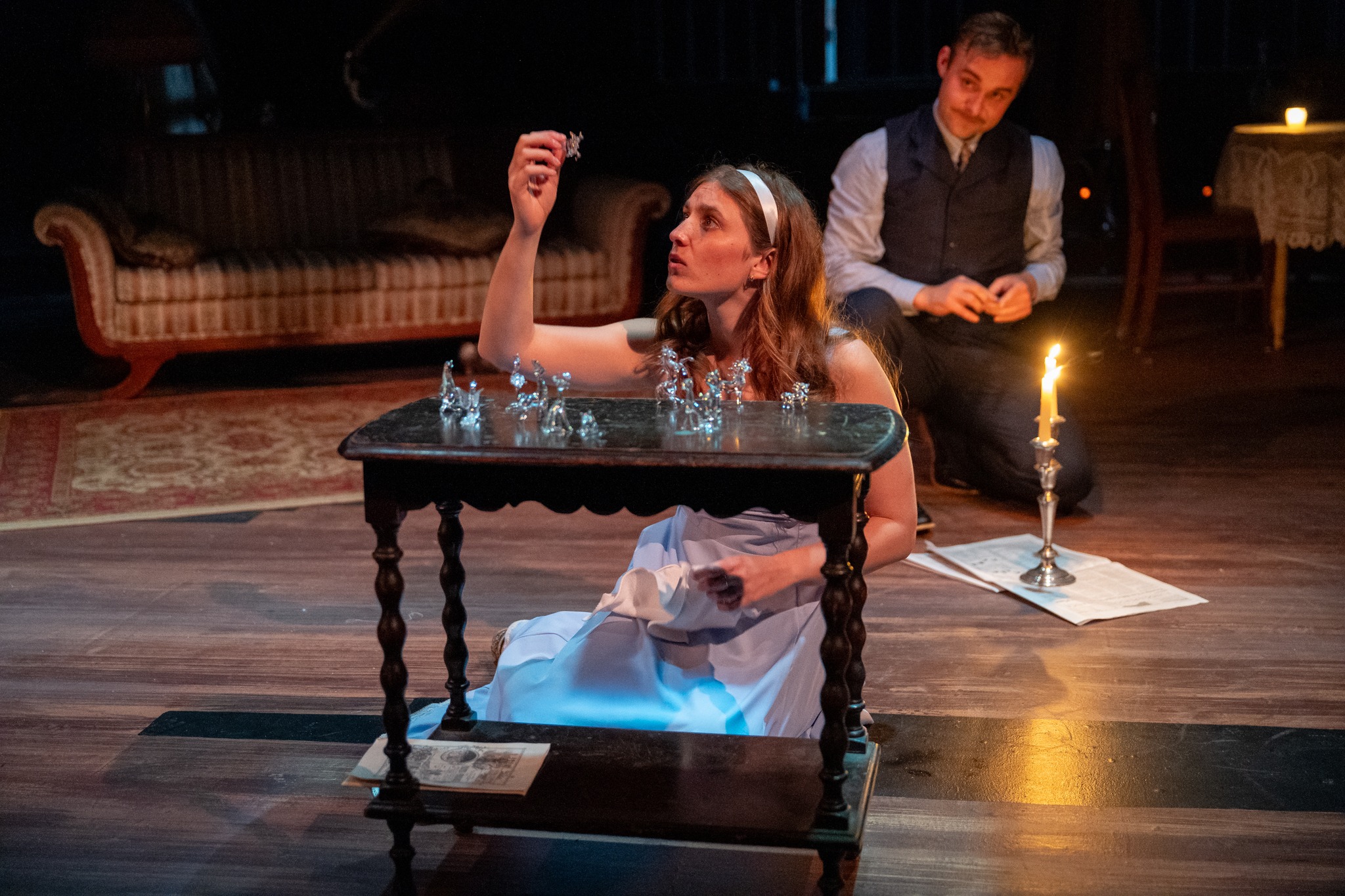
This minimalistic approach allows the audience to focus on Williams’ words and the true genius of the script. Without the distraction of glimmering glass animals and ornate period furniture, we too become submerged in Tom’s recollections, a key element of The Glass Menagerie’s success as a “memory play.”
A faded Southern belle of middle age, Amanda deals with her present by hanging onto her past. Abandoned by her husband, she lives with her children. Laura, in her 20s and afflicted with a limp, perhaps caused by polio, is debilitatingly shy. Tom, her younger brother, secretly writes poetry and supports the family by working a warehouse job that he hates. A fêted debutante in her Southern youth, Amanda longs for the creature comforts and male attention she enjoyed and spends most of her time reliving and recounting those happier times.
Amanda is also obsessed with finding a “gentleman caller” for Laura, whose crippling anxiety and introversion have sabotaged her every move, with the result of dropping out of high school and a secretarial course. Laura spends her days in her own homespun world, playing records on the Victrola and polishing and communing with her “glass menagerie,” a collection of tiny animals she engages with as a toddler would in fantasy play. Like Amanda, she treads the path of escapism.
The first five scenes of the play (“Preparation for a Gentleman Caller”) draw to an end as Amanda bribes Tom to bring home some nice young man from the warehouse by promising that, once Laura is married off, Tom is free to follow in his father’s footsteps. He tells her that Jim, a work acquaintance, will join them for dinner the next night. Amanda sets to work, reimagining the apartment, Laura, and the future.
After intermission, when the curtains are again drawn aside, the set revealed is firmly grounded in the “real” world of tangible accoutrements. After all, the very first outsider ever to enter the Wingfield inner sanctum might be scared away by anything short of at least the pretense of “normalcy.” Even Tom’s father is restored to his throne, majestically peering down at the chaos his legacy has sown.
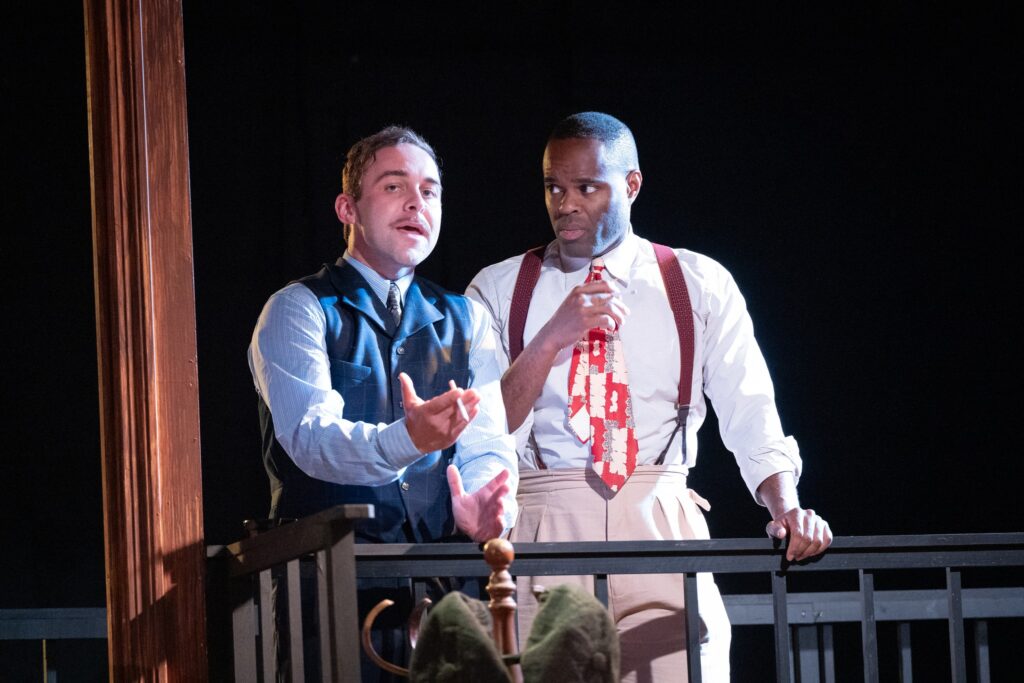
Subtitled “The Gentleman Calls,” these last two scenes are Williams at his heartbreaking best. Jim O’Connor (Patrick O’Konis, 2025 Elliot Norton Award Winner for Outstanding Lead Performance in a Play, Small), the man Tom has brought home, turns out to have gone to high school with the Wingfield siblings. Tom was “the” big man on campus, starring in the school play and excelling at any sport thrown his way. Like Tom, he is disappointed at his current lot in life and his hope to shine again is conveyed by his study of public speaking, radio engineering, and ideas of self-improvement.
The ending is predictably dark (this is Williams, after all), although there are bursts of cheer and light as Jim and Laura reminisce over their very different high school experiences. The real tragedy is that these two do connect in an authentic way, only possible in the living room of a home where its residents live in a dream world.
The acting in this four-hander is uniformly stellar, the direction more than spot on, and the script a critic’s delight. Even if you think you’ve seen The Glass Menagerie enough times for one lifetime, be sure to catch this version at Gloucester Stage through June 28. You’ll be sorry if you don’t.For more information, visit: https://gloucesterstage.com/glassmenagerie/