Reviewed by Michele Markarian
“Titanic the Broadway Musical”. Music and Lyrics by Maury Yeston. Story and Book by Peter Stone. Directed and Choreographed by Kevin P. Hill. Presented by Bill Hanney’s Theatre By the Sea, 364 Cards Pond Road, Wakefield, RI through August 15.
People have been fascinated by the tragic sinking of Titanic, despite it happening over one hundred and fourteen years ago. I have seen at least three Titanic exhibits, featuring artifacts, such as menus and cutlery, as well as photo stories of the ship’s passengers. Haunting and riveting as these exhibits have been, they fail to capture the excitement and atmosphere of the ship pre-disaster in the way that “Titanic the Broadway Musical” manages to convey. Despite a cumbersome book and a forgettable score, under Hill’s direction the talented cast creates an emotional arc that rises above the material.
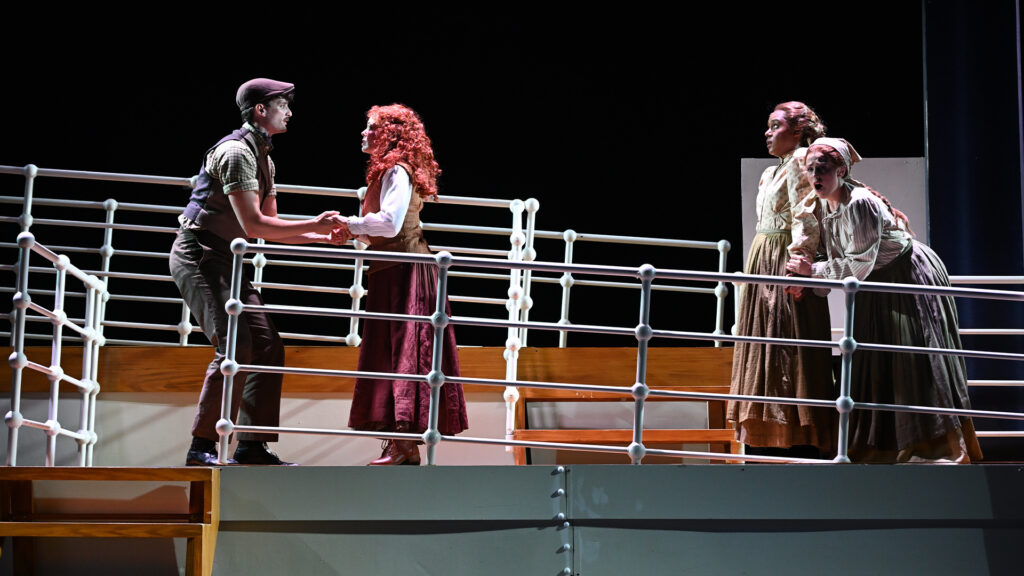
“Titanic” begins buoyantly, with crew members bidding their girlfriends goodbye and greeting excited passengers. One poor soul misses the launch and must forgo the voyage; he runs from the dock crying, “I’ll be the laughingstock of Poughkeepsie!” which is pretty lucky, all things considered. The excitement of Titanic’s maiden journey is palpable. This is a luxury liner like no other, designed to impress as well for safety. Society’s luminaries are on board – John Jacob Astor IV (Alexander Davis) and his pregnant, much younger wife, Madeline (Myranda Rose Silva), Isidor Strauss (Fred Sullivan, Jr.) and his wife, Ida (Dawn Tucker), and Benjamin Guggenheim (Andy McLeavery). A second class passenger, Alice Beane (Kristin Rose Kelleher) is starstruck, much to the annoyance of her husband, Edgar (Miguel Angel Vasquez). One can easily imagine Alice today being equally in awe of the Mar-A-Lago crowd. Also in second class is heiress Caroline Neville (Evan Vertram), who is giving up her status to marry Charles Clarke (Jackson Hurt), a man of lesser stature whom her father does not approve of.
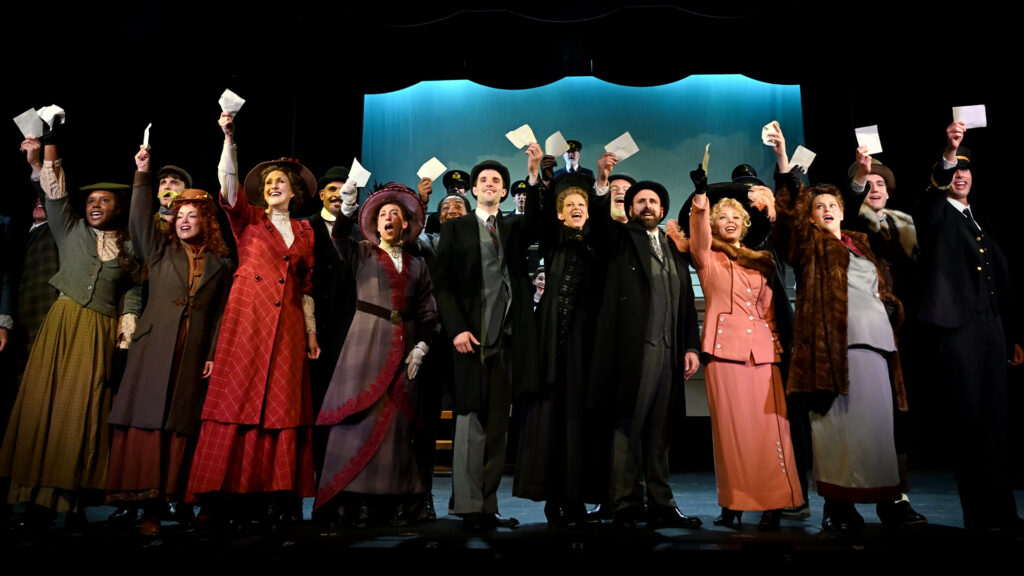
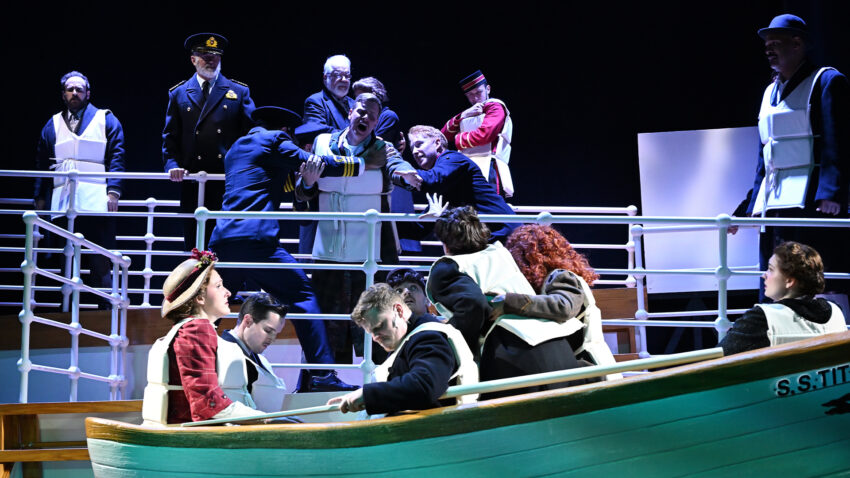
Third class brings three women named Kate, the most outspoken one being Kate McGowan (the excellent Sara Bleything), an Irishwoman on the hunt for someone to father her unborn baby. In addition, there is Captain E.J. Smith (a stately Jeff Williams), First Class Steward Henry Etches (Michael D. Viveiros), leading fireman Frederick Barrett (Brenton Cosier), wireless operator Harold Bride (Skyler Shields) and the villainous J. Bruce Ismay (Nathan Haltiwanger), chairman and managing director of the White Star Line of which the Titanic was part of. Ismay is the unfairly portrayed villain, urging Captain Smith to increase speed so that he could get the ship to New York in record time. In reality, Ismay was devastated and disturbed by the tragedy, which haunted him until the end of his life. Haltiwanger’s one-dimensional portrayal does not help – surely a man who wants something as badly as Ismay does would have more charm? It’s a miracle he wasn’t thrown overboard. By Act Two, we know what’s coming, and it isn’t pretty – first class passengers won’t put on lifejackets, wives and husbands are separated, the closest ship to Titanic doesn’t respond to the distress signal.
The action is played against Cassie McKnight’s excellent scenic design, with its various levels and vivid depiction of a tilted, sinking ship. While the score, in my estimation, is unremarkable (except for “The Blame”, with two riffs that are reminiscent of “Sunday in the Park with George” and “Jesus Christ Superstar”) the cast is full of vocal talent. Viveiros, as both Herbert Pitman and Henry Etches has a gorgeous voice, both speaking and singing. Vertram, as Caroline, is lovely to listen to, and Bleything, as Kate, has a luminous presence. Cosier and Shields, both strong singers, make beautiful music with “The Proposal/The Night Was Alive”. And “Still”, sung by Sullivan, Jr., and Tucker, is very moving, as Mrs. Strauss insists that she can’t leave her husband’s side, even to save her own life.
“Titanic the Musical” won four Tony awards in 1997 – Best Musical, Best Score, Best Book, and Best Orchestrations. So, while I wasn’t thrilled with the material, audiences – including the one at Theatre by the Sea – and The American Theatre Wing disagree with me. That said, the vulgar excess and class distinctions of 1912 feel very similar to what is being played out in America today. See for yourself and let me know what you think.