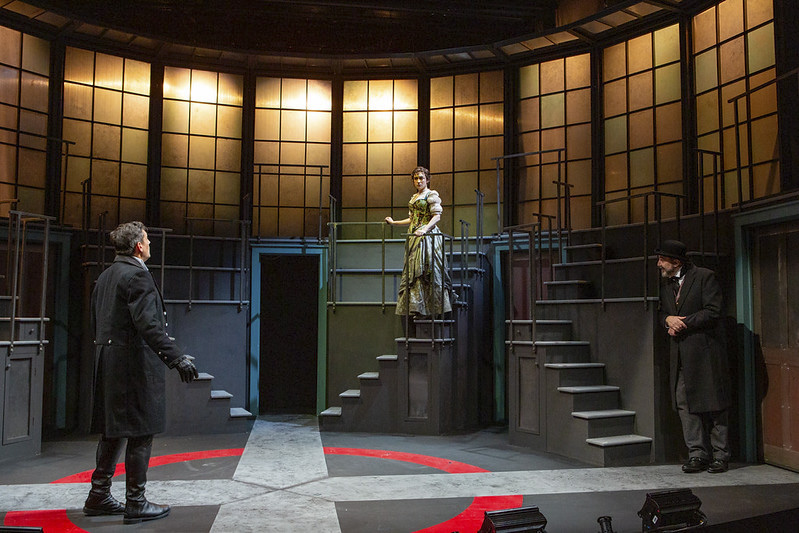
‘Dr. Jekyll and Mr. Hyde’ ─ Adapted by Jeffrey Hatcher from the novella, ‘Strange Case of Dr. Jekyll and Mr. Hyde’ by Robert Louis Stevenson; Directed by Jenny Lavery; Scenic Design by Michael Hoover; Costume Design by Yao Chen;Lighting Design by Brian J. Lilienthal; Sound Design by David Remedios. Presented by Merrimack Repertory Theatre at 50 E. Main St., Lowell, MA through November 1
By Mike Hoban
“Who knows what evil lurks in the hearts of men?” may have been the introductory line from the radio adaptation of The Shadow, the 1930s pulp magazine and radio drama, but it could easily have been applied to the Strange Case of Dr. Jekyll and Mr. Hyde, the 1886 Gothic horror novella by Robert Louis Stevenson. The tale of humanity’s internal struggle between good and evil, personified by the upstanding Dr. Jekyll and his malevolent counterpart, the fiendish Mr. Hyde, is one of literature and film’s most enduring tropes. The story has been adapted into film many times, from a 1920 silent version starring John Barrymore to later productions featuring Spencer Tracy, Michael Caine, and John Malkovich in the lead role. There’s even a Looney Tunes cartoon version starring Bugs Bunny.
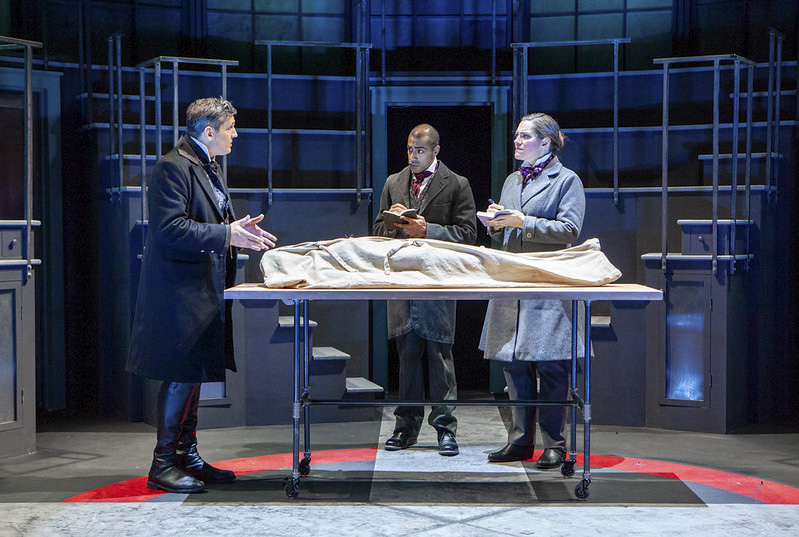
The story is also this year’s Halloween entry by Merrimack Rep, continuing its tradition of producing psychological and horror-themed plays for the holiday. The production adapts Stevenson’s masterwork through prolific playwright Jeffrey Hatcher, and while it deviates from the original ─ adding a love interest for Mr. Hyde in the form of chambermaid Elizabeth (Sarah Danko), for instance ─ it retains the story’s core.
Dr. Jekyll (Andre Martin) is a well-respected physician who secretly conducts unorthodox, pioneering experiments on himself designed to separate the good and evil within. When he ingests an elixir that he formulated in his private laboratory, he is transformed into his dark side ─ a vile, violent, conscienceless hedonist. In Hatcher’s adaptation, his inner demons are portrayed by multiple actors within the play, reflecting the shifting nature of his suppressed internal conflicts. The story is told in part through a series of monologues (much of it pulled directly from the original text) by Jekyll himself and his friends ─ lawyer John Utterson (Ed Swiney), Dr. Enfield (Brent Charles), Dr. Lanyon (Herman Gambhir), and his butler, Mr. Poole (Amber Quick).
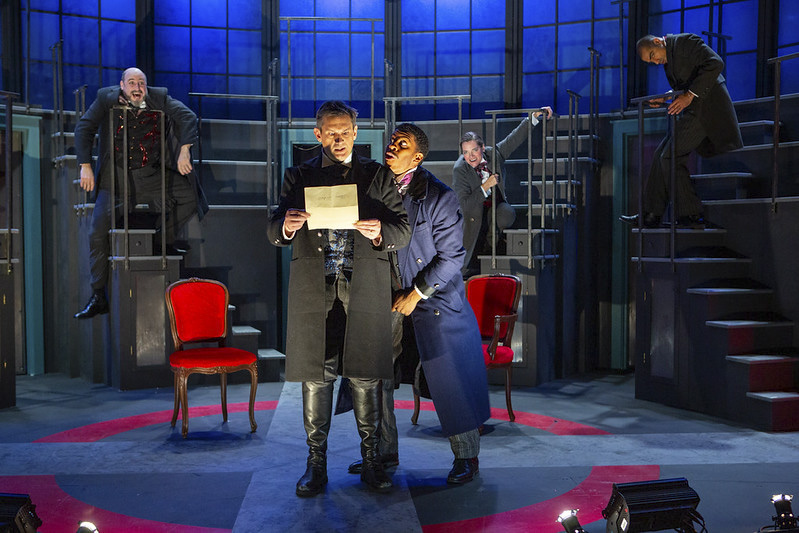
When Utterson encounters Hyde after Hyde has assaulted a young girl and her family is demanding compensation, he is shocked and dismayed to find out that he is somehow connected to his friend Jekyll. Suspecting fraud, Utterson takes his concerns to Jekyll, only to discover that the physician does indeed have a working relationship with Hyde. As Hyde ramps up his abhorrent behavior, brutally beating a rival physician to death with his cane and leaving a trail of mayhem, Utterson, with assistance from the others, begins assembling the pieces of the puzzle. Meanwhile, Jekyll is increasingly losing control of his experiment as Hyde begins to dominate, and the slide into evil is chilling.
The Jekyll and Hyde story has often been seen as a metaphor for addiction, more specifically alcoholism, and the parallels are striking. From the lack of recall of the previous evening’s events, to the progressive inability of Jekyll to resist the temptation of acting out as Hyde, to the violence and his warped relationship with Elizabeth, the correlation is apt.
Dr. Jekyll and Mr. Hyde is a first-rate psychological thriller, delivering genuinely frightening moments that befit the genre. The talented ensemble rises to the task this demanding script requires, particularly as actors double and triple in various roles, differentiated by accents and class. The same actors playing multiple roles can be challenging for the audience, and the Victorian-era language requires audiences not to treat this as passive entertainment.
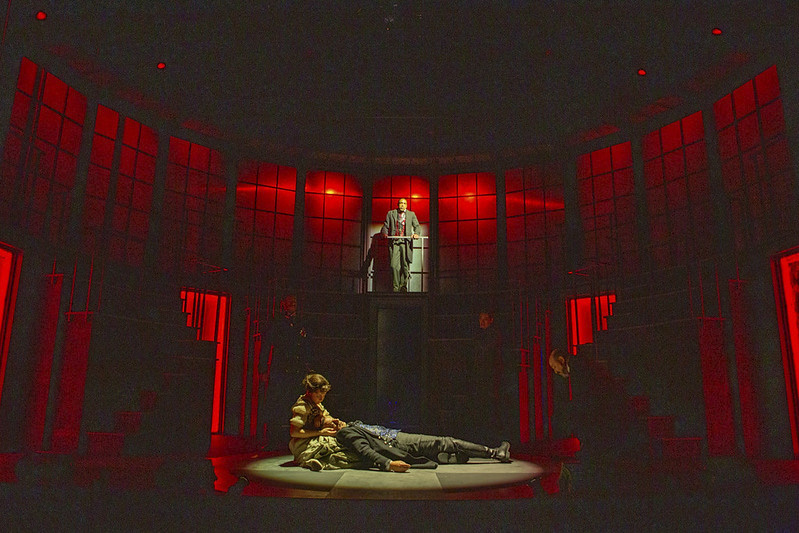
As with any horror-themed production, lighting and sound are pivotal to creating an atmosphere of dread, and Brian J. Lilienthal’s lighting and David Remedios’s sound design dramatically enhance the mood. Michael Hoover’s magnificent multilevel set is as glorious to look at as it is functional, serving seamlessly as a lab, surgical theater, hotel room, and town square.
MRT’s Dr. Jekyll and Mr. Hyde closes this weekend, and for theatergoers who prefer a more intellectual bent over slash and gore for their Halloween fare, it’s just the ticket. For more information and tickets, go to: https://mrt.org/
