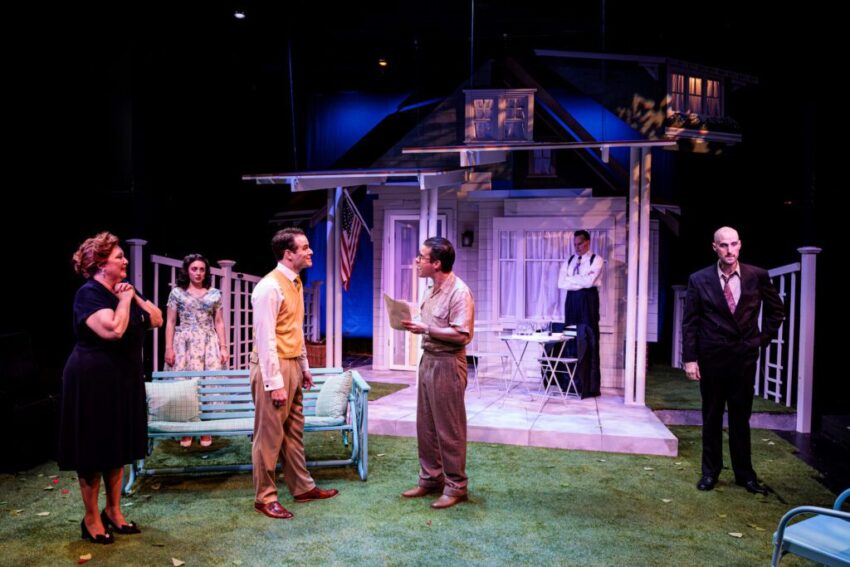
All My Sons ─ Written by Arthur Miller; Directed by Scott Edmiston; Scenic Designer, Janie E. Howland; Lighting Designer, Karen Perlow; Costume Designer, Chelsea Kerl; Composer & Sound Design, Oleg Smirnov. Presented by Lyric Stage Boston, 140 Clarendon St., through October 18
By Mike Hoban
It may only be September, but you’re unlikely to see a more compelling drama this theater season than Lyric Stage’s devastatingly tragic production of All My Sons. Penned two years before his masterwork, Death of a Salesman, Arthur Miller’s bleak commentary on the disturbing shift in American values post-WWII is frighteningly relevant today, as morality and integrity increasingly take a backseat to accumulating wealth, influence, and authority for far too many powerful Americans.
Like Death of a Salesman, the central figure is a father of two young men, only one of whom returned from the war. Joe Keller (Bill Mootos) and his dutifully supportive wife Kate (Laura Marie Duncan) have bought into the mythical American Dream ─ one that endorses measuring their lives by a set of metrics that elevate a warped brand of “respectability” over responsibility and caring for the well-being of others ─ which will eventually be shattered by the blinding light of truth.
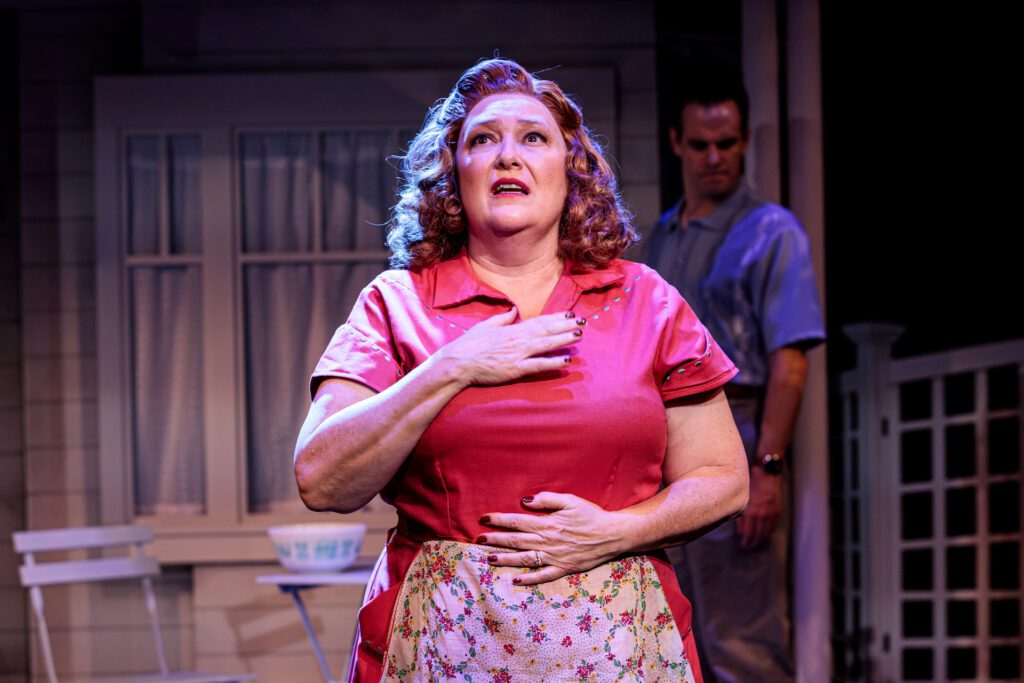
It’s a few years after WWII, and the war has taken a brutal toll on countless families. Joe and Kate’s son Larry was reported missing in combat during the war, but Kate cannot accept that he’s not going to return. Joe is a self-made business owner whose company supplied engine parts for the Army Air Forces fighter planes during the war, but was rocked by a shameful scandal when it was discovered they had shipped cracked cylinder heads, resulting in the deaths of 21 fighter pilots. Joe and his partner, next-door neighbor Steve Deever, are prosecuted and sent to prison, but Joe is exonerated while the disgraced Steve takes the fall, losing the respect of the community and his children, who do not speak to him.
The Keller’s other son, Chris (Mark Souza), a fighter pilot like his brother Larry, returned home safely from the war and went to work helping to manage his father’s business. Chris has invited Ann (Josephine Moshiri Elwood), Larry’s former girlfriend and Steve Deever’s daughter, for a visit ─ and to announce their intention to wed. Set entirely in the Kellers’ backyard, a kind of communal gathering spot for the neighborhood, the sins of the past will come to light, leaving a new, uncertain path for the affected families and America itself.
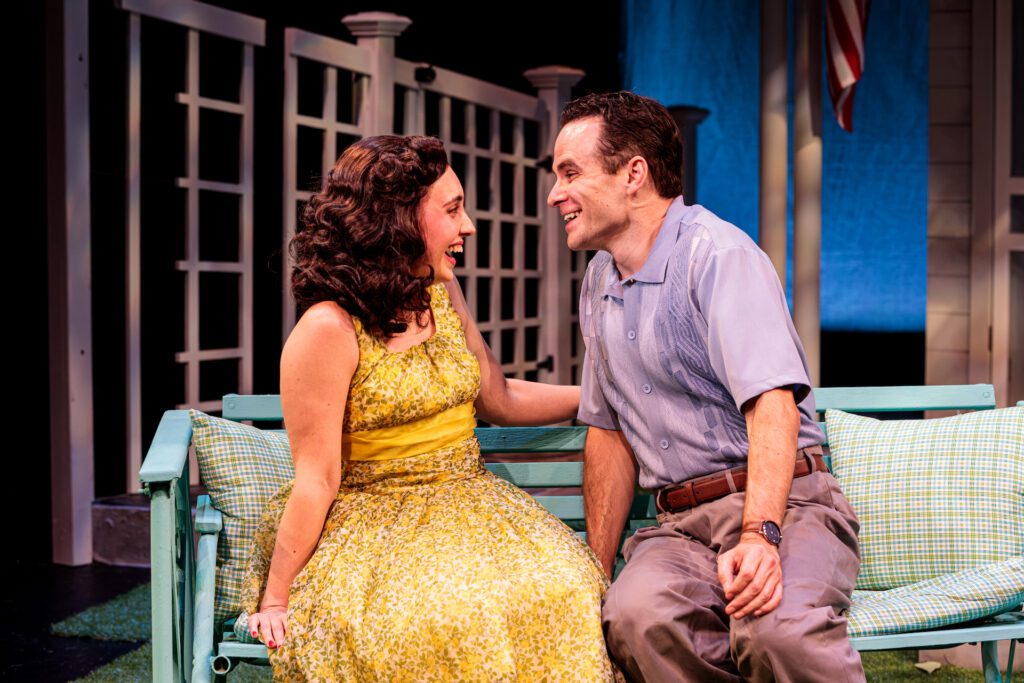
Miller is a masterful storyteller, methodically releasing breadcrumbs of information and slowly letting us discover not only the truth behind the crime but also the choices the players make to keep their worlds intact, no matter the price. He also makes clear that virtue comes with its own price. When a neighbor belittles Chris to Ann for his idealistic view of his father and his decision to marry his deceased brother’s girlfriend, Ann responds, “I don’t know. I think it’s mostly that whenever I need somebody to tell me the truth, I’ve always thought of Chris . . . . He relaxes me.”
Chris is the moral compass of the story, first as a patriot returning triumphantly from the “war of necessity,” then later as he becomes the archetype for those who questioned the machinations behind the conflict and the twisting of American ideals into something unrecognizable ─ although not to the degree of today.
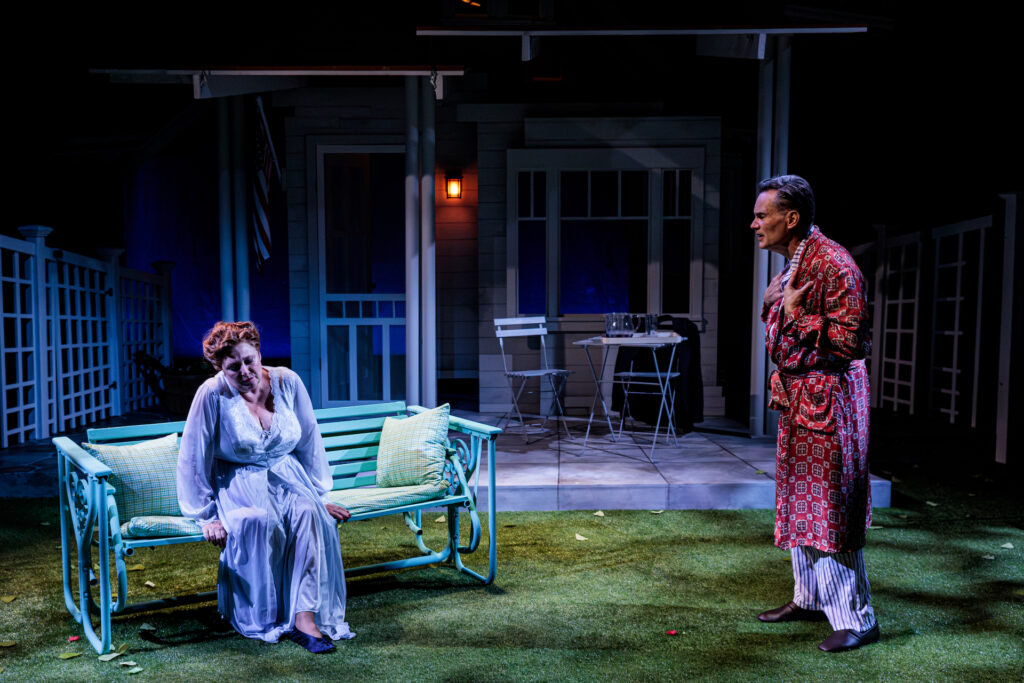
All My Sons, inspired by real-life events and winner of the first-ever Tony Award for Best Play in 1947, is an unquestionably brilliant work that is fully realized in the Lyric’s powerful production. Seamlessly directed by Scott Edmiston, the cast, particularly the leads, is superb. As Joe, Mootos masterfully seduces us with his everyman charm before revealing his deeply misguided ─ and disingenuous ─ sense of morality as his world disintegrates. Duncan embodies the warm matriarch of not only her family but the neighborhood, painstakingly concealing her steely interior.
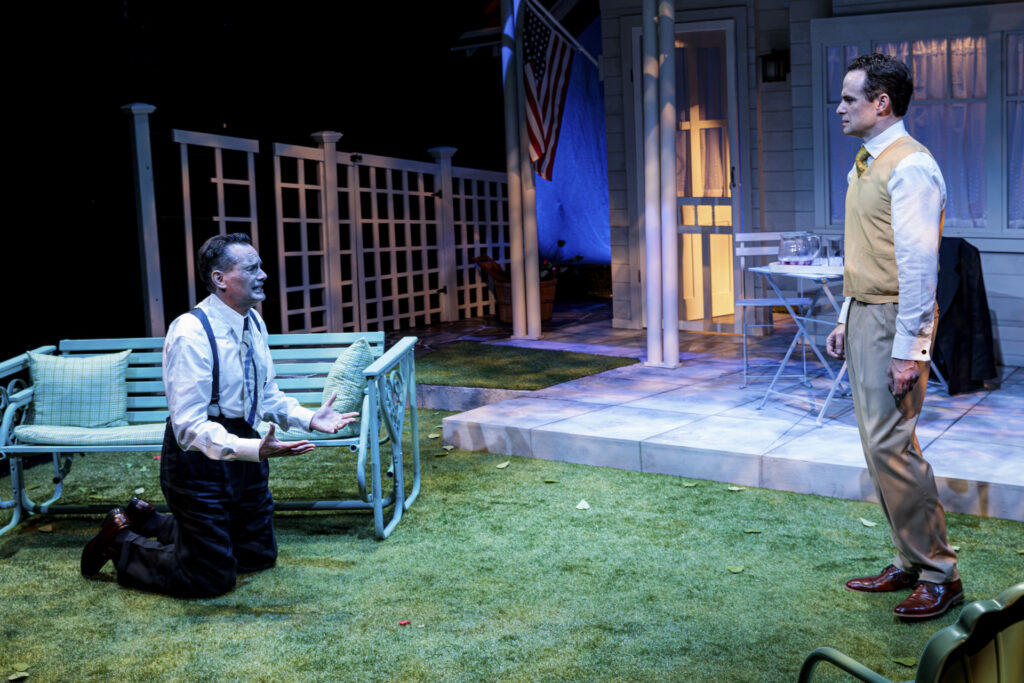
Elwood, who seems to be the most in-demand young actor in Greater Boston (and deservedly so), gives a beautifully understated performance as the conflicted Ann, and Souza’s transformation of Chris from a principled idealist to a disillusioned pragmatist feels deeply authentic. Janie E. Howland’s simple set effectively conveys the suburban, post-war, middle-class Midwest (the play is set in Ohio).
All My Sons is an impactful piece, and the first must-see for devoted Boston theatergoers this season. Sadly, it’s also a stark reminder that we’re still living in a world where profits trump integrity. For more information and tickets, go to: https://www.lyricstage.com/