Reviewed by Julie-Anne Whitney, Editor
1972, a world premiere rock opera with music and lyrics by Chadwick Stokes, book by Chadwick Stokes and Jessie Nelson; Directed by Jessie Nelson; choreography by Jill Johnson; scenic design by Amy Rubin; costume design by Nicole Jescinth Smith; lighting design by Ben Stanton; sound design by Justin Stasiw. Presented by American Repertory Theater at Farkas Hall in Cambridge, MA through December 6, 2026.
For more than 150 years, a person’s right and access to a safe abortion has remained the most hotly debated issue in the United States. In the mid-1800s, male American physicians overtook and undermined the practice of midwifery thus limiting access to care. In the late 19th and early 20th Centuries, strict sexual norms led to increased social stigma and decreased access to healthcare information. In the 1950s, married couples were not allowed to use birth control. By the ‘60s, increasingly limited access to abortions led to dangerous and sometimes deadly procedures for pregnant people.
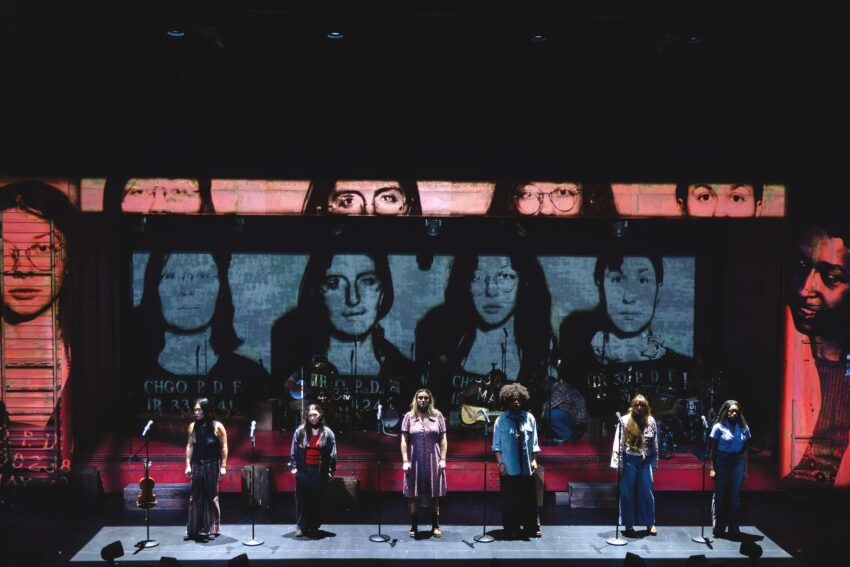
From 1969 to 1973, The Jane Collective, an underground activist group in Chicago, bravely defied the law to help people access safe (albeit illegal) abortions. Using a secret network of volunteers with complex and meticulous confidentiality procedures, the collective provided abortions and counseling to 11,000 pregnant people until the Supreme Court’s 1973 historic ruling, Roe v. Wade, which finally legalized abortion across the United States.
A.R.T.’s world premiere rock opera, 1972, begins 50 years later in 2022, when the Supreme Court overturned that very same landmark ruling. The story then immediately jumps back in time where we meet pregnant 19-year-old Hannah (Gracie McGraw) who, after being repeatedly abused by her boyfriend, decides to run with nothing but the clothes on her back. Following the train tracks out of town, she meets three fellow outcasts, Depot (Chadwick Stokes), Pinto (Will Urmston), and Eddy (Darren Buck) who befriend her, teach her how to hop a train, and help her find an abortionist in Ohio. While waiting in a dark and dirty room in the middle of nowhere, Hannah meets a scared young girl, Louisa (the impressive and memorable Jackera Davis), who dreams of being an astronaut and going to the moon. After escaping the dodgy abortionist, Hannah says goodbye to her friends, and hops a train to Chicago where she meets The Janes (Khaila Wilcoxon, Hannah Foxman, Jackera Davis, Darby Paterson, and Brit King), a group of women who offer safe abortion services from their homes. They offer her a cup of tea and tell her not to worry if she can’t pay. After her procedure, Hannah decides to join The Janes and help to build “a new world one woman at a time.”
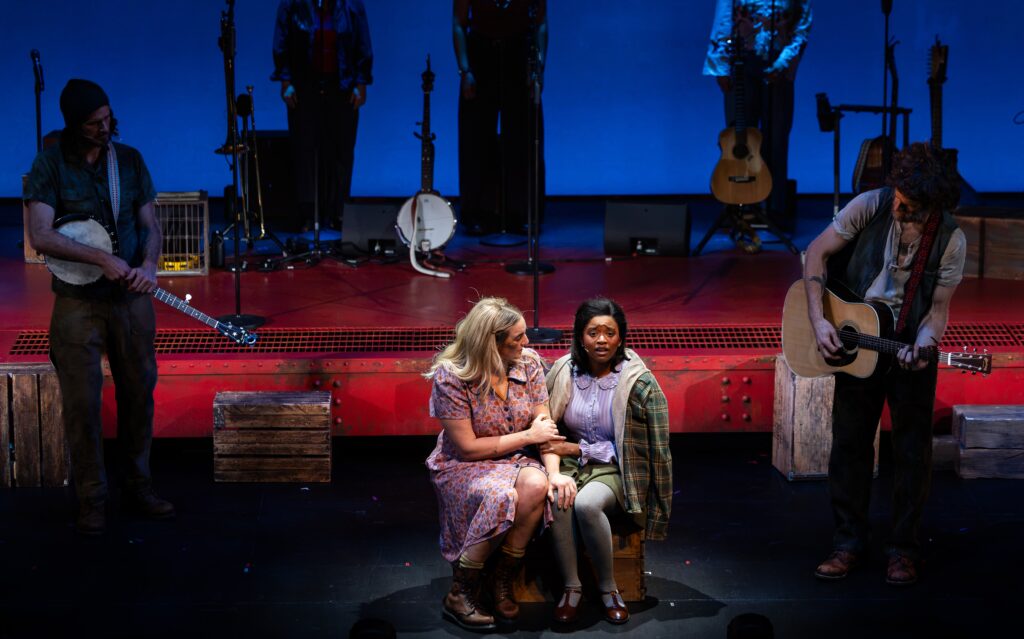
The show is described as a “heightened concert” which is exactly what it sounds like. The songs are performed in a concert style with microphones and instruments, and heightened theatrically with 70’s-inspired character-focused costumes (Nicole Jescinth Smith), emotionally driven lighting design (Ben Stanton), simple but intentional staging (Jessie Nelson) and unshowy, music-led choreography (Jill Johnson). While scenic designer Amy Rubin puts the cast in a train box car, she never lets you forget that it is also a concert stage– and this stage is a platform for rebels. Rock music has, historically, been a form of societal rebellion and this story is a rebellion against the control and harm of women’s bodies. The six male musicians are, literally and metaphorically, a rag tag band supporting and accompanying Hannah on her journey.
The structure of the show, conceived by Chadwick Stokes and co-written by Stokes and director Jessie Nelson, is interesting. Some songs are character-driven (i.e. sung/performed in character) and others are more narrative (i.e. performed collectively and not always in character). In the beginning, the three outcasts Hannah meets act as typical hero’s journey guides, but once she meets The Janes, the men fade into the background– a solid choice for this particular story– and essentially become a traveling band inside the boxcar while Hannah and The Janes remain front and center. Some songs felt extraneous like “Bird in Hand,” which gives backstory into the three outcasts, “The Months,” which is an expansion of Hannah’s story of abuse, much of which we learn just three songs earlier with her opening number, “Loaded Nissan”, and “Many Somewheres” which, sadly, killed the energy after the showstopping number, “It’s For You Jane,” led by the astonishing Khaila Wilcoxon whose powerful performance nearly stole the show. Other songs felt destined to become anthems, like “Cry Out” (“cry out for the country, cry out against the king, cry out for the court and the power they bring”), “It’s For You Jane,” (“it’s your god-damned body and your god-damned choice”) and “Chicago” (“you’re emblematic, patriotic, enigmatic…fight the systematic with the empathetic…”).
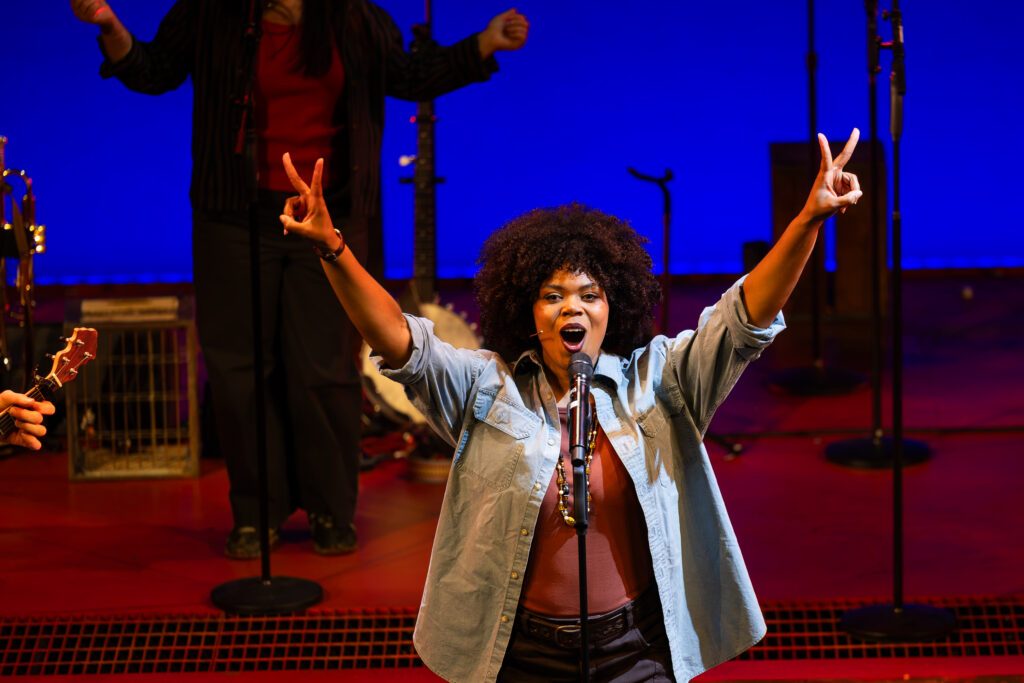
Stokes’ original music is layered with rich tones and harmonic sounds. The use of the violin (played with fire and flair by Brit King), banjo, and Stokes’ handmade oil-can guitar were lovely and, often, highly effective additions to the rock-centered sound, but they were sometimes drowned out by the overpowering drums. Stokes’ songs are rife with feminist, defiant, hopeful lyrics. Some of the songs are so good, it makes you wish you knew them so you could sing along. Gracie McGraw brings outstanding vocals to the role of Hannah. Her voice is clear, strong, and full of emotion, but her acting is less so. And Jessie Nelson’s thoughtful direction brings a lot of moving, imperfect parts together to create something whole and empowering.
A.R.T.’s rousing production of 1972 will bring you to your feet. It was particularly moving to experience the show the day after the 2026 midterm elections– both of which were a reminder that while we might sometimes “cry for the country and the state we are in,” the fight for a better world is never ending. For 50 years, abortions were (mostly) safe and accessible in this country– and now they’re not. So, as always, the fight continues.
