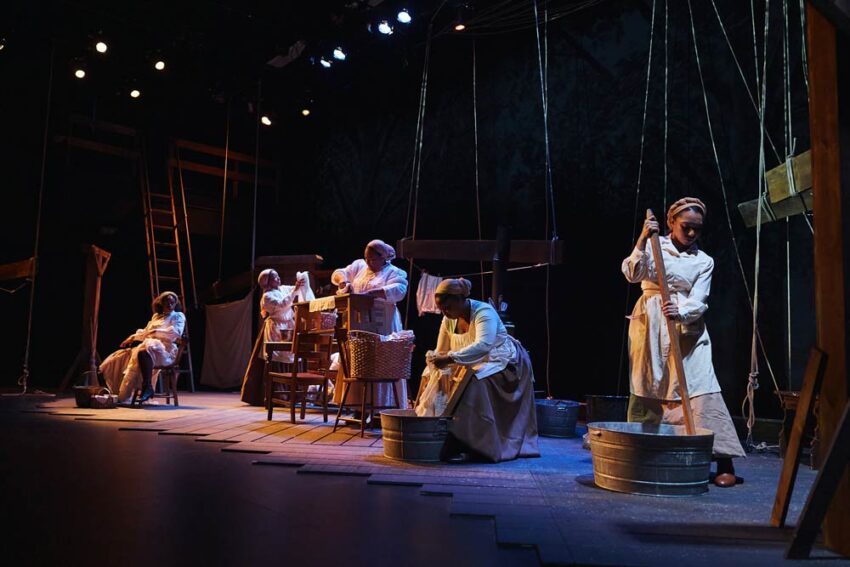
The history of workers’ rights in America is one fraught with tales of poverty and violent oppression, and often those tales center on white male workers. But one of the earliest and most influential workers’ actions was driven by washerwomen of color in Atlanta, Georgia. The Washerwomen’s Strike of 1881 is fairly well documented, if you know where to look for it, but it’s not something that dramatizations of the labor movement tend to celebrate.
Playwright Kelundra Smith not only remembered the Washerwomen’s Strike of 1881; she wrote a play about it, The Wash, in which a collective of hard-working washerwomen grow tired of being paid in canned goods or used clothing instead of cash — if they got paid at all. The play’s setting reflects the harsh inequities of the age faced not just by people of color, but virtually all women: Anna, the owner of the house where the washing is done, cannot be the legal owner of her home; that’s a privilege reserved strictly for men. Thus, Anna has to navigate a tricky situation just to pay her property taxes, given that her husband is dead.
To pay those taxes, though, Anna and the woman who work with her — including the skeptical Jeanie, as well as younger women like Tomasina, who is struggling against domestic abuse, the newly wedded Charity, and Jewel, who remains unmarried because it’s not men to whom she is attracted — need to formulate some way to press their case and collect the money they are earned. Their innovations will inform subsequent labor actions, and their cause only grows in strength as washerwomen, including white washerwoman, step up in solidarity.
The Wash is a story that remains more than worthy of telling, and Front Porch Arts Collective has made it the opening production of their 10th Anniversary Season. Front Porch cofounder Maurice Emmanuel Parent sat down with Theater Mirror’s Kilian Melloy to discuss the play’s historical context and its current resonances.
Theater Mirror: What drew you to The Wash for this season for Front Porch?
Maurice Emmanuel Parent: It was a script that was brought to us by Tasia [Jones], the director. We met [Kelundra Smith] at the National Black Theater Festival a couple summers ago. We liked the script, but we wanted to do a reading of it to see how audiences would respond…and they loved it. I was like, “We should listen to that.” Also, we love the story in thinking about a professional, Black-centric theater company that makes work for the entire Commonwealth to enjoy. What can we be putting out there? Moments of Black cultural history like this, which really was an inspiration for the modern labor movement, seemed really right.
Theater Mirror: This play suggests that there’s a connection between the oppression of workers and racism. Do they share a root cause?
Maurice Emmanuel Parent: I think they both come from the same psychological desire for hoarding of power and dominance. That power shaped oppression of workers and made it very specific to different groups. For Black folks, it became racism. But [for white] immigrants, people were their country. Irish and Italians were very low in status and were mistreated. There’s a play that we did a reading of about this, where in the early colonies — I’m not a historian and might get some of this wrong — Black people and Irish immigrants had similar status. As soon as the power structure saw that [immigrants like] the Irish looked more like them, that’s when racism was invented. And that’s [something] we still see today. What is the difference between certain people at all levels of the workforce, even at the executive level? They have the same work life, they have the same income, they have the same amenities and strengths, but then there’s friction. It’s from design. I think it was created as a way to uphold the systems of power.
Theater Mirror: Standing up and demanding what you deserve, as the washerwomen in Atlanta did in 1881, is an inherently political act. Was that part of the reason for putting this show on just after the midterms?
Maurice Emmanuel Parent: The politics of the show is exactly why we’re putting it on…the politics, the female power, the camaraderie. There’s a white character that comes in of similar economic strata. Wouldn’t it be great if we can just see that commonality and come together and bridge racial divides? That intrigued me about this play, and it’s something I love about it.
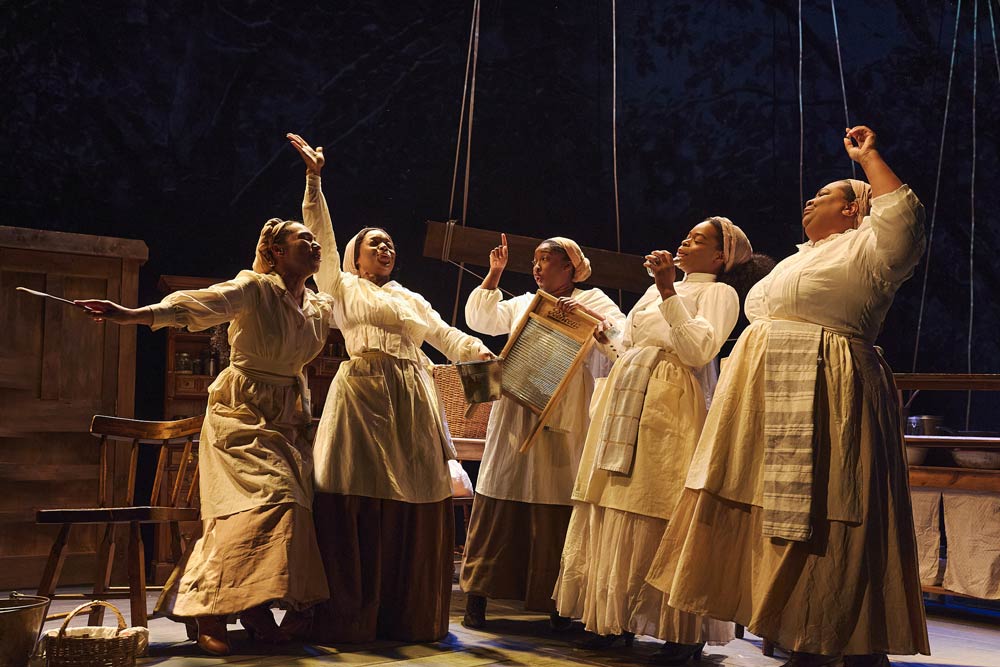
Theater Mirror: Director Tasia Jones, in a comment to the Boston Globe, said this: “Black women have always been at the forefront of movements.” Why has that role so often fallen to Black women in particular, and why don’t they get the credit they deserve?
Maurice Emmanuel Parent: Sexism and systemic disruption of the Black family. I think there are many historical landmarks now, [but] history is being erased and rewritten and deprioritized. Women have always been anchors for culture, particularly Black culture; we see women in particular leading the charge in many areas, and because of sexism, men will get the shine. And also, the laws they talk about in the play: Women couldn’t own property; they couldn’t pay their taxes. Anna owns a house and has to lie and say her dead husband’s still alive and working out of state, so they don’t take her home.
Theater Mirror: One aspect of the play that was unexpected and very welcome is that there’s some LGBTQ+ representation. What, to you, does that add to the play?
Maurice Emmanuel Parent: Front Porch, and many other theater companies, is led by people who are part of the LGBTQ+ community, so that just feels great. I think what it adds is the show has women who are open about their faith and their Christianity, and that’s a beautiful thing. Similar to the racism conversation we’re having, one character who has been vocally opposed [to the strike] says that all Christianity asks people to do is love, and there can’t be anything wrong with that. If the only thing that makes me hate you is I was told you’re bad, but I see you and you’re a person just like me — a person who has desires and hopes and love, just like I do —why should I hate you? We’re both after love. We’re both after companionship. We’re both after peace in this crazy world. Let me see the obvious truth that we’re better together. You’re a wonderful person. You do good work. You’re smart. But I’m supposed to hate you because of this rule? That’s when you get to break down those structures. I love that Mozelle [a white washerwoman] comes in and [joins the cause]. We get to interrogate that friction that is imposed from controlling entities. If you are with a sister in arms and washing, you both need to protest.
Theater Mirror: The play has an all-female cast, so I wonder if that was part of the appeal when it came to programming The Wash for this season.
Maurice Emmanuel Parent: Yes, that was very much part of the appeal, and also part of our approach to building the creative team. Tasia…wanted to build as much of a female creative team around the play as possible, and that’s really important. The Front Porch is a majority female-identifying company, and we are acutely aware, as Black people running a Black theater company, of exactly what you started this conversation with: The erasure of Black women’s contributions. It’s great to have this moment of history, highlighting a truth that counters the narrative that erases Black women so we can say, “When you think about the modern labor movement, do you think about Black women? Probably not. Well, here is a play that helps you interrogate that, and change that.
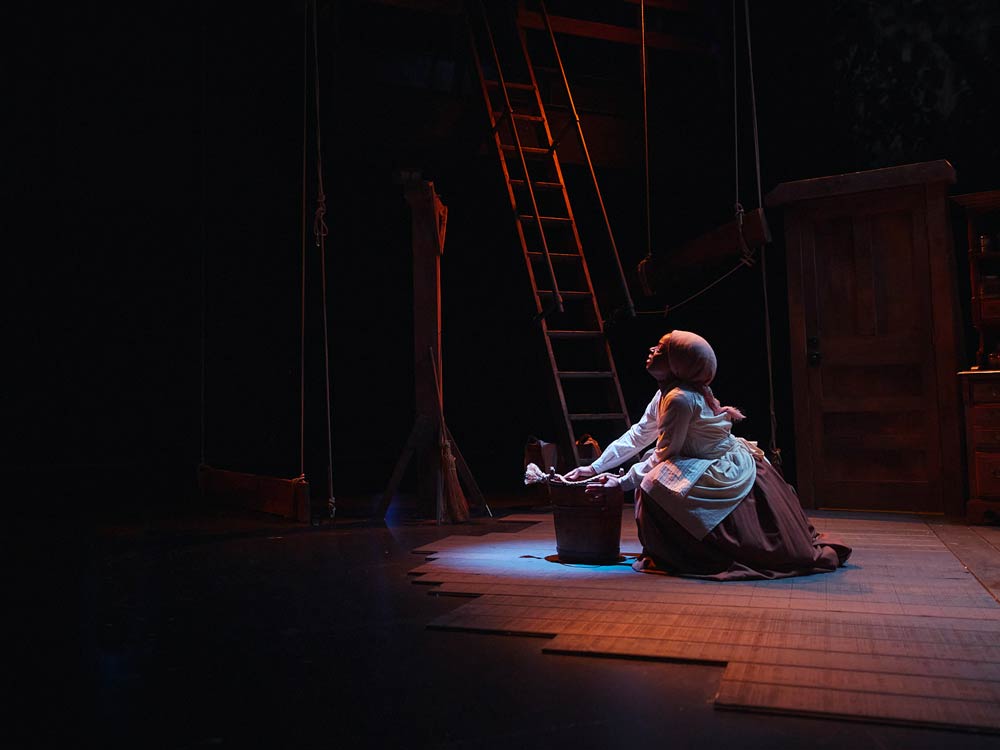
Theater Mirror: This is not just a play about standing up for what you deserve in the workplace, but also in your home and in your life. There are women in the play who drop their abusive husbands and who move forward in their lives in different ways, and it feels like that’s all stemming from what has begun in the washing collective.
Maurice Emmanuel Parent: Yes. They all change and grow in different ways. One character has something that has always been there, but they keep hidden. One person’s questioning their place in the world and finding it. People are faced with love and embracing it.
Theater Mirror: Mozzelle has one of the most memorable lines when she says, “Something’s got to be bigger than race.” What, to you, would that be?
Maurice Emmanuel Parent: Community, family, love. Maybe that’s why I started a Black theater company. You can honor racial and cultural difference, and uphold it, and it doesn’t have to be your own. You can understand our racial differences, and be above racism. I love my race. I want to be nothing else. But I can also recognize and love other races and go to Ireland or go to Iceland, and find commonality. Once you get above that, you do see our shared humanity. At the end of the day, we’re all humans. We all have the same desires. Our shared humanity is bigger than race, and it’s informed by race, and made better by it. That is racial love and appreciation and true multiculturalism, right?
The Wash plays through Nov. 22 at the Stanford Calderwood Pavilion at the Boston Center for the Arts in the Roberts Studio Theatre.
