Interview by Kilian Melloy
Frankie and Johnny in the Claire de Lune, presented by The Psych Drama Company, runs June 18 – 28, 2026 at the BCA Plaza Black Box Theatre in Boston.
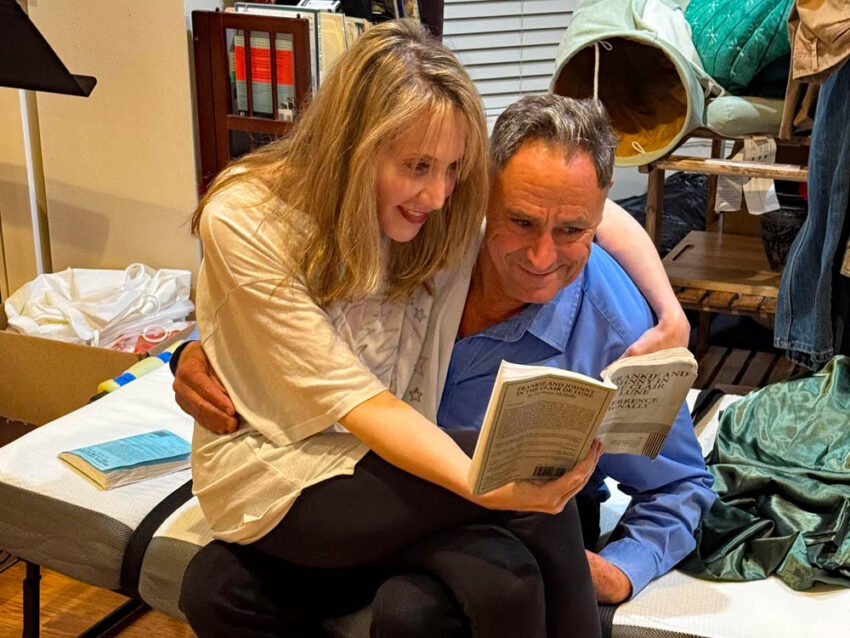
Two lonely souls connect in Terrence McNally’s play Frankie and Johnny in the Claire de Lune; the play begins with their cries of passion. But will a memorable night be all that passes between them? Or will this be the start of something more? For Frankie, played by Wendy Lippe in The Psyche Drama Company’s production of the 1986 two-hander, a one-off might be ideal; she’s been hurt… all too literally… in love before, and she doesn’t want a repeat. But for Johnny, played by Cliff Blake, the stars of romantic fate have aligned, and he’s willing to spend until dawn, if need be, pleading his case. It’s moonlight, the madness of infatuation, and the terror of intimacy in the New York City-set drama, which Broadway star and theatrical director Julia Murney helms in her Boston directorial debut.
Lippe and Murney have known each other for decades, having been at the BFA program at Syracuse University together, as well as the Carnegie Mellon Summer Institute in Musical Theater, and, even before that, at the Stagedoor Manor [ https://stagedoormanor.com/ ] summer camp. The two even survived what might have been a fatal car crash on a wintery night.
“We were driving back to the Syracuse University program,” Lippe recalls during our Zoom call. “I had fallen asleep. Julia was at the wheel. She slammed on the brakes on the ice, and when I woke up to her screaming, we were literally doing 360s down the highway. To the left would have been death, and to the right was a snowbank.”
“We have different memories,” Murney demurs. “I remember us going into the snowbank, but the car did not turn on its side. We were stuck in the snowbank in the wrong direction, and had to get towed out, but Wendy’s very deep imagination brought us to the brink of death.”
What they both recall is how an innocent twist of fate spared Murney from death aboard flight Pan Am 103, which was brought down by a terrorist bomb on December 21, 1988, over Lockerbee, Scotland.
“I studied in London, and it was at the end of the semester, and I was at the top of the wait list for that flight,” Murney recounts. “I just didn’t make the call because I already had somebody to go to the airport with. It was just kind of haphazard. There was nobody else from our program on the flight that I was taking.”
But a number of their fellow students were not so lucky. Lippe, who is the founding Artistic Director of The Psych Drama Company, has memorialized them with this production; text in the show’s program notes that Lippe is dedicating her performance in the production to those lost classmates.
Wendy Lippe and Julia Murney chatted with Theater Mirror’s Kilian Melloy about how their lives had crisscrossed over the decades, how they reconnected, and why Lippe brought her old acquaintance to Boston for this production.
Theater Mirror: Julia, you famously played Elphaba in a national tour and on Broadway in Wicked. Are you surprised to see how well Wicked the movie has done — how popular it is, so to speak.
Julia Murney: I’m not surprised, simply because it’s Wicked. The extraordinary lightning in the bottle that they caught was the [result of] the recognition factor of The Wizard of Oz. People thinking, “Oh, those are characters that I know” is what drew them in initially. It did feel like the audience was predisposed to loving it in a way that was fascinating. I’ve also been in shows that were definitely not that, so it’s interesting to be in that kind of a hit, especially since I was in it very early, when it was very new. Now there are people who saw it as teenagers who have children they are forcing to go see Wicked, they love it so much.
Theater Mirror: You’ve also appeared on countless TV shows — Sex and the City, Law and Order, Thirty Rock, Brothers and Sisters. Is directing a very different experience to acting, would you say, or are they extensions of each other in some way?
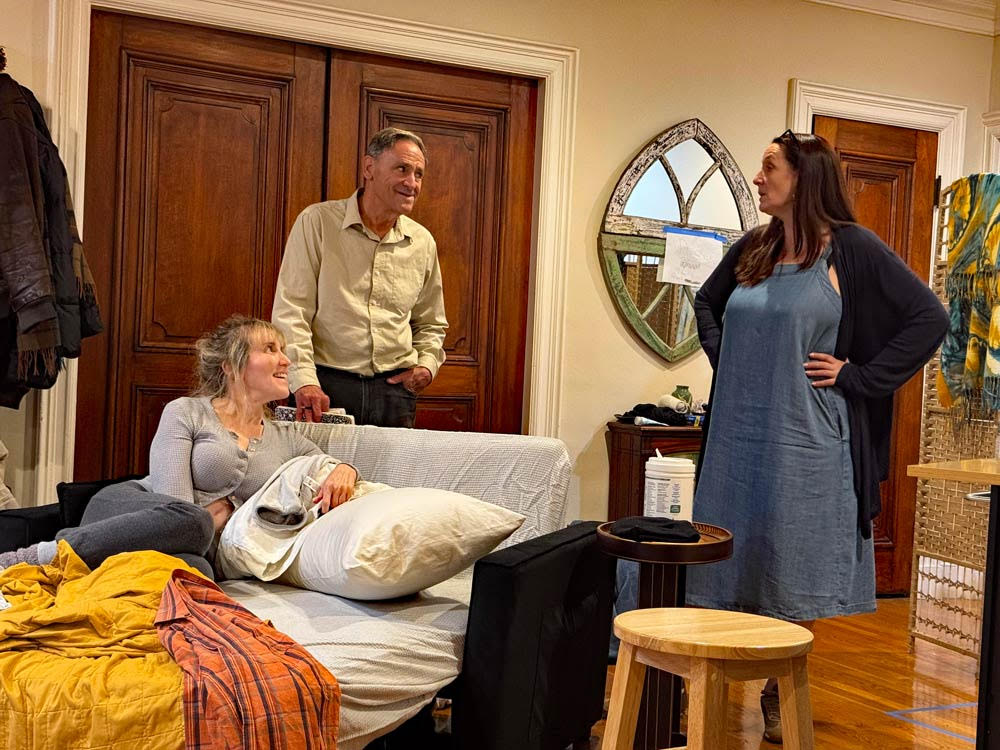
Julia Murney: Oh, they’re definitely extensions of each other. I love acting, but I also really like directing, and it’s nice to think about not having to pick one. You can’t give notes to people that are just the way you would do the play; you have to give notes based on how you’re viewing the play and what the characters are saying. [Frankie and Johnny] is the first play I’ve directed that is only two people and only one location, which doesn’t sound like it should make a difference, but it does. [When] shows change location, that’s part of the character of the show. Figuring out ways to make that interesting and flowing, those challenges are fun.
Theater Mirror: How do you approach those challenges, as well as the way the play pretty much unfolds in real time?
Julia Murney: Initially, it was just reading it and absorbing it and knowing the general gist of what you want for this play to be in the apartment and working with our set designer in terms of where those things get set up. In any kind of a regional theater setting, you’re dealing with specific spaces, and specific things that a space can do or not do. When you’re doing an L shape or in the round, you have to stage things differently. Someone’s always going to be behind you in the round. I did Evita in the round in California, and that was the first time I had ever done it; I remember at one point I went to turn around to, like, [makes a throat-clearing gesture] before I sang something big, and realized, “Oh, there’s a person sitting right there, I can’t clear my throat!” You have to figure that that sort of thing out.
Theater Mirror: Another thing that might be a challenge is this play was written in the ’80s, and there are certain elements of it that might be dated or even problematic. For example, the way Johnny is pressing so hard in his courtship; Frankie’s telling him, “Back off, go away, you’re a creep,” and he’s saying, “No, no, I want you, and I’m going for what I want.” His ardor could slip into something you may not want him to be doing. How are you walking that tightrope?
Julia Murney: I completely agree with you. This is the kind of a play that says, “The time is the present” at the beginning. Frankly, it could not take place at the present. I have firmly placed it in 1986, which is when the play was written. I mean, you can’t place it by saying it’s 1986, but you can hint at it in set dressing, in there’s a radio and there’s a DJ, and there’s pre-show music, and all those sorts of things leading people into that world.
The thing that stuck out to me is that she asks him to leave numerous times, and he doesn’t — which, to me, I’m like, “Stranger danger! What are we doing?” But that’s the play, and, unfortunately, Terrence isn’t here for me to ask. So, we have to figure out a way to say the lines he’s written and not make them sound like this creepy man who won’t leave her home. You want to root for them, you don’t want to be like, “Girl, get him out of your house!” — which is how you could potentially feel. So, we’ve tried to gently lean it into other directions.
Theater Mirror: Wendy, how are you playing Frankie? Are you presenting her in a way in which people will say, “She can handle herself — he’s a nuisance, but he’s not a danger to her”?
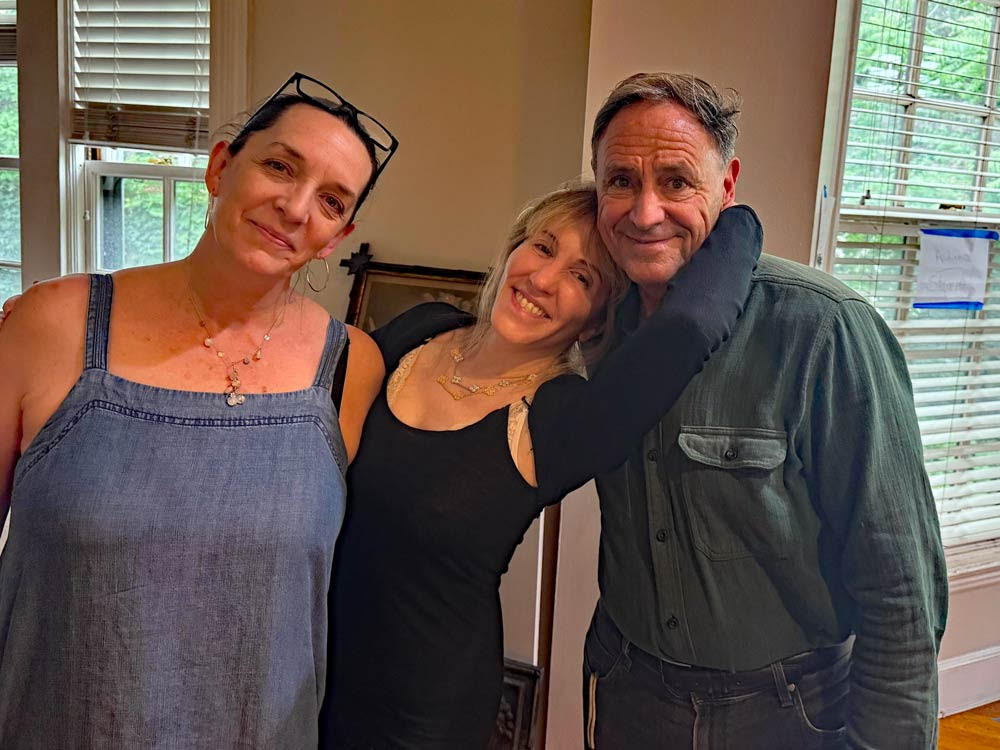
Wendy Lippe: I think the text is quite a challenge, because she goes back and forth between being charmed by him and then, “Whoa, leave!” I think Terrence does this beautifully in his writing, and that’s also her own inner struggle at a deep level: Wanting intimacy and wanting connection but having been through so much trauma and physical battering, and her mother abandoned her when she was seven. There’s this tension between her yearning and her guards, and so you’re constantly playing with that.
At a certain point, I really need him to leave, and he’s not going. That’s the first time, and the only time, where she’s like, “You really need to go,” and he doesn’t — because he’s Johnny, not because he’s being creepy. Because he’s so hungry for connection and love. She gets very triggered, and she smacks him, and that activates a whole bunch of physiological reactions from her past trauma. I think Julia has done a brilliant job of making the earlier experiences of asking him to leave not threatening. That has been enormously helpful, and I would never have found that without her.
Theater Mirror: This is obviously a play about relationships — not just between Johnny and Frankie, but between their parents, whom they discuss; the neighbors, who have very different kinds of relationship dynamics; and, of course, they’re the namesakes of characters in a famous song in which a woman kills her lover. What is the play telling us about relationships?
Julia Murney: I met Terrence, I sang for him once in a thing that was honoring him, but I certainly never had a conversation with him about Frankie and Johnny and its deeper meanings. I think there is something, though, [connected to] the fact that it was written in the early to mid-’80s by a gay man in New York City in the middle of the AIDS crisis. This is not about gay people, but I think there is an undercurrent standing in for the push and pull of what gay men were dealing with at that time in terms of what is safe, and what is intimacy, and “Is this going to kill me?” It’s not just, “I might end up with some inconvenience or a broken heart.” I think that’s part of what lurks underneath, is a feeling of the fear of commitment and all of the things that that means for damaged people.
Wendy Lippe: I also wanted to say something about the neighbors. We have one set of neighbors that are an old couple who have been together forever, and they are just in different worlds with each other. They’re alive, but their relationship is dead.
Theater Mirror: And this is before cell phones!
Wendy Lippe: Exactly. And then we have the other couple that we see through our window, where the man is beating the shit out of the woman. What I think is so interesting is that Frankie has a moment where she’s interacting with Johnny, and he’s like, “I have so much love to give,” and she’s like, “Look, I’ve given you all I’ve got. There is no more. I’m empty.” That is a really important moment. There’s the question of violence, but there’s also the question of deadness and emptiness as life goes on. She brings him to the window, and she shows him [these couples]. It’s different kinds of fears about intimacy and the ways that it can hurt us. There’s a range of things we don’t want to feel and see in ourselves and others, and those two couples are diametrically opposed in terms of the things that are going on, but we don’t want [to become] either one of them.
Julia Murney: I think Frankie is a character who has generally got her feet stuck in some heavy wet sand of the past, and Johnny is the kind of person who is trying to remake what he thinks might be his future, and he sees it in her. They just need to [connect in the present moment]. That seems so simple, but that’s the difference between a baby step and jumping the Grand Canyon. It just depends on who you are, and with the other person in that moment, and that’s a big factor in the play of the two of them.
Theater Mirror: Wendy, why did you decide to bring Julia in to make her Boston directorial debut for this play?
Wendy Lippe: Julia is a star in all things performing — singing, dancing, everything in the world — but it was her performance in Falling that I went to see off Broadway, for which she received a Drama Desk nomination. I was sitting in the audience, and I said, “This woman! Her capacity for drama! I gotta work with her, we gotta hire her.” And I looked at my program, because she was incredible, and I said, “Oh my god, it’s Julia fucking Murney!” I went backstage, I met her agent, I was like, “Julia, you have blown my mind.” I mean, I knew that she was good at everything, and everybody knows about Elphaba, and her singing voice, and Carnegie Hall and everything, but to see what this woman was capable of dramatically — I mean, I cried, I had shivers, I laughed. I remember her agent telling me, “Wendy, in New York City on Broadway, people get put into buckets,” and I just remember thinking, “This woman cannot be put in a bucket, and if it kills me, she is going to direct for the Psych Drama Company.” We don’t do musicals, and we don’t do light stuff. We only do hardcore literature, and I wanted no one other than this one for it, and she’s a rock star.
Julia Murney: I paid her a lot of money to say that.
[Laughter]