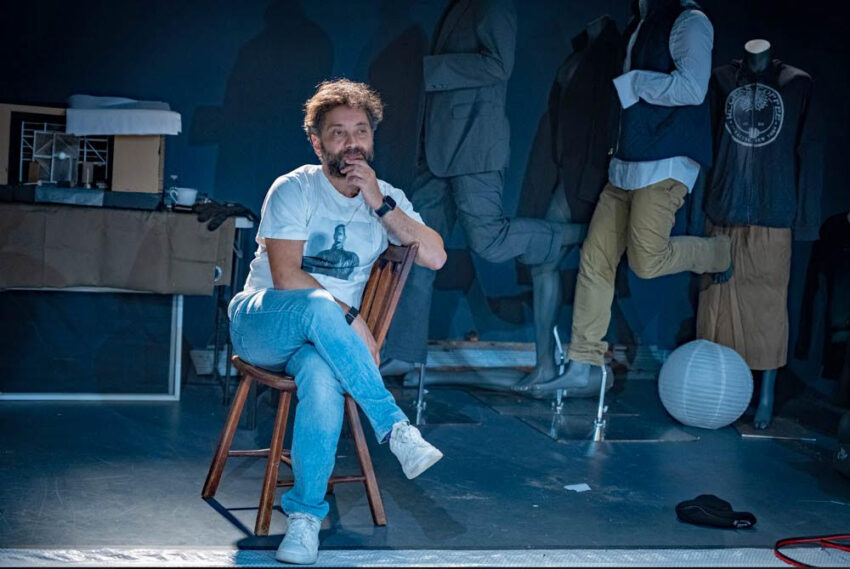
Interview by Kilian Melloy
Delirium, presented by Arlekin Players, plays June 18 – July 2, 2026 at the Calderwood Pavilion at the Boston Center for the Arts.
The typical rewarding theatrical experience might be akin to rock climbing: An ascent, handhold by handhold, toward a summit where the author’s message will be revealed like the vista of a valley below. In the case of Eugène Ionesco’s Délire à deux — typically translated Frenzy for Two — the experience is more like jumping out of an airplane: The landscape is laid out before you, certainly, but where you land is more or less up to you. This is a two-hander in which the place and time are essentially universal, as are the pair of characters we witness turning language on its head, hollowing out meaning, and shifting into various relationship modes in a kaleidoscopic fashion.
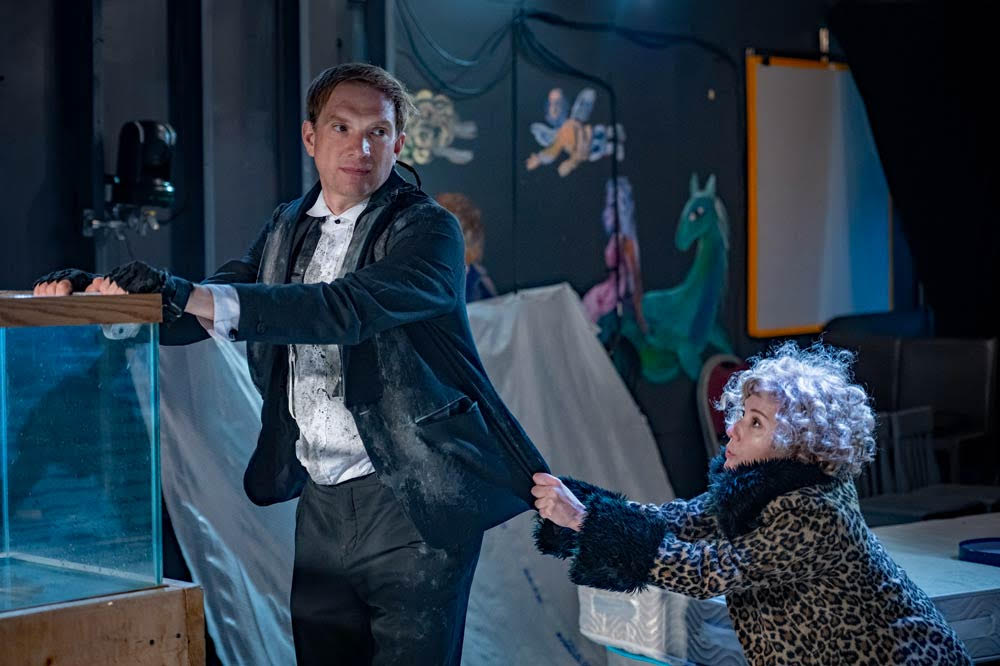
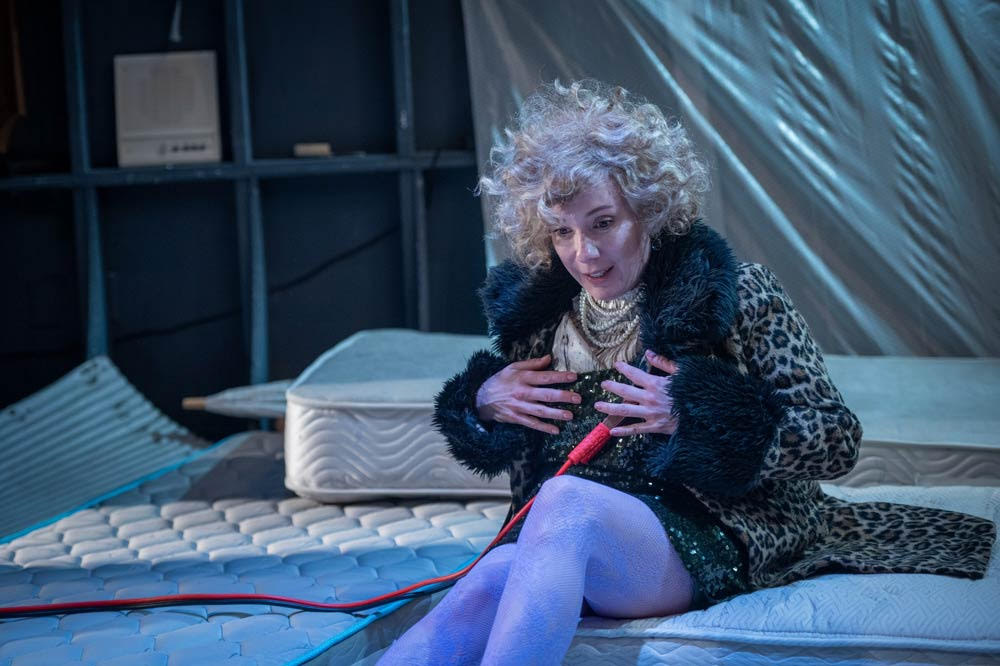
Igor Golyak, the founding artistic director of multiple award-winning theatrical company Arlekin Players, translates and adapts the play, giving it the title Delirium and honing its labyrinthine meditations toward a poetic distillation that doesn’t simplify the work, but invites the audience to engage with it emotionally and intellectually. The couple, named only He and She, bicker in their apartment while a war rages outside. No point of contention is too small, including whether a snail is the same thing as a turtle. (After all, She maintains, both animals carry their homes on their backs.) When they are not tearing into one another — sometimes with real heat, sometimes with affectionate verbal jousting — the couple seek ever-elusive safety.
The production boasts the star power of Russian actors Andrey Burkovskiy and Chulpan Khamatova — casting that lends additional weight to the play’s implicit themes of displacement. Burkovskiy and his family moved to Los Angeles in 2022, while Khamatova came out publicly against the war in Ukraine, a stand that essentially means self-imposed exile.
Igor Golyak shared his thoughts on the play, his take on the material, and how Ionesco’s vision remains timeless–and especially timely in 2026.

Theater Mirror: The Arlekin Players website says that your direction for this play, and I’ll quote, “unlocks the play’s heartbeat for our moment, our world, our collective delirium.” What does it mean to unlock a play from 1961 in a world that is so different now in many ways?
Igor Golyak: I think good plays have their own lives and develop just like a person develops throughout their life, so I don’t think the play’s life is limited to 1961. It was written in the ’50s after World War II, where nothing made sense, where we were learning about the horrific events of the Holocaust. Ionesco lived through this time where nothing made sense; that becomes the absurdity. In my adaptation there is a little piece that I inserted from Ionesco’s journals, where he underlines this idea that nothing ever is a constant. Things can flip at any moment, and they do. When we read this play out loud for the first time, the absurdity of language started making sense [for] our time.
Theater Mirror: You’re not simply translating from French into English, you’re translating in many ways. Did you also find other text by Ionesco, besides his diary, to add into this play?
Igor Golyak: I read a bunch of different diaries and all his other plays, and his manifesto about life and theater, and short stories. There’s a radio in the play, and some of the things that are being said on the radio come from things that he heard during, and right after, World War II. I’m using some of those, plus I’m using two children’s stories that he wrote for his daughter that I think lift the play and create a counterpoint and, at the same time, underline that people survive through their humanity by being with each other, even if it’s in a quarrel, like with this couple.
Theater Mirror: The relationship between He and She keeps shifting. They’re a couple who used to be married to other people; sometimes he speaks to her like a father would to a daughter; sometimes she’s more like a mother to him. They could be siblings. The relationship is slippery.
Igor Golyak: Yeah, I mean, he says, “I left my wife too, although I never had a wife.” So, did he have a wife, or did he not have a wife? It’s not [clear], and what is a wife in this world? The main thing is not taking what they say literally, just like, you know, Trump says something online, [and] if you take it literally you go insane. Same thing with these characters. The most important thing for me, in terms of this relationship, is the love that they have for each other. The way to survive this world is with each other and through each other, and I think this kind of family relationship, but also incredible love and surviving 17 years of bombardments, is peculiar. If you hear it, you hear it. You know what they’re talking about, although it’s absurd.
Theater Mirror: I wonder if part of what he’s saying to us is that we don’t live only in the actual moment, but with a whole slate of things that might have been and what still might be. This play suggests a kind of existence in which everything is liable to switch its fundamental character at a moment’s notice.
Igor Golyak: That’s right, that’s right. Also, that the past is a sort of a lost world. The world that has existed before the war has ended, that world has gone. There’s a new world that we must live in and figure out.
Theater Mirror: One interpretation that you could come to of this play is that, as a species, humans are just looking for an excuse to kill each other.
Igor Golyak: Yeah, I got that impression from this as well, that there is duality there. We see this couple that is bickering, but at the same time, love each other and are ready to save each other. If they didn’t care about each other, they wouldn’t be together. But the opposite is in the outside world, where, you know, the world has ended. There are humans that want to kill each other, but there are also humans that that love each other, and those [two things] can coexist in the same humans at the same moment.
Theater Mirror: I think you have cut right to the heart of it in choosing the title Delirium, because what we see here is a form of delirium, isn’t it?
Igor Golyak: Totally — like, maybe human existence is a delirium. It’s so recognizable with the wars that are happening right now, and what we hear in the news right now, it’s like almost the same language is used. I think the people that lived after World War II had a certain kind of understanding, a perception or ethos of the world that they existed in where things fell apart and things didn’t make sense. With us, it’s not as bad as after World War II, but we have some of the same feelings; we have some of the same recognizable perceptions that that I think are on display, and that’s why I picked the title Delirium. It think [the play] is a microcosm of the world, and frenzy, for me, is a word that kind of is limiting. It’s the delirium of the world, and it’s not just for two. It’s delirium for everyone.
Theater Mirror: It’s a play with a lot of paradoxes.
Igor Golyak: Yeah, and they make total sense, but they’re so deep at the same time. These people are not thoughtless, they’re not in a frenzy, they’re sincerely trying to figure out this world and each other.
Theater Mirror: Is what you look for in a play something that shakes us out of our typical way of thinking and makes us interrogate the world in a way we wouldn’t think to otherwise?
Igor Golyak: Yeah. For me, theater is about recognizing the perceptions of others, recognizing different types of others, and discovering the conversation or having people lean towards a dialogue of some sort. The way I would measure the success of a production is by what happens with people on their way home. Do they do they forget it? Do they need time to process it? Is it something that’s stuck in them? My goal is having people affected by the play in a way that hopefully brings people together.
Theater Mirror: is that related to what Ionesco called “imaginative truth,” the idea that he’s not necessarily interested in a realistic picture of the world and its day-to-day operations, but something different.
Igor Golyak: Yeah, and that difference is so interesting to discover in rehearsal. I think that difference is in the way that people solve problems. The problem can be, “How do I clean under my couch?” Sometimes we solve problems in a very direct way, but the creative ways of solving these problems create this interesting world of imaginative realism. I studied at the Vakhtangov Theater School, which kind of specializes in fantastical realism. That’s kind of the term that he invented, “fantastical realism,” and I’m very fond of this type of approach because I think it gets to the soul of people in a more direct way even though it’s very indirect, because we have to be involved and we have to be using our imaginations. They want to listen to music on the radio, they want to dance together and not listen to news, and he hooks up jumper cables and puts one end on the radio and the other end on an umbrella, and that becomes a huge antenna. That’s the way that he solves the problem, and that’s the world of these naive human beings that are trying to survive this world: With building an antenna out of umbrella hooked up to a radio.
Theater Mirror: How do you make choices as a director to close in on any given meaning in a play so full of shifting meanings?
Igor Golyak: I guess it’s whatever is closer to what I feel like people will relate to, to what I relate to, and to what the actors relate to. I’m building this play with two actors that ran from Russia after the war, the war had started, and they were superstars in Russia, especially Chulpan. [In Russia] she’s like Meryl Streep, that kind of level. Building a play with people that have their houses on their backs, just like a turtle and a snail, is very different than building it with local American actors, because that sensibility of displacement becomes a part of the story, so it narrows down what I want to talk about based on the group of people that I’m building it with.
Theater Mirror: When you build that interpretation, are you also building a world based on how the audience is responding in the moment?
Igor Golyak: Oh, totally. There is a lot of improvisation. There’s audience engagement that’s very tragic at the end. At the same time, it is very, very funny. It’s not the type of humor based on what they say, necessarily, but how they solve problems, how they overcome obstacles.
Theater Mirror: It also feels like a play that says, “Don’t look at me for answers. If you want meaning, you have to go find it on your own.”
Igor Golyak: That’s exactly right. That’s my approach, and I think that’s what’s in Ionesco’s play, as well.