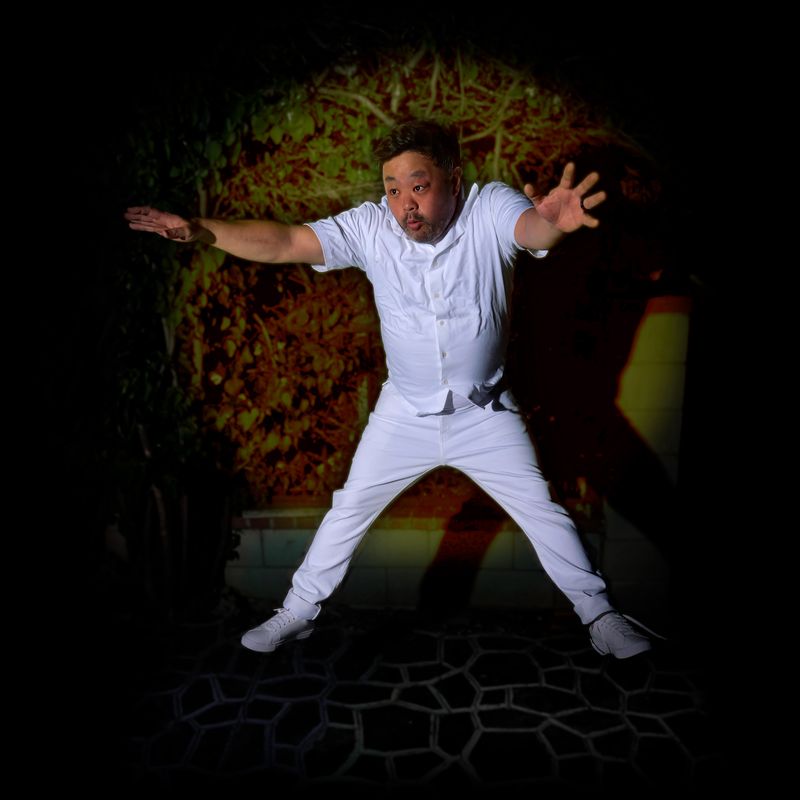
‘Sardines (a comedy about death)’. Written and performed by Chris Grace. Directed by Eric Michaud. Kevin Becerra, Associate Director of Artistic Programming and Activation. Kendyl Trott, Production Coordinator. At The Maso Studio at The Huntington Theatre, 264 Huntington Ave, Boston, through November 16.
By Linda Chin
At The Huntington Theatre, attendees of Sardines (a comedy about death) will be treated to sixty minutes of the sweet sounds of Amazing Grace. Not the comforting hymn that’s popular at funerals, but the words and voice of playwright-actor Chris Grace (NBC-TV’s Superstore) in a solo stage show about family, grief, and loss that he’s written and performs.
Creative genius Chris Grace generously gifts us with a work that’s tight in presentation − precise pacing and a pumped-up performance that made the time pass quickly, and strong in representation − opportunities for people who identify as Asian and/or gay to accurately portray lead characters made time slow down − are generous gifts. Like my family of birth, Chris’ parents emigrated from mainland China and wore white − not black − clothing while grieving.

Sardines’ darkness − and profundity − starts early, with the question posed in the beginning, “Can you enjoy something [like life itself] if you know how it ends [with death]? In Sardines, Chris recounts the losses of many people dear to him − a brother, a sister, both parents, and long-term partner James. When his father was alive, he disapproved of his homosexuality and career path, and they were estranged for 19 years. Like me, Grace and I had a mother who expressed concern for us by being hurtful (the buttons they constantly pushed were ones they installed). Grace and his husband, Eric Michaud, the show’s director, married in 2017, and Sardines includes a description of Michaud’s ordeal with cancer. Rather, his descriptive narrative is such that Grace’s response to the aforementioned question is to fill his life with joy and share his abundance and insightful perspectives with others.
To the question of why the play is titled ‘Sardines’, the short answer is that it is named after the reverse children’s “hide and seek” game. One person hides, but when they are found by the first seeker, rather than call victory/game over, the seeker joins them in the hiding spot, and so on, until the original hiding space becomes as crowded as a can of sardines (the sardines must be very quiet). Grace recounts this memory with a mix of sentimentality and sarcasm − quipping that typically the last person wandering around the house alone isn’t even sure if the game is over. He described his childhood home as a good spot because it had two levels (“humble brag”) and lots of closets (“prophetically”). I loved these asides!
Unlike other one-person shows I’ve seen, Grace as storyteller describes the events and characters to the audience, relying on the words and listeners’ imaginations rather than on costume changes, props, and impersonations of the characters. In addition to his narrative monologue style, Grace’s performance is also more minimalist, avoiding elaborate sets and projections.

And finally, in a one-person show, is it the star’s performance or the quality of the show’s material that makes it outstanding? The two are inseparably linked, and the absence of one diminishes the potential of the other. Grace’s material provides a rich foundation for his talents; his performance elevates the script. With both outstanding elements, Sardines is a memorable theatrical experience that my plus-one and I (and judging by their enthusiastic response, the entire audience) thoroughly enjoyed. The standout production graces the Maso Studio through November 16. For tickets and information, go to: https://www.huntingtontheatre.org/whats-on/sardines/