Photos by Annielly-Camargo
‘The Meeting Tree’ — Written by B. Elle Borders. Directed by Summer L. Williams. Dramaturgy by afrikah selah and Ilana M. Brownstein. Scenic Design by Cristina Todesco; Costume Design by Amanda Mujica; Lighting Design by Elmer Martinez; Sound Design by Aubrey Dube. Presented by Company One Theatre in partnership with Front Porch Arts Collective and the City of Boston’s Office of Arts and Culture. At Strand Theatre, Boston through Aug. 9. All tickets are pay-what-you-want.
By Shelley A. Sackett
B. Elle Borders’ The Meeting Tree (her first play) is a bold and effective new work that portrays the story of six generations of women and their interconnected lives as a backdrop for her exploration of bigger ticket issues. For 75 intermission-less minutes, she keeps the audience engrossed with her skillful storytelling that combines a tale of complex, emotionally deep characters with thought-provoking questions that prompt reflection about family history, the legacy of slavery in the United States, and the power of personal connection to overcome history.
In polarized times, Borders seems to ask, is redemption and healing possible? And if it is, at what price?
The world-premiere production, produced by Company One in partnership with Front Porch Arts Collective and nine community partners, is fittingly staged at the storied Strand Theatre, itself a century-old cornerstone of Dorchester. It opened in 1918 on the same day as the Armistice ended World War I and, after renovations, the faded grande dame still struts her stuff with art deco details, a majestic stage and elegant bones.
An allegorical narrative based on Borders’ grandmother’s memories of a childhood friendship, The Meeting Tree opens with the arrival of Sofia (Anjie Parker) at the Alabama farm where her ancestors were once slaves and where her own grandmother, Dixie (the talented Beyoncé Martinez) was raised by her grandmother, Katherine “Kitty” Montclair (Jacqui Parker, in a stunning, stand-out performance).
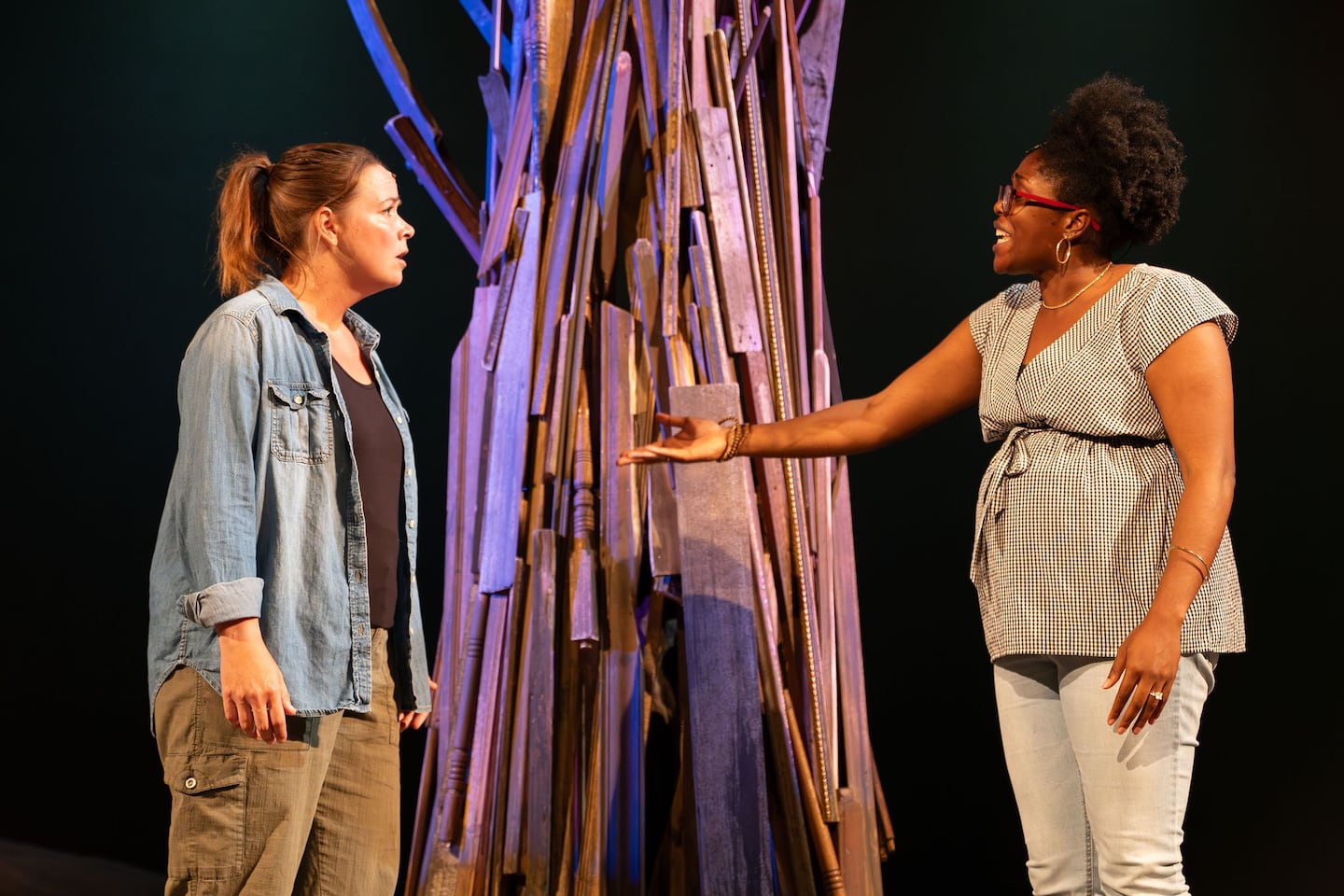
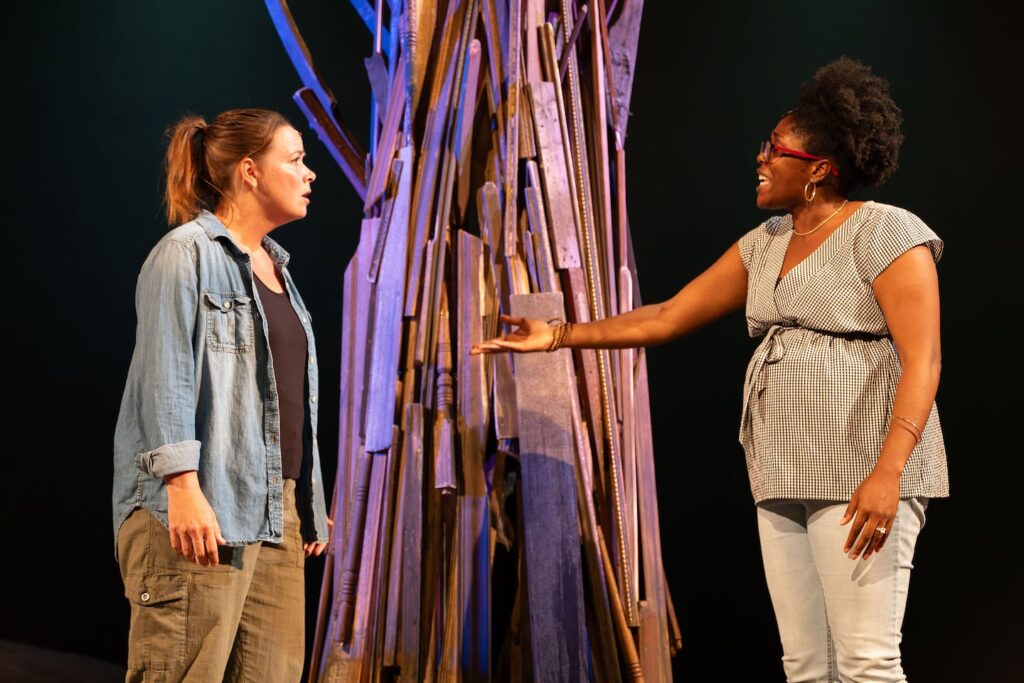
Sofia, who is pregnant, in her 30s, and Black, reverently carries her grandmother Dixie’s ashes into the Alabama cabin where her family had lived as slaves. She talks to herself via conversations with the urn. We learn that she has returned to her ancestral roots to claim the rights to the land she believes is hers.
She arranges a meeting with Alison (a thoroughly believable Sarah Elizabeth Bedard), her white counterpart in the story. Also in her 30s, Alison inherited the farm from her grandmother, descended from the family of Sofia’s ancestral enslavers. The farm is now “brown and dead,” a far cry from what it was in its heyday when the two women’s great-great-grandmothers forged a friendship that crossed more than interracial boundaries.
Sofia believes there is a will that promised the house and land to her family. “This is my ancestral home. And your people tried to keep it from us, but no more. Not one generation will go without what is owed,” she defiantly announces. Alison, of course, is buying none of it.
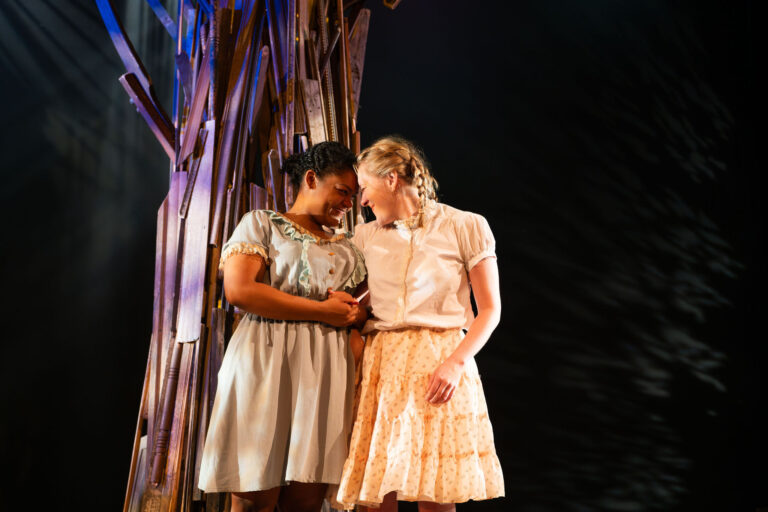
At the heart of their story (and the “meeting place” of the title) is a pecan tree, which separated the slave quarters, where Sofia’s grandmother was raised, from the “big” house, where Alison’s grandmother had lived. Giant and looming on the spare but effective stage (scenic design by Cristina Todesco), the tree is the main character and Svengali of the play, magically opening a keyhole through which Alison’s grandmother, Tessie (a terrific Rachel Hall), and Sofia’s grandmother, Dixie, melded in a color-blind friendship that provided as much sustenance for the isolated girls as the pecans did when baked in Dixie’s renowned pies and sold to help them make ends meet.
The tree also has spiritual powers and holds a secret agenda set in motion by the girls’ great-great-grandfather, Percy Baptiste Montclair, Sr.
If all this ancestral tree information sounds dizzying, it is. Fortunately, the play’s program is a rich source of context and information and helpfully includes a family tree for reference.
Sofia has come to Alabama as a second-in-her-class graduate of Yale Law School, hellbent on following her grandmother’s directive to reclaim what was left to her by the patriarch, Percy. Alison, whose liberal street cred numbers graduating from Auburn University and self-description as “liberal enough,” couldn’t be more dumbstruck. After a rocky start and a grand reveal, the two eventually join forces in pursuit of “the truth.”
The enchantment of Borders’ play is the way she effortlessly traverses time and storylines to somehow create a seamless multi-generational tale. (She is aided by Todesco’s set, which credibly takes us from the porch of the “big house” to a one-room shack to the statuesque pecan tree, with its majesty and power.)
She also time-travels, from the 1930s, when Tessie and Dixie first meet as 9-year-olds, to their teen and adult years into the 1940s and ultimately to 2020, where the play finds them. The actresses who portray them on this journey (under director Summer L. Williams’ sharp but compassionate direction) are captivating in their individual roles and coalesce into a powerful ensemble.
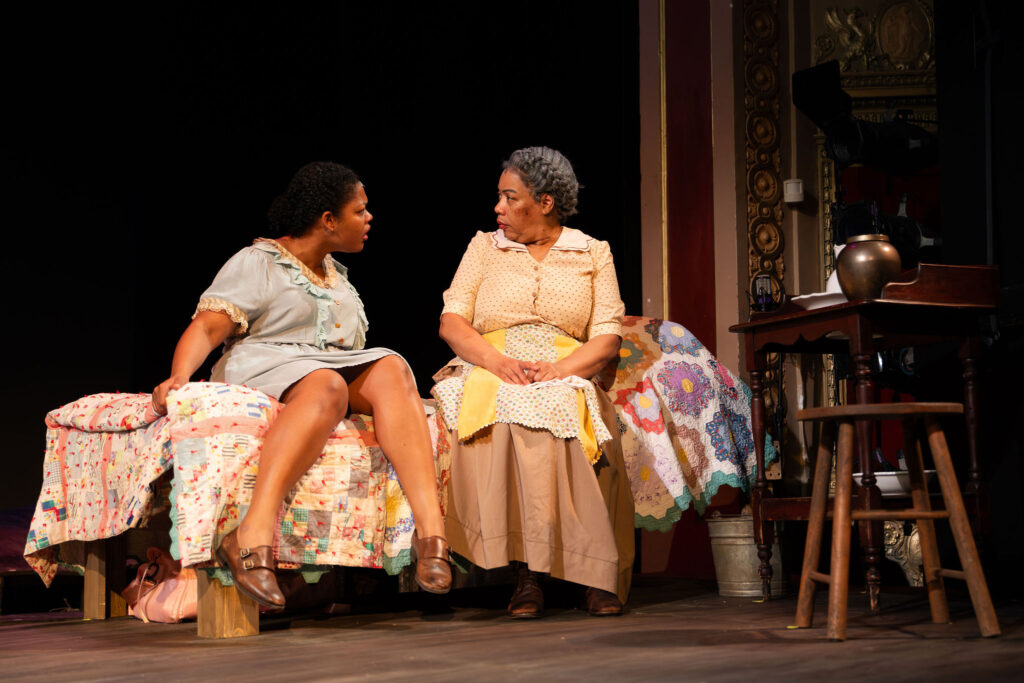
The highlights are the scenes between the 9-year-olds and several stand-out performances. As Tessie, Hall is a high-spirited delight, her accent like just the right dose of honey, her physicality infusing her with colt-like playfulness. Dixie (Martinez) plays hard to get at first, but ultimately Tessie’s charm and persistence melt her defensive shell and the two vow to take care of each other when they get old. “Where there’s me, there’s you. Where there’s you, there’s me,” they promise.
And, with those innocent words from babes, Borders unleashes a motherlode of tacit yet reverberating undercurrents. Who teaches hate to those who haven’t lived and don’t know the history of that hate? Why would anyone want this innate, colorblind acceptance to be drummed out of people?
As if on cue to answer those queries, Tessie’s grandmother, Elizabeth “Grande-mere” Montclair (Alex Alexander), emerges onto the porch, commanding Tessie to never see Dixie again (which is pretty hard to do, since they live next door and both frequent the pecan tree). Dixie’s grandmother, Kitty, has a softer heart and keener emotional intelligence, and she recognizes the power and potential the girls’ bond represents. Plus, with the most subtle phrasing and tilt of the head, Kitty lets us know she also takes great pleasure in doing her part to stick and twist the knife in wherever Grande-mere’s heart should reside.
In due time, the girls move on and the grandmothers pass away, but not before Kitty tells Dixie the entire story of her legacy and stolen inheritance. It is this story (and the pecan tree) that links Sofia and Alison and offers a possibility of a different future for them.
Preserving the past while imagining and reshaping the future is a prodigious goal. While Borders’ play is not flawless (Sofia delivers a few polemical speeches and a plot wrinkle has Alison traveling at bends-inducing speed between threatening to call the police on Sofia and aiding and abetting her own disinheritance) and the sound system uneven, these minor glitches do not diminish its importance as a work of art and centerpiece for promoting discussion and reflection.
At what point, Borders asks, do subsequent generations have a responsibility to both let go of shame and blame and honor the past? Company One is certainly doing its part with the production of The Meeting Tree. As the program notes state, its goal is “to amplify the essential need to face our uncomfortable, shared American histories — to build common ground, foster solidarity, and cultivate restorative practices for a vibrant, more just future.”
Highly recommended.
For more information, visit https://companyone.org/