Arlekin Players presents Our Class. Written by Tadeusz Slobodzianek. Adapted by Norman Allen. Directed by Igor Golyak. Scenic Design by Jan Pappelbaum. Costume Design by Sasha Ageeva. Lighting Design by Jeff Adelberg. Sound Design by Ben Williams. Projection and Video Design by Eric Dunlap, Igor Golyak with Andrea Mincic. Choreography by Or Schraiber. At Boston Center for the Arts, Calderwood Pavilion, 527 Tremont Street, Boston, through June 22nd.
By Linda Chin
With four 2024 Lucille Lortel Awards (Outstanding Revival, Director, Ensemble, Scenic Design) for its Off-Broadway premiere of Our Class in hand, Arlekin Players’ artistic director, Igor Golyak and producing director Sara Stackhouse have brought their production home to Greater Boston for audiences to “enjoy”. The play’s limited run at the BCA during June – Immigration Heritage Month – is timely given the 15-year-old Needham-based company’s history as an ensemble of immigrants from countries in the former Soviet Union. Written by Tadeusz Slobodzianek and adapted by Norman Allen, Our Class follows the stories of ten Polish classmates, half Jewish and half Catholic, who lived together in the small village of Jedwabne across eight decades of the 20th century.
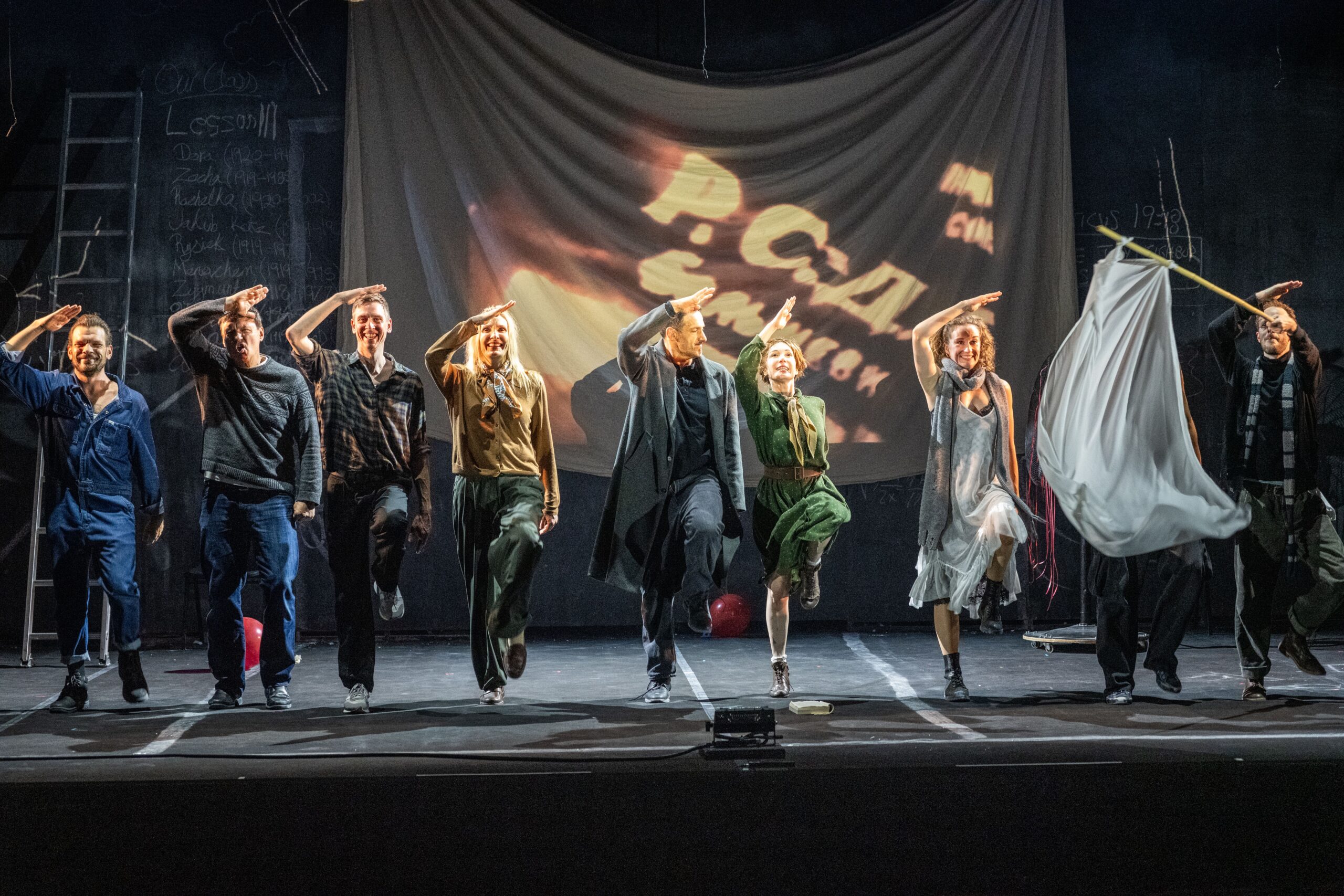
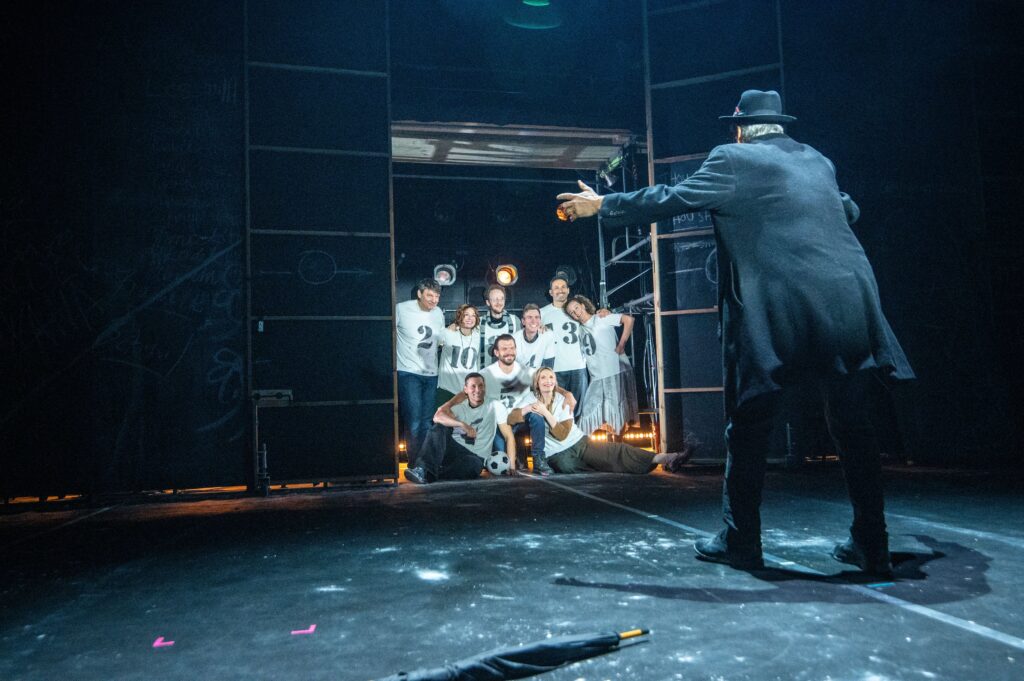
The word “experience” or “witness” might be a more apt descriptor than “enjoy.” Our Class includes lighter moments, particularly when the classmates’ portray their five-year old selves, singing songs, dreaming about what they want to be when they grow up (a pilot, a firefighter, seamstress, an actress…), making jokes about body parts and/or affectionately using Hebrew words (eg mohels – Jewish men trained to perform the ritual of circumcision), or first crushes, kisses or the charming staging of a mock wedding on the playground, but most of the play is dark. Our Class was inspired by real events in Poland in 20th century and a social and political climate that was turbulent turned torturous to deadly – and centers on the pogrom in Jedwabne on July 10, 1941 when members of the Jewish community were rounded up into a barn by their Polish neighbors, which the Poles subsequently set on fire, killing everyone inside. The production’s visual and verbal storytelling is so powerful, the ensemble’s physical acting skills so well-honed, and depictions of violence so stunningly staged that, despite one’s level of familiarity with the historical context and any content warnings, it is very difficult to watch and hear, to stomach and absorb.
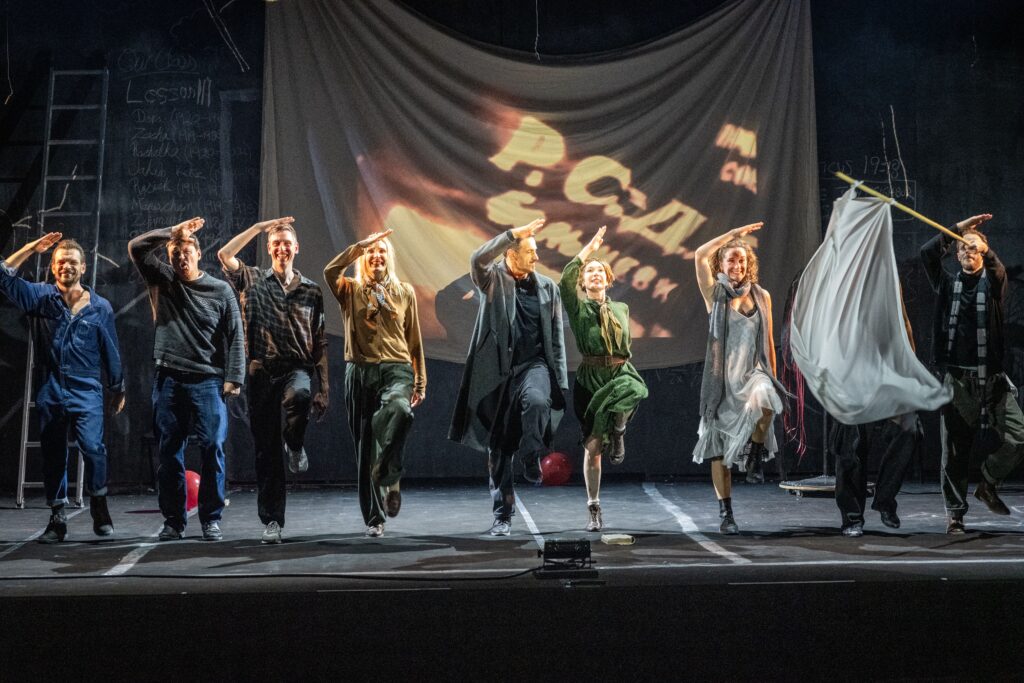
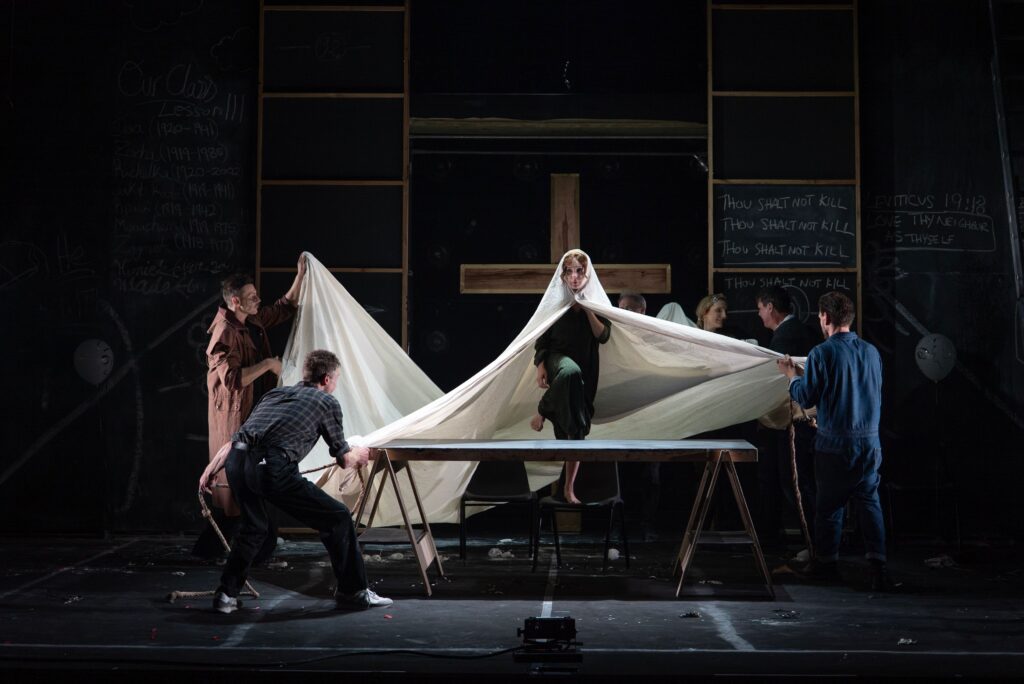
The inventive use of technology (projections and videos) that is now one of Arlekin Players’ trademarks supports the storytelling of Our Class. Scenic Designer Jan Pappelbaum has created a sturdy wooden backdrop painted matte black that spans the width and height of the stage and does triple duty as a working wall (that characters pop up behind, prop ladders against, exit and enter the stage via double doors); a larger-than-life screen for projections and real-time live feeds; and a chalkboard that contains words and drawings, including the lessons that are chapters/scenes in the play’s chronological script, structured as “Lessons,” and the names and lifespans of each of the ten characters, like a group tombstone.
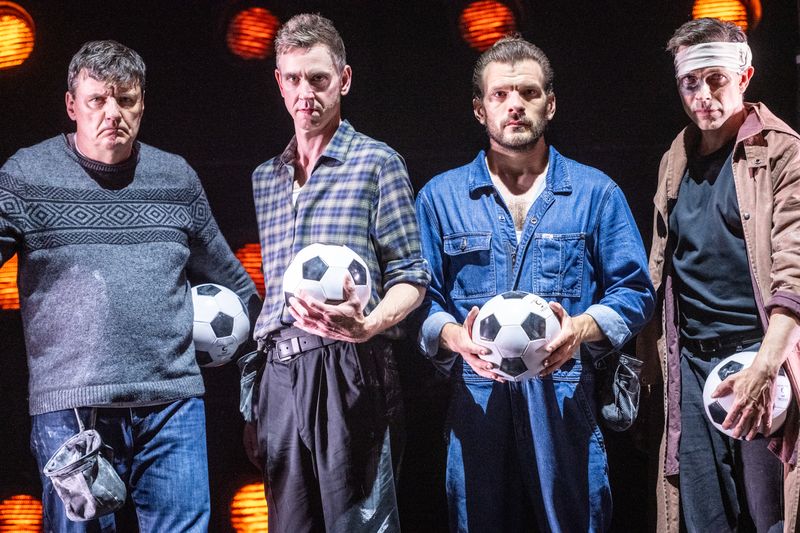
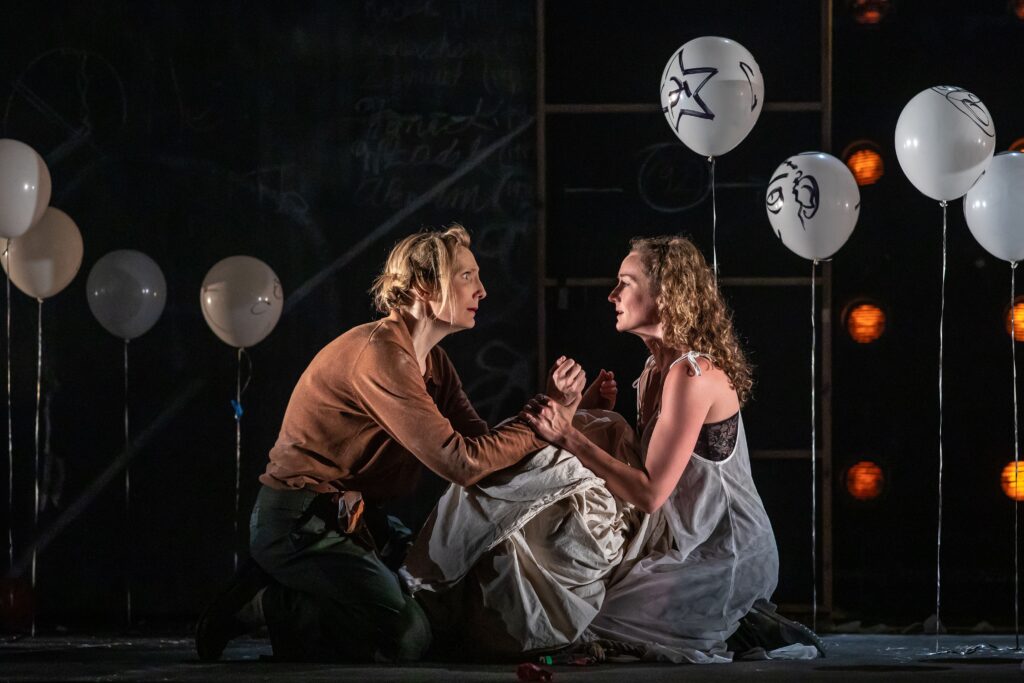
The exceptional ensemble for the Boston production includes two actors from the original cast, Richard Topol and Ilia Volok, who reprise the roles they originated in New York. The rest of the Boston cast features Jeremy Beazlie, Ryan Czerwonko, Zach Fike Hodges, Chulpan Khamatova, Deborah Martin, Gene Ravvin, Kirill Rubtsov, and Gigi Watson. Each of the actors gets a chance to demonstrate their acting prowess, versatility in portraying the characters at different ages and incorporate physical movement. Hodges (Jakub) and Watson (Dora), the first of the group to die – in their twenties – are tortured and raped by their peers while they are high up on the ladders. Chulpan Khamatova (Rachelka/Marianna) and Richard Topol (Abram) – the last of the ten classmates to survive, are excellent in their portrayals of their characters in their eighties.
One scene in Act I that took place when the classmates were adolescents (c. 1935?) – was a particular punch in the gut that set the stage for the aggressive behavior and acts of hate that would follow. Several of the Jewish students (Dora, Rachelka, both female) rally around their Jewish male classmate Jakub Katz, confronting a group of Catholic classmates (Rysiek, Zygmunt, Heniek, Wladek, all male – who later came to be known as the Four Musketeers) of barbaric behavior when they threw a brick that hit and hurt Jakub’s sister. The young men – displaying classic bullying behavior in the safety of a group – did not take responsibility and defended themselves (for picking on a female) by saying the projectile was meant for Jakub. This scene brought me back to the schoolyard bullying of my youth (in the 70s) but also took me out of the moment to the hate crime this past week (June 15, 2025) – where a brick marked “Free Palestine” was thrown through the window of the kosher grocery store (The Butcherie) in Brookline. The performances and lessons from the “past” that Our Class offers have touched my soul, as they undoubtedly will yours. An evening performance on Sunday, June 22nd has recently been added. For tickets and more information, https://www.arlekinplayers.com