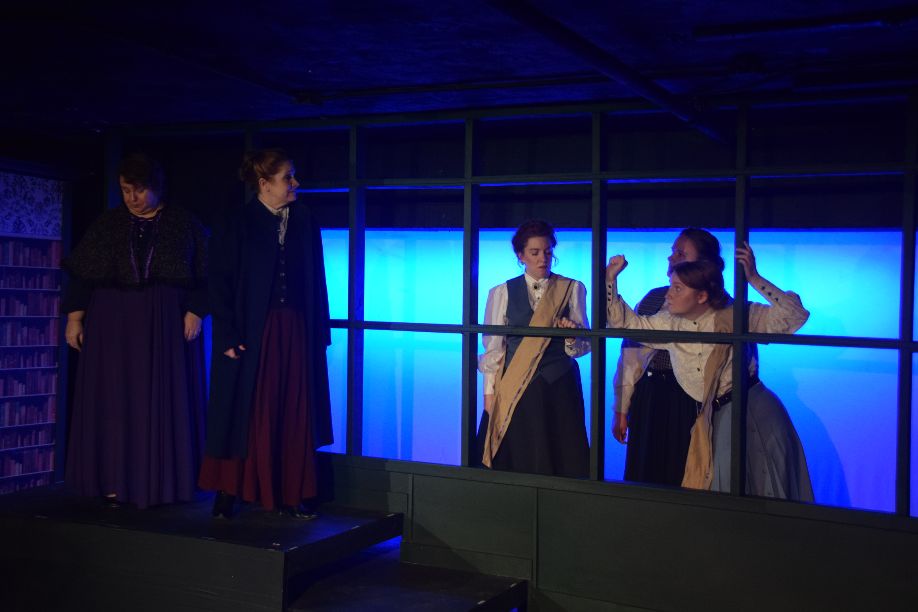
‘Bull in a China Shop.’ Written by Bryna Turner. Directed by Lisa Tierney. Stage Manager – Nicole O’Keefe; Lighting Designer – Dan Clawson; Set Designer – Britt Ambruson; Sound Designer/Sound and Light Op – Dannie Smith. Presented by The Tree House Collective at Abbott Memorial Theatre at Hovey Players, 9 Spring St., Waltham through June 29.
By Shelley A. Sackett
Mary Emma Woolley may be the least-known important historical figure you’ve never heard of. A radical feminist, education reformer and suffragette, she served as president of Mount Holyoke College from 1900 to 1937. She also lived a fairly openly lesbian life and shared a life-long partnership with Jeannette Marks, her former student and a firebrand academic revolutionary and writer.
Thanks to Bull in a China Shop, Mount Holyoke 2012 alumna Bryna Turner’s smart, ensemble-based one-act play, and The Tree House Collective’s skillful production, the story of Woolley’s fascinating life and important legacy are a little less unfamiliar.
Turner has a lot of material to work with and she covers a lot of ground in a mere 80 minutes, offering glimpses of American women’s history from 1900 to 1930s against the intimate details of Woolley and Marks’ 55-year-long relationship. Inspired by letters the two women wrote during absences from each other, her funny and tender script is also feisty and pedagogic. Her characters liberally sprinkle their conversations with spicy F-bombs one minute and rhapsodize about Virginia Woolf’s “Orlando” the next.
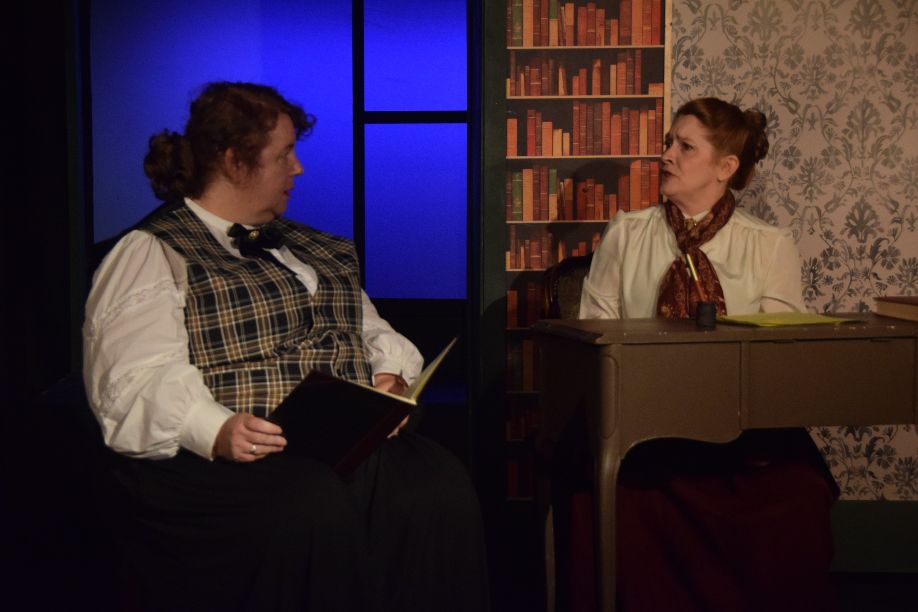
The play begins as Woolley (Linnea Lyerly) considers leaving her professorial position at Wellesley College for the presidency at Mount Holyoke. She and Marks (Heidi White) discuss the move while embracing on a tiny bed (Britt Ambruson’s minimalist set design is maximally effective). Like any couple, the two struggle with the adjustment Woolley’s position of power and her career ambitions would have on their relationship. With a light yet insightful pen, Turner makes clear that this lesbian couple is no more immune to the stress of these challenges than any heterosexual married couple might be. In both, it is assumed that the non-breadwinning wife would play a secondary, supportive role.
Although Marks is anxious and reticent, they do, of course, move to Mount Holyoke, where Woolley exercises prodigious power and Marks is an English professor, living in a faculty dorm. “I never wanted to be a wife,” Marks complains. Intoxicated by the heady opportunity to smash every social, political, cultural, and academic norm that constricts women, Wooley snaps back, “I want a partner, not a child. Grow up.”
Turner weaves a lot of facts into her play. We learn, by way of pithy, clever dialogue, that in the past, the college had placed an emphasis on women’s education in service to society (all students were required to learn laundry skills, for example, and attend daily chapel). Woolley, by contrast, laid the foundation for a women’s education to be valued for its intellectual merit. Period. On her watch, education for education’s sake would no longer be a brass ring reserved for men.
Ever the proverbial bull in a China shop, Woolley minces no words. “You want a training ground for good pious wives?” she asks during a practice interview with the Mount Holyoke hiring committee. “I’ll give you fully evolved human beings. Are you afraid they won’t find husbands? So what. If a man is interested in headless women, send him to France.”
Alas, while Woolley’s moves to upend the concept of womanhood are met with applause and adulation from the student body, the stuffier, straighter board of trustees and heavy-hitter donors prove a tougher sell.
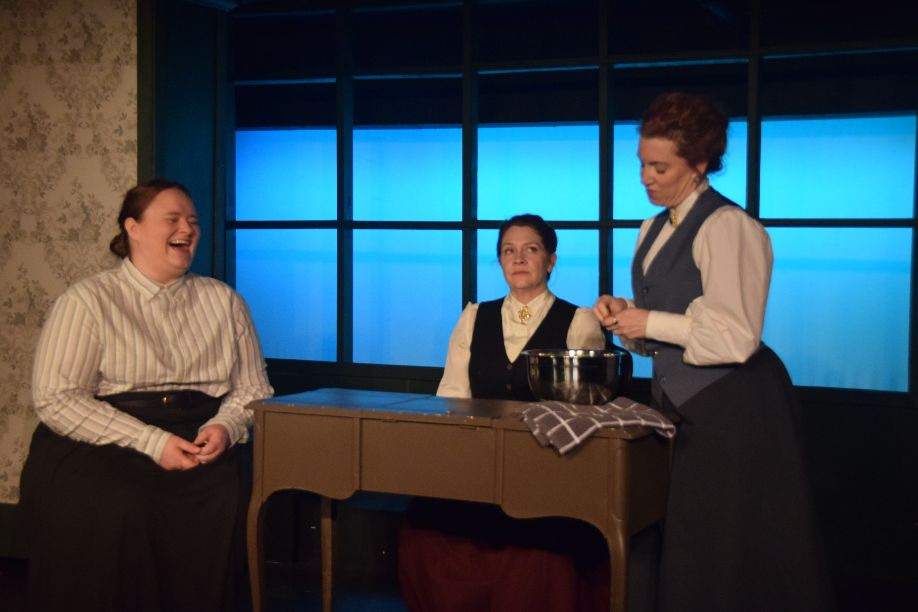
Dean Welch (Karen Dervin) tries to rein Wooley in when she treads too close to the board’s lines in the sand, but Woolley pays no heed until, at last, it’s too late. Before that eventuality, however, there are many delicious subplots to unfold.
There is, for example, the secret fan club that springs up on campus, dedicated to worshipping the romance between Woolley and Marks. Fan club president Pearl (Anneke Salvadori), a student of Marks’ who is so besotted with her teacher that she stalks her like a lovesick puppy, actually pens sonnets about her eyes in the student evaluation forms.
There is a suffrage protest that lands Marks and Woolley on opposite sides of the college administration’s official stand. There is Woolley’s three-month trip to China, which ignites Marks’ predictable affair with Pearl. Felicity (Hannah Young), Marks’ protective and invaluable roommate, is a grounding voice of reason amidst the ensuing domestic chaos.
Turner also raises plenty of philosophical questions clothed in adroitly crafted, though at times dense, conversation. Is Woolley a realist, opportunist or idealist when she doesn’t risk taking a public stand on women’s suffrage until after receiving the board’s approval? Is she sincere or a manipulator, and, at the end of the day, do her motives matter as much as her actions?
The Tree House Collection has mounted a production that feels greater than the sum of its parts. Director Lisa Tierney makes admirable use of the simplest of sets to evoke a bedroom, office, classroom, rooming house, train, and jail. The pacing is brisk, with pleasing, period musical interludes (Dannie Smith) that accompany quick set changes between scenes.
And then there is the crackerjack acting. As Woolley, Lyerly is a complicated, powerful presence, as beguiling and charming as she is frustrating and infuriating. White plays Marks as an intense, humorless professor who seems to be in need of either a chill pill or a new lover. (Young, as roommate Felicity, tries her best to steady Marks’ listing boat).
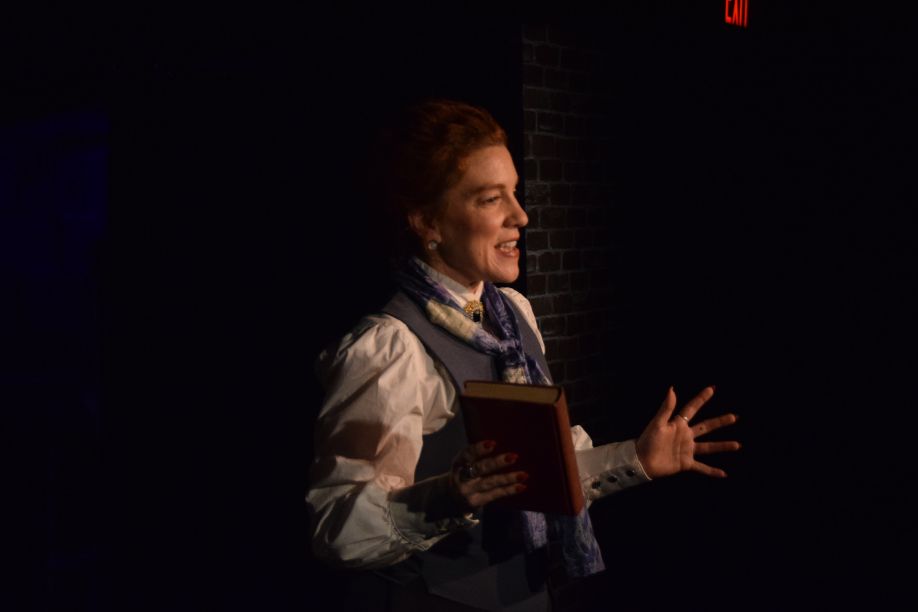
But the real surprises and pleasures are Dervin, as Dean Welsh, and Salvadori, as Pearl. Dean Welsh presents as all business and conformity on the outside, but Dervin’s nuanced performance imbues her with a hint of rebellion and a wink of humor. Salvadori simply steals every scene she is in. Her Pearl is dry-witted, wry and droll, and Salvadori deadpans even her most outrageous lines to great effect. Although the scene where Pearl fantasizes about wreaking havoc on Marks after being dumped by her for the returning Woolley could use some editorial tweaking, Salvadori’s delivery could not be more spot on.
Bull in a China Shop debuted off-Broadway in 2017 at Lincoln Center’s Claire Tow Theater, where it earned glowing reviews and played to sold-out audiences. Lincoln Center has offered Turner a commission for her next play. I, for one, can’t wait to see what bauble catches her eye.
For more information, visit https://www.treehousecollective.us/home