Interview by Kilian Melloy
The HawtPlates — a family group consisting of sister and brother Jade and Justin Hicks and Justin’s wife Kenita Miller-Hicks — bring their “live concept album” Dream Feed to Boston from November 19 – 22. Presented by ArtsEmerson, the show is a deep dive into the stuff that dreams are made of, asking what the stories we encounter in our hours of sleep mean, and how they can connect us.
Originally a commission by the Artist Residency Program at New York’s arts organization HERE, the show had its premiere earlier this year at the Under the Radar Festival in New York City. Writing about the show, HERE notes, “The HawtPlates music breaks down vernacular music styles into multiple modes of vocalizing, producing their sound and songs in the spirit of the family heirloom. Their work honors lineage while reporting a universally human experience.” Kenita underscores that during a chat about the show, telling Theater Mirror, “A lot of the pop place for us is very ancestral driven,” before adding: “Lineage is very important to us.”
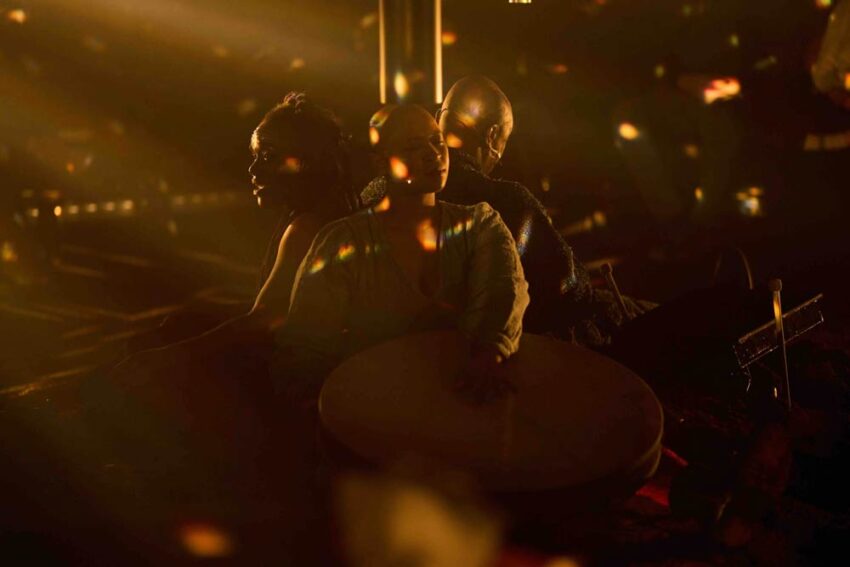
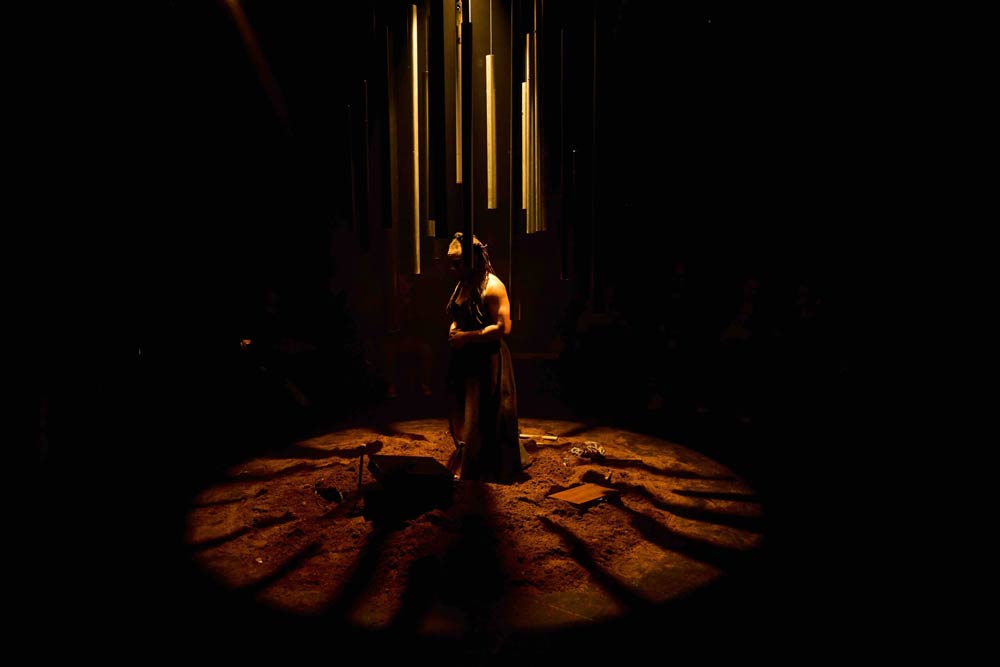
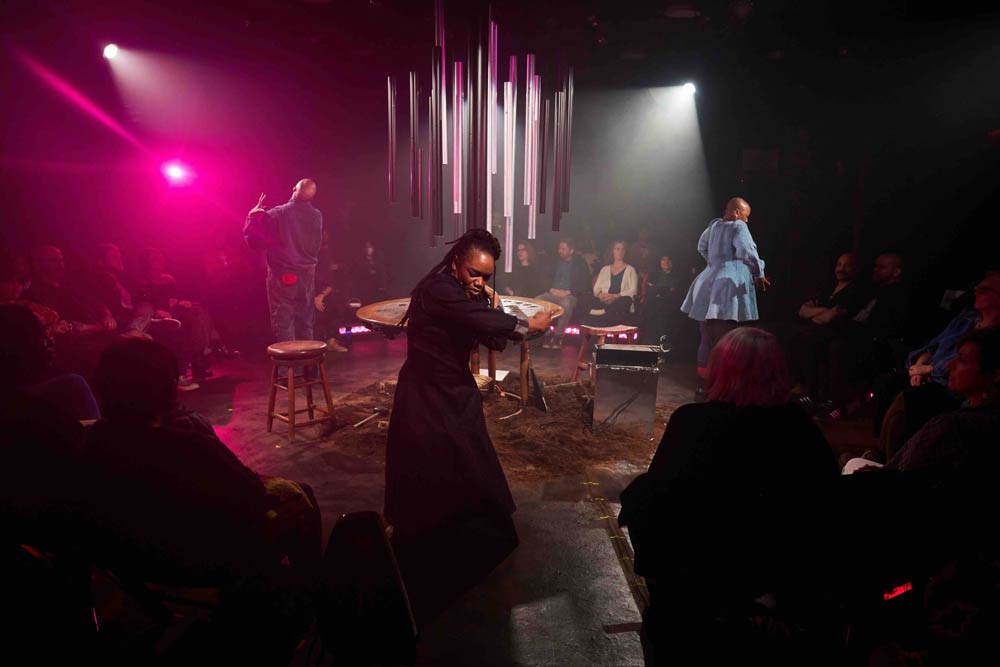
A unique musical experience, the show distills dreams into music and embraces dream logic — and dream proportion — with the inclusion of oversized chimes and dirt on stage from which, in an echo of what it means to dig from the subconscious, musical instruments are excavated.
Read on to discover more about what this two-time Grammy-winning group has in mind when they bring their dreams to Boston.
Theater Mirror: Dream Feed is described as a “live concept album.” Can you say a bit about that?
Jade Hicks: It’s really an invitation for people to explore things that are unexpected and unexplored in our waking lives. What’s happening in that dream state that allows you to connect in a way that doesn’t happen while you’re awake? That’s what it feels like to me.
Justin Hicks: We consider the work we make to be kind of our take on live versions of a concept album. So, we’ll choose a theme, or an idea, or a story, and [address it] in the way that a band might respond to a particular subject, or person, or a point in history. We do that with a lot of liberty and a lot of poetics. We don’t seek to reenact or to draw a straight line through a story; we kind of dance about these ideas, and we offer a group of songs, and we perform them live in a way that’s physically and visually engaged and lets the audience do some of the math with us. I think it offers a kind of opening, whereas I think a lot of times in theater, especially musicals everything is laid out for you and there’s a kind of a, “Well, there it is” notion. We are more interested in how songwriting can activate the listener and engage them in a way that [allows] their story to be part of what we’re doing…
Kenita Miller-Hicks: We don’t necessarily look for a linear narrative. We let the music speak first, and it tends to be very abstract. We have things that we anchor in symbolism and theme, but it does give the audience the opportunity to glean whatever they want from it.
Justin Hicks: It’s a lyric-driven piece. There is language that I think offers a lot of play in the listeners’ minds and offers a lot of imagery. We let the atmosphere and the lighting and the set design pull a lot of things together into a cohesive image.
Kenita Miller-Hicks: We’ll give ourselves a formula that we can improvise around, and because we’re family, it’s kind of like a fun dance that we do. The family frequency is something I think is a blessing, and very special.
Theater Mirror: What was the origin for this show? Exploring what the subconscious tells you in dreams, and what you can do with that as artists? Or did this originate in some other way, like through Jade’s dreams?
Justin Hicks: I mean, it’s kind of both.
Kenita Miller-Hicks: I think the dreams ended up being a beautiful discovery that came into it. It’s what your psyche does when you’re sleeping — it takes your reality and breaks it. We have this beautiful offering in that Jade, out of the three of us, is the one who remembers her dreams and was already in the practice of documenting them. It made sense to use those gems.
Jade Hicks: It’s really fascinating that dreams are so deeply personal, but at the same time somehow universal. That’s how I feel Dream Feed relates to me specifically. We’ve all had dreams that might seem similar, but they feel so different to each individual. I feel like that’s another level of connection between us and the audience, because there are things that we might say that you’re, like, “Oh, man, that’s really trippy,” and then others might be like, “I had that dream.”
Justin Hicks: There are lyrical wisps of the iconic dreams that every culture ascribes some sort of meaning to, like dreams of flying, and teeth falling out, or about being close to dying. We don’t sit in those ideas too much, but we nod to them. We’re trying to drop people into a liminal space between sleeping and awake. We think of this piece as us meeting in a dream world, where we’re each at our own kind of point in a dream sequence…
Theater Mirror: Waking life can feel overwhelming these days, and maybe what we need is rest, and a way of looking beyond where we are in this current moment.
Justin Hicks: I wouldn’t disagree. We were thinking through the piece in the early stages and ideating and trying to figure out what we were going to make…The idea is that dreaming could be a configuration of information that could jar something in your waking life that allows you to imagine something a little bit outside of the box. I think that’s definitely at play, but I think the piece is a little bit more personal than that, because we’re really engaging in some personal stories.
Kenita Miller-Hicks: It is inspired from a very personal place, from our little family nucleus. We are trying to be present in the world, and we are trying to exercise what we need through our work, and it seems to meet at a timely moment where everybody collectively, and ourselves, are screaming for rest. I would love to think, in a kind of woo-woo way, that [as] we are trying to link with ancestry, we are activating a tool that will remind you that you can rest. I get excited when I feel like those things are linking up and we’re in the moment, we’re meeting it, and we’re possibly healing in it.
Jade Hicks: It does feel like our work has some synchronicity with what is going on in the world, and it should. There’s a lot of noise and distraction, and I feel like Dream Feed offers a space for people to turn inward and explore our imaginations and reconnect with the parts of ourselves that we don’t always get a chance to make space for.
Theater Mirror: Where else will you be heading with Dream Feed?
Justin Hicks: Dream Feed is a one-off right now. Hopefully we’ll get to play it again…We did a concert at Brooklyn Bridge Park, and we played a lot of songs from Dream Feed. That’s the gift of making work that is music-based; it can be kind of modular, so the songs will always have a place.
Theater Mirror: Are you already starting to imagine, or outline–or dream–future projects?
Justin Hicks: We’re working on making the album, and we might have a single up when the run hits in Boston. We’ll probably drop something on Bandcamp, or something. Also, we have a couple of commissions coming up for ’28, ’29. They haven’t officially been announced by the companies that we’re working with, but we’ll make two new works.
This interview has been edited for length, flow, and clarity. Dream Feed plays November 19 – 22, 2026 at the Emerson Paramount Center in Boston.
