Reviewed by Jamie Lin
Finding Nemo; Book, music, and lyrics by Kristen Anderson-Lopez and Robert Lopez; book adaptation by Lindsay Anderson; music and orchestrations adapted and arranged by Myrna Conn; directed by Nick Vargas; music direction by Jordan Oczkowski; choreography by Hannah Shihdanian; set design by James Rotondo; lighting design by Hope Debelius; sound design by Irene Wang; costume design by Eric Tâm Tran; props design by Amanda Gibson; stage managed by Fanni Horváth. Presented by Wheelock Family Theatre through December 13, 2026.
The 2003 Pixar classic Finding Nemo is now a musical playing at Wheelock Family Theater through December 13. The movie’s 100-minute runtime has been trimmed to a slim 60 minutes even with the addition of 16 songs penned by Frozen composer duo Kristen Anderson-Lopez and Robert Lopez.
Audiences are welcomed by Wheelock’s artistic director and stage director Nick Vargas, who shouts out the newly revamped sound system (more on that later). Two screens flanking the stage display captions for the entire show, including the pre- and post-show speeches: a welcome access tool that highlights Wheelock’s family-friendly nature.
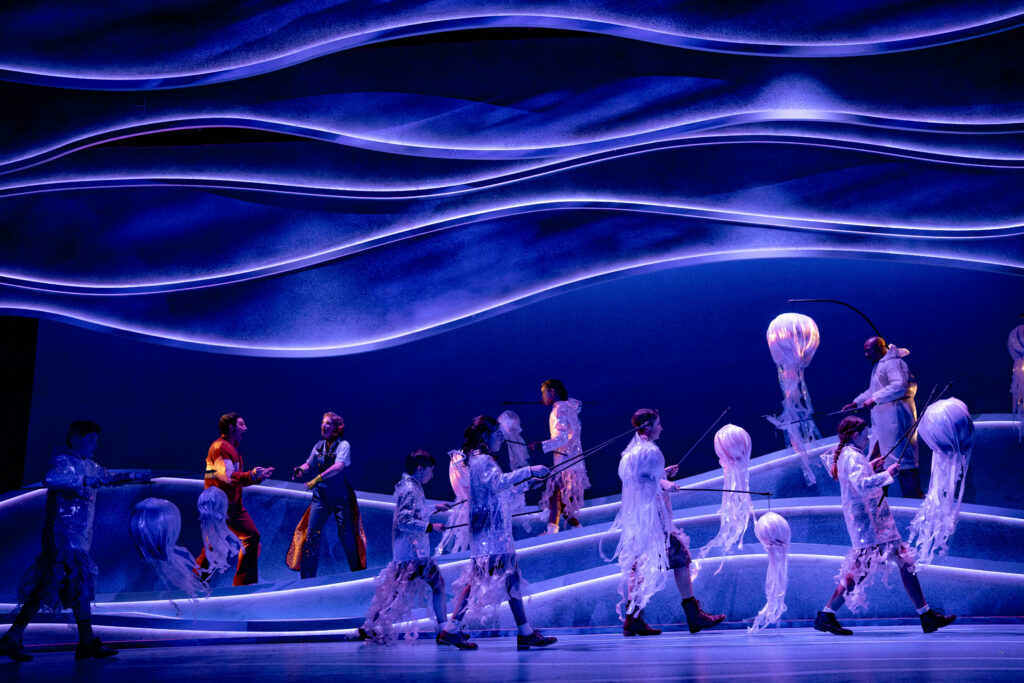
Wave platforms in various blues adorned with lights and augmented by the ocean’s soundscape transform the Wheelock stage into Finding Nemo’s ocean setting, designed by James Rotondo. After a brief happy moment between clownfish parents-to-be Marlin (Jared Troilo) and Coral (an affecting Kiko Laureano), a barracuda swarms their home. Coral bravely shields their roe, but the barracuda claims all their children save one. The attack is shorthanded effectively through lighting, a storytelling choice that saves this moment from being too scary for its young audience (the show is recommended for ages 4 and up). Left with only Coral’s orange-and-white handkerchief, Marlin names their surviving child in her honor: Nemo.
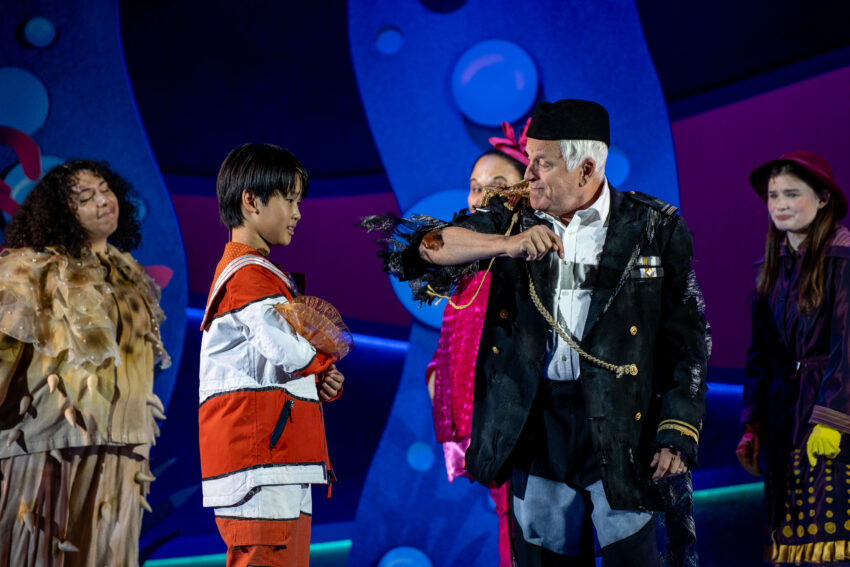
Fast forward to the first day of school for Nemo (Herman Xu), sporting both a “special” fin and Coral’s handkerchief. Marlin is understandably anxious after the opening events, but like any child embracing their newly found independence and autonomy, Nemo is ready to join the big blue world. But the combination of classmate teasing and Marlin’s overprotective hovering drive Nemo to leave the safety of the (sea) schoolyard and, defiantly, touch a boat. The unseen humans capture Nemo, setting off the clownfish’s dual journeys: worrywart Marlin’s odyssey to recover his son, and Nemo’s quest to return home.
Marlin is aided chiefly by the cheerful but forgetful Dory, played winningly by Joy Clark, who counterbalances Marlin’s perpetual frown with a sunny disposition and broad comedic instincts. Nemo finds allies in his aquarium tank in officious Gill (Chip Phillips), kind auntie-like figure Peach (Carolyn Saxon), cheery Bloat (also Kiko Laureano), and nervous Gurgle (Allie Knupp). The aquarium crew make a great team though are undercut by spotty sound, as the mics often cut in-and-out for Gill and Gurgle. Hopefully, Wheelock’s new sound system works out its kinks for the rest of the run.
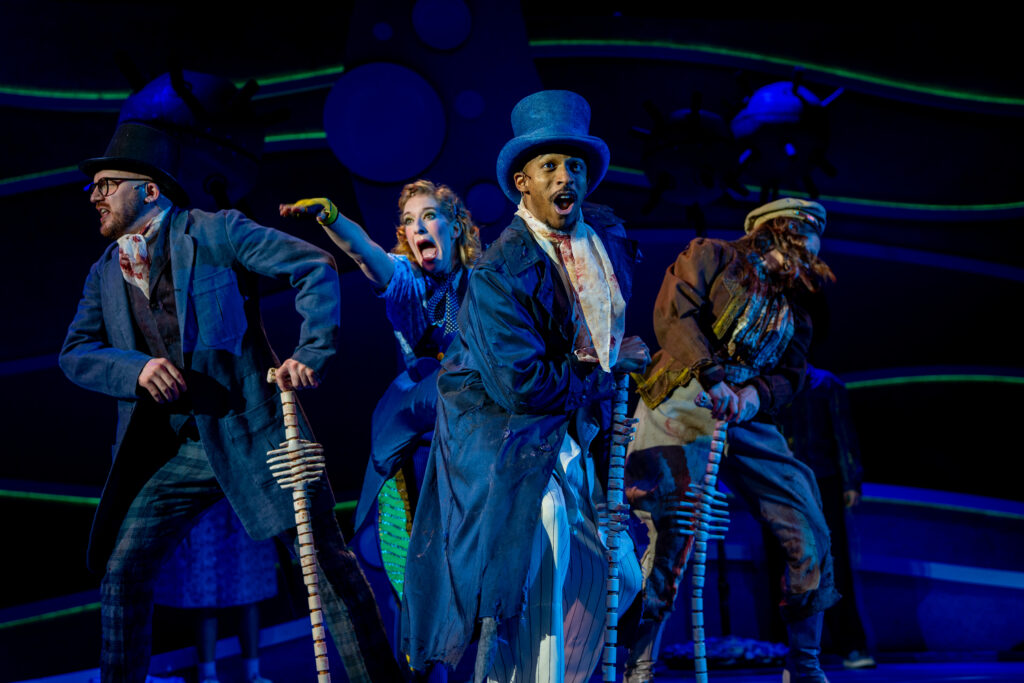
The musical numbers add great fun and energy to the story, be it familiar or new. “Fish Are Friends Not Food” was a particular standout, as the sharks, led by Bruce (Darren Paul), tap like Fred Astaire with top hats and skeleton canes to delightful effect. The teen quartet of Moonfish (Dziko Caplan, Drew Factor, Brynn Kilgore, Andrea Leonarte) dazzled in all their dance features throughout the show and moved the bubble stage columns with aquatic efficiency for scene transitions. Choreographer Hannah Shihdanian has molded both adult and child ensembles into schools of graceful fish without feeling like cartoonish caricatures. The jellyfish work in “Just Keep Swimming” was particularly masterful.
Costumes by Eric Tâm Tran are inventive: contemporary street clothing transformed by undersea details, like diaphonous ruffles to represent fins or patterned scarves over bumps to represent turtle backs. The turtle costumes felt less effective, but the sharp sharks and the collegiate whimsy of Professor Ray’s (also Carolyn Saxon) costume were standouts, as were the military epaulets and shredded sleeves on Gill, to signify his own scarred fin.
Scenic, lighting, sound, and props work in concert to bring the ocean and aquarium to life, transforming the set in key moments through lighting (designed by Hope Debelius) and sound (designed by Irene Wang). A massive star to props designer Amanda Gibson for her work on the Nigel seagull puppet, who appears larger-than-life through awe-inducing stage magic. And well-deserved claps to the stage management team, led by Fanni Horváth, for their roughly 1000 cues (as reported by Troilo in his post-show behind-the-scenes feature).
Any deep fans of the movie may find the plot points briskly condensed here, but the songs and dances keep the story swimming along. The life lessons for children and parents alike make this story worth swimming to for audiences young and old.