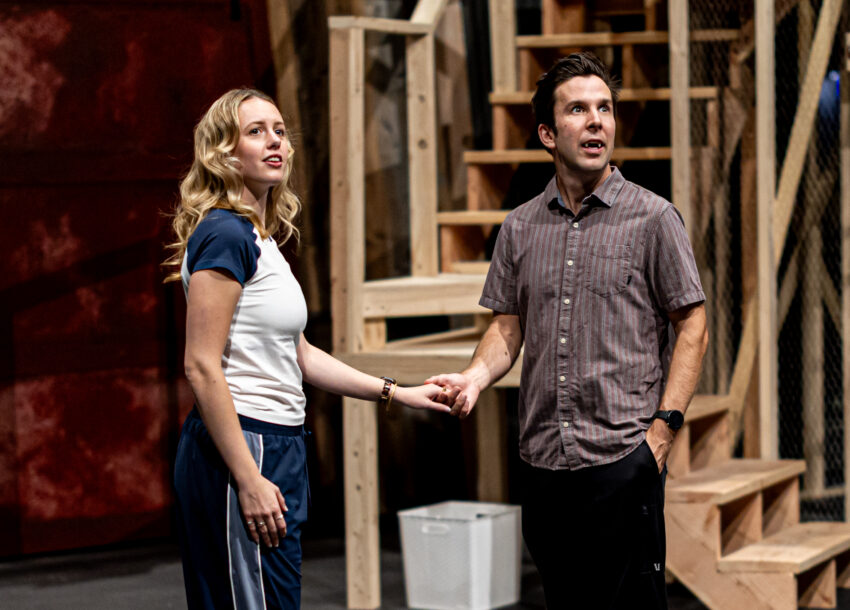
Interview by Kilian Melloy
Bat Boy: The Musical, a 1997 stage musical, has an origin story as strange as that of its central character. Tabloid newspaper Weekly World News ran a story in 1992 about a boy raised in a cave by bats — a novel, if somewhat improbable, twist on the familiar tale of the boy raised by wolves. The story featured a not-very-convincing black and white photo of the supposedly half-bat, half-human child, fanged mouth open wide, bat ears and pale skin standing out even in newsprint. It took book writers Keythe Farley and Brian Flemming only a few years to turn the yarn into an entertaining play, with lyricist/composer Laurence O’Keefe writing the songs.
In their vision, the bat boy is a mythical creature discovered deep in a cave by a trio of siblings. Their graceless overtures to the youth, who is unused to human company, prompt him to panic and the result is a bite suffered by one of the teens, the bat boy captured, and a town convinced they have a genuine monster on their hands. Add to that a mysterious bovine ailment on local farms, and a full-on frenzy of anti-bat sentiment crystallizes. Can mobs with torches and pitchforks be far behind?
As it happens, the bat boy is taken in by Meredith, the wife of the town veterinarian, Dr. Parker, and given the name Edgar. The Parkers’ daughter, Shelley, is ambivalent at first — her first words upon seeing him are, “Mom, he’s so gross. Mom, can he stay?” — but it’s not long before the two young people discover feelings for each other. Even as young romance blossoms, so does the bat boy’s grasp of language and social niceties. Before long he’s sipping tea and chatting amiably… and with great eloquence. The forces of prejudice and fear are not so easy to dispel, however, and Edgar and the town’s residents are headed to a showdown at, of all things, a religious revival.
Starring as Edgar in the Umbrella Stage Company’s season-opening production of the musical is Johnny Shea, whose turn with the company last season as Jon in Jonathan Larson’s tick, tick… BOOM! won him an Elliot Norton Award. Shea chatted with Theater Mirror about the play’s evergreen themes of othering and acceptance, and about finding the light (and the laughs) in an absurdist story that’s as filled with drama and darkness as with satirical depictions and witty jokes.
Theater Mirror: You won the Elliot Norton Award for Outstanding Performance earlier this year for tick, tick… BOOM! Congratulations on that.
Johnny Shea: Thank you so much.
Theater Mirror: And now you’re back with Umbrella Theater Company as Bat Boy. Do you see any resonance between the two roles?
Johnny Shea: Being back at the Umbrella is really exciting. I enjoyed working there on tick, tick… BOOM!, and in terms of [the main characters’] hunger and passion, I do see a connection. Jon [in tick, tick…BOOM!] is urgently trying to pursue making something meaningful out of his art and his work, and I think Edgar in Bat Boy has that same hunger and passion and desire to belong, and to be accepted into this community. So, in terms of their fire and energy, I think I do see a parallel there.
Theater Mirror: This is a unique play. I don’t think I’ve ever seen a play that said it was “licensed under agreement with Weekly World News.”
Johnny Shea: I know, it’s crazy, right? Some of the people in our cast recalled memories from when they were younger and had real fears of this [tabloid] cover. It’s amazing that the writers caught wind of the tabloid and decided to let the musical follow.
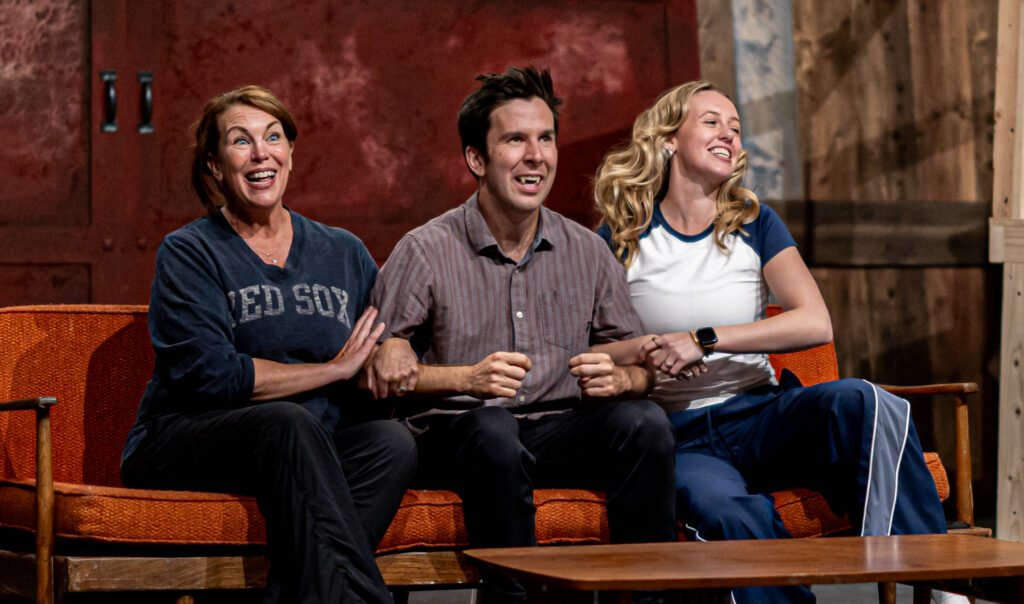
Theater Mirror: Edgar starts out as quite feral. Or do you see him more as… raw? Unspoiled by civilization?
Johnny Shea: I like seeing it both ways. The feral side is probably the biggest challenge of the role. Edgar has been raised by bats, so he’s purely animalistic. But I also like how this could mean he’s untouched by the world yet — pure and raw. Everything is new to Edgar. Everything is impacting him and changing the way he sees the world. What’s interesting about the play is that we see him cultivate seeds of goodness and curiosity but also [we see him] learn darker elements that lead to the play’s tragedy.
Theater Mirror: What about the makeup? Are you wearing prosthetics?
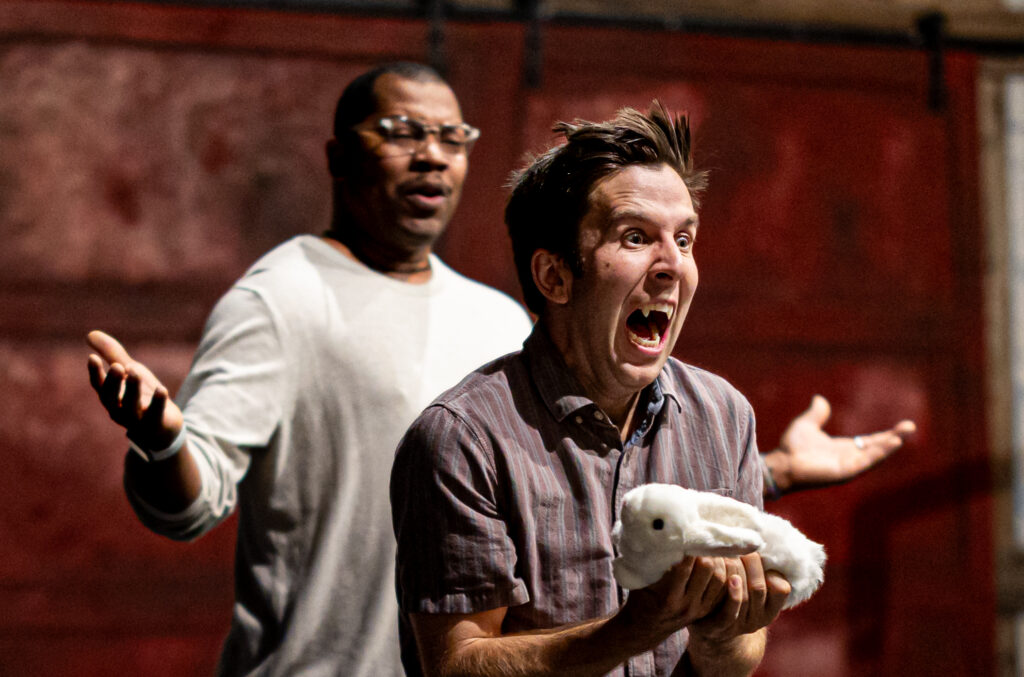
Johnny Shea: We’re doing fangs…and a bald cap. I had the thought of shaving my head, but I’m not sure how I’d look, so we decided to go with the bald cap; it’s easier for everyone. We’re also doing ears.
Theater Mirror: There’s some pretty dark stuff here, for a comedy. How are you finding the funny in the midst of so much mayhem?
Johnny Shea: It’s a real challenge of the show. There could be laughter, or shock, or disgust, or horror. There’s a wide range of possible outcomes because it’s like a Greek tragedy, but also absurd. I think Jeremy [Johnson], our director, is doing a good job finding the right tone…Lawrence O’Keefe, in the playwright’s notes, talks about playing this with real, genuine commitment while in an absurd universe. It’s difficult, because it’s tricky dealing with things that are really heavy and sad. But I kind of love that it does all of that.
Theater Mirror: Bat Boy seems like it could be played right now as a metaphor for xenophobia and anti-immigrant sentiments.
Johnny Shea: There’s a lyric from the storytellers — the ensemble characters who play multiple roles and serve like a Greek chorus — where they sing, “He’s much like me” about Edgar. I think he can serve as a metaphor for marginalized or oppressed people. The fear of the unknown and the hatred of things we don’t understand is something Edgar and the society around him represent. We have a responsibility to create a sense of poignancy amidst this otherwise silly story so audience members can see themselves in this character. It feels important to do right now because of the political climate. Oppressed people are othered, seen as less than or different, and often driven away or pushed out. This show deals with that pretty head on.
Theater Mirror: The writers touch on something that feels obvious now: Persecution is not always just a matter of fear of the unknown. Sometimes, permission is all people need to hate and attack.
Johnny Shea: Yeah, scapegoating is a big part of the show. The cows are dying, they need someone to blame, and mob mentality kicks in. There’s something about our animal side, the primitive side in all of us that lashes out when we’re afraid. Edgar learns this; he didn’t start with it. He learned it from the society around him. He embraces it. He says, “I’m not a boy, I’m an animal,” and he believes what he thinks are truths about him.
Theater Mirror: The songs seem to drive much of the story, rather than merely accompany it.
Johnny Shea: Yeah, it’s mostly songs. There aren’t that many book scenes. The twists and turns in the songs often drive the plot, which is exciting. Characters make big discoveries in each song…And there are curveballs along the way. That’s fun to play, because it’s not always the case in musical theater.
Theater Mirror: Is there a song that hits you particularly hard?
Johnny Shea: “Let Me Walk Among You” is probably my favorite song to sing. The melodies are lovely, but Edgar’s making his case for why he should be accepted. I’ve dealt with my own feelings of wanting to belong and wanting to fit in. He’s singing about what makes the town beautiful — looking at all these people, children, husbands, wives. There’s a real appreciation of the world around him. It feels like a Quasimodo or Evan Hansen thing, and I can relate to being a wallflower and expressing that through song. I also love “Show You a Thing or Two,” where Edgar transforms from being feral to a refined gentleman in minutes. It has a My Fair Lady quality. He rattles off cultural references, and it feels like a celebration of knowledge and curiosity. He just wants a normal day, and I think that helps me appreciate a normal day a little more. It doesn’t always need to be spectacular.
Theater Mirror: Monsters in stories like this tend to be eloquent — like the Elephant Man, or Frankenstein’s monster. Edgar, too, is highly articulate, and he speaks beautifully even if some people are shocked at his appearance.
Johnny Shea: Edgar’s always been a genius, even when he was in caves. He just didn’t have the access or resources to unlock that potential. He becomes the smartest bat person in Hope Falls. [Laughter] I’m working to find cleanliness and precision even in my physicality when he becomes a gentleman. There’s a scene where they’re sipping tea, and I need to remind myself to fix my posture because it’s so foreign to me. But Edgar’s so determined to get it right and to fit in. His desire to please is so strong that he really gives it his all…Hopefully the audience will grow to like him and be on his side, and hopefully that makes it a big shift when he embraces his inner darkness. The last lyric is, “Don’t deny your beast inside.” That’s the heart of the show: The knowledge that all of us have a shadow side to one degree or another, and we must embrace it rather than repress it.
Bat Boy: The Musical runs Sep 25 – Nov 8, 2026 at Umbrella Arts Center in Concord, Mass. For tickets and more information go to https://theumbrellaarts.org/production/bat-boy-musical