Photos by Nile Scott Studios
By Kilian Melloy
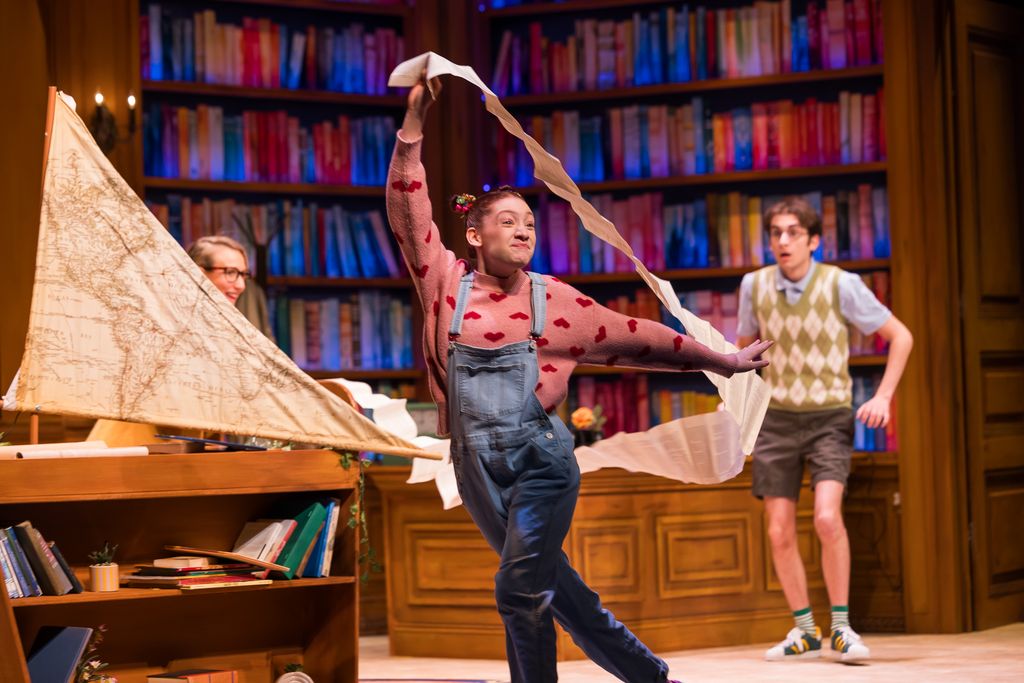
For the second January in a row, Adam Theater will be putting the “lion” in the Calderwood Pavilion with a production of Library Lion, a musical that celebrates the importance both of reading and of celebrating people for who they are.
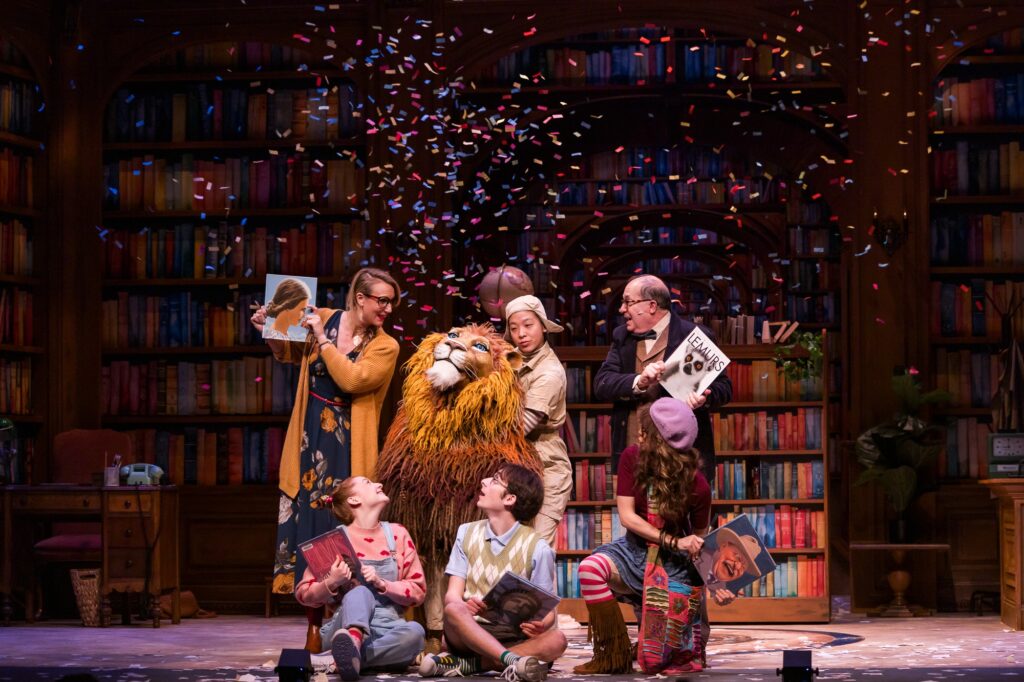
The story is sweet and compelling. When a lion wanders into a library, his appearance stirs panic in some. Others, however, find his presence to be perfectly fine, so long as he follows the usual rules: No running, no shouting, no eating or drinking. The lion becomes a regular at the library (and its popular story hour) at the same time as two children are learning how to use the library as a resource, and to understand that books can fuel the imagination. But suspicion and fear linger, and when a misunderstanding happens, the lion’s place in the library’s community is put into question. It’s the kind of story that, ironically, can get a book challenged, or even banned, these days.
That is not at all beside the point. “We believe that different people have value to the world,” Adam Theater’s founding Artistic Director, Ran Bechor, says. A veteran of both the theatrical and educational worlds — he once served as the principal of a school for gifted students in his native Israel — Bechor adds, “We are happy to celebrate others, always, and we believe that kids don’t see these barriers and these walls. They can see [other] kids as kids.”
Long-cherished aspects of American society, such as education and scientific expertise, have recently come under attack as never before. Adam Theater co-founder and Executive Director Karin Sharav Zalkind calls the play’s library setting a matter of “creating institutional trust,” and points out that “when a library, and particularly the library of Boston, is open and free for all, it permits everybody to walk through the door. As long as you maintain [the] rules [of the library], you’re fine, and that’s part of the play.
“I think in many ways marginalized communities can feel comfortable being in a space where all are welcome and accepted, and all are safe,” Sharav Zalkind continues, “because they’re kept within the boundaries of what the library permits. Libraries are also a source of knowledge, and so a good way to start learning about ‘the other’ is in the library.”
The musical play, which is based on Michelle Knudsen’s 2006 children’s book of the same name, is slated to run Jan. 10 – 25 at the Calderwood Pavilion. The book and music are by playwright and screenwriter Eli Bijaoui and recording artist Yoni Rechter, with whom Bechor has collaborated on Adam Theater’s adaptation of Uncle Max, which is based on a children’s book by playwright Hanoch Levin.
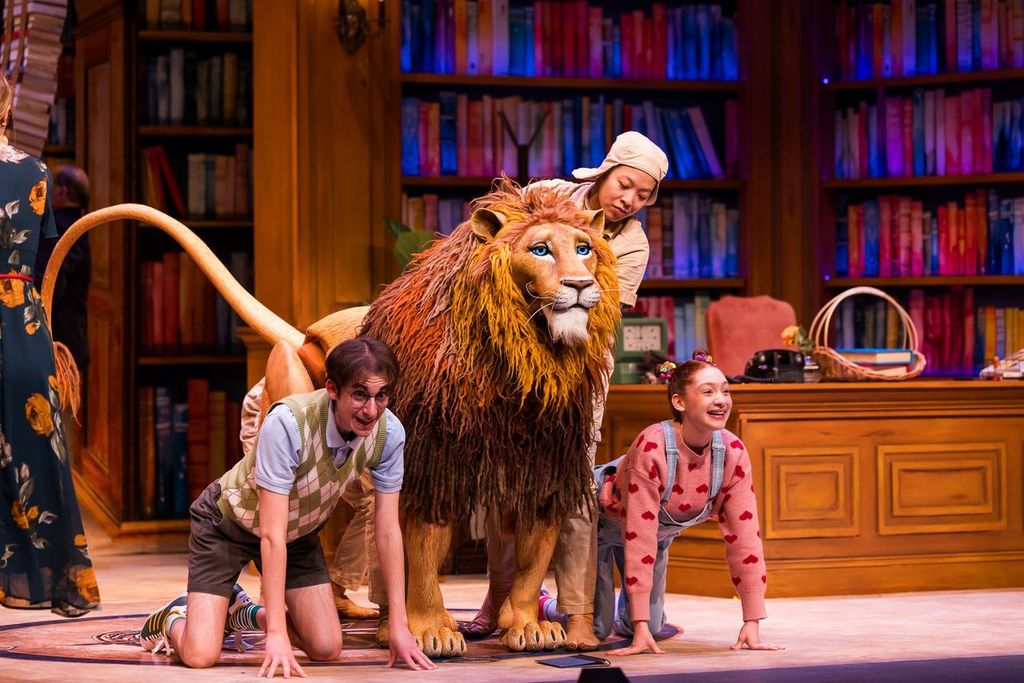
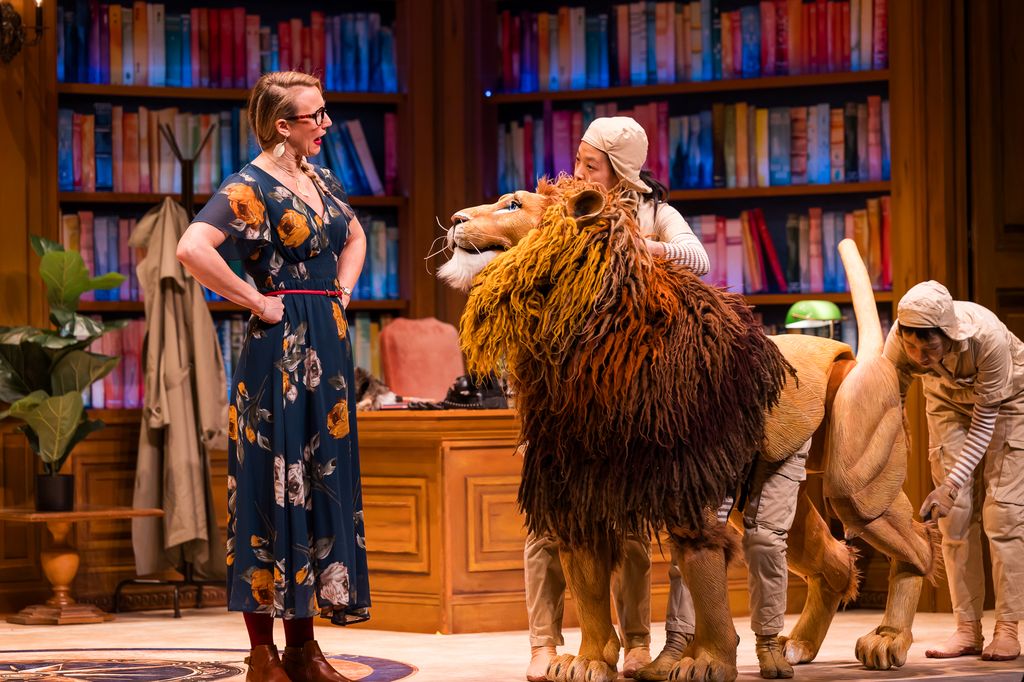
The upcoming production will meet the same high standards as last year’s run of Library Lion, with a colorful, imaginative set, top-shelf sound and lighting design, and the show’s centerpiece: A full-sized puppet designed by the Jim Henson Creature Shop and operated by three puppeteers.
“We want to create really high-quality theater and art for kids,” Sharav Zalkind says. “We feel that kids deserve a real space in the arts world, where we’re looking at their developmental stage, where we’re looking at not cutting corners, putting on recorded music.” Instead, the company employs live musicians to play Rechter’s music, which, Sharav Zalkind points out, “specifically speaks to kids.”
Though the company was only established in 2023, it has already made a mark, drawing significant partnerships with leading corporations and foundations.
Although the company was only established in 2023, it has already made a mark, drawing significant partnerships with leading corporations and foundations. Sharav Zalkind, with a background as a commercial designer, spoke to the importance of the business side of the theater company, saying, “My job for many years has been to help small companies grow and build their identities and tell their stories through the space that they’ve created. It’s a language of design and thought and intention. I have the experience of both — being the artist, but also producing a project with a budget of a million to three million that you have to run, and you have to make work.”
Ran Bechor and Karin Sharav Zalkind found time before a recent rehearsal to chat with Theater Mirror about the play, their backgrounds, and the mission of Adam Theater.
Kilian Melloy: Ran, you’re directing the new production, and you also directed last year’s production at the Calderwood, as well as the play’s premiere at the Boston Public Library. It’sbecoming a bit of a Boston tradition, isn’t it?
[Laughter]
Ran Bechor and Karin Sharav Zalkind, in unison: Yes!
Ran Bechor: Thank you that you said it!When we established Adam Theater, we wanted to do high-quality art [that would be] accessible to every child. We had an amazing collaboration with the Boston Public Library, where we did [the show] 18 times, and we brought 1,000 kids from Boston public schools for free.
Kilian Melloy: The Boston theater scene has suffered in the aftermath of the pandemic. Did starting a new theater company feel like it was an opportunity, or more of a challenge, or a mix of both?
Karin Sharav Zalkind: I think theater for young audiences was obliterated — like, there was nothing left. But we have great connections with the Boston Public Schools, with Somerville Public Schools, with Cambridge Public Schools; we have been able to partner up with the Mandel Foundation to get a two-year grant to bring second graders from Boston Public Schools. That was the charter: We’re going to bring every second grader to see a play and start to educate them from that age [about the theatrical arts]. And the schools have been amazing to work with.
Ran Bechor: I feel that a lot of people learned from the pandemic that they can live without people — they can live virtually. I learned from the pandemic that I cannot live without people. We have to continue meeting with people live, without screens, and give meaning and value to all the community.
Kilian Melloy: Has the city’s theater community also been helpful?
Karin Sharav Zalkind: The theater community in Boston is very open and accepting. Very early on, we had deep conversations with a lot of theater makers here, so it was very helpful.
Kilian Melloy: Tell me a little about the lion puppet. Did you go to Jim Henson’s Creature Shop and say, “Look, we need a lion,” or how did this happen?
Ran Bechor: Well, it was a great story. We reached out to them, and they knew the book already, and they were very excited about the fact that the show would be in the Boston Public Library. Immediately, it was like a click. We understand each other very, very well. The people at Jim Henson’s Creature Shop understand two things very deeply about human beings. One is the physicality of creatures, and the second is the psychology, because you need to express this, this feeling, and experience of this creature, and it was an amazing collaboration.
Karin Sharav Zalkind: They usually build puppets that are for TV, so the amount of mileage that they need from the puppet is different than the amount of mileage that we need, because the puppet doesn’t just appear on stage. We rehearse with it every single day. So, we’ve tweaked and found different ways to work with it, and that’s why they were such amazing collaborators, because they want to learn from us what works and what doesn’t work. We’ll send them a video, and then we’ll talk together about how to fix it. They’ve been a really amazing partnership of people who want to create good quality art for children. It becomes a very beautiful energy, because that energy is projected also on the stage with the puppeteers, as well. What’s interesting with the way Ron envisioned it is that the puppeteers are like the agents of imagination, the agents of movement. It’s kind of the first time that people are taking puppeteers seriously, that they are an integral part of the storyline. I think they take a lot of pride in it as well, because they work really hard.
Kilian Melloy: Would you be open to maybe adapting some other children’s book that might need a puppet to become a stage play? The Tiger that Came to Tea, for example.
[Laughter]
Karin Sharav Zalkind: A lot of our work, we want to intertwine with literacy. You don’t surprise a child in theater; you want them to be a part of it, and you want them to understand things about themselves, and not necessarily the glitz and glamor and so forth [of theater]. It’s more about the storytelling and creating community around storytelling.
Kilian Melloy: This is a lion puppet that has to be operated by three people.
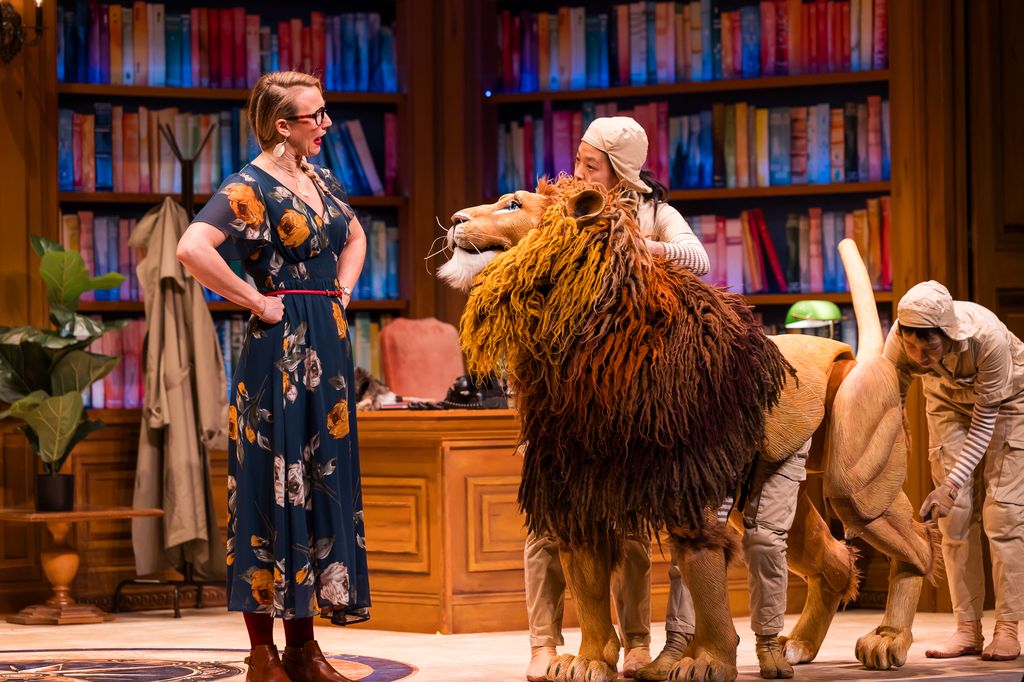
Ran Bechor: In this run, we replaced all three puppeteers, so we taught them from the beginning how to walk with the lion. [We have] rehearsals for three hours focused just on the lion: “We want to be here, and not here.” It’s very precise work to be sure that we can see how they manage the lion, and at the same time, the kids can choose to believe that this is a real lion on stage.
Kilian Melloy: That explains the costuming of the puppeteers. They are quite visible and not in Kabuki black or something.
Ran Bechor: Yes.There is this moment when everything gets stuck.
Kilian Melloy: You mean that moment when one of the librarians is carrying a stack of books that starts to fall over, and everyone freezes in place.
Ran Bechor: One of the puppeteers goes out from the lion, fixes things, and comes back. I want all the time that the kids will remember [this is] theater. We expose the mechanism of the theater. It’s not a video. We are not trying to build a perfect and finished world for kids, we’re trying to show them how we build the world in front of them, and their imagination needs to work with us to make this magic happen.
Kilian Melloy: One thing that I hear is that the kids are not scared at all when the lion appears. It’s the opposite — they are insane with excitement.
Ran Bechor: [Kids] have so much imagination. I’ve always said to do theater for young audience, you don’t need just to love kids; you have to love what kids love.
Kilian Melloy: Adam Theater was established in 2023 and already, just looking at your web page, there are so many corporations and foundations that you’ve allied with. Has the public embrace of the theater company also been that enthusiastic?
Karin Sharav Zalkind: I will give you the best example: We approached the Boston Public Schools around May to get a letter of endorsement that second graders are going to see the show. By August, hardly any schools signed up. But suddenly, in mid-September, we were flooded—we have over 100 schools where teachers are looking out for this content and trying to get it in [for students to see the play]. Unfortunately, we can only accommodate 35 schools, so there’s a waiting list for next year. That’s super validating.
Our sales are going well. Last year, we sold out over two weekends in January, and people were coming from Maine, from New Hampshire, from Connecticut, Delaware, and New York. I’m sure once [word] is out, people are going to understand more and more that this is available and want to be a part of it. And yes, we have immense support of donors who understand art, understand literacy, understand community, and find it important. We’re very, very proud to have their support.
Kilian Melloy: Is Adam Theater it named after a person, or is the name a reference to the biblical Adam and perhaps suggesting the start of a new theatrical lineage?
Ran Bechor: First of all, this is my son’s name. But second, “Adam” in Hebrew [connotes] human being. When you say to someone, “Be a human being,” you say, “Be Adam.” We’re trying to think about what it is to be a human being, and how to make kids grow as human beings in [terms of] ethics.
“Library Lion” runs Jan. 10 – 25 at the Calderwood Pavilion. For tickets and more information, visit the Adam Theater website