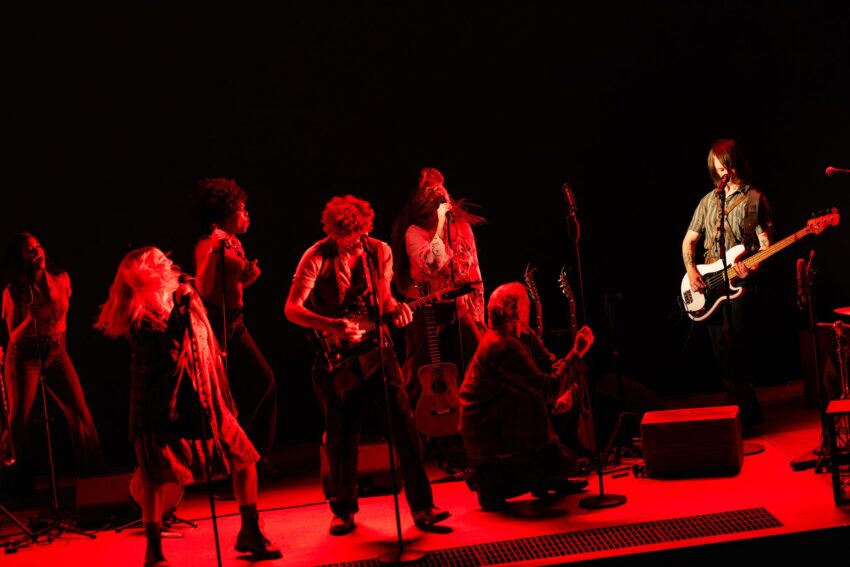
1972: A Rock Opera, a world premiere rock opera with music and lyrics by Chadwick Stokes, book by Chadwick Stokes and Jessie Nelson; Directed by Jessie Nelson; choreography by Jill Johnson; scenic design by Amy Rubin; costume design by Nicole Jescinth Smith; lighting design by Ben Stanton; sound design by Justin Stasiw. Presented by American Repertory Theater at Farkas Hall in Cambridge, MA through December 6, 2026.
By Shelley A. Sackett
Seeing the A.R.T.’s 1972 on November 4 was akin to being trapped in a time-traveling, giddy yet sobering snow globe. The dreamlike stage (with its transparent scrim enhancing the setup of guitars and other acoustic instruments) and nostalgic — for those of us of a certain age — soundtrack (Rod Stewart, Moody Blues, Leonard Cohen) set the time and place directly in 1972. Yet, the energy and excitement of the audience on this blue wave morning after belonged squarely to 2026.
When Chadwick Stokes (best known as leader of the bands DISPATCH and State Radio) steps to the microphone with his 11-piece band, the Pintos, and belts out the opening number that showcases a feisty violin (Brit King), horns, gorgeous harmonies and Stokes’ signature smart, reflective and narrative lyrics, it’s clear that calling 1972 a “Rock Opera” is an apt moniker.
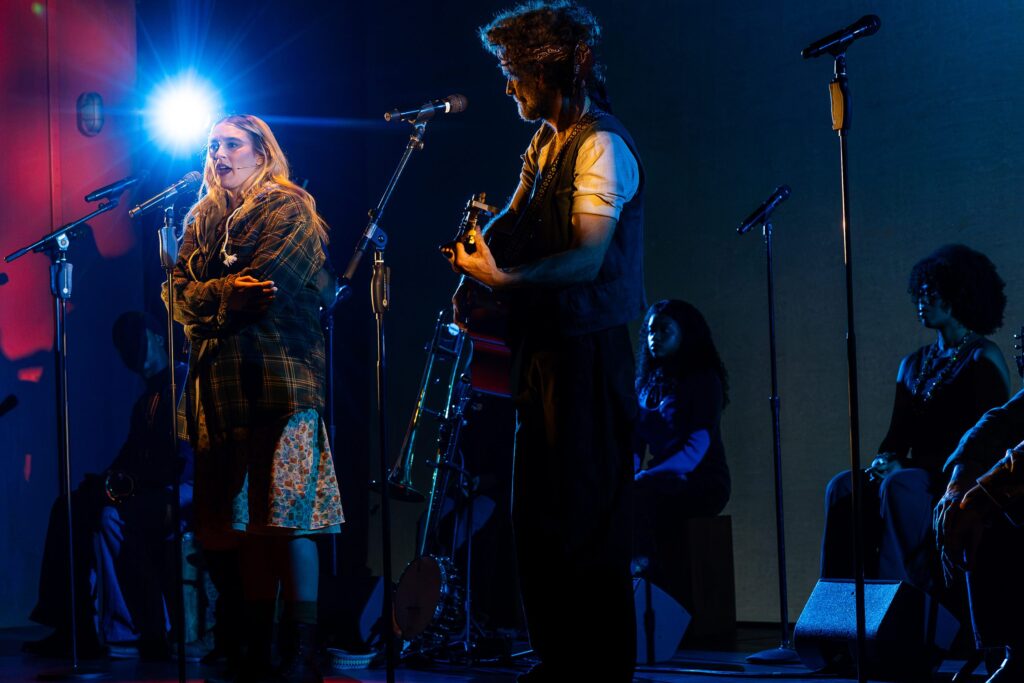
The story unfolds over the course of that one year through song and drama, set against Amy Rubin’s creative scenic design that allows maximum flexibility yet clearly anchors each scene. An open-sided boxcar and train tracks ground the bulk of the action on the trains the cast will jump on and off throughout the production. Lighting (Ben Stanton) and sound (Justin Stasiw) designs augment the effect.
The plot harkens back to 1972, when abortions were illegal and the Vietnam War was raging. We meet Hannah (played to vocal and dramatic perfection by Gracie McGraw, daughter of country stars Tim McGraw and Faith Hill), a sad 19-year-old abused wife who has just learned she is pregnant. Poor and alone, she vows that she will not bring this child into this world.
We will follow Hannah’s journey from January through December, the months lit above stage right to remind the audience where they are in the story.
She flees, penniless and with only the clothes on her back. Following the train tracks out of town, she runs into Depot (Stokes), Pinto (Will Urmston) and Eddy (Darren Buck). They are huddled around a fire bucket and, although Hannah at first approaches them with the apprehension of a feral animal (McGraw’s facial control is a master class in effective subtlety), she eventually warms to their offer to join them.
She explains her predicament and tells them her plan. Depot offers to help by teaching her how to hop trains (one of Stokes’ real-life passions). Eddy rails against her decision, but doesn’t try to stop her.
She manages to find an illegal abortionist (also played by Buck, who repeats his “bad guy” snarl and snark role in every character he portrays) who has to get high to perform his duties. He eclipses the cruelty of Hannah’s husband, and she manages to escape with her life (although without the money she has prepaid him). Louisa (a terrific Jakera Davis), whom Gracie befriends in the “doctor’s” waiting room, isn’t so lucky; she too flees, but not until after she has undergone the procedure.
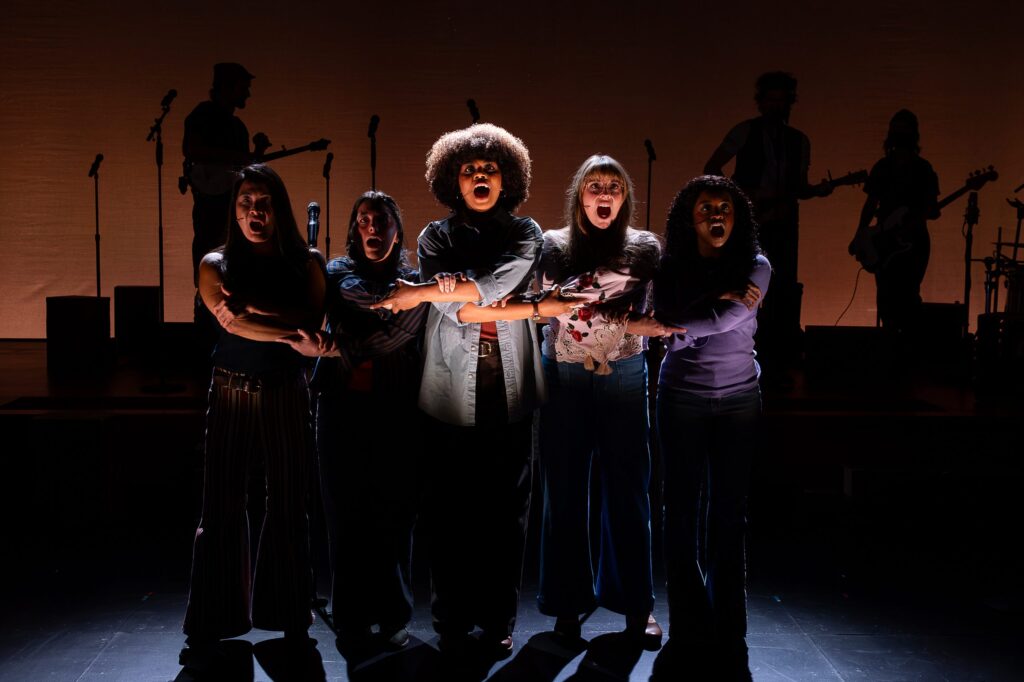
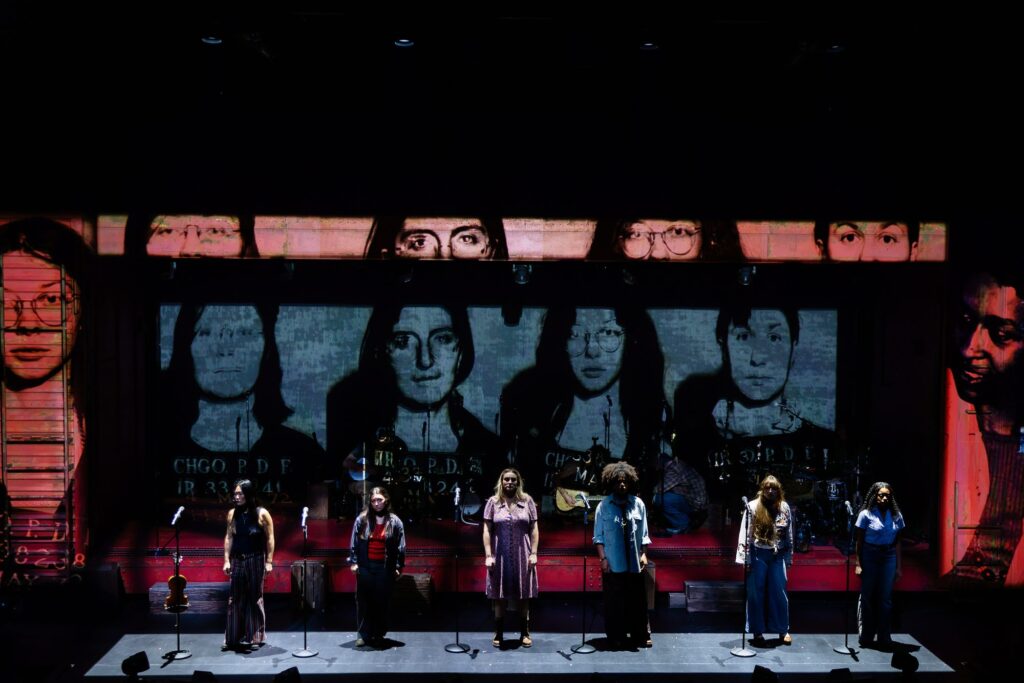
Eventually, Hannah meets up with the Janes, a group of women based in Chicago who offer safe, compassionate, sliding-fee abortions. Played by five sassy women (Khaila Wilcoxon brings down the house as Harlan, leader of the pack), the Janes offer Hannah safe harbor from the storm and a lifeline to a new life. Empowered and befriended, Hannah joins the group and finds the camaraderie, hope and purpose she has longed for.
Touted as a “heightened concert,” 1972 checks a lot of boxes. The coziness of Farkas Hall heightens the intimate vibe of the show. Stokes’ poignant and inspiring songs (based on the book co-written with Jessie Nelson, director and author of Waitress) are stand-alone knockouts and a coherent libretto. Nelson’s direction never sags; neither does the cast. Costumes (Nicole Jescinth), make-up/hair/wigs (Krystal Balleza) and especially music direction (Jacob Yates) are icing on this rich layer cake.
The play ends with the event that, in a backhanded manner, sparked Stokes’ passion and spawned 1972. On January 22, 1973, the Supreme Court ruled 7–2 in favor of “Jane Roe” (real name Norma McCorvey), striking down a Texas law that criminalized abortion except when necessary to save the life of the mother. The Court held that the right to privacy—derived from the “liberty” protected by the Fourteenth Amendment’s Due Process Clause—is broad enough to encompass a pregnant person’s decision whether or not to terminate a pregnancy.
That ruling, like the recent Blue Wave, kindled the hope that light did exist at the end of a senselessly cruel, mean-spirited dark tunnel. The cast (and audience) rejoice at the play’s final number, “Cry Out”; redemption, renewal, and revolution are in the air.
Nonetheless, it bears remembering that Stokes’ inspiration to pen 1972 is rooted in the Supreme Court’s 2022 ruling that overturned Roe v. Wade. Let us all hope he will draw inspiration to create a sequel when that ruling is neutered, replaced with a kinder and gentler attitude towards what should be a matter of choice rather than edict.
HIGHLY RECOMMENDED!
For more information, visit https://americanrepertorytheater.org/
