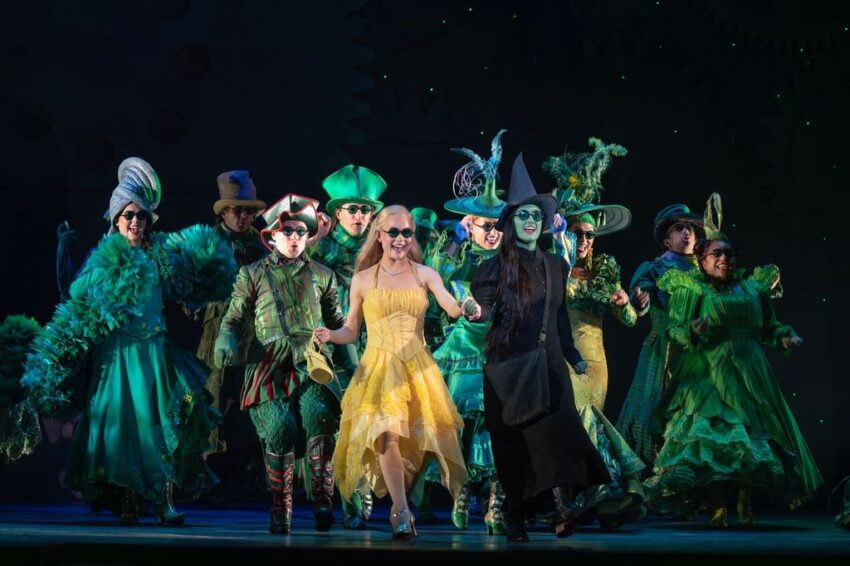
‘Wicked’ — Music and Lyrics by Stephen Schwartz. Book by Winnie Holzman. Based on the novel by Gregory Maguire. Directed by Joe Mantello. Set by Eugene Lee; Costumes by Susan Hilferty; Lighting by Kenneth Posner; Sound by Tony Meola; Music Arrangements by Alex Lacamoire and Stephen Oremus; Music Direction by Faith Seetoo; Dance Arrangements by James Lynn Abbott. Presented by Broadway in Boston at The Citizens Opera House through November 15.
By Shelley A. Sackett
It’s nearly impossible not to think of the current state of our political situation while watching Broadway in Boston’s excellent production of ‘Wicked,’ at the Citizens Opera House through November 15. Although its thinly veiled political, ethical and social commentary on the nature of good and evil takes place in the Emerald City of Oz, its lyrics might have been torn from the latest Op-Ed pieces of our national newspapers.
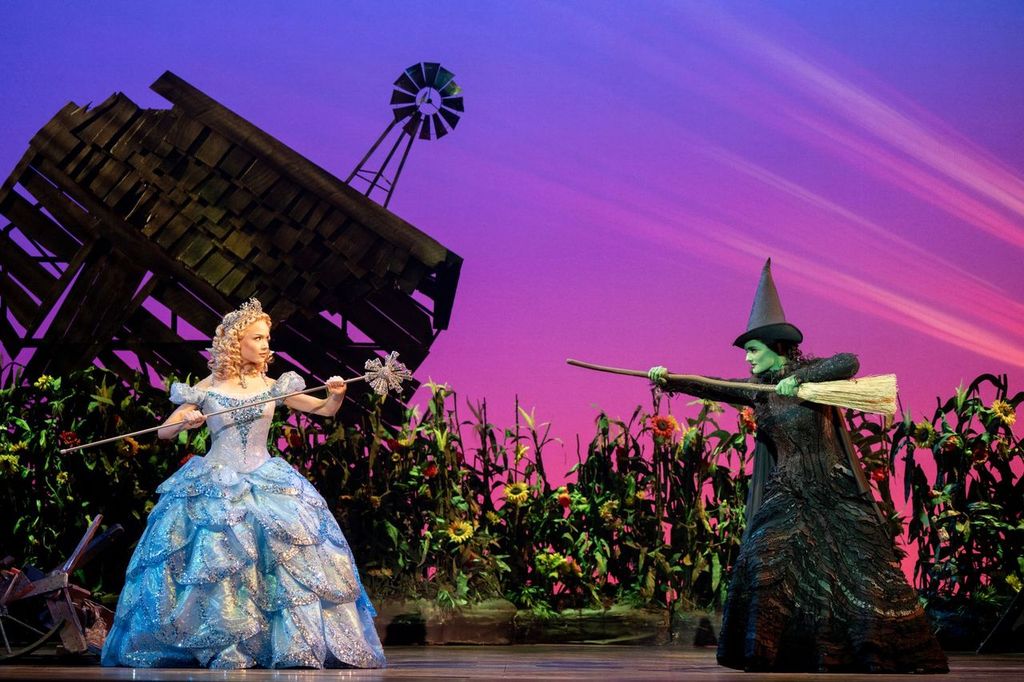
Loosely based on Gregory Maguire’s 1995 novel, “Wicked: The Untold Story of the Witches of Oz” (which, in turn, is loosely based on L. Frank Baum’s 1900 novel, “The Wonderful Wizard of Oz”), “Wicked” delves into the backstories of Glinda, the Good Witch of the North, and the Wicked Witch of the West. In this theatrical version, librettist Winnie Holzman and songwriter Stephen Schwartz have given their Wicked Witch a name (Elphaba), a sorrowful backstory, and a moral compass loaded with heart.
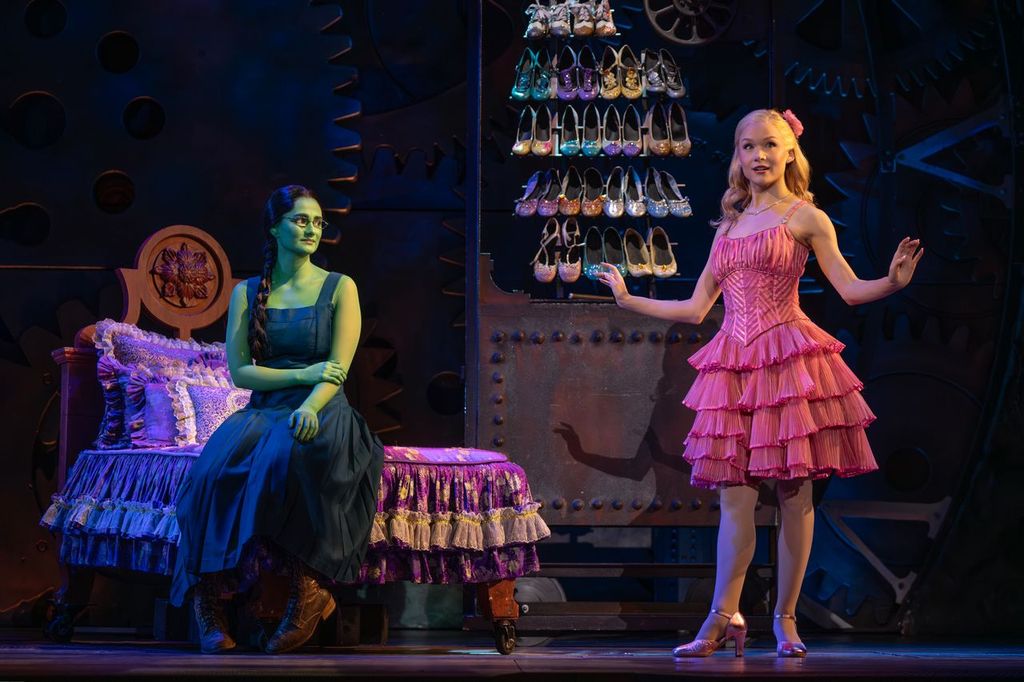
They are less kind to Glinda, whom they paint as a narcissistic opportunist whose true North points to one thing — popularity.
The musical assumes its audience is familiar with the original Oz story and proceeds to turn that story on its head. Set in Oz before and after Dorothy’s arrival from Kansas (she never appears on stage), “Wicked” focuses on the complex relationship between Glinda Upland and Elphaba Thropp, the future Good and Wicked witches.
The show opens with a number that pulls out all the big production stoppers and has the audience cheering by its end. Eugene Lee’s magnificent Tony Award-winning set of metal sculptures and clock towers is imposing and sturdy enough to climb on, which the flying monkeys (still crowd pleasers from the original “The Wizard of Oz”) are happy to do. The orchestra is pitch-perfect, Munchkins cavort, and the cast belts out the first musical number (“No One Mourns the Wicked”).
The cause for all this celebration is the death of the Wicked Witch of the West. Glinda (née Galinda), played by Claudia Bennett, the allegedly good witch, floats down out of the sky, protected from the masses she lords over by her pink bubble shield. “Are people born Wicked?” she muses, “or do they have Wickedness thrust upon them?”
The rest of the plot centers on reminiscences about their shared past. Elphaba (“beautifully tragic”), played by Aline Mayagoitia, was born with green skin and promptly disowned by her father, the Governor of Munchkinland. Her younger paraplegic sister Nessarose (“tragically beautiful”), played by Cristina Sastre, is the light of her father’s eye. When Nessarose is sent to the posh Shiz University, Elphaba is allowed to go too, but only because she is to care for her sister. Although Elphaba’s native tongue is sarcasm and she shows disdain for study and fellow students, she is actually a very bright, funny and caring soul.
Enter Galinda, her perfect foil. A stuck-up, shallow blonde bombshell with a one-track mind and a warehouse full of clothes, she is all about — and only about — Galinda.
The school’s headmistress, Madame Morrible Susan Cella), decides to care for Nessarose herself and assign Elphaba to room with — no surprises here — Galinda. The two eventually become friends and, though their characters lead them to completely different destinies, their relationship is the driving and unifying energy behind the plot.
So is sorcery, and it is Elphaba’s innate abilities (and Galinda’s lack thereof) that both separate and draw the two girls together. The plot thickens when a rakish young prince, Fiyero (Ethan Kirschbaum), arrives at Shiz. He presents himself as shallow and vain (which attracts Galinda like a moth to a flame), but he is actually as compassionate and thoughtful as Elphaba.
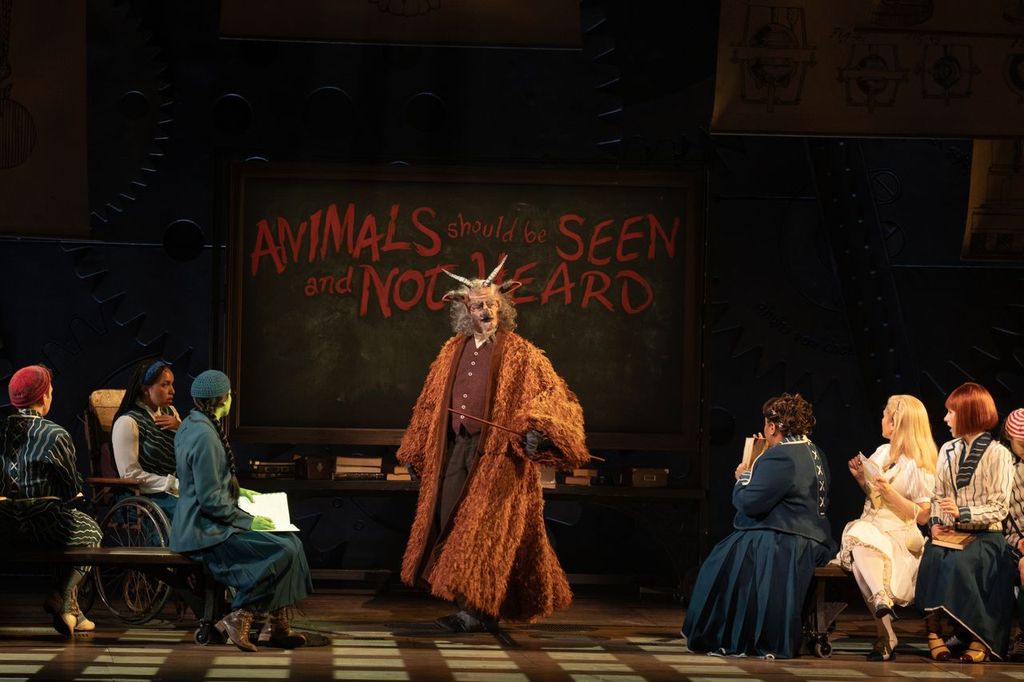
All three are enrolled in a class taught by Dr. Dillamond (Drew McVety as a comely goat), the only animal teacher left at Shiz. He and Elphaba share a sandwich (she eats the sandwich; he eats the wax paper wrapping) and recognize each other as kindred souls — both discriminated against, ostracized and lonely. When he warns Elphaba of a conspiracy afoot to stop animals from speaking, she is as alarmed as he is.
Eventually, Elphaba is invited to meet the Wizard of Oz. She, in turn, invites a pouting Galinda to come with her. Together, they encounter a Wizard (Tom McGowan) more corrupt and ruthless than the rheumy-eyed Frank Morgan in the 1939 film. He has ordered that animals be stripped of their ability to speak and caged after decades of rising to professorship positions. He urges citizens to spy on each other. Speech is monitored and controlled and propaganda abounds. “The truth,” after all, “is what everyone agrees it is,” the Wizard explains.
Glinda (she has changed her name by then) drinks the power Kool-Aid and joins the Wizard’s gang of merry pranksters. Elphaba, horrified, goes Rambolina.
There are lots of plot twists and nods to the original L. Frank Baum story. We see where the Tin Man, Scarecrow and Cowardly Lion came from. We put two and two together about which witch was under the house that Dorothy and Toto flew in on. We learn how Elphaba got her green skin and why her mother left her a bottle of green elixir. The musical numbers are well executed, and the cast is solid. (Pablo David Laucerica is a standout as Boq, the Munchkin besotted with Galinda).
Overall, “Wicked” is a glitzy show with enough humor, razzle dazzle, music and dance to please pretty much everyone. Broadway in Boston has done another very good job.
Yet, the show is more than theatrical eye candy, with thought-provoking, serious points too. We have seen “Good” Glinda and “Wicked” Elphaba through clear lenses, and neither is as advertised. Glinda is more wicked than good; Elphaba is more “good” than Glinda could ever be. And so we wonder: what does it really mean to be deemed “good” or “wicked” in a world where those words are defined by whatever suits those in power? Can good intentions ever absolve bad results? And will we ever see a turnaround from our current political, moral and humanistic entropy?
If it can happen in Oz, well, maybe it can happen here too.
For more information, visit: https://boston.broadway.com/shows/wicked-2/