‘Rhinoceros‘ by Eugène Ionesco, translated by Derek Prouse, adapted by American Repertory Theater. Directed by Diane Paulus. Scenic Design by Riccardo Hernández; Costume Design by Anita Yavich; Lighting Design by Jen Schriever; Sound Design by Fitz Patton; Special Effects Design by Markus Maurette; Fight Direction by Thomas Schall; Movement Advisor Jill Johnson; Dramaturgy by Ryan McKittrick; Production Stage Manager Ryan Gohsman. Produced by American Repertory Theater in Cambridge, MA through September 27, 2026.
By Shelley A. Sackett
Eugène Ionesco (né Ionescu) was born in Romania in 1909. He spent most of his childhood in France, returning to Romania with his father in 1925. As a young man in Bucharest, he witnessed the rise of the Iron Guard, a violent and prominent fascist movement, and watched in horror and despair as many of his friends, mentors, and intellectuals embraced its Nazi ideology. When his father, a magistrate, opportunistically shifted toward antisemitism and totalitarian politics in 1936, Ionesco broke off relations with him. The two never reconciled.
Years later, while living in France, he remained deeply scarred by World War II and the way ordinary people had accepted the extraordinary. In 1959, he wrote Rhinoceros, his “Absurdist” play that illustrates how society and herd mentality normalizes extremism. Now in production at American Repertory Theater’s Loeb Drama Center through September 27, this 2-ish hour (one intermission) is a response to and condemnation of the seduction of the surging rise of Fascism and Nazism during the years preceding World War II.
Rhinoceros starts out as an alarming, grotesque anomaly. Quickly, that anomaly is rationalized, debated into legitimacy, and eventually adopted by civic institutions as the new norm, leaving dissenters feeling like they are the ones losing their minds.
If this sounds like 2026 as much as 1936, well it should. The play’s themes of mob mentality, philosophy and (im)morality couldn’t be more timely.
If it sounds dark and depressing, it is that too, but rest assured that Tony Award-winning director Diane Paulus and her star-studded cast (led by John Turturro, Paul Giamatti and Tatiana Maslany) and creative team will mesmerize you with the most energetic, innovative, talented and — yes — hilarious evening of theater this side of Broadway. (Who would have guessed Ionesco could be quite THAT funny about a topic that painful?)
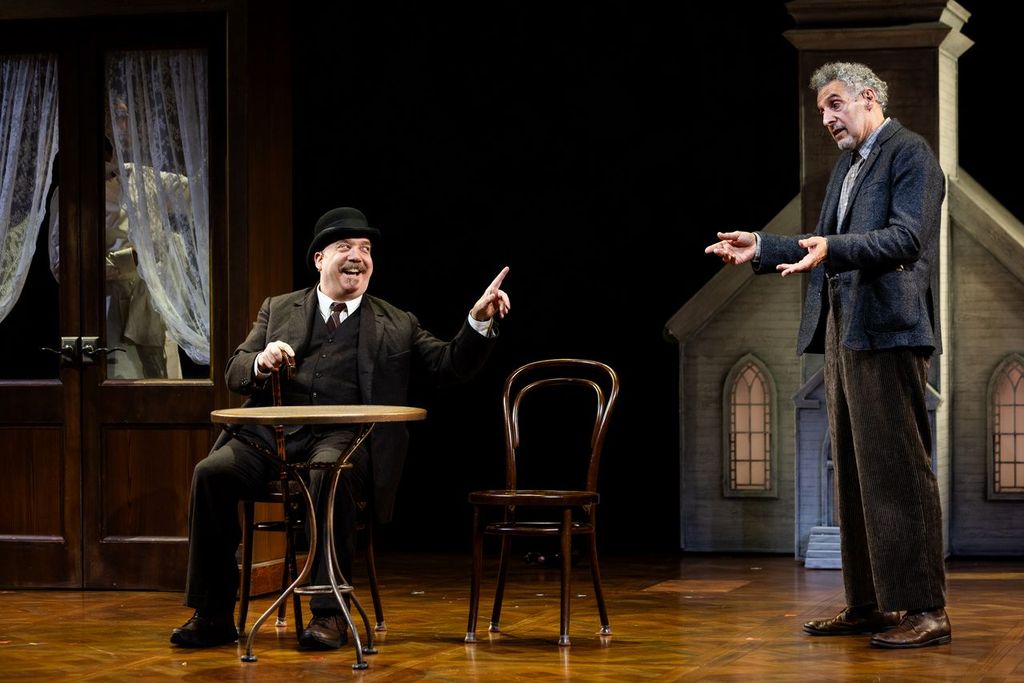
The play opens on a small, provincial French town square. The tidy, attractive café, church and grocery store (set by Riccardo Hernández) are the centers of activity. Bérenger (Turturro) is a low-level clerk who is too apathetic even to hate his job. He nurses a hangover and thirsts for his first drink of the day while awaiting his best friend, Jean, a man as buttoned-up and practical as Bérenger is disheveled and detached. Jean is a man of purpose with nary a moment to waste, except when it comes to criticizing his friend.

Ionesco pens his most clever lines for these two, and Obie and Emmy Award-winning Turturro and three-time Golden Globe awardee Giamatti couldn’t be better matched, each electrifying in his own way. Part Vladimir and Estragon, part Laurel and Hardy, they are a winsome duo.
Turturro brings humor and heartache to Bérenger, withstanding Jean’s barbs one minute, regretting his life the next. (“I’ve always tried to live, but I’ve passed life by,” he laments.) His cadence is impeccable, his flourishing gestures and facial expressions works of art.
It is Giamatti, however, who will steal the first two acts (he doesn’t appear in Act III) with his staccato sarcasm and self-serving puffery. He uses his whole body to summon comedic punctuation, shape-shifting (literally) before our eyes.
All is not well in our bucolic town, however. A rhinoceros has been spotted, raging through the streets. Suddenly, one stampedes through town. A second tramples a cat.
The sound (Fitz Patton), special effects (Markus Maurette) and lighting (Jen Schriever) are dark and menacing. We feel the presence of these enormous animals as they blast past. Kudos to these three, who bring the stampede to life without overplaying their hand and turning the sublime into the mundane.
Jean is beside himself, asking everyone what they thought of what happened. “I can’t get over that!” he exclaims over and over. “It shouldn’t be allowed.” Nonplussed, Bérenger tries to rationalize the rhinoceroses’ appearance. Perhaps they escaped from a zoo, he suggests. In any case, it doesn’t matter, because it’s over.
Except it isn’t over and it does matter. Some don’t believe the news reports. (“I never believe journalists. I don’t need them to tell me what to think,” one of Bérenger’s co-workers says). Some think they should be left alone (“Are they harming you?”) Some question the morality of deciding whether to become a rhinoceros or not; others reframe good and evil, wondering whether they are merely “personal preferences.”
Suddenly, townspeople are changing into rhinoceroses. At first, it seems to be against their will. It just happens. There are debates about whether the metamorphosis is caused by a disease, why it is happening, whether it isn’t a good thing after all, and, finally, whether there is any reason NOT to join the crusade.
Even Jean embraces becoming one of the herd. Giamatti’s transformation is such a tour de force of frenzied snorting, frothing and rutting we almost expect him to return for the curtain as a fully shapeshifted rhinoceros.
Act III continues the downward spiral, but without the warmth and humor. A placid co-worker sheds his white button-down oxford for a horn and thick skin. One by one, the entire town “gets used to it.” Bérenger and his girlfriend, Daisy (Tatiana Maslany, the Emmy winner of TV’s “Orphan Black”), are the last holdouts until she too falls under the spell of mass conformity.

Alone, the last human left standing, Bérenger wonders if he’s made the right choice, then turns on himself. He is ugly. They are beautiful. He is miserable. They are happy. He will come to a bad end. They will triumph.
But be that as it may, he’s not giving up. He may be the last man standing, but he’s not capitulating. Long live Bérenger; long live Ionesco; and long live Diane Paulus and her reign at A.R.T.!
Highly recommended!
For more information, visit https://americanrepertorytheater.org/shows-events/rhinoceros/