
Reviewed by Julie-Anne Whitney (Editor)
Rhinoceros by Eugène Ionesco, translated by Derek Prouse, adapted by American Repertory Theater; directed by Diane Paulus; scenic design by Riccardo Hernández; costume design by Anita Yavich; lighting design by Jen Schriever; sound design by Fitz Patton; special effects design by Markus Maurette; fight direction by Thomas Schall; movement advisor Jill Johnson; dramaturgy by Ryan McKittrick; production stage manager Ryan Gohsman; produced by American Repertory Theater in Cambridge, MA through September 27, 2026.
Romanian-French playwright, Eugène Ionesco, wrote all of his most enduring works in the 1950s in the wake of World War II. His 1959 absurdist masterpiece, Rhinoceros, was written as an act of resistance against the spread of fascism and oppression across Europe in the early 20th Century.
The play takes place in a small, ordinary town and follows Berenger, a simple man with no particular talents who doesn’t fit in anywhere, and “barely [has] the strength to go on living.” He struggles to connect with others, is always running late, and is perpetually hungover. Berenger is weary of life and asks himself, “How can mankind put up with being here?” Berenger’s friend, Jean, berates him for his negligence and laziness, explaining that all he needs is some willpower. Then, seemingly out of nowhere, a rhinoceros stampedes through the town, shocking everyone except Berenger who does not seem surprised or impressed.
An epidemic, of sorts, starts spreading across the town and, one by one, Berenger’s neighbors, friends, and colleagues start changing into rhinoceroses. At first, some people are bewildered by this news while others remain indifferent. Some wonder if the rhinoceroses are made up. Others disagree on the beasts’ arbitrary features (“does it have one horn or two?”). One man suggests that journalists concocted the story just to sell papers. Is it propaganda? Is it an illness? Is it a cult? Eventually, the shock wears off and the “epidemic” becomes normalized. People go about their lives, comfortably living alongside the rhinoceroses. Berenger, however, is distraught, but his concern for others is not enough to keep people from changing. Once someone changes into a rhinoceros, man and beast can no longer understand each other. Despite the loss of humanity and the rise of conformity, Berenger remains resolved in resisting the spread of the “epidemic,” and fights on alone.
Using the metamorphosis of man into beast as a metaphor for collective hysteria and mindless conformity, Ionesco’s play highlights the alarming ease and speed with which some people can abandon their values and beliefs, and turn into something unrecognizable. But he doesn’t ever explain how the characters lose their humanity. “What can be the reason for it?” Berenger asks. Were they converted? Have they lost their minds? Did they join the herd out of fear? Did they change because everyone else was doing it? Did it give them a sense of belonging they didn’t have before? Whatever the reason, people “are free to do as they like,” one character declares. After all, “there is nothing you can do when things like this happen.”
The story’s rising tension is managed beautifully by Diane Paulus’ meticulous direction. Paulus knows how to use the space and where/when to direct your attention. She keeps the action moving and ensures that the dialogue stays at a sharp, quick, pace which only makes the absurdity of certain moments feel even funnier. She also knows when to let the actors shine and lean into their comedic strengths. There were moments that felt chaotic but, perhaps, in this world that was intentional. Paulus’ choice to keep the changing humans in their human form (i.e. no horns or masks, etc.) was surprisingly moving as it reminded viewers that, even if you can’t understand it, a “rhinoceros” looks just like you and me.
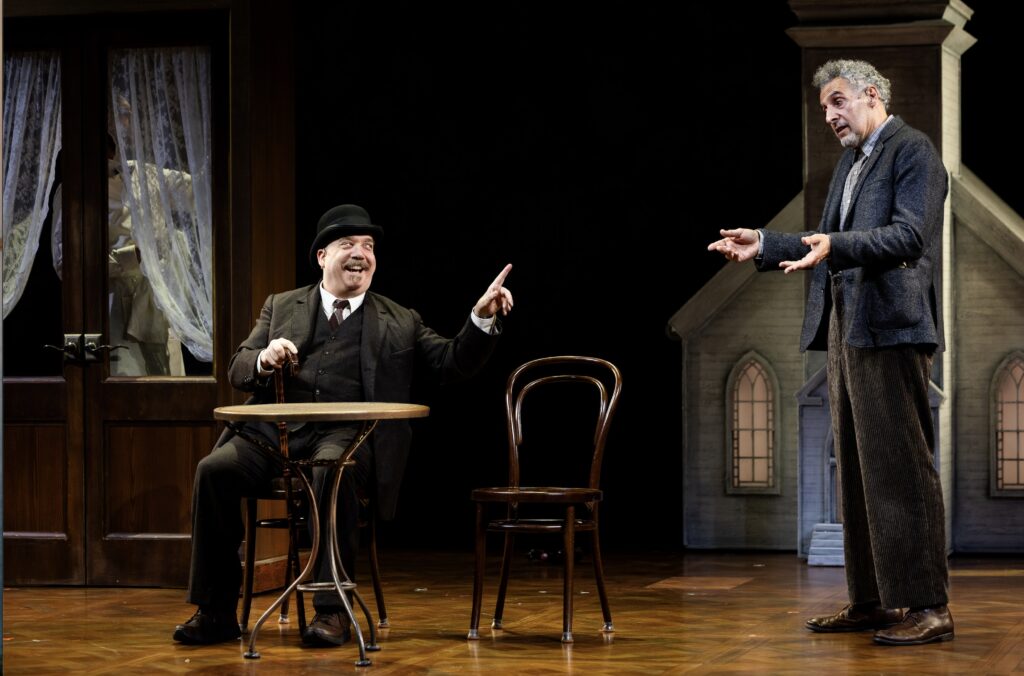
John Turturro gives a masterful performance of Berenger that perfectly balances the character’s sorrowful ambivalence, quiet strength, and deeply human vulnerability. He and Paul Giamatti are brilliant together, and both actors have impeccable comedic timing that will leave your sides aching. Giamatti’s performance of Berenger’s friend, Jean, is tinged with just the right mix of arrogance and insecurity in order to maintain the character’s likeability. His “transformation” scene is, easily, the comedic highlight of the production. Tatiana Maslany seems miscast as Daisy, Berenger’s colleague and love interest. Maslany is nearly 30 years younger than Turturro, and it shows. While the character of Daisy isn’t written or fleshed out as well as Berenger, Maslany still doesn’t manage to bring enough depth or weight to her performance to make us care about her eventually joining the herd.

Riccardo Hernández’s scenic design is spare but effective. Two rolling doors that double as entrances to shops and bedrooms help give a sense of place. A disproportionately small church is placed upstage center in Act One and toppled onto its side in Act Two. It is an unacknowledged but ever-present feature throughout the play suggesting, perhaps, that the church is influencing the rhinoceros “epidemic.” In the final scene, a symbolically large barricade appears that mirrors Berenger’s modest one as he tries to keep the beasts from taking him, and is oddly (or, perhaps, intentionally) reminiscent of the barricade in Les Miserables. The message was clear: We must not surrender.
For six decades, Ionesco’s Rhinoceros exposed a shameful political plague of the past, and now it urgently warns of the perils of the future. During WWII, fascism spread like wildfire through China, Germany, Italy, and Japan. More than 80 years later, authoritarianism is still a problem in China and Italy, has been an issue in North Korea and Russia for decades, and is on the rise in France, Hungary, India, Poland, and the United States. Democracies are collapsing around the world and, as Daisy says to Berenger in the final scene, “no one seems surprised anymore.”
Ionesco’s play asks: how do we maintain our humanity in a world with so much brutality? Where do we find the truth when we’re surrounded by misinformation, distortion, and fabrication? How do we hold onto ourselves and our community when faced with apathy, indifference, and emotional detachment? Rhinoceros does not give us the answers to these questions but urges us to find the answers ourselves– and find them we must.