Interviewed By Kilian Melloy
Los Angeles-based playwright Luis Alfaro finds contemporary parallels to the ancient world with his 2010 reinterpretation of the classic Sophocles play Oedipus Rex, in which Alfaro sets the characters and action in modern-day LA’s prison system as well as the city’s neighborhoods. Oedipus, prophesied to kill his father, Laius, is consigned by his father to die at the hands of a trusted henchman, Tiresias. Instead of murdering the infant, Tiresias raises him as his own son. So devoted is Tiresias that when the youthful Oedipus ends up in prison, Tiresias, though now blind, goes to prison himself to make sure that Oedipus has proper guidance and an education while incarcerated. Eventually, Oedipus is released; once on the outside, it doesn’t take him long to encounter trouble: A heated dispute with an old man ends with the enraged Oedipus killing him. Lacking other options, Oedipus seeks the help of an old friend, Creon, who is now an important figure in the city’s gang culture. Though their arrangement is supposed to be temporary, it’s not long before the forceful and charismatic Oedipus has replaced Creon as the “king” of the gang. Moreover, despite her being in mourning for her murdered husband, Oedipus successfully courts Creon’s sister, Jocasta… who, as it happens, is the former wife of Lauis, the very man Oedipus killed in his fit of rage. Thus, the circle closes, prophecy is fulfilled, and psychoanalysis gains one of its most recognizable clinical terms. What follows is the aftermath of fate intersecting with hubris in the finest style of Greek tragedy.
Oedipus el Rey comes to Boston with a production by The Huntington Theatre. Slated to run at the Roberts Theatre in the Calderwood Pavilion at the Boston Center for the Arts from May 7 to June 7, and helmed by Huntington’s Artistic Director Loretta Greco, the production features costumes by Alex Jaeger, whose designs grace not only stages around the country but also cinema and television screens.
Jaeger logged on for a Zoom chat with Theater Mirror about the play’s enduring themes, finding the classical echoes in contemporary culture, and how the often-overlooked art of costuming deeply informs the theatrical experience.
Theater Mirror: Your costume designs are amazing. Did you do them with a computer?
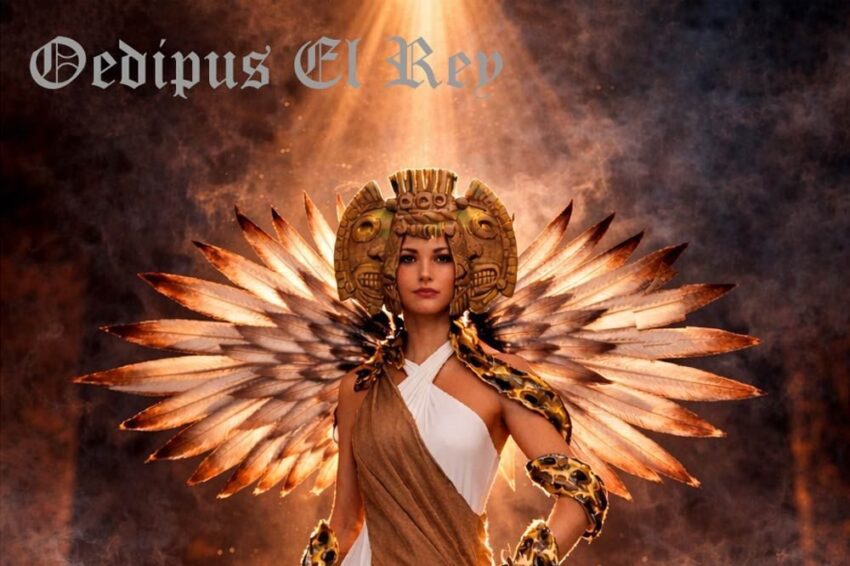
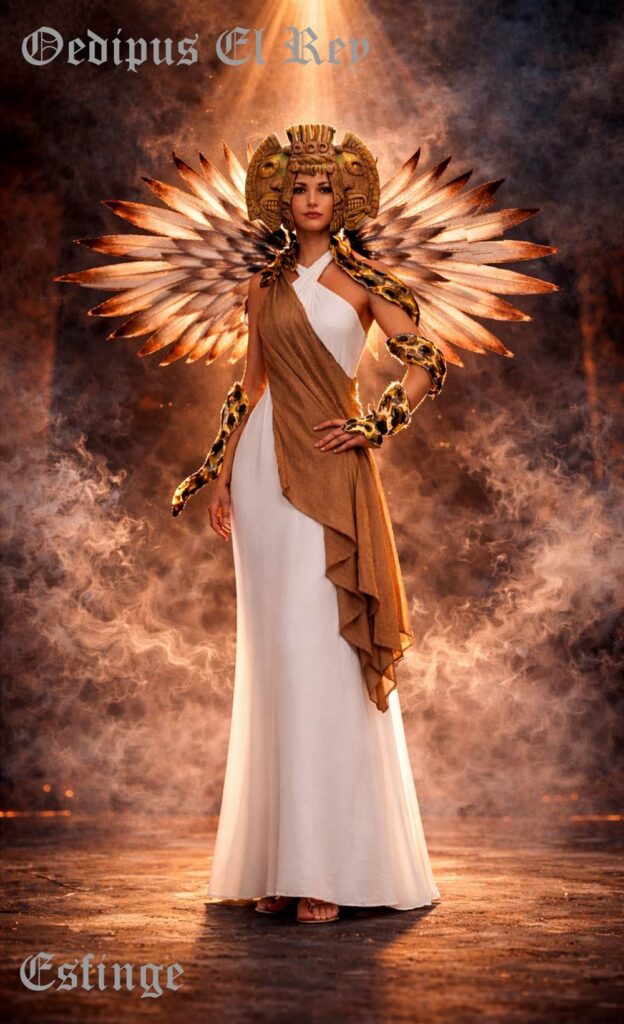
Alex Jaeger: I did the drawings, and then I had a meeting with the set designer… the set is very moody and black, and there’s lots of smoke and dramatic lighting and projections and things. I took my drawings, and I put them into Adobe Suite, and I just told it to make a really dramatic, smoky background, and that’s where I did the drawings. It’s a combination of hand-drawn stuff and computer wizardry.
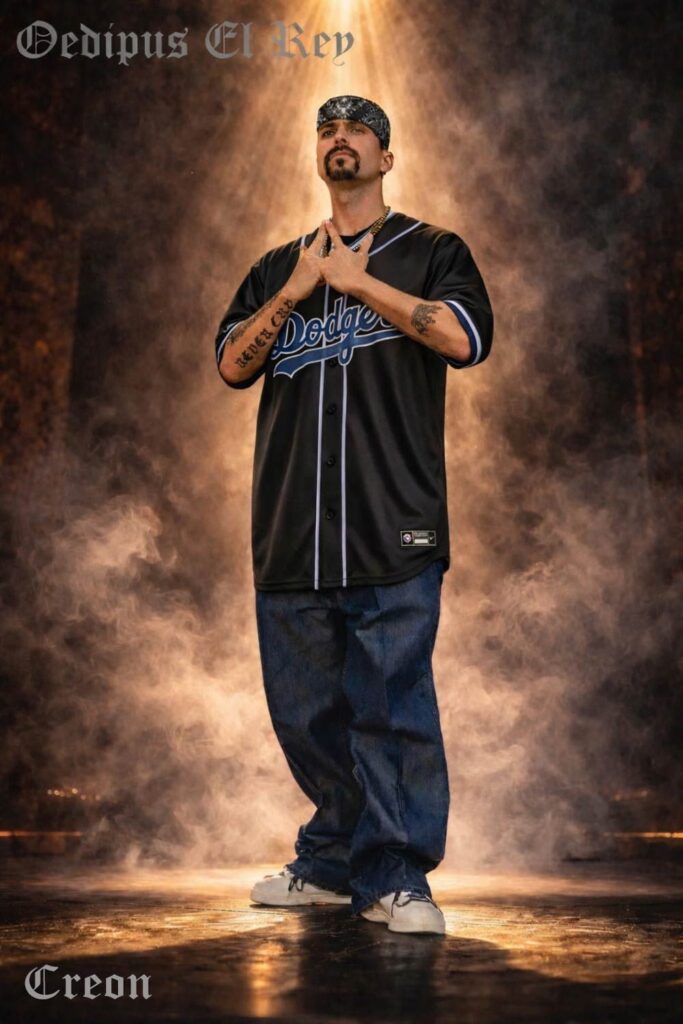
Theater Mirror: The looks are striking. Tiresias’ blend of street style and prison garb; Creon’s look as a modern king; the elaborate and exotic style of Esfinge, the Sphinx; and then Jocasta, who looks like a version of the Madonna. What kind of research were you doing in terms of contemporary culture and the classical influences?
Alex Jaeger: Well, I live in Los Angeles, so I am surrounded by a lot of this culture. When I go downtown, I can see the various kinds of subcultures of the vendors, the people who do the mystical healing, and the average street person on the street. It’s all around me, and it’s very interesting to me. So, I already had that kind of in the back of my mind, and I did drive around downtown LA taking a lot of pictures, so I did a lot of primary research that way. Of course, we have apparitions from ancient Mexico, and also, we’re trying to bring in some of the Greek influence, as well. It was kind of a mash-up of all of those different kinds of aesthetics.
Theater Mirror: One character has a line in which he says, “We’ve all got destiny. We’ve all got a story written for us.” That’s the essence of Greek tragedy. How did that influence the design of the costumes?
Alex Jaeger: It’s tough, because we try not to tell the audience what’s going to happen — although in this case, I think most people probably know the story from high school. But, yeah, it’s a tricky line to balance. You want to honor the story. And, again, we all know how it’s going to turn out, but we don’t want to be too cliché or obvious about it right from the start.
Theater Mirror: Was it difficult to imagine what contemporary royalty, in whatever sense of the word we’re using here, would look like?
Alex Jaeger: That’s interesting, because in Cholo gang culture, there are people who are actually called kings. They are the gang leaders, and the symbology is the same: There are crowns. Oedipus is not part of the family until he marries into it, but he assumes the role, and he adopts crowns and the attitude of a king, but not in the sense of European royalty. It’s something that he’s actually earned, and he gets respect for his toughness, and then he rules over the neighborhood that he’s in.
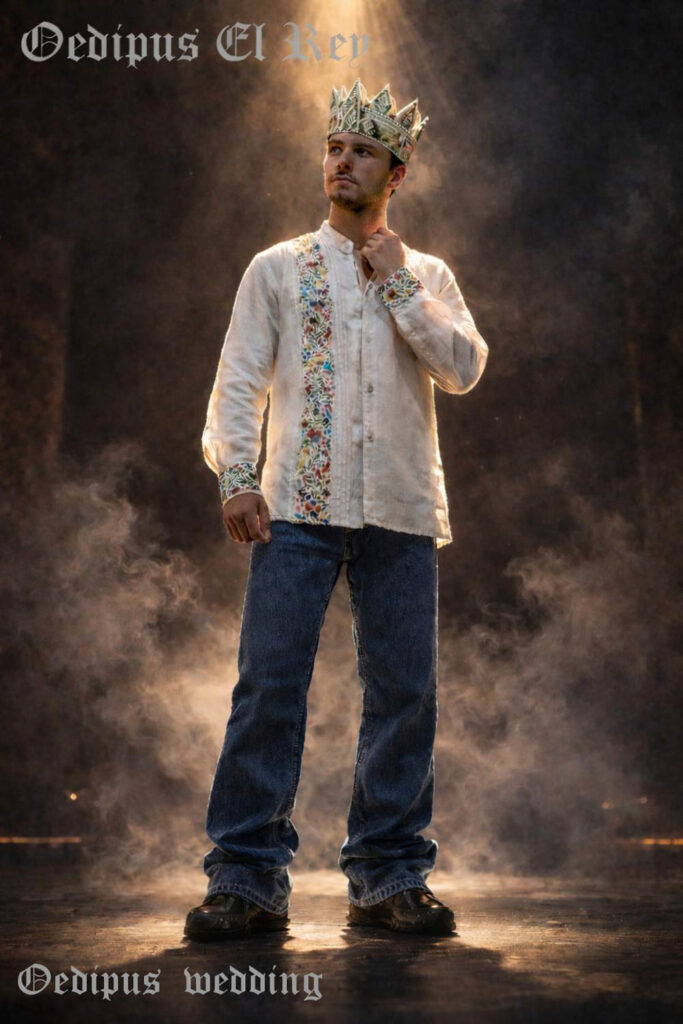
Theater Mirror: So that crown that’s in the costume design for Oedipus, that’s not borrowed from myth or history? That’s really contemporary?
Alex Jaeger: That’s a drawing of his wedding look when he’s married to Jacosta. The shirt with the colorful flowers embroidered on it is a traditional Mexican wedding shirt, and there is a tradition in many cultures of giving the couple money, and there is a money crown that is part of that. The subjects would have donated money, and somebody would have done this sort of magical origami and folded it all into a crown. At the wedding dance, they place it on his head. It’s a real thing.
Theater Mirror: There are moments in the script where you can imagine what the lighting or the sound design might be like, like when the script says Jocasta becomes “light and young,” or when Oedipus realizes the full significance of Tiresias’s revelations about his own lineage. How does costuming serve these dramatic moments?
Alex Jaeger: I think I’m going to put it mostly on the actors this time, especially Jocasta. We see her at the beginning, she’s pregnant, and then she believes that her baby has died, so she starts off in a place of real sadness and loss. She is just sort of existing, and so we have her in basic clothes. Her hair is kind of — she hasn’t really put much thought into her appearance. And then, around the time that she is falling in love with Oedipus, we switch her [look].
There’s not a lot of color in the costumes. It’s a lot of black and white and grays and denim, stuff like that. We switch her into a burgundy dress that sort of represents lifeblood, and Oedipus lets her hair down, and that’s when the acting comes in. She comes back to life, and she refines her happiness and her sexiness through meeting him.

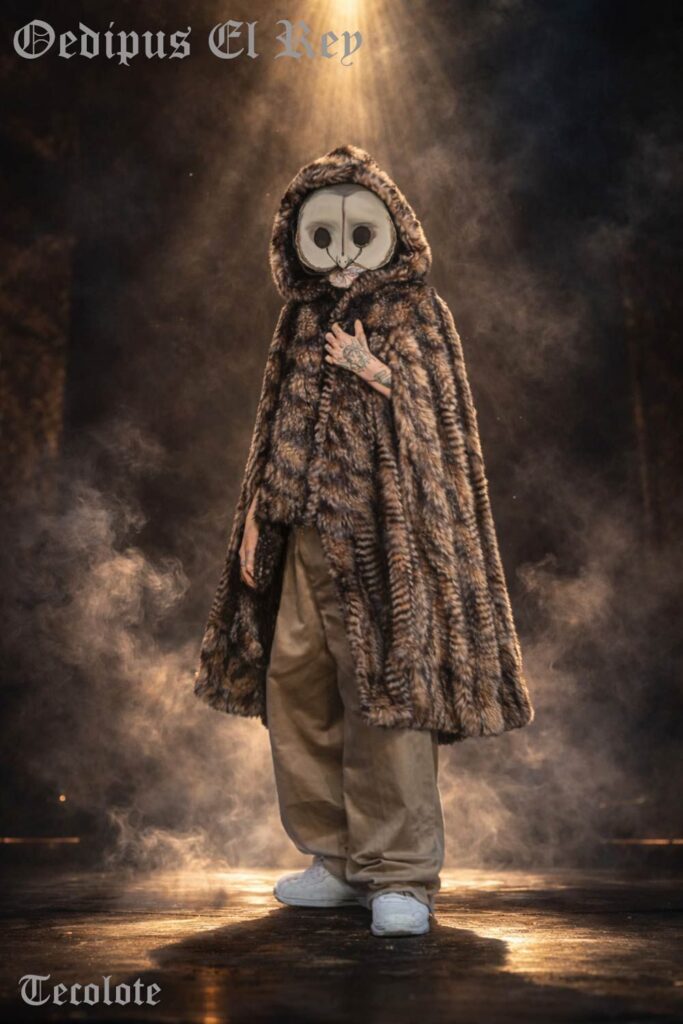
Theater Mirror: Literal blindness is a major part of the story, but there are literary kinds of blindness that are also important. These costumes are so gorgeous, you want vision to persist, but then again, costuming is also about texture — so, what kinds of textures did you want to bring into the fabric and the cuts and embroidery?
Alex Jaeger: Oh, that’s very interesting. There are some iconic looks and patterns that appear over and over with the street looks. In Los Angeles, there’s a lot of plaid, and there are a lot of sports jerseys and things like that, so we incorporated those into it. As far as Jocasta, all her clothes are sort of body-skimming in different ways. We have a very tight, stretchy dress for her maternity dress, so the focus is really on her pregnancy, and then, afterwards, the dresses sort of skim and reveal — and then unreveal — her body in lovely, subtle ways so that we can see her without it being overtly sexual. But she is very beautiful and sexy and womanly in them, as well.
The way the play is structured, we begin in prison, and we’ve got this chorus [playing various characters]. I tried to bring in colors and textures and things that would be identifiable as, “Oh, this is an older character. This is a street guy. This is a vendor just trying to get by in his daily life.” It all has to happen really quickly in front of the audience, so [it was a matter of] picking things that sort of had an iconic feel to them. Hopefully, the audience can identify the [different characters in the chorus] immediately, because it happens so quickly, and they change characters constantly.
Theater Mirror: Speaking of Jocasta’s look, the first thing I was struck by with that lace shawl is how it gives you a glimpse at what’s underneath. It’s veiling at the same time as it’s enhancing. There are truths and secrets that are veiled in the play, and all of that comes to life; I felt that that was an especially apt look for this production.
Alex Jaeger: Yeah, the wedding is very spontaneous. They decide they’re going to get married; their friends come over and decorate the backyard, and she doesn’t really have a wedding dress. She finds a white sundress that she has; rather than [being] what we would consider a bridal veil, that’s more of a mantilla, which hearkens back to the old world, and is something that maybe belonged to her grandmother that she just had at the house. It’s this blending of ancient and tradition with modern [looks].
Theater Mirror: What took you into costuming and, more specifically, costuming for the theater?
Alex Jaeger: I grew up around design, so I knew a lot about design already, and then I studied performance because, like any good teenager, I wanted nothing to do with anything that my family was involved in. After a few years of performing, I decided that was probably not a good career for me, so I went back to school. I studied design. I worked as a fashion designer for years and then figured out that I could combine my love of theater and performing arts with my design knowledge, so I went back to school yet again and got a master’s degree in costume design.
Theater Mirror: You also do costuming for movie and TV projects.
Alex Jaeger: I love doing film and TV. It’s really fun, it’s interesting, but I just don’t have a lot of opportunity to do that. It’s very difficult to do both theater and film and TV, because the scheduling is so different. Once in a while, when my theater friends decide they’re going to make a movie or something, I get to do it then, and that’s always fun. But I love live theater. There’s nothing like it, because you’re creating an experience that you can sit with the audience and go along on the ride with them, and that’s really not the case in film, where you don’t have any idea what it’s going to look like in the end. You go to the premiere with the people that you’ve worked on the movie with, but you don’t really experience it with the people that you’ve made it for [the way] you do in theater. I love that about it.
Theater Mirror: What would be your dream project — something that would let you realize visions for costuming you haven’t had a chance to do yet?
Alex Jaeger: I’ve been doing this a long time; I’ve had a chance to do most everything. I think what I love about my job is that every project is completely different, and even if it’s a show that I’ve done before, I approach it as if it’s a new production every time. I just love having new projects come my way.
Theater Mirror: How about clothing as a personal statement or a personal reflection?
Alex Jaeger: Oh, man, I’ve spent so much time thinking about what other people are wearing, and theater design is way more involved than I think most people realize. I’m usually in some sort of comfort wear. It’s only on opening nights that I get to dress up. It’s not like a lot of people think — you know, I go shopping at boutiques all day and have fancy lunches, and then every night there’s some sort of glamorous Hollywood party. It’s not like that at all. It’s actually really hard work.
Theater Mirror: And the clothing has to stand up to all that.
Alex Jaeger: Exactly, and I’m constantly getting dye and paint on myself, or having to crawl around on the ground to look at the length of a hem, or digging through warehouses of old, musty costumes. I’m usually very practical [about how I dress] in that sense.
I also teach costume design, and whenever my students have any kind of a presentation or a show or something, I have to really get on them to figure out what they’re going to wear, because it’s always a joke that the costume designer is the worst-dressed person.
Theater Mirror: What’s next for you?
Alex Jaeger: Oh, my goodness… I’m in the midst of things. Concurrently [with Oedipus el Rey] I am also doing another production of Leopoldstadt. Last week I was in Chicago doing fittings for that, and I’m in the preliminary stages of a production of Shakespeare’s Winter’s Tale, so that’s all very, very busy. And then the things beyond that, I’m not yet allowed to talk about.
Theater Mirror: Shakespeare is reinvented, restaged, and reconceptualized all the time in various periods of history, fantasy worlds, and so on. That must be almost tabula rasa for a costume designer.
Alex Jaeger: Yeah, it really is. For this production we’re doing, the theater wanted to present something that the audience would recognize as Shakespearean, since it’s very rarely done in Elizabethan/Tudor kind of stuff anymore. So, what the director and I decided on is we’re doing a version of Elizabethan meets Dolce and Gabbana. It’s very high fashion. I don’t know if you follow any high fashion, but a lot of times they’re they take inspiration from history, and they have these over-the-top gowns with a giant ruff and, you know, some sort of regal robe with fur on it, and then thigh-high, red vinyl boots. It’s just this whole mixture of things. That’s what we’re working on for that. It’s fun.
“Oedipus el Rey” will run May 7 – June 7 at The Roberts Theatre at the Calderwood Pavilion at the Boston Center for the Arts, 527 Tremont St. in Boston. For tickets and more information, follow this link