Reviewed by Michele Markarian
The Mystery of Irma Vep – A Penny Dreadfulby Charles Ludlam; Directed by David R. Gammons, Dramaturgy by Texaco Texeira-Ramos, Scenic Design by David R. Gammons, Lighting Design by Jeff Adelberg, Costume Design by Seth Bodie, Sound Design & Original Compositions by Nate Tucker, Props Design by Lauren Corcuera, Stage Managed by Fanni Horváth; Produced by Central Square Theater in Cambridge, MA through June 21, 2026.
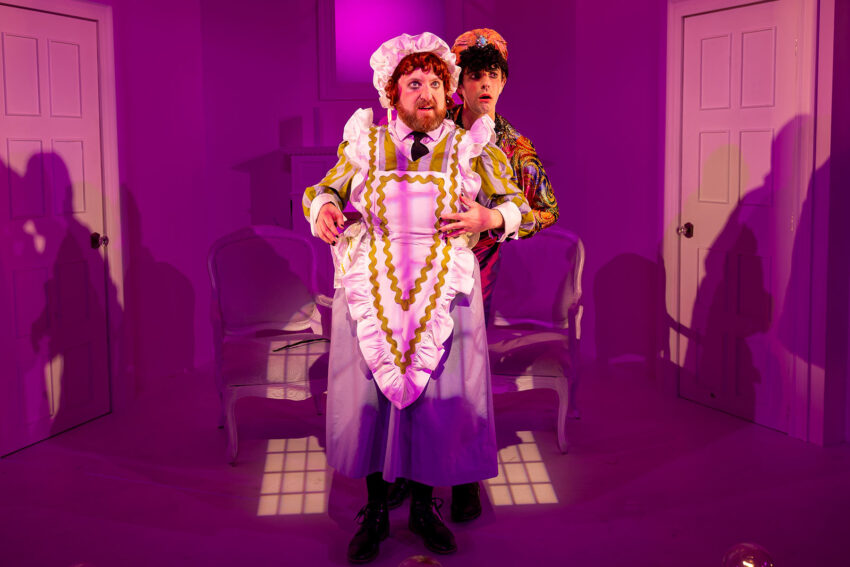
The first thing to catch my eye when I walked into the Central Square Theater this week was David R. Gammons’s gleaming white set, a work of art served well by Jeff Adelberg’s lighting design. This was the perfect backdrop for the creative antics of Gabriel Graetz and Paul Melendy, who between them play eight characters in this madcap, satirical two-hander of Gothic melodrama.
Enid (Paul Melendy), a former actress, is the second wife of Egyptologist Edgar (Gabriel Graetz), who remains devoted to his dead first wife, Irma (Graetz) as well as to his dead son, Victor, much to Enid’s dismay. The servants Jane (Graetz) and Nicodemus (Melendy) remain devoted to Irma’s memory, although Nicodemus harbors an unrequited love for Jane. The house is plagued by both a vampire and a werewolf, who are more familiar to Edgar and Enid than they realize. The mystery of who killed Irma and Victor is ultimately resolved in an unexpected twist, leaving Edgar and Enid to begin anew.

Charles Ludlam’s play is the perfect showcase for Graetz and Melendy, who were so good together in last year’s Featherbaby. Melendy brings a loopy intensity to everyone he plays. As Enid, Melendy is a beautifully reminiscent combination of early Dead or Alive Pete Burns and Kate Bush; his Nicodemus is raggedly caring. Melendy’s sense of fun and melodrama is not without vulnerability, which makes him extremely watchable and sympathetic, despite his characters’ obvious flaws. Graetz provides a nice ballast – all of his characters are grounded in a stolid sensibility, although his dancing as Edgar at the tomb of an alleged Egyptian princess is unexpectedly whacky and delightful. The two of them maintain several different accents per character perfectly and withstand over 30 costume changes. In lesser hands the material would not stand up quite as well.
Despite clever lines such as “Virginity is the balloon in the carnival of life. It vanishes with the first prick” and Gammons’s well-paced direction, the play was not really my cup of tea. It is lightweight, and campy, but a little too long and not quite pointed enough in the satire for my taste. Still, the audience thought it amusing, and as a master class in acting, it worked.
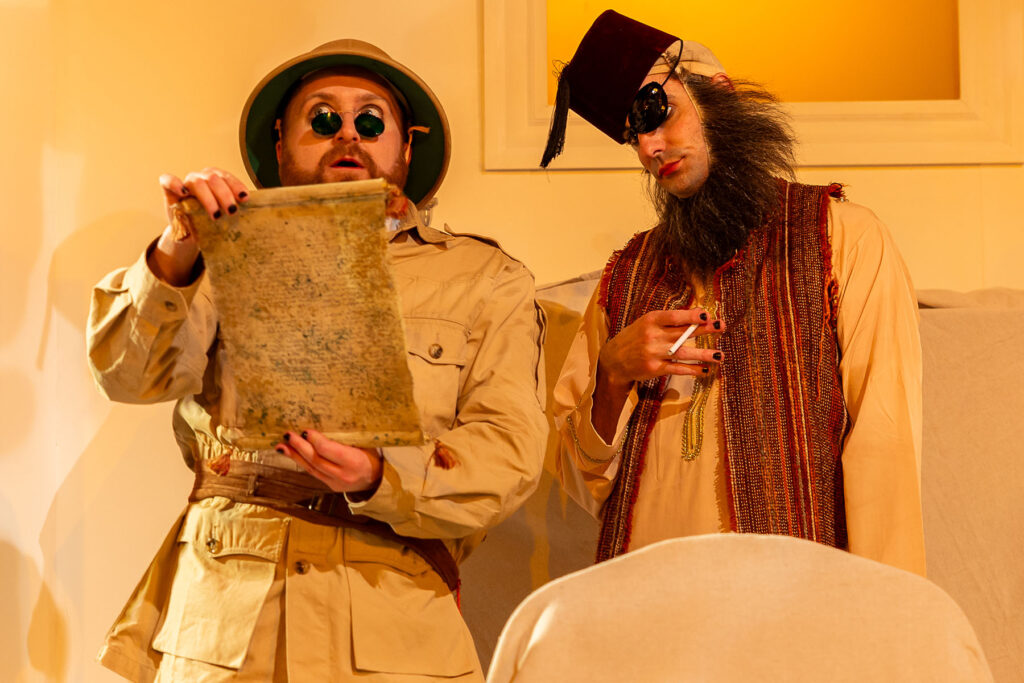
A play with this kind of frenetic action can’t work without plenty of backstage help; kudos to stage manager Fanni Horvath as well as wardrobe supervisor Rebecca Straniere and production assistant Emma J. Hunt, who served as wardrobe runners for the multi-layered, clever costumes designed by Seth Bodie. As the actors strip down at the end of the play, the set does as well, curtains parting on either side to reveal the backstage, the people behind the curtain, so to speak. The costumes are gone, the subterfuge over, which is the perfect ending to a play with many layers and various curveballs.