Reviewed by Julie-Anne Whitney
Dalloway: First Love by Lindsay Joelle. A world premiere production directed by Rebecca Bradshaw; scenic design by Kristin Loeffler; costume design by Chelsea Kerl; lighting design by M Berry; sound design by Aubrey Dube; intimacy direction by Cassie Chapados; stage managed by Carolyn Ferris; presented by Gloucester Stage Company in Gloucester, MA through August 29, 2026.
Virginia Woolf’s Mrs. Dalloway was published in 1925, in between both World Wars. In addition to other themes, the book centers on issues of mental health (i.e. suicide and depression), suppressed queer love, and strict gender roles. It was written at a time when homosexuality was widely considered a mental illness, homosexual acts were still illegal (a law that stood in the U.K. until 1967), and queer writers were being censored and tried for “obscenity.”
The novel chronicles a single day in the life of Clarissa Dalloway, a wealthy socialite who is preparing for a party she will host that evening. While running errands in London, Clarissa is repeatedly reminded of her teenage years in Bourton. She remembers a summer party when she couldn’t “take her eyes off Sally,” a feisty, beautiful young woman with a caressing voice. Clarissa experiences the “most exquisite moment of her whole life,” that evening when walking with Sally who suddenly picks a flower and kisses her on the lips.
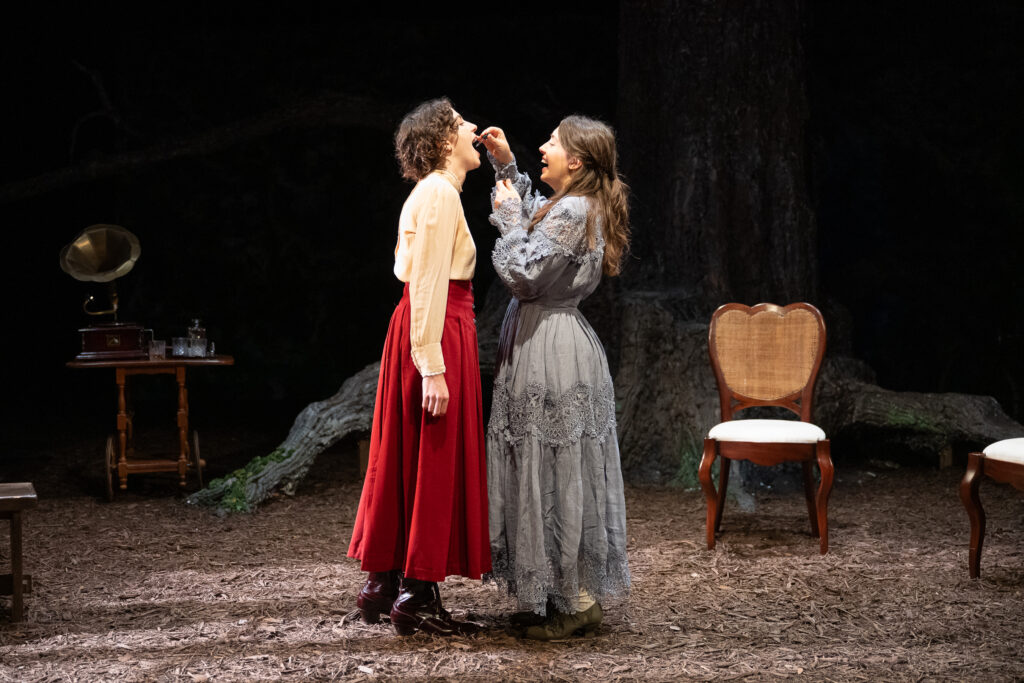
Lindsay Joelle’s new play Dalloway: First Love takes place in the summer of 1890 when Clarissa meets and falls in love with Sally. Joelle’s play, described as a prequel to Woolf’s Mrs. Dalloway, explores the same themes as the novel but in a more light-hearted way. 18-year-old Clarissa Parry is unexpectedly visited by her childhood friend, Peter Walsh, who has left Oxford and comes to propose to Clarissa before returning home to India. To Peter’s great frustration, a slew of arrogant, far wealthier suitors appear with the same intention. When Sally Seton arrives and finds herself enamored by Clarissa’s innocence and kindness, she and Peter try to thwart the other suitors as best they can. Knowing that she must marry in order to save her family’s failing estate, Clarissa is polite to the men but quickly becomes dazzled by Sally’s brazen behavior and startling confidence. When Clarissa rejects Peter and Sally rejects Clarissa, the summer ends with heartbreak for everyone as they realize that “the freedom to be unapologetically oneself” is not something they are likely to experience.
Gloucester Stage’s world premiere production is led by a stellar four-person cast. Josephine Moshiri Elwood brings a softness and genuine innocence to Clarissa Parry; her portrayal is youthful and energetic and, at times, laced with a touch of sadness. Haley Dyana Schwartz is indelibly watchable as Clarissa’s love interest, Sally Seton. Schwartz saunters and struts about the stage like a man, unapologetically owning every scene she walks into. She seemed to enjoy Sally’s naughtiness, and leaned into the character’s reckless behavior. But when Sally’s truth (and betrayal) is eventually revealed, Schwartz brought an undeniable depth to a moment when her character was, ironically, denying herself. Shobhit Piasa’s performance as Clarissa’s best friend, Peter Walsh, is grounded, charming, and sincere. Piasa made it easy to sympathize with Peter’s unrequited love and ultimate failure; you could feel the audience rooting for him. Jesse Garlick will surprise and delight you with his distinctly different portrayals of Clarissa’s father, Mr. Parry, as well as Clarissa’s many suitors (aka The Slew), all of whom have a different accent and physicality. But it was his portrayal of Mr. Dalloway that was most memorable– if only because of the stark contrast to Garlick’s earlier performances.
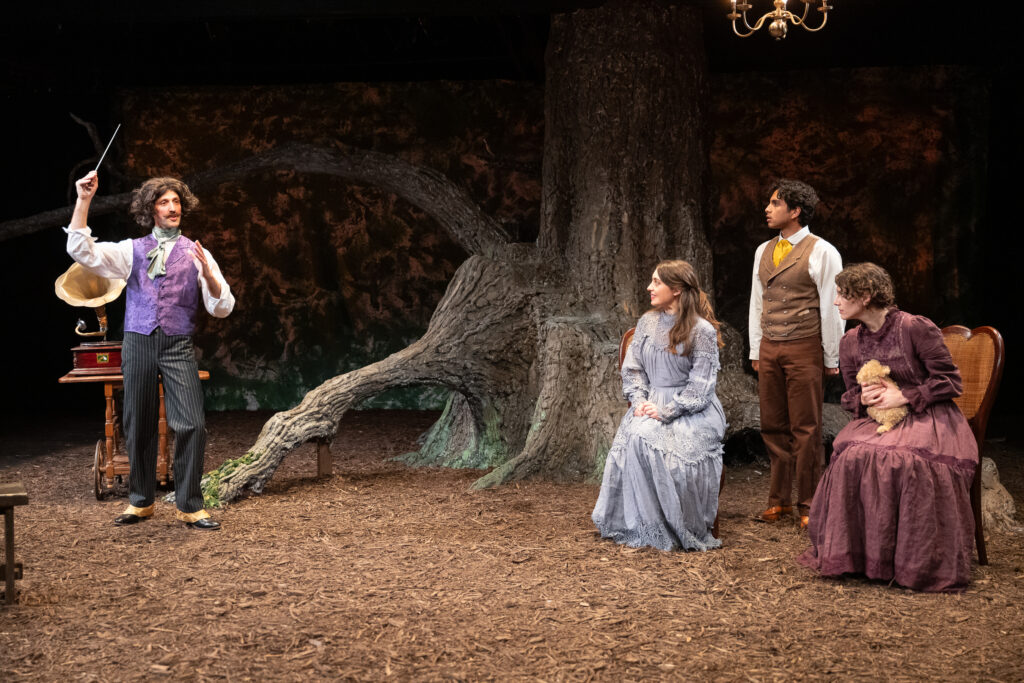
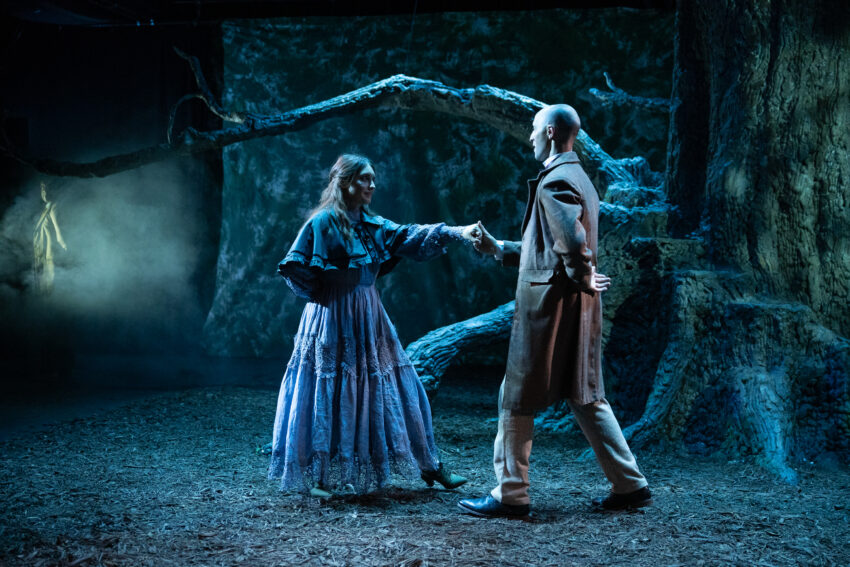
The world of Dalloway: First Love centers around an ancient oak tree in a woodland on the Parry Estate in Bourton. Most of the scenes take place under the tree’s invisible canopy or among its branches. The tree has special significance for Clarissa because her elder sister fell (or jumped) from the tree and died a year ago. Since her sister’s death, Clarissa has suffered from depression and was prescribed laudanum– a tincture of opium– to suppress her mood swings and erratic behavior. In her grief, she spends a lot of time at the tree, seeking solace, to stay connected to her sister and, sometimes, even to talk to her. Set designer Kristin Loeffler has created a robust and substantial tree-like structure with a gnarled, textured surface full of shadows and depth. Clarissa is often seen climbing the tree or sitting in the nook of a branch and, in a moment of sorrow, she leans into its familiar warmth for shelter and comfort. The tree suddenly becomes like a mother, sturdy and reliable, present and sympathetic. This motherly tree holds the truth of what happened to Clarissa’s sister. It also bears witness to Clarissa’s first kiss, her first love, and her first heartbreak– as it likely did for generations of people before her. Placing Loeffler’s tree center stage was a beautiful reminder of the impact and importance of the natural world in our everyday lives.
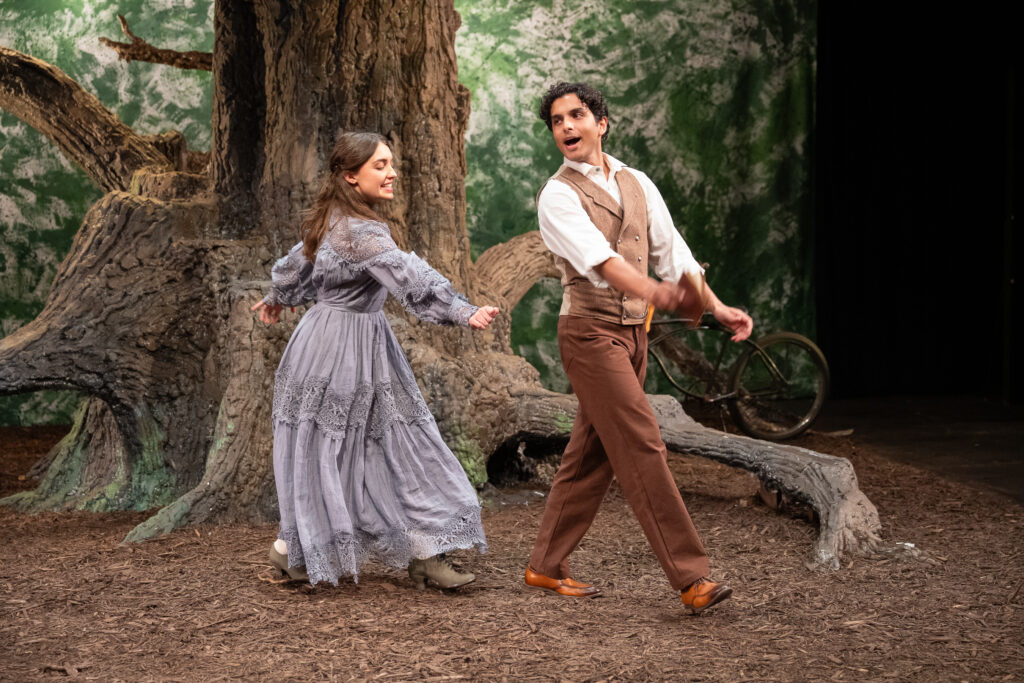
Chelsea Kerl’s costumes helped to shape the mood and tone of the play. Clarissa’s only outfit– an ankle-length, greyish blue dress with lace accents– seemed to be a bit too long and too loose for her suggesting, perhaps, that she had chosen to wear one of her late sister’s dresses, and that she rarely took it off. Clarissa offers some of her sister’s gowns to Sally who, having arrived at the Parry Estate by surprise and without a travel bag, has nothing else to wear. Sally indulges in Clarissa’s kind offer, donning a different dress for every day she is there. Kerl’s costumes for the men also had emotional significance. Kind-hearted, penniless Peter is dressed simply in quiet shades of brown, cream, and yellow. Meanwhile, “the slew” of wealthy, upper-class suitors are dressed in velvet, pin-stripes, decorative waistcoats, and flashy cravates (with the exception of Mr. Dalloway who arrives in modest attire of brown, beige, and green).
Lindsay Joelle’s Dalloway: First Love was inspired by Virginia Woolf’s Mrs. Dalloway, but the play stands on its own and is a beautiful story in its own right. There is a lot of heart and humor in this play. Joelle’s dialogue is clear, quick, and witty. Her characters are rich, real, and relatable. Gloucester Stage’s luminous, engaging production will leave you wanting more– from the playwright, the actors, and the text that inspired it all.
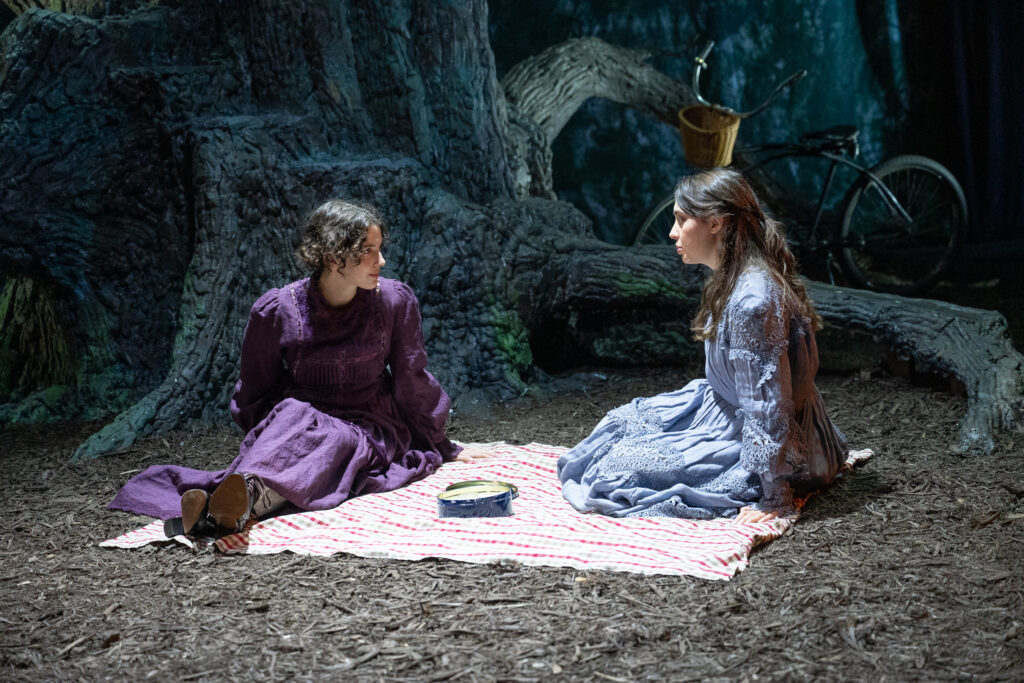
In an early moment in the play, Sally entices Clarissa with her dream of a utopia only for women where they are no longer required (or have financial need) to marry. At first, Clarissa can’t quite imagine a world like that. But after kissing Sally, Clarissa can no longer contain her feelings and she begins to imagine a different life for herself. “You woke me up,” she tells Sally. Sadly, the moment doesn’t last. Ignoring her own instincts and desire, Sally reveals her real reason for appearing in Bourton and explains why she can’t stay there. Before parting, the two young women reimagine their shared utopia “where every flower grows,” a place with no cities, “no marriage,” no societal pressures or expectations, “only woods and water,” and love.
101 years ago, Virginia Woolf had the courage to write a kiss between two women, a kiss that made “the whole world turn upside down,” a kiss that created one singular “moment of happiness.” One year ago, Lindsay Joelle wrote a scene between two women who share a kiss that changes their lives– just not in the way they wanted it to. Maybe, one day, queer women won’t need to imagine a utopia where they are free to love each other without the fear of judgement or persecution. Maybe, one day, that utopia will become reality.
…
Click here to read my interview with playwright Lindsay Joelle and director Rebecca Bradshaw.