Reviewed by Camille Cuzzupoli
William Tell, music by Gioachino Rossini, libretto by Victor-Joseph Étienne de Jouy & L.F. Bis; co-directed by Vita Tzykun and David Adam Moore; conducted by David Angus; scenic, costume and projection designs by Vita Tzykun and David Adam Moore; lighting design by Eric Southern. Presented by Boston Lyric Opera at Emerson’s Colonial Theatre through October 4, 2026. Sung in French with English surtitles
You’ve heard William Tell even if you haven’t heard of William Tell.
The overture will be instantly recognizable to anyone watching, but not everyone in the crowd will have context for it. The story behind Boston Lyric Opera’s production is as resonant as its music is familiar: the Helvetians, a people hurting under the oppressive rule of the Allemanians and their tyrannical general, Gessler, are inspired to revolt by William Tell, a husband and father who rises to mythic status through his commitment to freedom (and through shooting an apple off his son’s head—or in this case, his daughter’s.) It’s a story of the enduring power of the everyman, where love and community are the pillars of revolution.
Every performer in BLO’s William Tell sounds superb, with no exceptions. George Gagnidze (Tell, the leader of the revolution), Konu Kim (Arnold, a young revolutionary in love with Mathilde), and Anya Matanovič (Mathilde, the princess) have voices that must be heard to be believed. The power of their voices, however, is admittedly softened by less expressive acting performances. A lesson could be learned from Brianna J. Robinson (Jemmy, Tell’s daughter) and Morgan Mastrangelo (Ruodi, a cowardly fisherman), who easily draw your attention with their revealing and affecting depictions. The orchestra, conducted by David Angus, deserves as much kudos as the cast. Listening to them bring the score to life is as riveting as watching the revolution on stage. In a way, the orchestra is like the Helvetians: a vibrant group with a common goal, where individual talents come together to build a working, moving whole.
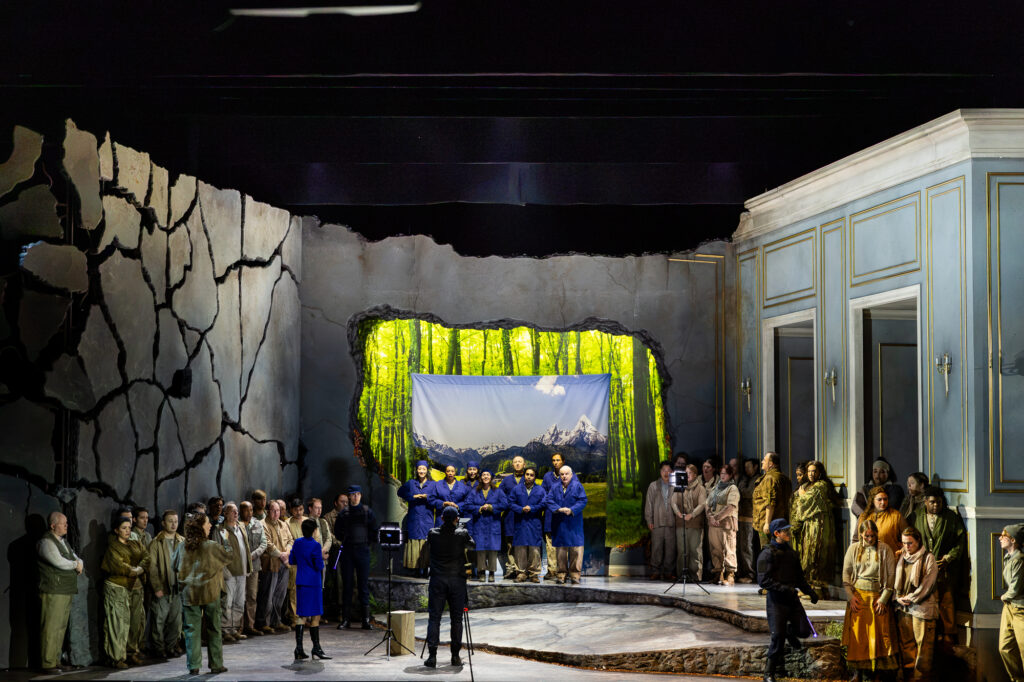
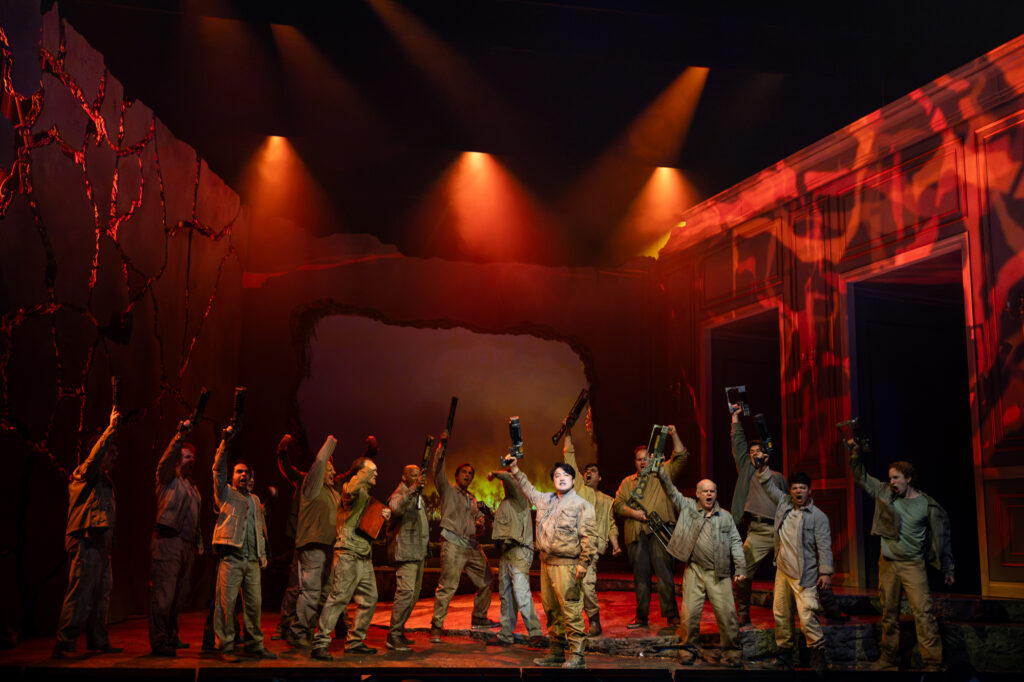
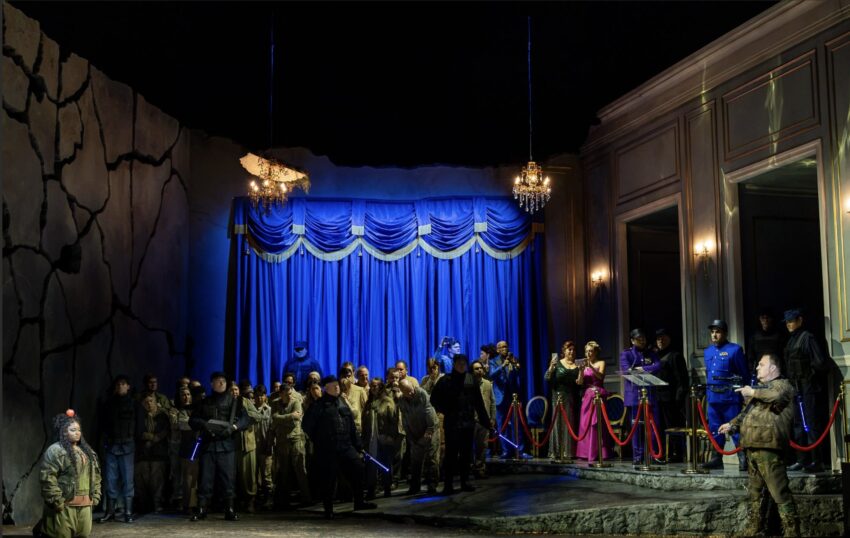
Co-directors Victoria Tsykun and David Adam Moore also co-designed the set, costumes, and projections. The challenging nature of opera often involves a “park and bark” style of performance which is effective for solos and small groups, as it is in William Tell. However, some more directorial risk and kinetic, collaborative blocking would have paid off in spades. Tsykun and Moore’s costume design shares this predicament. It’s all vaguely 21st century attire, perfectly competent, but not fully successful at creating visual interest or fleshing out character identities. BLO Artistic Associate Anne Bogart writes gorgeously in her program note about how William Tell depicts quiet acts of a community’s resistance to oppression (i.e. weddings, rituals, stories, etc.), sometimes with gestures as small as “a red thread stitched inside the lining of a grey coat.” Unfortunately, these “red threads” were not always clear in this production. On the other hand, Tsykun and Moore’s set design is distinctive and evocative, with one half depicting a fractured, crumbling city and the other a once-shining, gold-trimmed palace. The Hurt Locker by way of Versailles.
Opera is a unique genre of the performing arts. It straddles the line of realism and melodrama in a way that most commercial theatre does not. But like most performing arts, opera is also a container for different talents to come together and create something bigger than itself. Boston Lyric Opera has beautifully demonstrated that every component of this opera, and opera itself, is Helvetian. Follow the singers, the supertitles, or the two together. Look at the stage, the pit, or the two together. Experiencing each element individually is lovely, but together is the better way.