Reviewed by Julie-Anne Whitney, Editor
Harper Lee’s To Kill a Mockingbird, adapted by Aaron Sorkin; directed by Loretta Greco; dramaturgy by Charles Haugland; scenic design by Andrew Boyce; lighting design by Christopher Akerlind; costume design by Celeste Jennings; sound design by Daniel Baker; wig, hair, and makeup co-designed by J. Jared Janas and Cassie J. Williams; stage managed by Kevin Schlagle; presented by The Huntington Theatre in Boston through November 8, 2026.
Harper Lee’s To Kill a Mockingbird was published in 1960 to immediate widespread acclaim. Winning the Pulitzer Prize for fiction the following year, the book would go on to become one of the best-selling– and most frequently banned– novels of the 20th century. For more than six decades, To Kill a Mockingbird has incited heated debate around the book’s complex themes of racial prejudice, social inequality, and moral education. With mentions of rape and incest, expressions of racism, sexism, and classim, the book also emphasizes tolerance, decency, and goodness. Set during the Great Depression in the fictional town of Maycomb, Alabama, the novel follows widower attorney, Atticus Finch, as he tries– and fails– to defend a Black man falsely accused of raping a white woman. The trial and subsequent violence are viewed through the eyes of Atticus’ nine-year-old daughter, Scout, who loses her innocence upon witnessing such injustice.
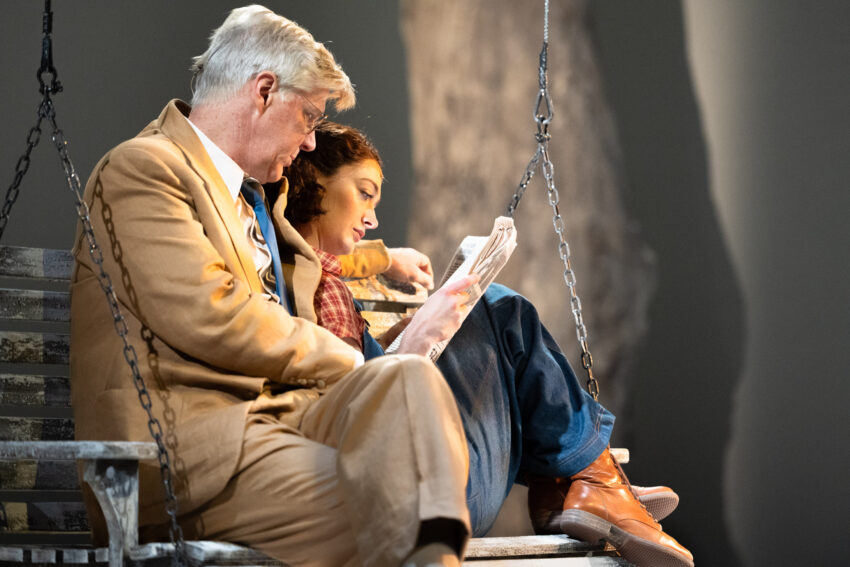
In the novel, Atticus is the moral compass of the story; an ideological symbol of integrity and empathy. Lee wrote Atticus (modeled, some say, after her own father) as a highly principled, truth-seeking hero who rejects the hateful mob mentality of his peers. In the play, Aaron Sorkin takes Atticus off his pedestal, making him decidedly less noble and, therefore, decidedly more human. Sorkin’s Atticus is a kind man blinded by his determination to respect everyone– even those who do not deserve his respect. He makes us question Atticus’ “empathy” for the story’s most hateful/hated character, Bob Ewell, who rapes and beats his own daughter and blames Tom Robinson for his heinous crime. Exposing Atticus’ imperfections even further, Sorkin places him in opposition to his 12-year-old son, Jem, who has a fighting spirit and disagrees with his father’s pacifist ways.
Along with his younger sister, Scout, Jem and their neighbor friend, Dill, narrate the story together, offering their naive yet surprisingly insightful views on the dark and violent happenings in their small town. While different from Lee’s approach in the novel, Sorkin’s use of the shared narrator role is no less effective. The three children offer an unfiltered perspective layered with innate curiosity and compassion– something the adult characters often lack due to cynicism, ignorance, or hardship. The children easily express their frustration and disappointment, their fear and grief over what is happening in their community. And when young Dill can’t hold back his tears after the wrongful verdict is announced, Mr. Deas (a “race traitor” who sympathizes with and befriends the Black people in town), tells the boy, “You get used to cruelty. You build up a tolerance.”
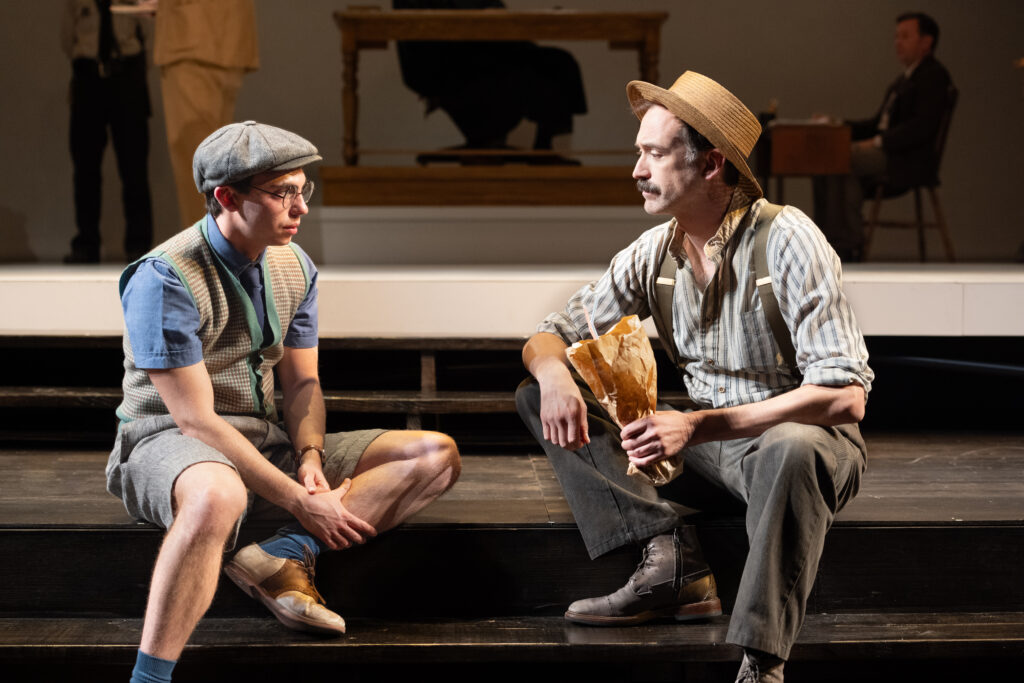
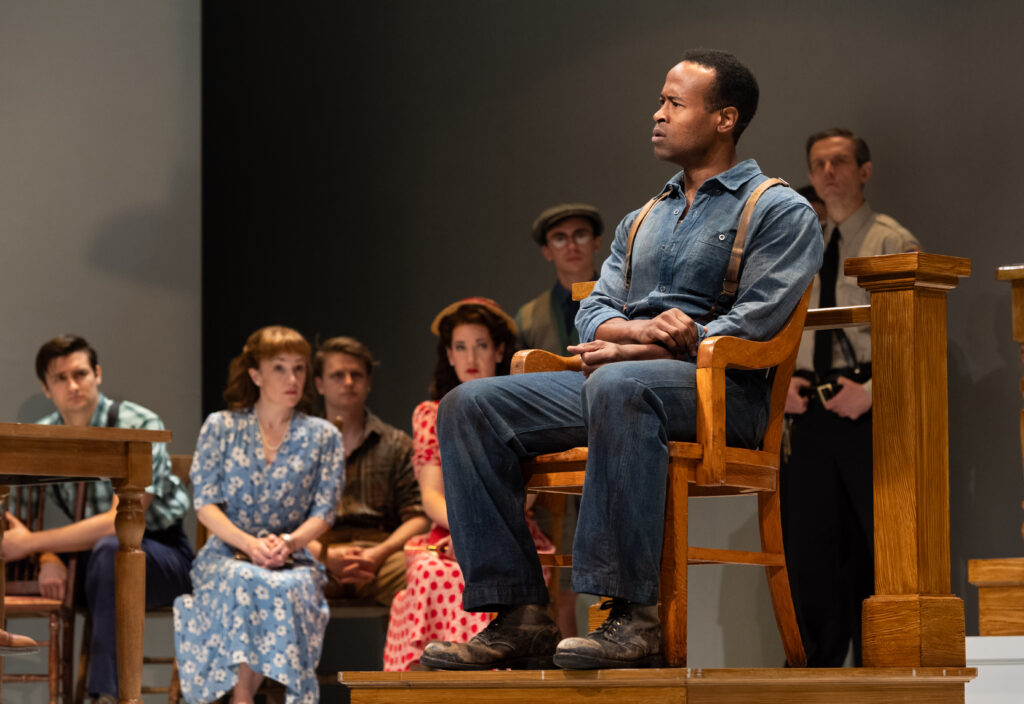
Karen Killeen is delightful in the role of Scout, bringing warmth and pluck to a beloved character. As the boisterous and determined Jem, Benjamin Izaak teeters beautifully on the line between boyhood and manhood. As the nerdy, precocious, fatherless Dill, Andrew Stevens Purdy will make you laugh and break your heart. Karl Kenzler plays Atticus with such humble sincerity that it was impossible not to love him. In arguably the most difficult role, Liam Craig manages to present Bob Ewell as a deeply flawed, insecure man rather than a caricature of a villain. Rafael Jordan brings tenderness and quiet strength to the role of Tom Robinson, the accused. Patrice Jean-Baptiste will knock you out with her sturdy, compelling performance as the Finch family housekeeper, Calpurnia. Musician/composer Ashley Frith has, perhaps, the most intriguing and impactful role as she frequently appears (remaining unseen by the other characters) with her violin or banjo, mirroring and elevating the emotion throughout the play. A kind of musical conscience for the story, her compositions are the soul of this production.
Loretta Greco’s graceful direction is so seamless (excluding the unnecessary and distracting “ham costume” reenactment), you almost forget that the show didn’t get this good by itself. Along with her stellar design team, she manages to create a production that feels familiar but fresh. Andrew Boyce’s scenic design centers around two features: a towering, moss-covered live oak tree that bears witness to history, to this story, and its many characters. And a white-washed courtroom in which all the color, detail, and life comes from the people that occupy it. Boyce’s simple pallet allows Christopher Akerlind’s lighting design to shine. The two artforms work beautifully together in this production, particularly at the beginning of every courtroom scene when five rows of overhead lights descend from above, emphasizing that the focus– and responsibility– is on everyone in the room.
The Huntington’s production of Harper Lee’s To Kill a Mockingbird will surely be a standout this season. The production is full of heart and intentionality. Greco’s choice to bring all the characters together– the heroes and the villains– to listen to Scout’s final monologue moved me to tears. It was a powerful reminder that the work of dismantling systematic racism in this country belongs to all of us. Or, as Scout wisely says, “something large [is] required of us.”