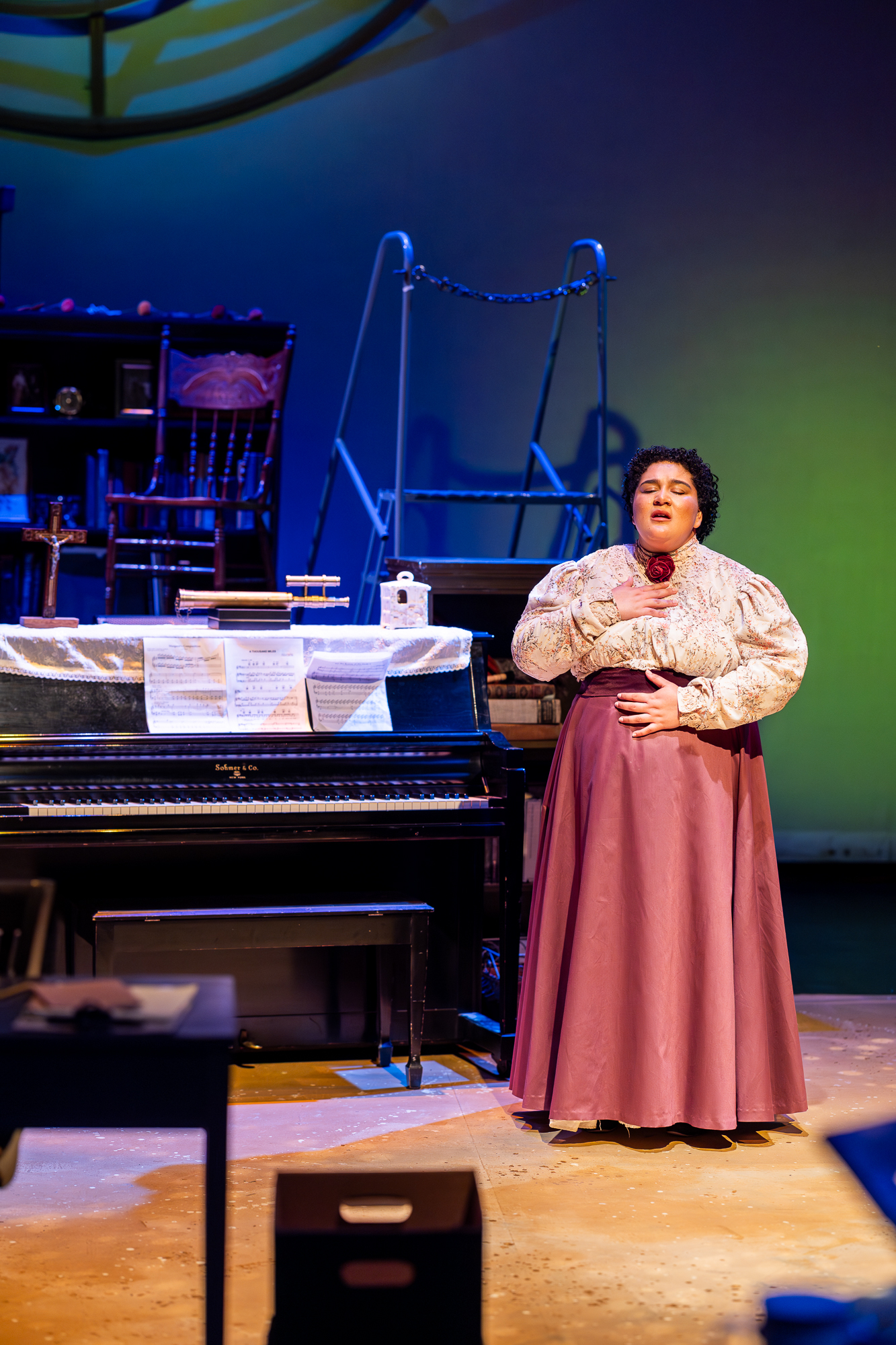
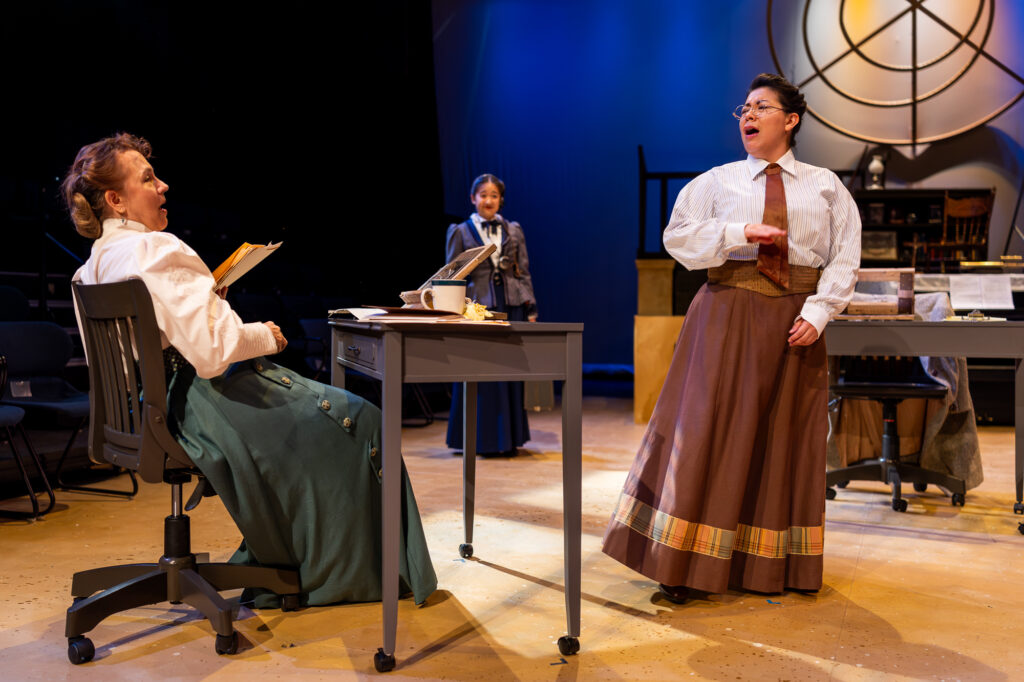
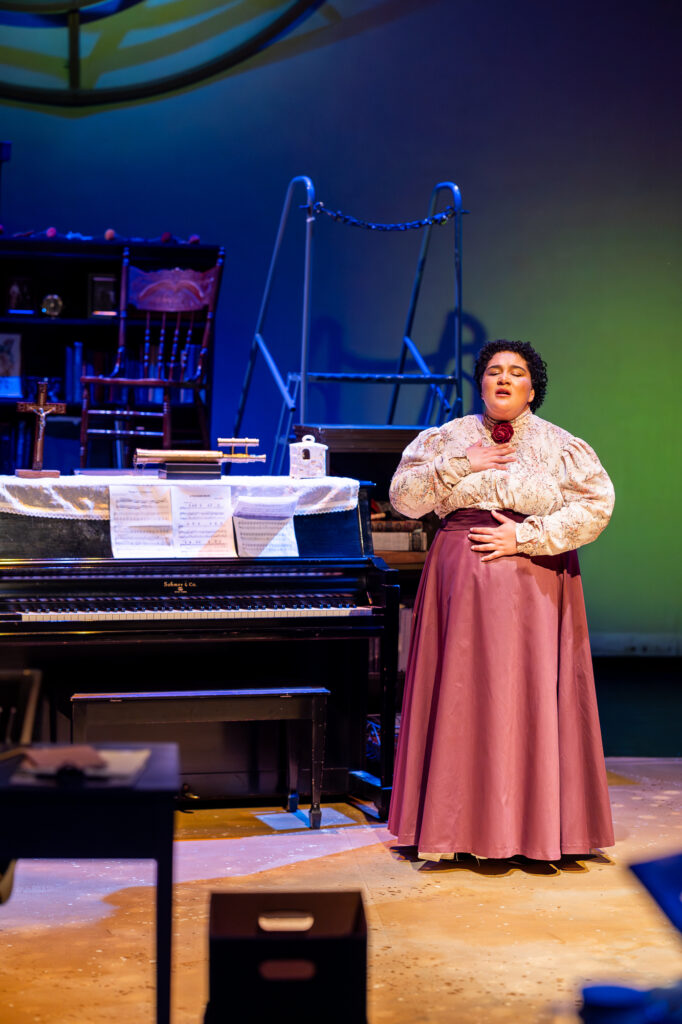
Photos by Nile Scott Studios
‘Silent Sky.’ Written by Lauren Gunderson. Directed by Sarah Shin. Scenic Design by Qingan Zhang; Costume Design by Leslie Held; Lighting Design by Eduardo M. Ramirez; Sound Design and Composition by Kai Bohlman. A Catalyst Collaborative@MIT Production. Presented by Central Square Theater, 450 Massachusetts Ave., Cambridge through October 5.
By Shelley A. Sackett
Lauren Gunderson’s career as a playwright (she is also a screenwriter and short story author) has largely focused on stories about iconoclastic women in history, science and literature. She is one of the top 20 most produced playwrights in the country, with over twenty plays produced. (Lyric Stage Boston’s 2022 production of her The Book of Will was a knockout).
With Silent Sky, a Catalyst Collaborative@MIT Production presented by Central Square Theater through October 5, she turns her attention to the story of Henrietta Swan Leavitt, a young astronomer whose scientific brilliance and curiosity led to her discovery of the relationship between luminosity and the period of Cepheid variables (a star that pulsates).
If that sounds wonky and more opaque than incandescent, it is. Yet, thanks to Gunderson’s witty, tightly crafted script and several outstanding performances, the almost two hours almost fly by.
The play starts in 1902 with Henrietta (Jenny S. Lee), the daughter of a rural preacher in Lancaster, Mass., speaking to her sister, Margaret Leavitt (Kandyce Whittingham). Henrietta, a recent Radcliffe College graduate, studied the classics with strong interests in math and astronomy. She considers herself, above all else, to be a scientist.
Margaret, on the other hand, considers herself (and Henrietta) to be unmarried, marriage-aged women whose lives will be unfulfilled until their status changes.
Henrietta has just received an invitation to join the Harvard College Observatory. She assumes that she will be working with the college’s “Great Refractor” telescope directly under its greatest faculty member, Dr. Pickering. She is determined to accept their offer, despite Margaret’s trying her best to get her to understand that she will die an old maid if she does.
Ironically, her words fall on deaf ears (Henrietta contracted a disease that led to deafness). “I need to start my life,” Henrietta pleads. “With daddy’s money.”
Dowry in hand, she burns any hope of marrying and heads to Harvard.
There, she is met by Peter Shaw (an excellent Max Jackson). It is Shaw’s unfortunate duty to inform Henrietta that she has been hired to join The Harvard Computers, a sisterhood of scientists who analyze plates that contain images from the telescope they are not allowed to touch. These women do the necessary mathematical equations for the observatory’s male-only research team, who absorb (code for steal) the women’s work and pass it off as their own.
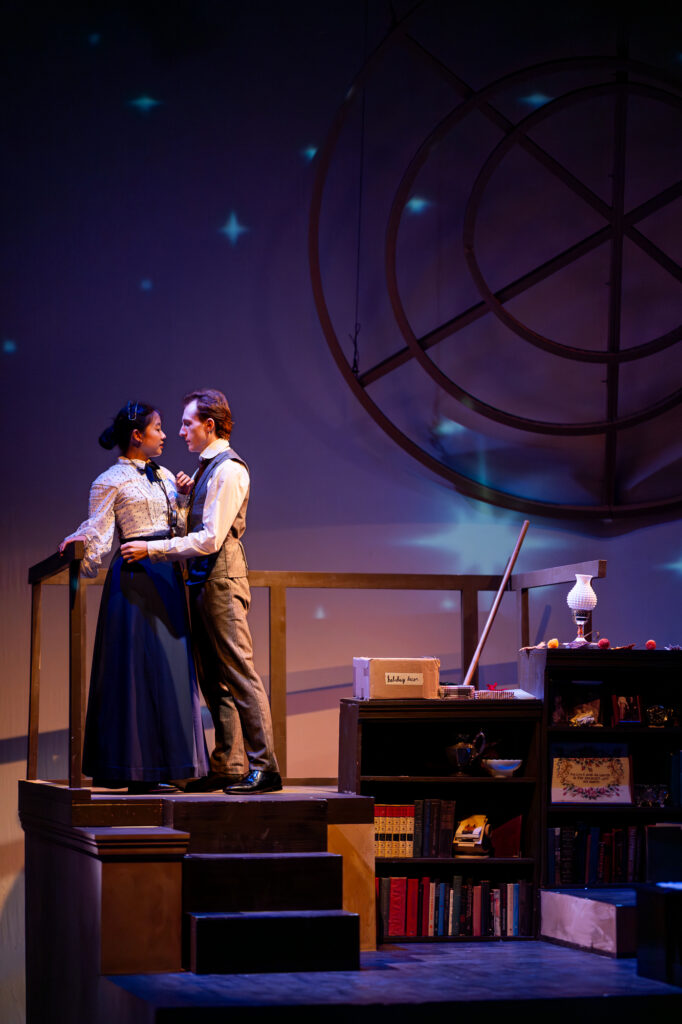
Shaw’s second unfortunate duty is to inform Henrietta that he is her boss and mediator to Dr. Pickering, whom she will also never see. Needless to say, Henrietta goes ballistic in the first of many scenes that are so well written but flatly executed.
As Shaw, the inferior physicist whose father’s connections landed him his job, Jackson turns in a solid performance. He is clearly out of his league professionally and his will, credentials and verbal swordsmanship are no match for Henrietta’s. The two circle the desk as Henrietta puts on her best pit bull persona, furious and determined.
Gunderson’s script is crisp, funny and fast-paced, a gift to both actors and audience. The problem is that Lee doesn’t quite have the tone and touch that the part of Henrietta requires. Strident and droning, she struggles to flesh out Henrietta with the nuance and rhythm she needs.
Her co-workers, thankfully, are another story. As Williamina Fleming, the Scottish housekeeper turned “computer,” Lee Mikeska Gardner is the runaway showstopper. Pitch perfect in every way, she milks her character’s dry sense of humor with straight-faced deliveries in an impeccable (and easily comprehensible!) brogue. She has some of the show’s best lines and delivers them like the consummate (and much regaled) actress she is.
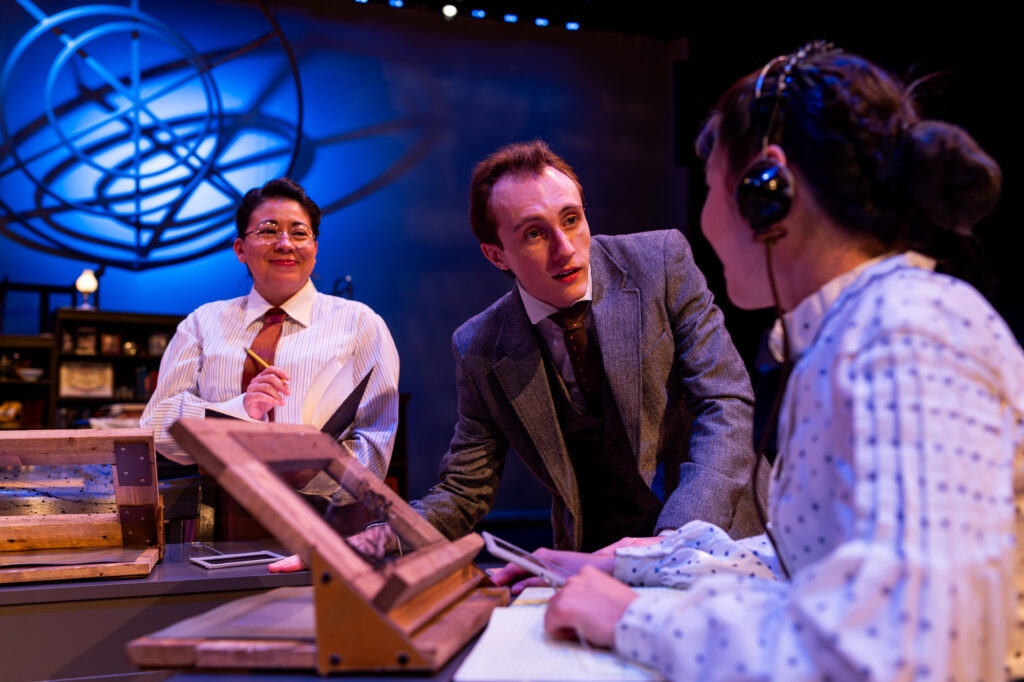
Annie Cannon (Erica Cruz Hernández, also very good) is the no-nonsense, brilliant scientist and head of the computing team. A diva relegated to backup singer, she is at peace with her lot. “I don’t need a title,” she declares. “My life is my work.”
The two convince Henrietta to stay. At least she has access to the world she longs to live in and, with Cannon and Fleming as her colleagues, its best minds.
The play unwinds fairly chronologically with relationships, historical events and family crises moving the story along. Eventually, her discovery allowed astronomers to estimate greater distances up to ten million light-years away, much greater than one hundred light-years. Hubble used the law to estimate the distance of the Andromeda galaxy in light-years. She was nominated for the Nobel Prize in physics, but she had already passed away 4 years earlier.
Gunderson tackles more than just Henrietta’s contribution to science, however, with big-ticket issues and questions. Societal restrictions on women permeated every aspect of her life. It was expected she would be a homemaker and supporter rather than a contributing participant. Her legacy was to be her children, a life well lived, measured in her husband’s accomplishments.

Henrietta, on the other hand, dared to challenge long-held norms and trumpet the call for women’s independence, unfettered scientific research, and academic gender bias blindness. Thank you, Central Square Theater, for spotlighting this little-explored crusader. Sadly, over a century later, her concerns couldn’t be more relevant.
For more information, visit https://www.centralsquaretheater.org/