Reviewed by Megan Murphy
All The Devils Are Here created and performed by Patrick Page; directed by Simon Godwin; scenic design by Arnulfo Maldonado; costume design by Emily Rebholz; lighting design by Stacey Derosier; sound design by Darron L. West. Produced by Octopus Theatricals and presented by ArtsEmerson at the Emerson Paramount Center’s Robert J. Orchard Stage through November 1, 2026.
Playbill Magazine once referred to Patrick Page as the “villain of Broadway.” But it’s the very question of what makes a villain that the Grammy Award®-winning actor explores in his riveting one-man production of All the Devils Are Here, a show which examines the evolution of villainy through the lens of William Shakespeare’s antagonists.
While Page is widely known for his portrayal of Hades in the Tony Award-winning musical Hadestown, he is also no stranger to the Bard. During the course of his decades-long career, he has played several of Shakespeare’s villains, from Macbeth to Iago, Prospero, and King Lear. One has to wonder if while studying these sinister characters, Page sensed the underlying humanity that would inspire him to create and perform this piece.
At its core, All the Devils Are Here is an 85-minute case study on the depiction of villainy, and how it evolves, shifts, and develops across Shakespeare’s works. Early on in the show, Page states his central claim: that Shakespeare invented “the villain” as it is defined today. To prove his point, he takes the audience on a winding journey through Shakespeare’s anthology, bringing us face-to-face with more than a dozen of the playwright’s most famous villains. He traverses chronologically, touching upon works like King Richard III, Othello, Macbeth, and The Tempest.
Between these scenes are interludes where Page shares how Shakespeare’s lived experiences – including his exposure to morality plays, cultural bias, racism, love, and lust – inspired and influenced his depictions of villainy. Over time, we gradually see these antagonists evolve from personified vices into three-dimensional beings with motives, consciences, and a strong sense of right and wrong. Page reflects on how their self-loathing, thirst for revenge, and moral cowardice are qualities that also exist within ourselves, and encourages us to ponder this idea with curiosity and compassion.
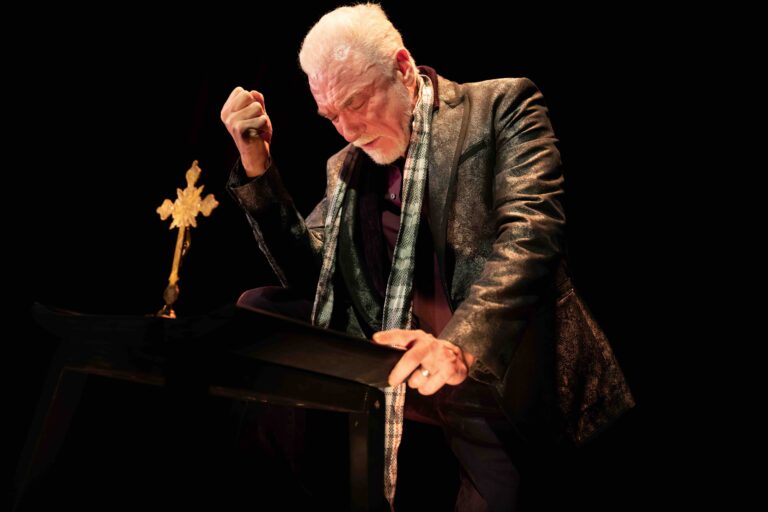
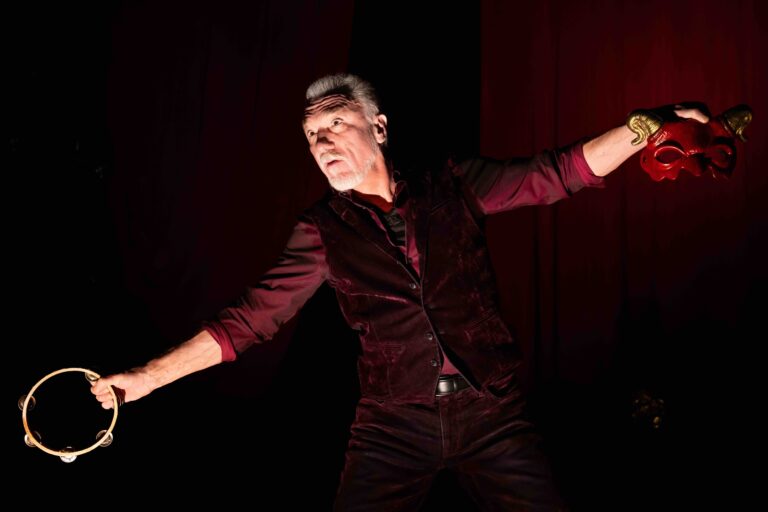
Patrick Page is an unshakeable force throughout this solo production. His strong stage presence and widely-recognized bass voice lend themselves perfectly to the malevolent figures he portrays. His passion for Shakespeare is evident in the delivery of each scene; every line is driven home with intentionality and passion. It is clear that he possesses significant wisdom and experience with Shakespeare’s canon, and his ability to recite entire scenes from memory while playing multiple characters at once is impressive. As himself, Page interacts with the audience as a professor would in a classroom of attentive and engaged students, weaving his knowledge together with humorous pop culture references to Homer Simpson, John Wick, and even the ill-fated musical Spiderman: Turn Off the Dark, where he played Norman Osborn/The Green Goblin.
The play’s direction by Simon Godwin successfully conveys the separation between the present reality and the fictional worlds of the villains Page portrays. As himself, Page largely remains on the stage’s center platform. But when he embodies a particular character, the unleashing of his emotions is mirrored in the expanded ways he uses the space, whether that’s through the extra utilization of set props, making a costume change, or moving downstage and off the platform entirely.
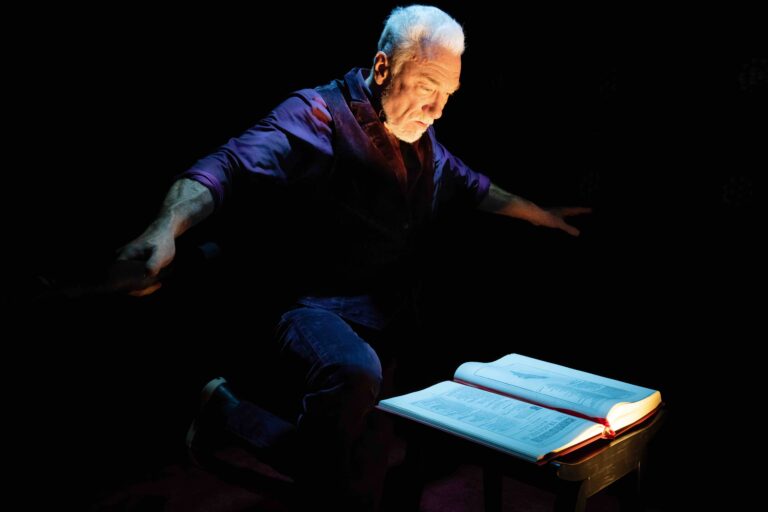
The set and lighting play a uniquely-prominent role in enhancing the story’s mood and ambiance. Scenic Designer Arnulfo Maldonado and Lighting Designer Stacey Derosier have successfully created a space that is both simple and multidimensional. The set acts as both a classroom and stage in its own right, with the lighting choices orienting the audience to which setting is the focus. When Page is acting as himself, the brightly-lit stage resembles the fluorescent light of a lecture hall. But when he begins reciting a scene or soliloquy, noticeable shifts occur. The lights often dim, produce menacing illuminations and shadows, or portray colors indicating time of day or emotions like envy or jealousy. Through it all, the side and overhead lighting fixtures resemble the bars of a jail cell. It’s as if the spirits of the wicked have been imprisoned for trial, and are urging us as the jury to challenge our conceptions of them.
There are many reasons why Shakespeare continues to withstand the test of time. And it’s shows like this that remind us that the worlds and characters he created have much more to teach us about the best and worst of human nature, both within others and ourselves.
