Reviewed by Julie-Anne Whitney
Delirium, Translated and Adapted by Igor Golyak from Eugène Ionesco’s Frenzy for Two; Directed by Igor Golyak, Scenic & Props Design by Jan Pappelbaum and Cecilia Xuetong Feng, Lighting Design by Jeff Adelberg, Sound Design by Denis Zabiyaka, Original Compositions by Anna Drubich, Costume Design by Sasha Ageeva, Stage Managed by Sherry Wang. Presented by Arlekin Players at the BCA Calderwood Pavilion in Boston, MA through July 2, 2026.
Eugène Ionesco was a Romanian-born French playwright remembered as the “father of theater of the absurd.” Ionesco wrote more than 30 plays and is best known for his works The Bald Soprano, The Lesson, The Chairs, and Rhinoceros, all of which were written in the 1950s. His 1963 one-act play Frenzy for Two (Délire à deux) is a lesser known, infrequently performed work that takes place in a small apartment where an artist and his mistress are arguing about their relationship while a war bangs on outside.
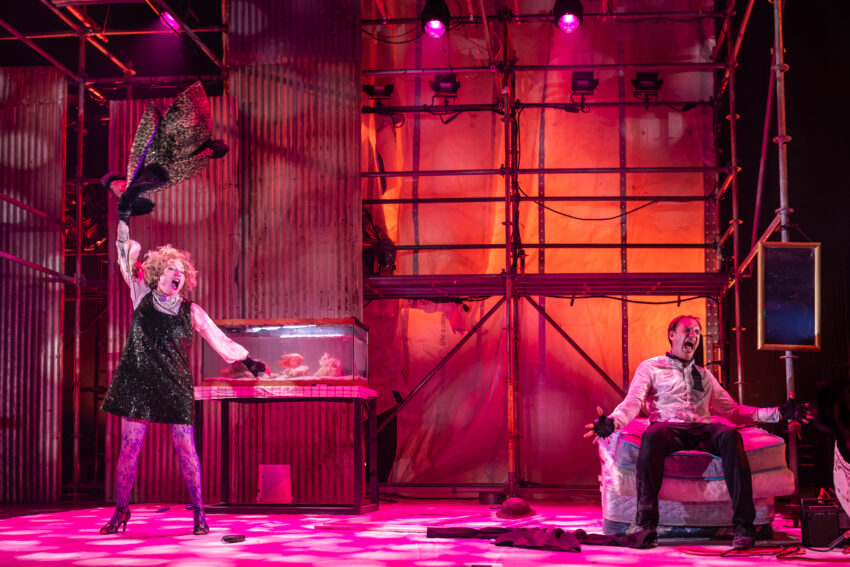
Arlekin Players’ riotous, rampantly imaginative, and deeply moving production, Delirium, is a new adaptation of Ionesco’s Frenzy for Two helmed by Arlekin’s Artistic Director, Igor Golyak. In Delirium, a couple is trapped in a seemingly endless argument about nothing while a seemingly ceaseless war about everything rages outside their door. The war inside starts with a disagreement between She and He about whether a snail and a turtle are the same thing. “Don’t the snail and the turtle both hide in their shells?” She asks. They both “walk around with its house on its back,” She declares. “A slug is a snail without a house. But a turtle has nothing to do with a slug,” He asserts. It seems, at first, to be a rather trivial (and bizarre) thing for them to quarrel about. As the play goes on, you realize that, perhaps, She and He are the snail and the turtle; they are not the same but they do have similarities. They, too, have learned how to hide from the outside world. They, too, have learned to make a home wherever they are with whatever they have.
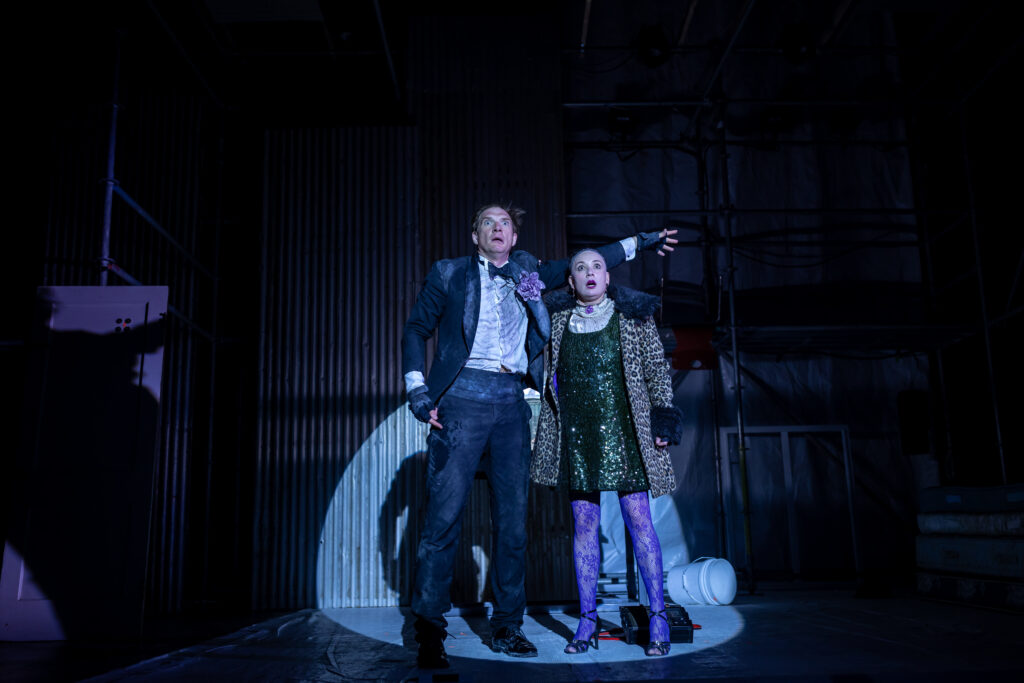
Delirium, like Frenzy for Two, does not follow a typical play structure (i.e. a plot that’s broken down into scenes and focuses on a central conflict that usually leads to some kind of resolution). There is obviously conflict in this story and the stakes are, literally, life or death, but the play is essentially one long stressful, chaotic scene at the end of which is…more stress and chaos. There is no “resolution” in this story because as She wisely asserts at the beginning of the play, “When it’s not war, it’s still war,” and as He concedes at the end of the play, “When it’s over it has to start again.”
It is never clear what the outside war is about. You don’t know where or why it’s happening, who is fighting or who is losing. You don’t know where She and He stand in regards to the war, other than their fear of it. They disagree on everything and their incessant bickering is interrupted every few minutes by alarms, explosions, gunshots, and the sound of people being dragged out of the apartments above and below them. Despite the discord and destruction happening around them, She and He keep doing all the things people do in times of unrest; they fight and make up, they dance and play, they laugh and cry, they eat and have sex. They do what they can to survive and to help each other because, in spite of their many grievances, they still care about one another.
Actors Andrey Burkovskiy (He) and Chulpan Khamatova (She) are extraordinary performers. They bring a magnetic energy to the stage that makes it impossible to look away from them. Golyak certainly puts them through the wringer, but Burkovskiy and Khamatova seem game for anything whether it’s climbing, crawling, running, being wet, or getting dirty. Both actors fully committed to every weird, hilarious, and unexpected thing Golyak had them do, and they definitely earned their standing ovation.
Delirium was a clear reminder (as if we needed one) that Igor Golyak is the most wildly inventive director in Boston. He makes the stage a playground, using it in such surprisingly creative ways you can’t help but be impressed– even if you aren’t sure what everything means (and, maybe, you don’t need to know). His direction is innovative, intentional, and compelling. The stories he tells– and the productions he makes– are unlike anything else you will see in the Greater Boston area.
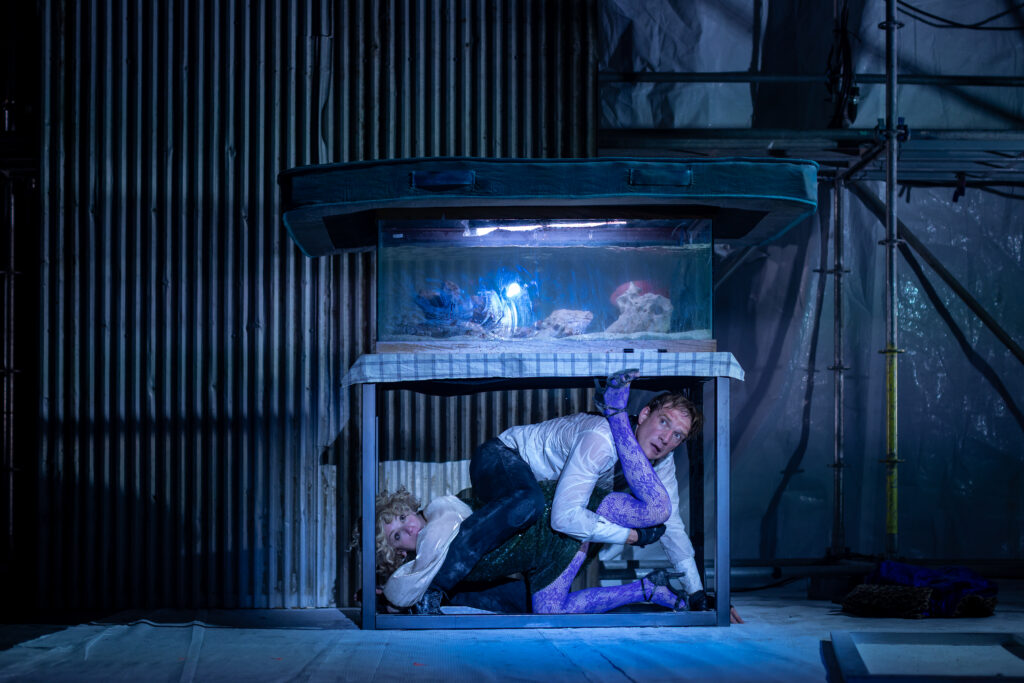
Part of Golyak’s power is in the team he brings together. Jan Pappelbaum and Cecilia Xuetong Feng’s scenic design was an emotional marvel. With a show like this, some audience members might only see what is literally there (i.e. a bunch of scaffolding, a large fish tank with a real fish, a door, a bucket, and a pile of mattresses) and not look for a deeper meaning. But meaning was all I saw. Scaffolding is what you put up around a building when it needs repairs or support; it’s the thing that holds a building up and keeps it standing. And the fish is in a cage just like the characters are. They’re all being kept there against their will with no way out. In fact, to get “out” would likely mean certain death. What you’re looking at isn’t a home– it’s a place to hide.
Sasha Ageeva’s costumes seem, at first, to be a peculiar choice. He is wearing a dusty, stained tuxedo and She is wearing a leopard-print coat, a sparkly green dress, and purple tights. Not exactly what you would expect people to wear when there’s a war happening. But isn’t that what some people do when facing their death? They put on their finest clothes and face the end with whatever dignity they can muster. Or maybe dressing up was their way of defying the ugly, damaged world around them; their way of saying ‘I’m still here.’
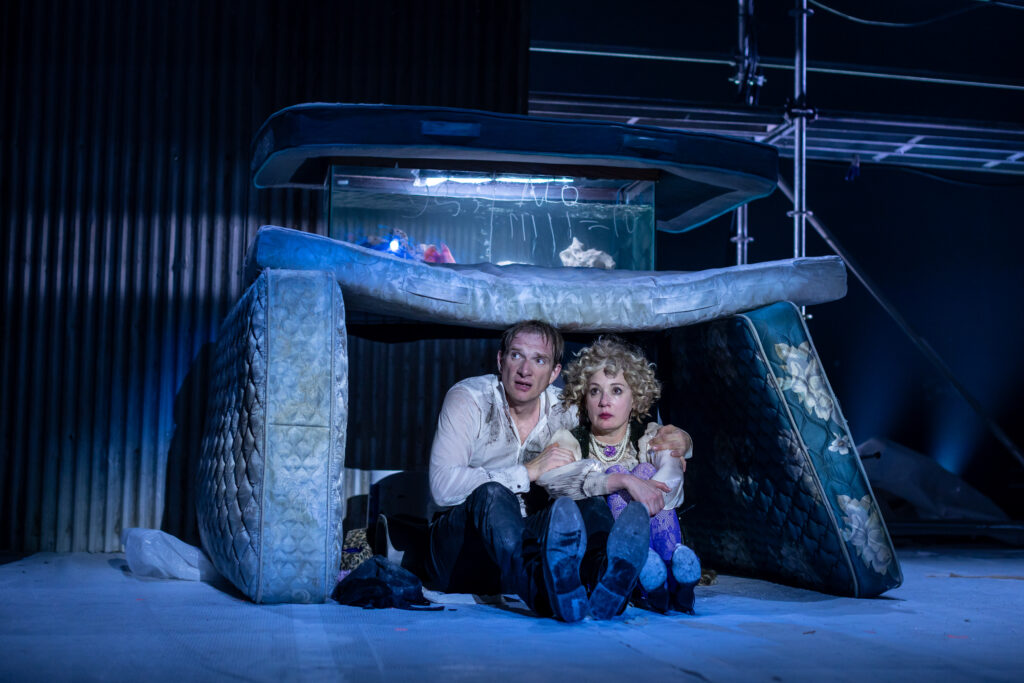
If you’re open to it, you will find meaning and substance in this weird little play. Yes, the characters talk a lot of nonsense and you probably won’t understand half of what they’re saying. But, if you stick with it, you will find that that doesn’t really matter. There’s a moment toward the end of the play in which She and He are looking blankly into the distance while telling particularly strange, illogical stories. It made me wonder if all the madness, the fighting, and maniacal behavior was simply a result of all the trauma the characters have experienced. “The world is upside down,” She says. Now, if that isn’t something we can all relate to, I don’t know what is.
Ionesco did his most memorable work in the 1950s in the aftermath of WWII. He used absurdism to highlight the flaws and failures of human nature, to show the universal loss of innocence and truth, and to urge audiences to find and retain their humanity. In Delirium She and He seem to care only about themselves and, occasionally, each other. They are flawed, but they are honest with one another. The world around them is full of violence, fear, and loss so they use conflict to create connection and imagination to escape reality. When the outer world is fractured by chaos, sometimes the only way to survive is to live inside the mind. Things might become delirious or even deranged in there, but at least it’s home.