Reviewed by Julie-Anne Whitney
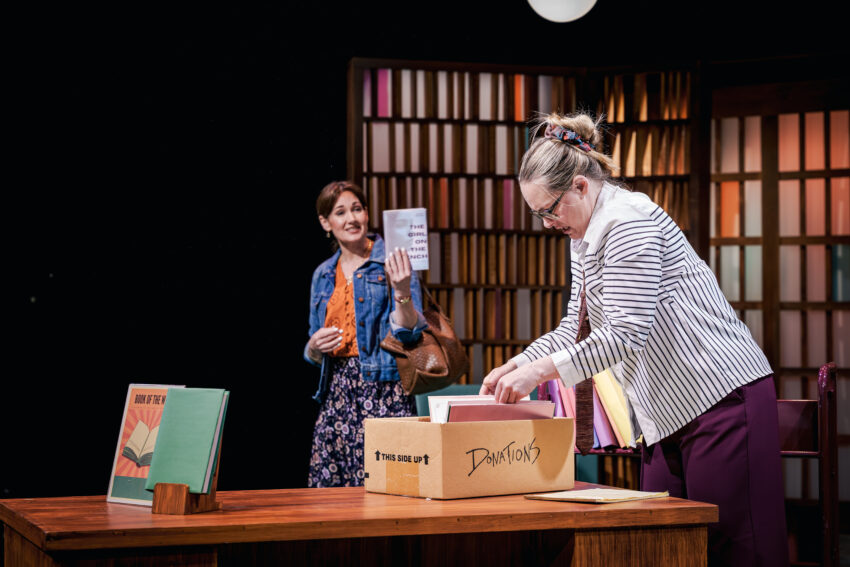
Bad Books (Regional Premiere) by Sharyn Rothstein. Directed by M. Bevin O’Gara, Scenic Design by Dahlia Al-Habieli, Costume Design by Chelsea Kerl, Lighting Design by Karen Perlow, Sound Design by Zoe Stanton-Savitz, Props Design by Emme Shaw, Fight Consulting by Omar Robinson, Movement Consulting by Sophia Shaw, Stage Managed by Chris Daly. Produced by Gloucester Stage Company in Gloucester, MA through June 27, 2026.
Book banning is an ugly, centuries-old practice in the United States. It began right here in (what is now known as) Massachusetts in 1637 with Thomas Morton’s New English Canaan, a work that “criticised Puritans, their government, and their treatment of Native Americans.” For nearly 400 years, books have been taken out of print, removed from stores, banned from schools, and burned in the street. People have lost their jobs, had their lives threatened, and even gone to jail over banned books.
Today, most banned books in the U.S. are about Black and/or LGBTQIA+ characters. Books that are described as obscene, offensive, explicit, and controversial for talking about race, racism, social justice, sexuality, gender expression, and coming out. Every year, the American Library Association compiles a Most Challenged Books list. According to the 2025 report, “92% of book challenges came from pressure groups and government officials…with more than 5,600 books banned from libraries” across the country– more banned books in a single year than ever before.
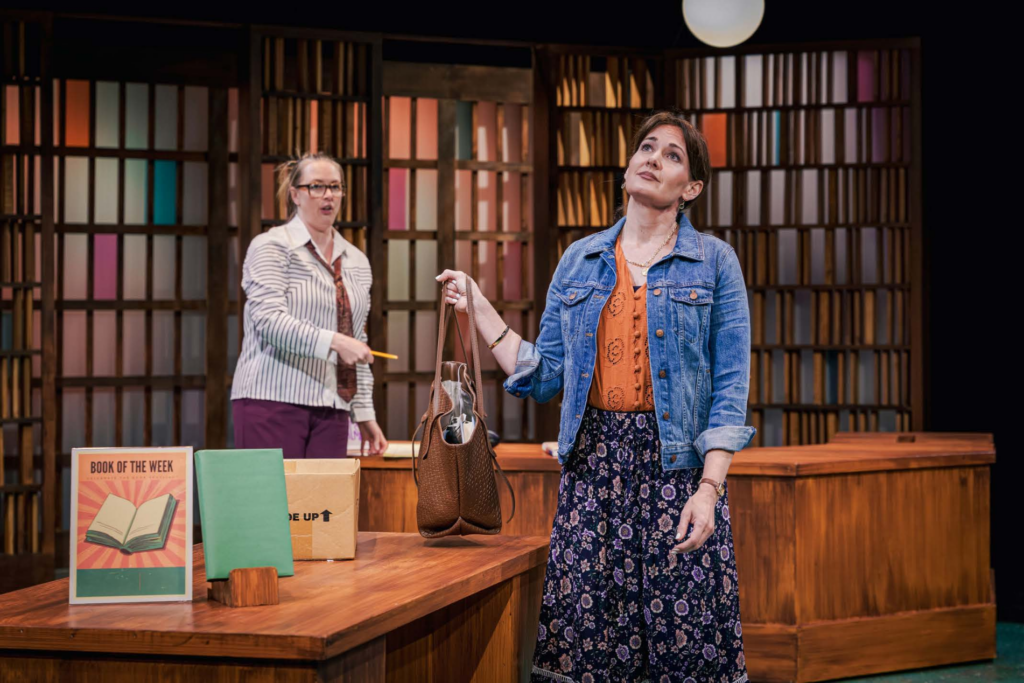
Playwright Sharyn Rothstein tackles this complex issue in her play, Bad Books, now running at Gloucester Stage. On the surface, the play is about a mother and a librarian who disagree about what a sensitive 15-year-old boy should be reading– one wants to choose for him and the other wants the boy to choose for himself. But under the surface, you realize that the characters– like all humans– are fighting their own battles and have their own fears and experiences that inform both their beliefs and their choices. The Mother wants to protect her son, but she goes about it the wrong way and, sadly, suffers great consequences. The Librarian believes that books can change lives (“It may not seem like much to ban a single book,” she says. “But to the kid that needed that book, it’s like an entire universe disappears.”), but she’s also lonely and judgemental, and her anger costs her her job.
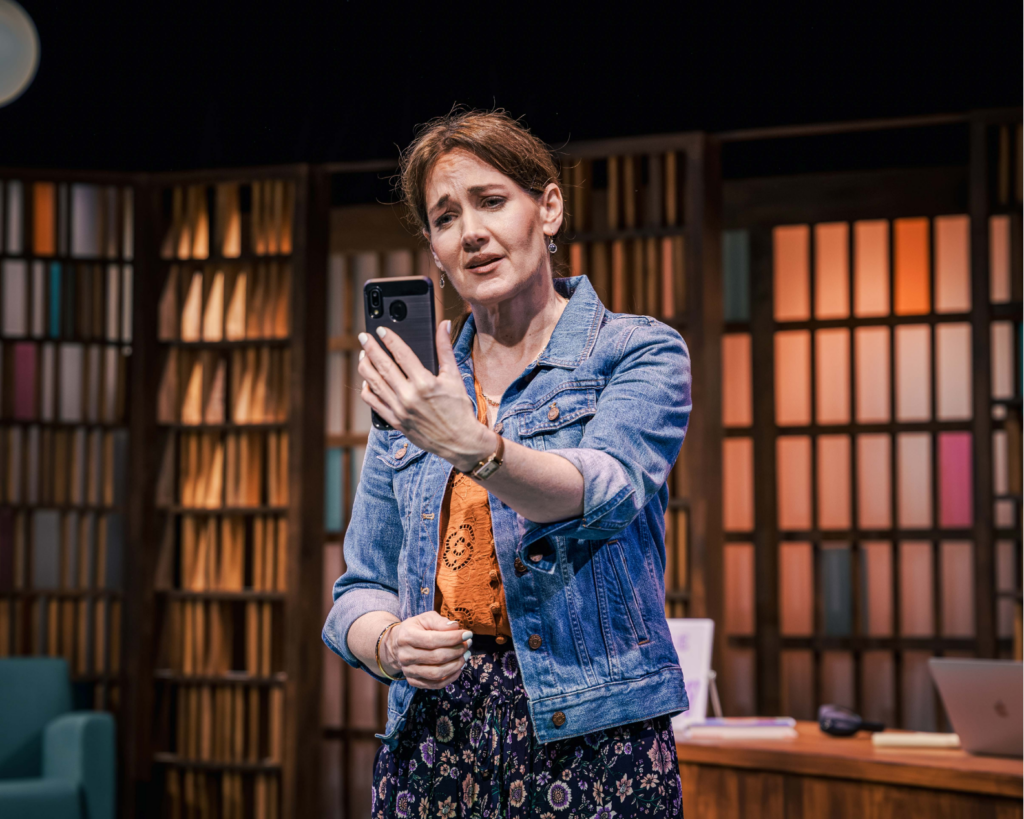
Their conversation is unexpectedly calm at first. The Mother expresses her concern that her son spends “too much time reading” and she wonders whether he should be more active and start playing sports. But when The Mother reveals why she’s really there– to complain about a (fictional) book called Boob Juice that The Librarian recommended to the boy– they start circling like a pair of prize fighters around the issue of censorship. When The Mother suddenly starts filming the escalating battle and posts it online, The Librarian begs her to reconsider– emphasizing the unwarranted violence that has ruined the lives of other librarians and teachers. Things start to quickly spiral out of control and, before they know it, the personal and professional lives of both women are forever changed.
This censorship culture war is playing out all over the United States these days. Just like in Rothstein’s play, many people are asking: what are the boundaries of parental authority vs “outsider” influence (i.e. librarians, teachers, coaches)? How do you balance the need for control and freedom for adults and minors? How do we address the unchecked power and influence of social media in all of this? Will the warring sides ever find common ground? Bad Books asks all of these questions, and Rothstein does a solid job of presenting multiple points of view by having one of the two actors play three different characters, all of whom offer conflicting perspectives.
Therese Plaehn exists so comfortably in the contrasting roles of The Librarian, The Manager (aka The Mother’s boss), and The Editor (aka Jeremy’s girlfriend’s mother), it was hard not to be impressed every time she took the stage. Plaehn’s choices are unexpected, disarming, and authentic, and she has a magnetism that makes her very compelling. Aimee Doherty, arguably, had the harder job in the single role of The Mother, who isn’t written as well or with as much dynamism as Plaehn’s characters. But she maintains a steadiness and believability without ever going toward melodrama in a role that could very easily be played that way.
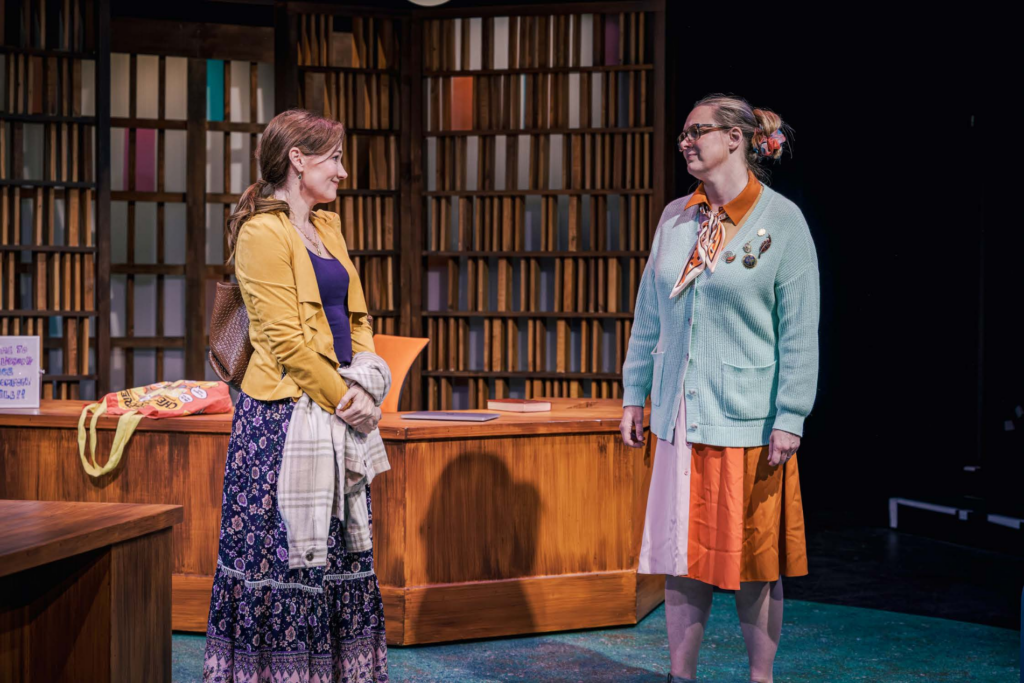
One of the most thought-provoking ideas posed in Bad Books is that parents shouldn’t parent their kids alone. Most kids are influenced, mentored, cared for, and taught by adults who are not their parents. When The Librarian wisely argues to The Mother, “Being a reader doesn’t make you an expert on books. Just like being a parent doesn’t make you an expert on children,” it reminds The Mother that, like all parents, she is learning while doing– and there’s no shame in that. One or two parents or guardians can’t possibly know everything there is to know about life, being human, and living in a beautiful but dangerous world. As a person without children and someone who gratefully learns from others all the time, it made me wonder why so many parents often cling to the belief that they alone should guide their children. It made me wonder where that belief came from and why (and how) it has become so pervasive throughout the country. It made me wonder how the kids of those parents would feel about all of this and whether anyone has ever asked them what they want.
Gloucester Stage’s highly enjoyable production will get you thinking and keep you laughing. It will also have you wondering whether censorship and book banning will ever cease to be a problem in a country filled with people who seem hell-bent on telling others how they should live and who they should be. Maybe book banning is too much a part of the fabric of who we are as a nation. Maybe censorship is unavoidable in a country wracked by the fear of anything or anyone we do not understand. Maybe there is no common ground. But if that’s true, then where do we go from here?