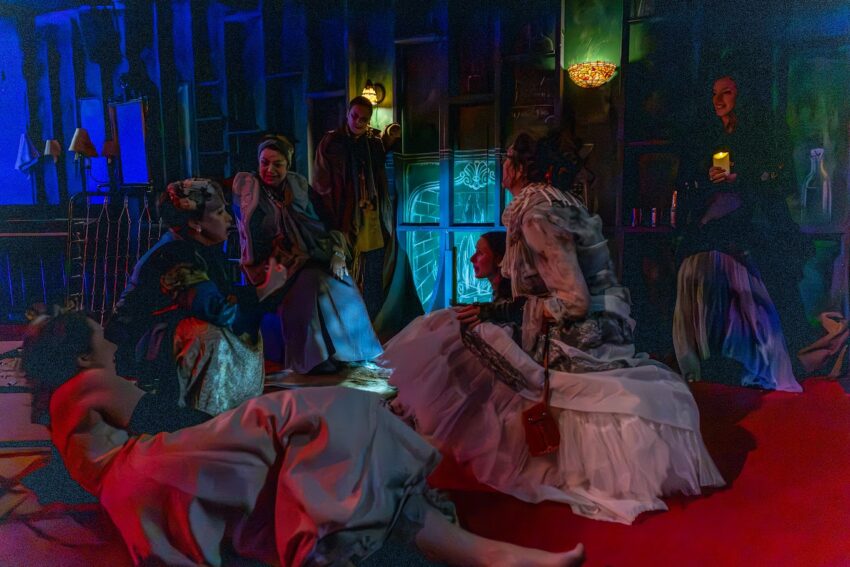
Tell Me, Mother — Conceived and Directed by Yana Gladkikh. Devised by Yana Gladkikh and the Arlekin ensemble. Choreography by Suli Holum; Sound Design by Bryce Somerville and Victor McSurely; Lighting Design by Stephanie Howell; Scenic Design by Peter Rule and Yuliya Doshen; Costume Design by Anastasiya Ivanenko. Performed in Russian, Armenian and Hebrew by Arlekin Players Theatre’s resident company with English supertitles. At Arlekin Theater, Needham, 368 Hillside Ave., through December 20. (75 minutes)
By Shelley A. Sackett
There is always a touch of magic in the room at any Arlekin Players’ production, and it’s always a good idea to arrive early to savor the set. A preview of Tell Me Mother was no exception. Like a 17th-century Dutch wünderkammer (cabinet of curiosities), the seemingly random props included: a green neon strip, a small beat-up fridge, a blackboard, an upright piano, an old cot, books, and a vintage typewriter. What would the theatrical alchemists conjure this time from this motley assortment?
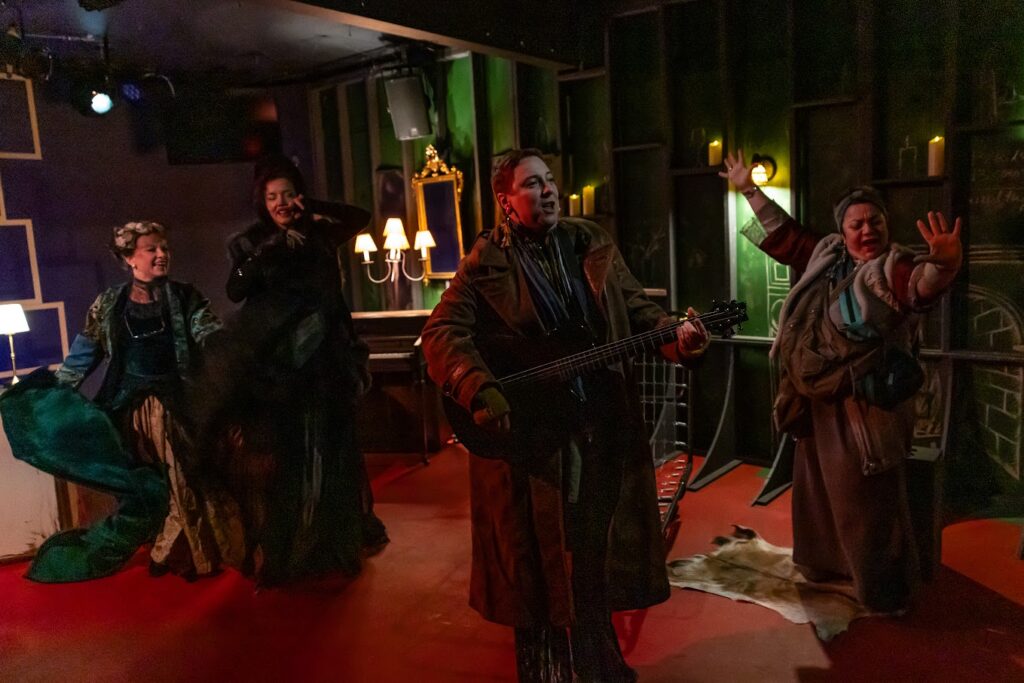
Photos by Olga Maturana.
Unannounced and barely noticeable, a woman enters this 35-seat “café at the end of the world.” She straightens the room and wipes the floor. Another enters and hands the typewriter to an audience member. A regal, tall woman fastens a necklace and hums to herself while a young girl in a backward baseball cap shows off a prized album cover.
“Tell me a story,” one says, “the story of the women in my family.” And just like that, the fourth wall evaporates, and we are in a play within a play.
Sliding among (mostly) Russian, English, Armenian and Hebrew — with English supertitles — the cast of seven women — Jenya Brodskaia, Polina Dubovikova, Anna Furman, Julia Shikh, Irina Knyazhitskaya, Nana Petetsky-Ghukasyan, and Polina Vaserman — will take on many roles as they spend the next 75 minutes sharing songs and stories grounded in the joys, traumas, sacrifices, pain, frustrations and responsibilities of motherhood. Weddings are as much symbols of loss as gains. Mothers who send sons to war sacrifice their own dreams to create more human beings who may or may not love them. They all wonder if they are good or bad mothers.
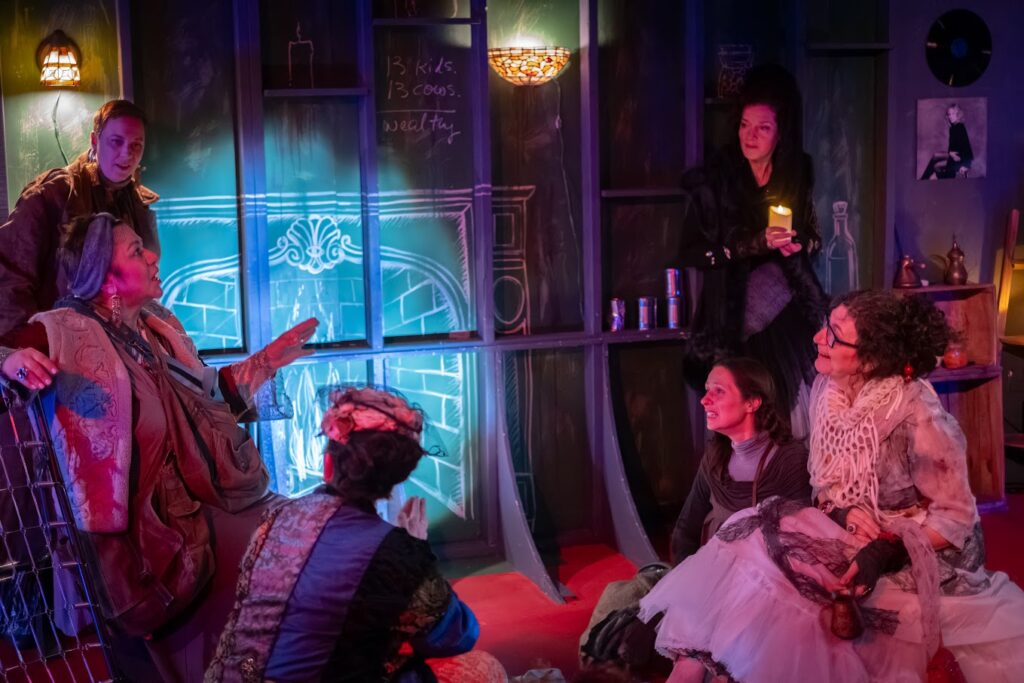
“What is so wonderful about motherhood anyway?” someone asks. They all sigh.
The women then trade stories about motherhood against a backdrop of man-made conflicts that transcend time, place and ideology. Their tales (based on real-life testimonies and documentary materials) move from the 1991 Moscow coup, to New York on 9/11, to an imaginary call center during the war in Ukraine, to a kibbutz under attack in Israel.
Yana Gladkikh, who conceived and directs the show, shares in her director’s statement that she “wanted to make an extremely personal piece that touches on subjects I do not have space to talk about in everyday life. Subjects I am afraid and hesitant to bring up, because they are so delicate and sensitive that they are avoided most of the time.”
On paper, she succeeds. The intimacy, raw emotionality, and brilliance of this smart, creative, complex-yet-not-complicated script let us into the hearts and minds of these courageous and resilient women. They struggle between staying at home defending their babies and joining their peers to defend democracy. They resent how motherhood interferes with their autonomy, yet panic at the thought of losing that child.
Personal stories merge into one global chronicle of endurance, resilience, resistance and, ultimately, rebellion.
While the ensemble and sound, set and lighting are striking, there are roadblocks to maximum appreciation of the production. The breadth of material and overlapping but disconnected stories create some confusion; a pause and transitional clues would be a helpful thread to keep the episodic action coherent and connected. So would a little trimming and reorganizing.
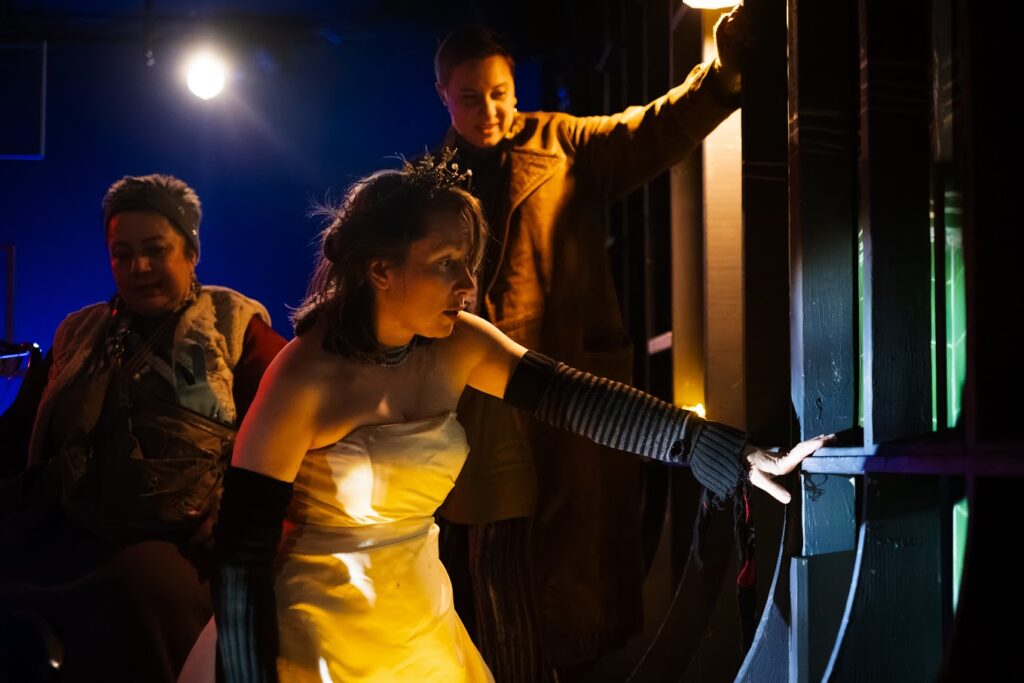
Also, it is frustrating to have to multitask as English supertitles flash by on small screens while the actors engage in pivotal scenes. We shouldn’t have to choose between understanding the dialogue and watching the action unfold.
These points, however, can’t erase the emotional and theatrical power of Tell Me, Mother. As Gladkikh points out, “What might we hear if we truly listened to [Mother’s] story? What does she need from us?” It is well worth following her advice and listening to these seven women’s stories and checking out the latest Arlekin endeavor. Something might just change in us, too.
For more information, visit https://www.arlekinplayers.com/